

Microsoft trades lower as U.S. considers ban on Chinese optical hardware, challenging AI supply chain

Microsoft (MSFT) stock is trading lower, with investors focused on a new U.S. government policy risk that could affect its core AI business. A potential import ban on Chinese-made optical transceivers has emerged, directly threatening expansion of critical domestic AI infrastructure and data centers. Traders are watching for any U.S. policy decisions or updates on the ban proposal that could shape MSFT's hardware supply chain exposure.
 512.12
533.19
Highlights
- Microsoft warns that a proposed U.S. ban on Chinese optical transceivers may severely hinder AI infrastructure growth in the United States.
- Government trade policy and supply chain dependencies introduce significant regulatory risk for Microsoft stock beyond company-specific factors.
- Microsoft stock trades below key moving averages, with technical indicators showing persistent sell pressure and potential downside toward $442 if policy restrictions proceed.
U.S. policy threat to AI hardware supply chain expansion
According to Investing.com, on November 10, 2026, Microsoft warned that a proposed U.S. government ban on Chinese-made optical transceivers could cripple the domestic expansion of artificial intelligence infrastructure.
The proposed policy would restrict access to specialized hardware that underpins AI data centers, potentially leading to slower growth, increased costs, and operational challenges for U.S.-based technology companies like MSFT.
This risk channel highlights how evolving government trade policy—rather than company-specific developments—could weigh on the stock, as key supply chain dependencies leave MSFT vulnerable to regulatory shocks.
Broader risk limits bullish 4H setup despite SMA and MACD weakness
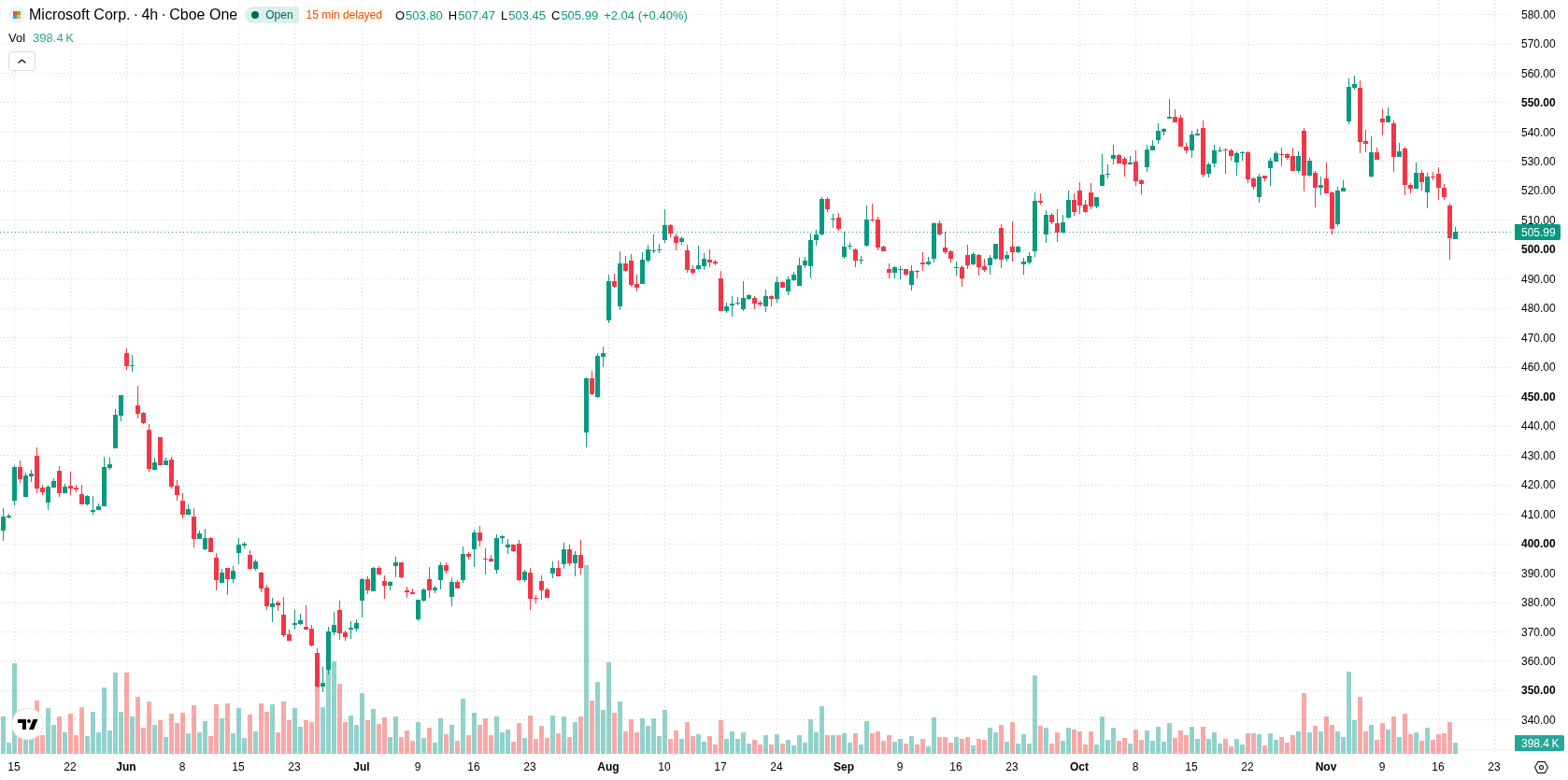
The 4H chart setup reflects wider macro uncertainty, with MSFT stock trading below the D1 SMA-50 at $519.43 but above the D1 SMA-200 at $441.83. Weakness is reinforced by the price slipping below the H4 SMA-20 at $530.87, indicating pressure on short-term momentum.
With the H4 Kijun resistance at $532.05 and both MACD and ADX generating sell signals, technical conditions remain fragile. Mixed signals from retreating short SMAs and the absence of upward momentum highlight cautious sentiment as hardware policy risks hang over the sector.
Regulatory clarity to determine direction within $442–$519 band
MSFT's outlook is closely tied to U.S. policy decisions on Chinese optical hardware imports. Downside risks could intensify if price action moves toward support around $442, while a recovery above resistance at $519 would signal stabilization. Any concrete regulatory outcome will likely set the direction for the next sustained move.
Previously it was reported that Microsoft expanded its AI capabilities with new models targeting software development, cybersecurity, and image generation, underscoring its focus on domain-specific solutions and operational safeguards. The current regulatory risk around Chinese-made hardware imports adds a new dimension to Microsoft's outlook, as the company's future performance now hinges on government policy decisions with significant implications for its domestic AI infrastructure expansion.






Latest Microsoft News



-
 Afghanistan
-
 Albania
-
 Algeria
-
 Angola
-
 Argentina
-
 Armenia
-
 Australia
-
 Austria
-
 Azerbaijan
-
 Bahamas
-
 Bahrain
-
 Bangladesh
-
 Belarus
-
 Belgium
-
 Bolivia
-
 Botswana
-
 Brazil
-
 Brunei
-
 Bulgaria
-
 Cambodia
-
 Cameroon
-
 Canada
-
 Chile
-
 China
-
 Colombia
-
 Congo
-
 Costa Rica
-
 Cote d'Ivoire
-
 Croatia
-
 Cuba
-
 Cyprus
-
 Czechia
-
 DR Congo
-
 Denmark
-
 Dominican Republic
-
 Ecuador
-
 Egypt
-
 El Salvador
-
 Estonia
-
 Eswatini
-
 Ethiopia
-
 Finland
-
 France
-
 Georgia
-
 Germany
-
 Ghana
-
 Greece
-
 Haiti
-
 Hong Kong
-
 Hungary
-
 India
-
 Indonesia
-
 Iran, Islamic republic
-
 Iraq
-
 Ireland
-
 Israel
-
 Italy
-
 Jamaica
-
 Japan
-
 Jordan
-
 Kazakhstan
-
 Kenya
-
 Korea
-
 Kuwait
-
 Kyrgyzstan
-
 Laos
-
 Latvia
-
 Lebanon
-
 Lesotho
-
 Libya
-
 Lithuania
-
 Luxembourg
-
 Madagascar
-
 Malaysia
-
 Malta
-
 Mauritius
-
 Mexico
-
 Moldova
-
 Mongolia
-
 Montenegro
-
 Morocco
-
 Mozambique
-
 Myanmar
-
 Namibia
-
 Nepal
-
 Netherlands
-
 New Zealand
-
 Nigeria
-
 North Macedonia
-
 Norway
-
 Oman
-
 Pakistan
-
 Palestine
-
 Panama
-
 Papua New Guinea
-
 Paraguay
-
 Peru
-
 Philippines
-
 Poland
-
 Portugal
-
 Puerto Rico
-
 Qatar
-
 Reunion
-
 Romania
-
 Rwanda
-
 Saudi Arabia
-
 Serbia
-
 Singapore
-
 Slovakia
-
 Slovenia
-
 Somalia
-
 South Africa
-
 Spain
-
 Sri Lanka
-
 Sweden
-
 Switzerland
-
 Syria
-
 Taiwan
-
 Tajikistan
-
 Tanzania
-
 Thailand
-
 Trinidad and Tobago
-
 Tunisia
-
 Turkey
-
 UAE
-
 Uganda
-
 Ukraine
-
 United Kingdom
-
United States
-
 Uruguay
-
 Uzbekistan
-
 Venezuela
-
 Vietnam
-
 Yemen
-
 Zambia
-
 Zimbabwe
- Forex
- Crypto












