

BNS slides over 2% as stock trades below key moving averages and sentiment stays cautious

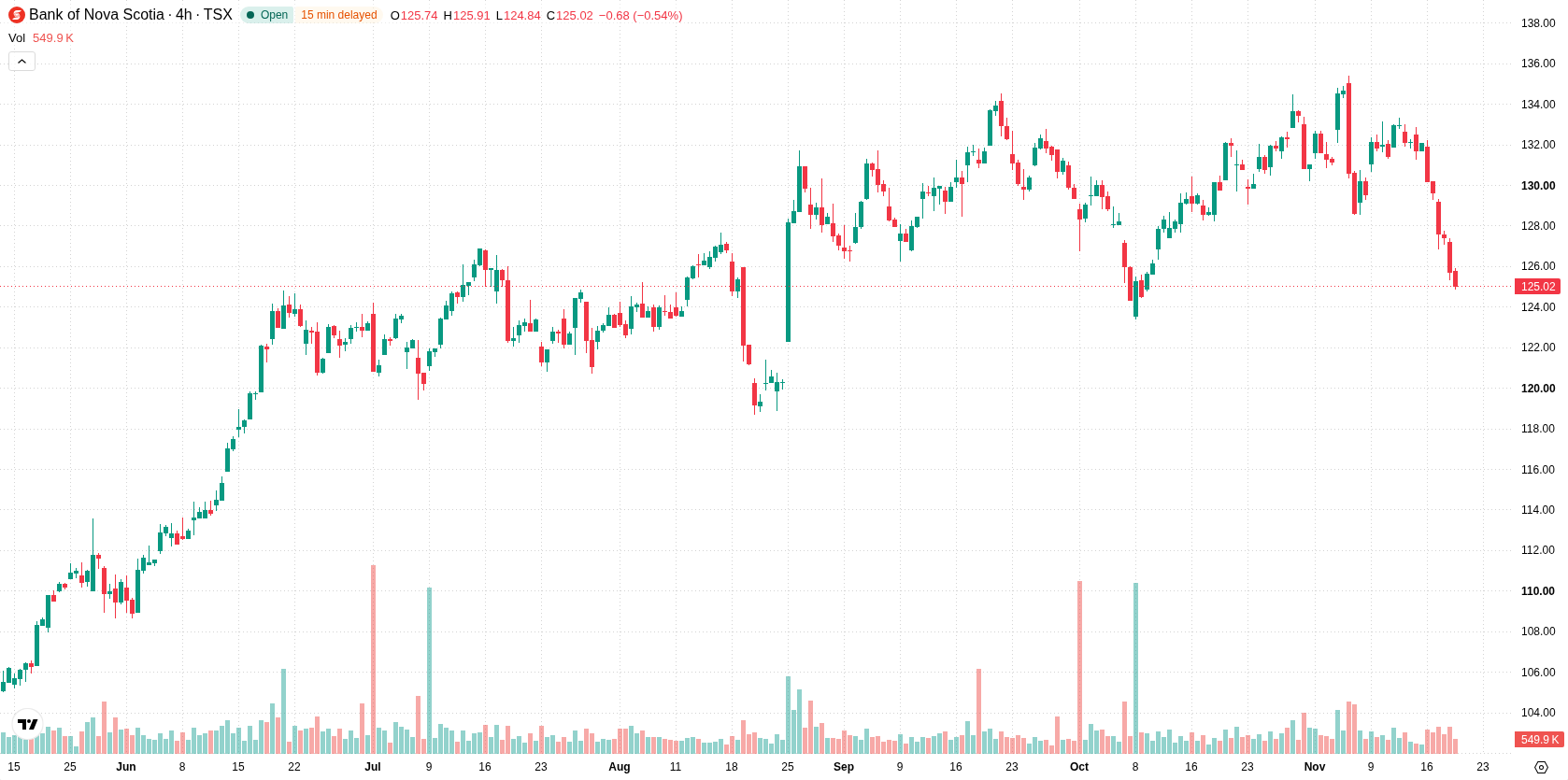
The Bank of Nova Scotia (BNS) fell 2.00% after renewed selling pressure dominated the session. This decline is reinforced by short- and medium-term technical weakness, as BNS remains below its 20-day and 50-day moving averages, though long-term structure is still bullish.
 123.43
132.22
Highlights
- Bank of Nova Scotia expanded its share buyback program to lower the outstanding share count by approximately 3.3%.
- The Public Sector Pension Investment Board increased its position to more than 3.2 million shares, and the bank introduced an AI-powered Commercial Navigator tool.
- Shares of Bank of Nova Scotia face ongoing short- and medium-term technical pressure, with projected five-day range between C$121.8 and C$127.95 and indicator signals showing neutral to oversold conditions.
Buyback expansion and institutional demand offset by persistent selling
Bank of Nova Scotia expanded its share buyback program to reduce the outstanding share count by about 3.3%. The Public Sector Pension Investment Board increased its holdings, now owning over 3.2 million shares. The bank also launched the Commercial Navigator, an AI tool to streamline credit processes, though price action has remained under broader selling pressure.
Key support levels tested as momentum signals selling exhaustion
BNS is trading below its 20-day and 50-day moving averages at C$131.24 and C$130.14, but remains above the 200-day average at C$116.11. This structure points to ongoing short- and medium-term pressure from sellers, while the long-term trend stays bullish. The nearest support is at C$124.86 with resistance at C$126.8. Oscillators are neutral: RSI, MACD, and ADX do not signal strong momentum. Stochastic RSI and CCI are both in oversold zones, indicating possible selling exhaustion but not an imminent rebound. Bull/Bear Power confirms sellers dominate intraday momentum, and volatility for the day is 2.03%. Intraday price action underscores a cautious tone as the session trades near its lows.
Earlier, analysts noted that Bank of Nova Scotia was experiencing ongoing technical weakness and a tendency toward consolidation amid mixed signals. The current analysis adds support for this view, highlighting neutral technical oscillators and an evenly balanced risk of breakout or breakdown, signaling that traders should monitor for a decisive move beyond the established volatility band in the coming sessions.






Latest Bank of Nova Scotia News




-
 Afghanistan
-
 Albania
-
 Algeria
-
 Angola
-
 Argentina
-
 Armenia
-
 Australia
-
 Austria
-
 Azerbaijan
-
 Bahamas
-
 Bahrain
-
 Bangladesh
-
 Belarus
-
 Belgium
-
 Bolivia
-
 Botswana
-
 Brazil
-
 Brunei
-
 Bulgaria
-
 Cambodia
-
 Cameroon
-
 Canada
-
 Chile
-
 China
-
 Colombia
-
 Congo
-
 Costa Rica
-
 Cote d'Ivoire
-
 Croatia
-
 Cuba
-
 Cyprus
-
 Czechia
-
 DR Congo
-
 Denmark
-
 Dominican Republic
-
 Ecuador
-
 Egypt
-
 El Salvador
-
 Estonia
-
 Eswatini
-
 Ethiopia
-
 Finland
-
 France
-
 Georgia
-
 Germany
-
 Ghana
-
 Greece
-
 Haiti
-
 Hong Kong
-
 Hungary
-
 India
-
 Indonesia
-
 Iran, Islamic republic
-
 Iraq
-
 Ireland
-
 Israel
-
 Italy
-
 Jamaica
-
 Japan
-
 Jordan
-
 Kazakhstan
-
 Kenya
-
 Korea
-
 Kuwait
-
 Kyrgyzstan
-
 Laos
-
 Latvia
-
 Lebanon
-
 Lesotho
-
 Libya
-
 Lithuania
-
 Luxembourg
-
 Madagascar
-
 Malaysia
-
 Malta
-
 Mauritius
-
 Mexico
-
 Moldova
-
 Mongolia
-
 Montenegro
-
 Morocco
-
 Mozambique
-
 Myanmar
-
 Namibia
-
 Nepal
-
 Netherlands
-
 New Zealand
-
 Nigeria
-
 North Macedonia
-
 Norway
-
 Oman
-
 Pakistan
-
 Palestine
-
 Panama
-
 Papua New Guinea
-
 Paraguay
-
 Peru
-
 Philippines
-
 Poland
-
 Portugal
-
 Puerto Rico
-
 Qatar
-
 Reunion
-
 Romania
-
 Rwanda
-
 Saudi Arabia
-
 Serbia
-
 Singapore
-
 Slovakia
-
 Slovenia
-
 Somalia
-
 South Africa
-
 Spain
-
 Sri Lanka
-
 Sweden
-
 Switzerland
-
 Syria
-
 Taiwan
-
 Tajikistan
-
 Tanzania
-
 Thailand
-
 Trinidad and Tobago
-
 Tunisia
-
 Turkey
-
 UAE
-
 Uganda
-
 Ukraine
-
 United Kingdom
-
United States
-
 Uruguay
-
 Uzbekistan
-
 Venezuela
-
 Vietnam
-
 Yemen
-
 Zambia
-
 Zimbabwe
- Forex
- Crypto












