

Morgan Stanley stock faces resistance at $180.78 with baseline pressure on current support zone: weekly forecast

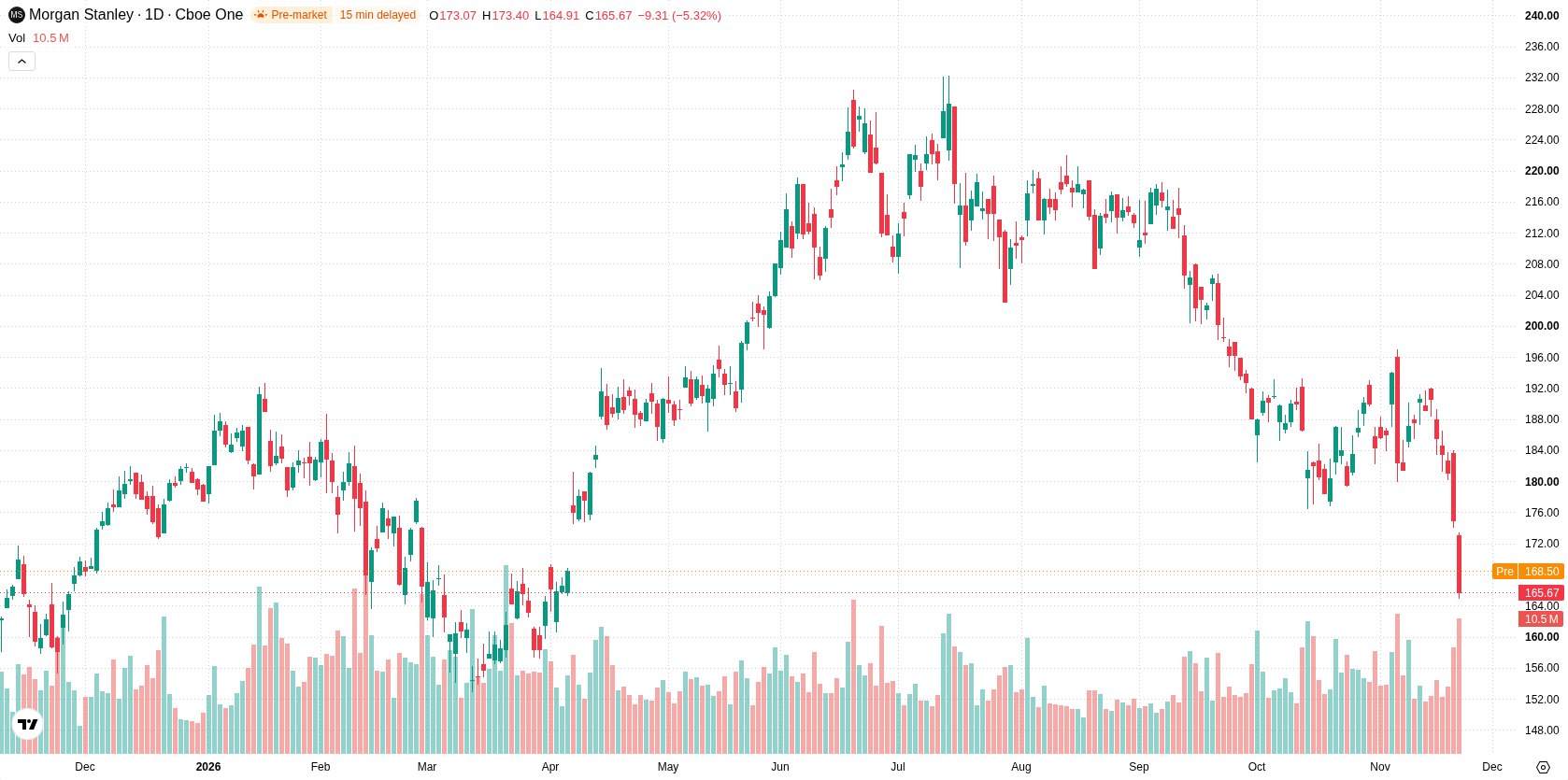
Shares of Morgan Stanley (MS) are trading near $166 after a steep decline of about 13% over the past week, with the selloff pushing the stock into oversold territory. The move was largely triggered by a significant corporate action, setting the stage for a critical test of support and potential rebound risk as the new week approaches.
 175.16
186.49
Highlights
- Shares of Morgan Stanley fell 13.1% for the week, closing at $165.67 near the bottom of their recent range.
- The stock trades below all major daily moving averages and stands 14.8% under its 200-day, indicating a bearish long-term trend.
- Volatility increased to 14.78% with technical indicators in oversold territory and a support level at $164.93 now being tested, with next week’s range projected as $154.76 to $176.57.
Earnings volatility and fund flows shift as accounting changes hit sentiment
Morgan Stanley enacted an accounting policy change for carried interest revenue in its Investment Management unit, retroactively reducing retained earnings by $719 million, as reported by Seeking Alpha. This move, disclosed in an SEC filing and effective October 1, 2026, aims to smooth future earnings volatility. Separately, Advisors Asset Management Inc. acquired 255,504 shares of MS in the third quarter, according to MarketBeat.
Oversold momentum intensifies as volatility expands and support is tested
The daily setup on Morgan Stanley stock shows a sharp move lower without a sustained trend, as volatility expanded to 14.78%. RSI, CCI, and Stochastic RSI are all in oversold territory, with RSI registering 29.9, pointing to potential selling exhaustion and possible rebound risk. The nearest support now sits at $164.93, a level being tested, while resistance comes in at $180.78 from the daily Ichimoku Kijun.
Consolidation base expected as downside risks outweigh breakout odds next week
Next week, the expected range is $154.76 to $176.57, with a 22% probability of an increase and 78% chance of a decrease. The base case is further consolidation around current levels, anchored near $164.93 support. A break above $180.78 would suggest a reversal attempt and lift the stock toward the top of the range. Should support at $164.93 give way, shares could extend losses toward the lower boundary near $154.76.
Earlier, analysts noted that successful deal activity in European banking could spur broader consolidation across the sector, with Morgan Stanley seeing a more favorable regulatory and transaction environment ahead. Against this backdrop, the recent accounting policy change and heightened market volatility make $164.93 a pivotal support level, offering traders a clear marker for near-term downside risk in Morgan Stanley shares.






Latest Morgan Stanley News




-
 Afghanistan
-
 Albania
-
 Algeria
-
 Angola
-
 Argentina
-
 Armenia
-
 Australia
-
 Austria
-
 Azerbaijan
-
 Bahamas
-
 Bahrain
-
 Bangladesh
-
 Belarus
-
 Belgium
-
 Bolivia
-
 Botswana
-
 Brazil
-
 Brunei
-
 Bulgaria
-
 Cambodia
-
 Cameroon
-
 Canada
-
 Chile
-
 China
-
 Colombia
-
 Congo
-
 Costa Rica
-
 Cote d'Ivoire
-
 Croatia
-
 Cuba
-
 Cyprus
-
 Czechia
-
 DR Congo
-
 Denmark
-
 Dominican Republic
-
 Ecuador
-
 Egypt
-
 El Salvador
-
 Estonia
-
 Eswatini
-
 Ethiopia
-
 Finland
-
 France
-
 Georgia
-
 Germany
-
 Ghana
-
 Greece
-
 Haiti
-
 Hong Kong
-
 Hungary
-
 India
-
 Indonesia
-
 Iran, Islamic republic
-
 Iraq
-
 Ireland
-
 Israel
-
 Italy
-
 Jamaica
-
 Japan
-
 Jordan
-
 Kazakhstan
-
 Kenya
-
 Korea
-
 Kuwait
-
 Kyrgyzstan
-
 Laos
-
 Latvia
-
 Lebanon
-
 Lesotho
-
 Libya
-
 Lithuania
-
 Luxembourg
-
 Madagascar
-
 Malaysia
-
 Malta
-
 Mauritius
-
 Mexico
-
 Moldova
-
 Mongolia
-
 Montenegro
-
 Morocco
-
 Mozambique
-
 Myanmar
-
 Namibia
-
 Nepal
-
 Netherlands
-
 New Zealand
-
 Nigeria
-
 North Macedonia
-
 Norway
-
 Oman
-
 Pakistan
-
 Palestine
-
 Panama
-
 Papua New Guinea
-
 Paraguay
-
 Peru
-
 Philippines
-
 Poland
-
 Portugal
-
 Puerto Rico
-
 Qatar
-
 Reunion
-
 Romania
-
 Rwanda
-
 Saudi Arabia
-
 Serbia
-
 Singapore
-
 Slovakia
-
 Slovenia
-
 Somalia
-
 South Africa
-
 Spain
-
 Sri Lanka
-
 Sweden
-
 Switzerland
-
 Syria
-
 Taiwan
-
 Tajikistan
-
 Tanzania
-
 Thailand
-
 Trinidad and Tobago
-
 Tunisia
-
 Turkey
-
 UAE
-
 Uganda
-
 Ukraine
-
 United Kingdom
-
United States
-
 Uruguay
-
 Uzbekistan
-
 Venezuela
-
 Vietnam
-
 Yemen
-
 Zambia
-
 Zimbabwe
- Forex
- Crypto












