

DAX gains more than 2% after strength into the close and intraday volatility amplify move

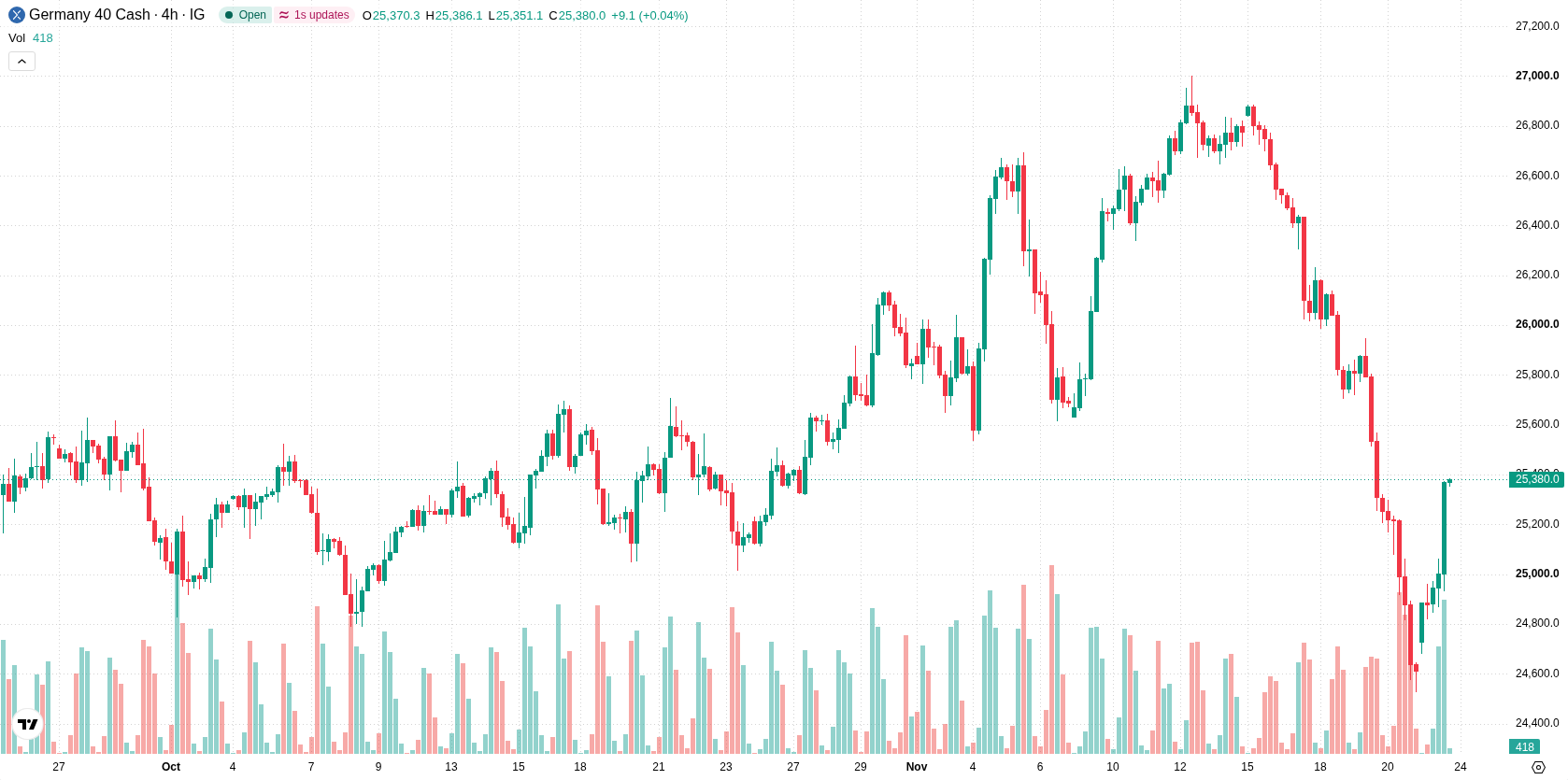
DAX Index (DAX) rose 2.12% today as renewed buying interest was supported by a rebound from technical levels, with strength into the close and intraday volatility amplifying the move. The advance looks limited, as price remains below both the 20-day and 50-day moving averages, indicating that short- and medium-term downward pressure persists.
 25365.05
26442.00
Highlights
- DAX remains below short- and medium-term moving averages but holds above its 200-day trend level, signaling persistent longer-term bullish structure.
- Oscillator signals are oversold with neutral momentum readings, indicating potential for a near-term rebound or consolidation around current levels.
- Expected 5-day trading range is 24,537 to 26,174, with a 70% probability of a downward move and primary support at 24,999.
Mixed technical signals temper rebound from oversold oscillator levels
DAX is trading below the 20-day (26,034) and 50-day (25,616) moving averages, while remaining above the 200-day (24,999) moving average. This signals persistent downward pressure in the short and medium term, yet the longer-term structure remains bullish. Nearest resistance is at today's high of 25,365, and key support sits near the 200-day average at 24,999. Momentum indicators are mixed: MACD and ADX are neutral, and the RSI is also neutral. Both the Stochastic RSI and CCI are in oversold zones, suggesting possible rebound potential or signs of selling exhaustion. Bull/Bear Power is negative, showing intraday seller dominance, while the Awesome Oscillator remains neutral. The index advanced 526.05 points, or 2.12%, after opening with a downside gap of around 0.46%. Price is near the high end of today's range with intraday volatility at 2.84%. Although there is evidence of strength into the close, divergence between oversold oscillator signals and lackluster momentum raises caution over near-term direction.
Earlier, analysts noted that the DAX Index was experiencing persistent technical-driven pressure and a tendency toward rangebound performance. The current analysis adds evidence of short-term stabilization but emphasizes that a decisive break above 26,174 or below 24,537 will be critical in signaling the next directional move.






Latest DAX News





-
 Afghanistan
-
 Albania
-
 Algeria
-
 Angola
-
 Argentina
-
 Armenia
-
 Australia
-
 Austria
-
 Azerbaijan
-
 Bahamas
-
 Bahrain
-
 Bangladesh
-
 Belarus
-
 Belgium
-
 Bolivia
-
 Botswana
-
 Brazil
-
 Brunei
-
 Bulgaria
-
 Cambodia
-
 Cameroon
-
 Canada
-
 Chile
-
 China
-
 Colombia
-
 Congo
-
 Costa Rica
-
 Cote d'Ivoire
-
 Croatia
-
 Cuba
-
 Cyprus
-
 Czechia
-
 DR Congo
-
 Denmark
-
 Dominican Republic
-
 Ecuador
-
 Egypt
-
 El Salvador
-
 Estonia
-
 Eswatini
-
 Ethiopia
-
 Finland
-
 France
-
 Georgia
-
 Germany
-
 Ghana
-
 Greece
-
 Haiti
-
 Hong Kong
-
 Hungary
-
 India
-
 Indonesia
-
 Iran, Islamic republic
-
 Iraq
-
 Ireland
-
 Israel
-
 Italy
-
 Jamaica
-
 Japan
-
 Jordan
-
 Kazakhstan
-
 Kenya
-
 Korea
-
 Kuwait
-
 Kyrgyzstan
-
 Laos
-
 Latvia
-
 Lebanon
-
 Lesotho
-
 Libya
-
 Lithuania
-
 Luxembourg
-
 Madagascar
-
 Malaysia
-
 Malta
-
 Mauritius
-
 Mexico
-
 Moldova
-
 Mongolia
-
 Montenegro
-
 Morocco
-
 Mozambique
-
 Myanmar
-
 Namibia
-
 Nepal
-
 Netherlands
-
 New Zealand
-
 Nigeria
-
 North Macedonia
-
 Norway
-
 Oman
-
 Pakistan
-
 Palestine
-
 Panama
-
 Papua New Guinea
-
 Paraguay
-
 Peru
-
 Philippines
-
 Poland
-
 Portugal
-
 Puerto Rico
-
 Qatar
-
 Reunion
-
 Romania
-
 Rwanda
-
 Saudi Arabia
-
 Serbia
-
 Singapore
-
 Slovakia
-
 Slovenia
-
 Somalia
-
 South Africa
-
 Spain
-
 Sri Lanka
-
 Sweden
-
 Switzerland
-
 Syria
-
 Taiwan
-
 Tajikistan
-
 Tanzania
-
 Thailand
-
 Trinidad and Tobago
-
 Tunisia
-
 Turkey
-
 UAE
-
 Uganda
-
 Ukraine
-
 United Kingdom
-
United States
-
 Uruguay
-
 Uzbekistan
-
 Venezuela
-
 Vietnam
-
 Yemen
-
 Zambia
-
 Zimbabwe
- Forex
- Crypto












