

Apple rises as robust inflation and Fed talk keep risks from higher Treasury yields in focus

Apple (AAPL) stock is trading higher at $350.15 as of November 23, 2026. Rising U.S. Treasury yields, after unexpected inflation data and Federal Reserve commentary, are challenging equity valuations. Investors remain alert to future moves in yields, which could continue to affect major technology stocks like AAPL.
 352.59
356.42
Highlights
- U.S. Treasury yields posted their sharpest increase in 19 months after inflation exceeded expectations and a key Federal Reserve official supported rate hikes.
- Rising yields pushed up discount rates and made fixed income more attractive, exposing technology stocks such as AAPL to valuation pressure.
- AAPL stock remains in a bullish structure above key longer-term moving averages, but near-term support around $350 is critical as technical signals are neutral and further yield increases could trigger renewed weakness.
Rising U.S. yields after strong inflation affect AAPL valuations
According to CNN, on November 10, 2026, U.S. Treasury yields surged the most in 19 months following higher-than-expected inflation data and public statements from a key Federal Reserve official that boosted expectations of further interest rate hikes.
This sharp rise in Treasury yields raised the discount rate used in equity valuation models and increased the attractiveness of fixed income over stocks. As a result, technology companies such as AAPL are exposed to valuation pressure when yields rise.
Although this macro environment creates a challenging backdrop, AAPL's price action demonstrates resilience despite these headwinds, as the risk channel is conditional on continued yield increases rather than current market behavior.
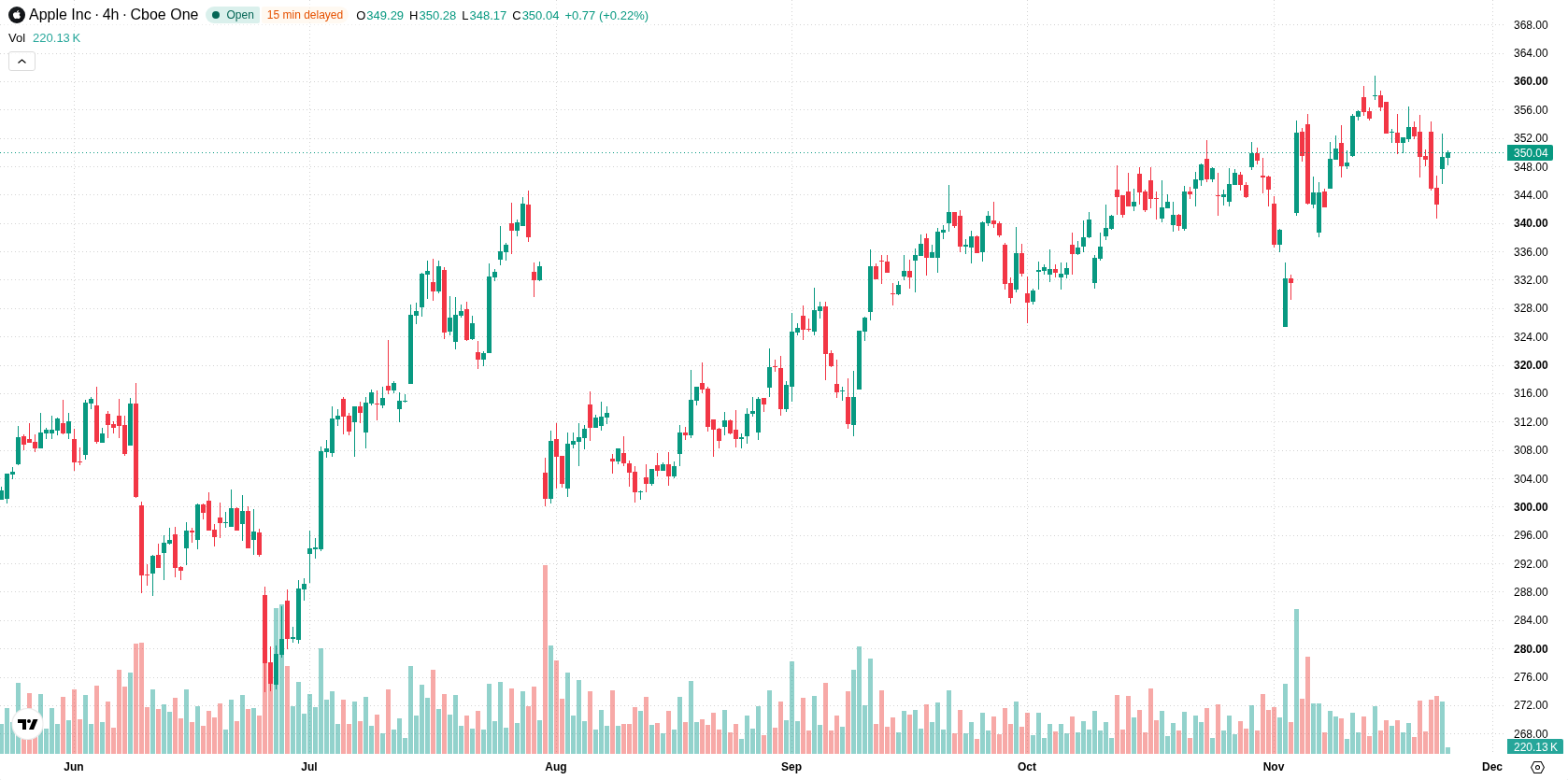
Price holds above key bullish averages amid mixed signals
On the 4H chart, AAPL remains above both the D1 SMA-50 at $341.86 and the D1 SMA-200 at $303.24, indicating an ongoing bullish structure relative to its longer-term moving averages. The price is just below the H4 SMA-20 at $351.49, suggesting caution around short-term momentum.
With the H4 Kijun at $349.57 serving as immediate support, the MACD and ADX are both neutral, pointing to a lack of strong directional conviction for now. Technicals show mixed signals, aligning with broader uncertainty from macro risks.
Yield-driven macro risk may pressure AAPL unless $350 support holds
Further increases in U.S. Treasury yields or hawkish Fed guidance would add pressure to AAPL and other large-cap stocks. Vigilance around the $350 area, marked by the H4 Kijun, is warranted as a near-term support zone. Sustaining above this level may help stabilize price action, while a clear break could signal renewed vulnerability to external macro risks.
In a recent review, analysts noted that Apple shares had shown resilience during periods of broader technology sector volatility, maintaining a relatively stable trend despite market corrections. The current article builds on this by emphasizing that future shifts in U.S. Treasury yields and associated Federal Reserve policy remain the primary external risks likely to influence AAPL's next significant move.











-
 Afghanistan
-
 Albania
-
 Algeria
-
 Angola
-
 Argentina
-
 Armenia
-
 Australia
-
 Austria
-
 Azerbaijan
-
 Bahamas
-
 Bahrain
-
 Bangladesh
-
 Belarus
-
 Belgium
-
 Bolivia
-
 Botswana
-
 Brazil
-
 Brunei
-
 Bulgaria
-
 Cambodia
-
 Cameroon
-
 Canada
-
 Chile
-
 China
-
 Colombia
-
 Congo
-
 Costa Rica
-
 Cote d'Ivoire
-
 Croatia
-
 Cuba
-
 Cyprus
-
 Czechia
-
 DR Congo
-
 Denmark
-
 Dominican Republic
-
 Ecuador
-
 Egypt
-
 El Salvador
-
 Estonia
-
 Eswatini
-
 Ethiopia
-
 Finland
-
 France
-
 Georgia
-
 Germany
-
 Ghana
-
 Greece
-
 Haiti
-
 Hong Kong
-
 Hungary
-
 India
-
 Indonesia
-
 Iran, Islamic republic
-
 Iraq
-
 Ireland
-
 Israel
-
 Italy
-
 Jamaica
-
 Japan
-
 Jordan
-
 Kazakhstan
-
 Kenya
-
 Korea
-
 Kuwait
-
 Kyrgyzstan
-
 Laos
-
 Latvia
-
 Lebanon
-
 Lesotho
-
 Libya
-
 Lithuania
-
 Luxembourg
-
 Madagascar
-
 Malaysia
-
 Malta
-
 Mauritius
-
 Mexico
-
 Moldova
-
 Mongolia
-
 Montenegro
-
 Morocco
-
 Mozambique
-
 Myanmar
-
 Namibia
-
 Nepal
-
 Netherlands
-
 New Zealand
-
 Nigeria
-
 North Macedonia
-
 Norway
-
 Oman
-
 Pakistan
-
 Palestine
-
 Panama
-
 Papua New Guinea
-
 Paraguay
-
 Peru
-
 Philippines
-
 Poland
-
 Portugal
-
 Puerto Rico
-
 Qatar
-
 Reunion
-
 Romania
-
 Rwanda
-
 Saudi Arabia
-
 Serbia
-
 Singapore
-
 Slovakia
-
 Slovenia
-
 Somalia
-
 South Africa
-
 Spain
-
 Sri Lanka
-
 Sweden
-
 Switzerland
-
 Syria
-
 Taiwan
-
 Tajikistan
-
 Tanzania
-
 Thailand
-
 Trinidad and Tobago
-
 Tunisia
-
 Turkey
-
 UAE
-
 Uganda
-
 Ukraine
-
 United Kingdom
-
United States
-
 Uruguay
-
 Uzbekistan
-
 Venezuela
-
 Vietnam
-
 Yemen
-
 Zambia
-
 Zimbabwe
- Forex
- Crypto












