

Can Shell withstand global investor caution amid rising US Treasury yields and shifting monetary signals?

Shell (SHEL) stock is trading in the GBX3,564 region, with slight movement to the downside as of November 23, 2026. Rising U.S. Treasury yields have created a less supportive environment for equities such as Shell, as higher yields may draw investor capital away from stocks. Traders are closely watching for additional U.S. inflation updates and signals from the Federal Reserve regarding future rate actions.
 3588.00
3667.00
Highlights
- U.S. Treasury yields jumped as October inflation outpaced forecasts and a weak 10-year auction raised prospects of further Federal Reserve rate hikes.
- Elevated U.S. yields can increase global funding costs, steering capital toward safer U.S. assets and away from equities like Shell.
- Shell stock remains in a longer-term bullish structure but faces short-term downward momentum, with key support at GBX3,355 and resistance near GBX3,594.
US Treasury yield spike on post-inflation data risk channel
According to CNBC, on November 10, 2026, U.S. Treasury yields saw a sharp increase after October inflation data came in above expectations and the 10-year Treasury auction attracted weak demand, raising the likelihood of more Federal Reserve rate hikes.
This macro development can elevate global funding costs, which may discourage investment in equities like Shell and prompt some investors to shift funds toward comparatively safer, higher-yielding U.S. assets.
While Shell's core business position is unchanged, moves in U.S. yields serve as an external risk that can influence investor preference and sector flows, particularly when monetary policy outlooks remain uncertain.
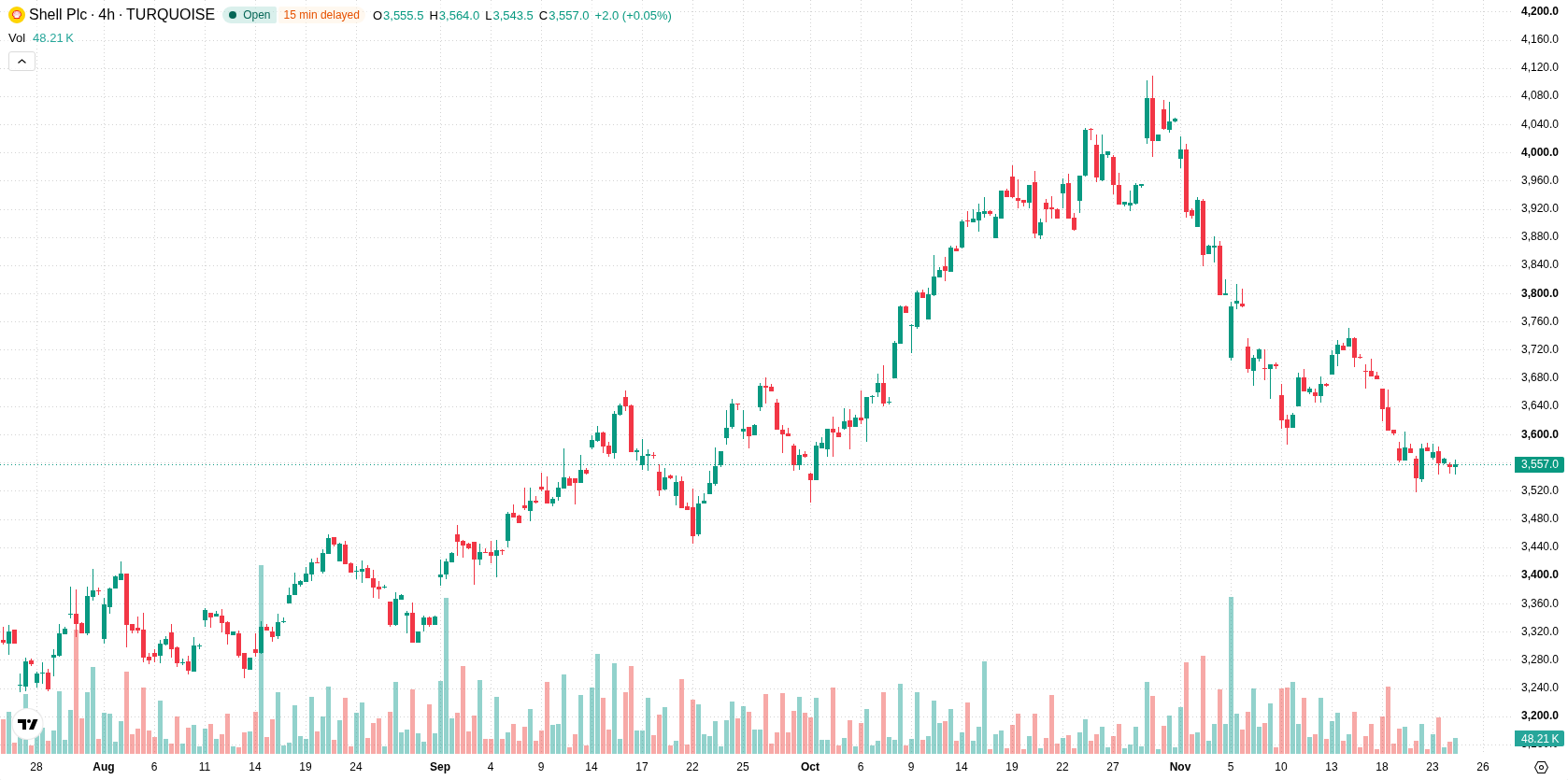
Bearish momentum with key SMAs and MACD on the 4H chart
On the technical side, SHEL is positioned below its D1 SMA-50 at GBX3,739 but remains above the D1 SMA-200 at GBX3,355, suggesting the longer-term bullish structure is intact, though short-term pressure is present. The 4H SMA-20 at GBX3,631 also sits above the current price, indicating absent short-term upward momentum.
Both MACD and ADX on the 4H timeframe currently signal a sell bias, reinforcing the notion of prevailing downward momentum amid broader risk aversion tied to global policy shifts. The H4 Kijun rests at GBX3,593, serving as the first notable resistance level for any near-term rebound attempts.
US policy moves as catalyst; resistance at GBX3,594, support near GBX3,355
External risks from shifting U.S. interest rates and yields could keep volatility elevated for Shell unless policy uncertainty resolves. Near-term resistance appears around GBX3,594, while firmer support levels are seen near GBX3,355. A push above GBX3,594 would be needed to ease present selling pressure, whereas a break below GBX3,355 could shift attention to further downside.
Previously it was reported that despite buybacks and operational developments, Shell's technical outlook was weighed down by prevailing bearish momentum and external macroeconomic risks. The current article adds that sustained pressure from rising U.S. Treasury yields remains a key risk factor, with further moves likely depending on the direction of U.S. monetary policy and its impact on sector flows.










-
 Afghanistan
-
 Albania
-
 Algeria
-
 Angola
-
 Argentina
-
 Armenia
-
 Australia
-
 Austria
-
 Azerbaijan
-
 Bahamas
-
 Bahrain
-
 Bangladesh
-
 Belarus
-
 Belgium
-
 Bolivia
-
 Botswana
-
 Brazil
-
 Brunei
-
 Bulgaria
-
 Cambodia
-
 Cameroon
-
 Canada
-
 Chile
-
 China
-
 Colombia
-
 Congo
-
 Costa Rica
-
 Cote d'Ivoire
-
 Croatia
-
 Cuba
-
 Cyprus
-
 Czechia
-
 DR Congo
-
 Denmark
-
 Dominican Republic
-
 Ecuador
-
 Egypt
-
 El Salvador
-
 Estonia
-
 Eswatini
-
 Ethiopia
-
 Finland
-
 France
-
 Georgia
-
 Germany
-
 Ghana
-
 Greece
-
 Haiti
-
 Hong Kong
-
 Hungary
-
 India
-
 Indonesia
-
 Iran, Islamic republic
-
 Iraq
-
 Ireland
-
 Israel
-
 Italy
-
 Jamaica
-
 Japan
-
 Jordan
-
 Kazakhstan
-
 Kenya
-
 Korea
-
 Kuwait
-
 Kyrgyzstan
-
 Laos
-
 Latvia
-
 Lebanon
-
 Lesotho
-
 Libya
-
 Lithuania
-
 Luxembourg
-
 Madagascar
-
 Malaysia
-
 Malta
-
 Mauritius
-
 Mexico
-
 Moldova
-
 Mongolia
-
 Montenegro
-
 Morocco
-
 Mozambique
-
 Myanmar
-
 Namibia
-
 Nepal
-
 Netherlands
-
 New Zealand
-
 Nigeria
-
 North Macedonia
-
 Norway
-
 Oman
-
 Pakistan
-
 Palestine
-
 Panama
-
 Papua New Guinea
-
 Paraguay
-
 Peru
-
 Philippines
-
 Poland
-
 Portugal
-
 Puerto Rico
-
 Qatar
-
 Reunion
-
 Romania
-
 Rwanda
-
 Saudi Arabia
-
 Serbia
-
 Singapore
-
 Slovakia
-
 Slovenia
-
 Somalia
-
 South Africa
-
 Spain
-
 Sri Lanka
-
 Sweden
-
 Switzerland
-
 Syria
-
 Taiwan
-
 Tajikistan
-
 Tanzania
-
 Thailand
-
 Trinidad and Tobago
-
 Tunisia
-
 Turkey
-
 UAE
-
 Uganda
-
 Ukraine
-
 United Kingdom
-
United States
-
 Uruguay
-
 Uzbekistan
-
 Venezuela
-
 Vietnam
-
 Yemen
-
 Zambia
-
 Zimbabwe
- Forex
- Crypto












