

Strong inflation reading keeps Shell facing steeper borrowing challenges amid dollar strength

Shell (SHEL) stock is trading higher in a modest daily move, as global macro factors influence the sector. Risks from elevated U.S. inflation and increased rate hike expectations are raising funding costs for multinationals. Market participants are watching upcoming U.S. inflation releases and central bank policy for future direction.
 3588.00
3708.50
Highlights
- Strong U.S. inflation data for November 2026 increased risks of a larger Federal Reserve interest rate hike and raised U.S. bond yields.
- Rising U.S. yields and a stronger dollar may increase global funding costs for companies such as Shell, affecting borrowing and capital expenditure plans.
- Shell stock maintains a long-term bullish posture above key support, but short-term technicals signal resistance ahead and vulnerability to renewed volatility.
U.S. inflation surprise and Fed rate fears elevate global funding costs
According to Reuters, strong U.S. inflation data for November 2026 raised concerns about a larger than expected interest rate hike by the Federal Reserve. This event triggered a rapid rise in U.S. bond yields and lifted the dollar sharply on November 10, 2026.
Higher U.S. yields and a stronger dollar directly increase global funding costs, which can impact financial conditions for companies like SHEL. As a result, Shell may see higher borrowing costs and more challenging capital expenditure planning, although these effects are linked to the macro environment rather than company-specific developments.
While this external macro risk is present, the modest upward move in SHEL suggests the market may be balancing these funding concerns against sector resilience or hedging strategies, with no confirming company-specific news reported.
Short-term resistance and mixed momentum despite long-term bullish trend
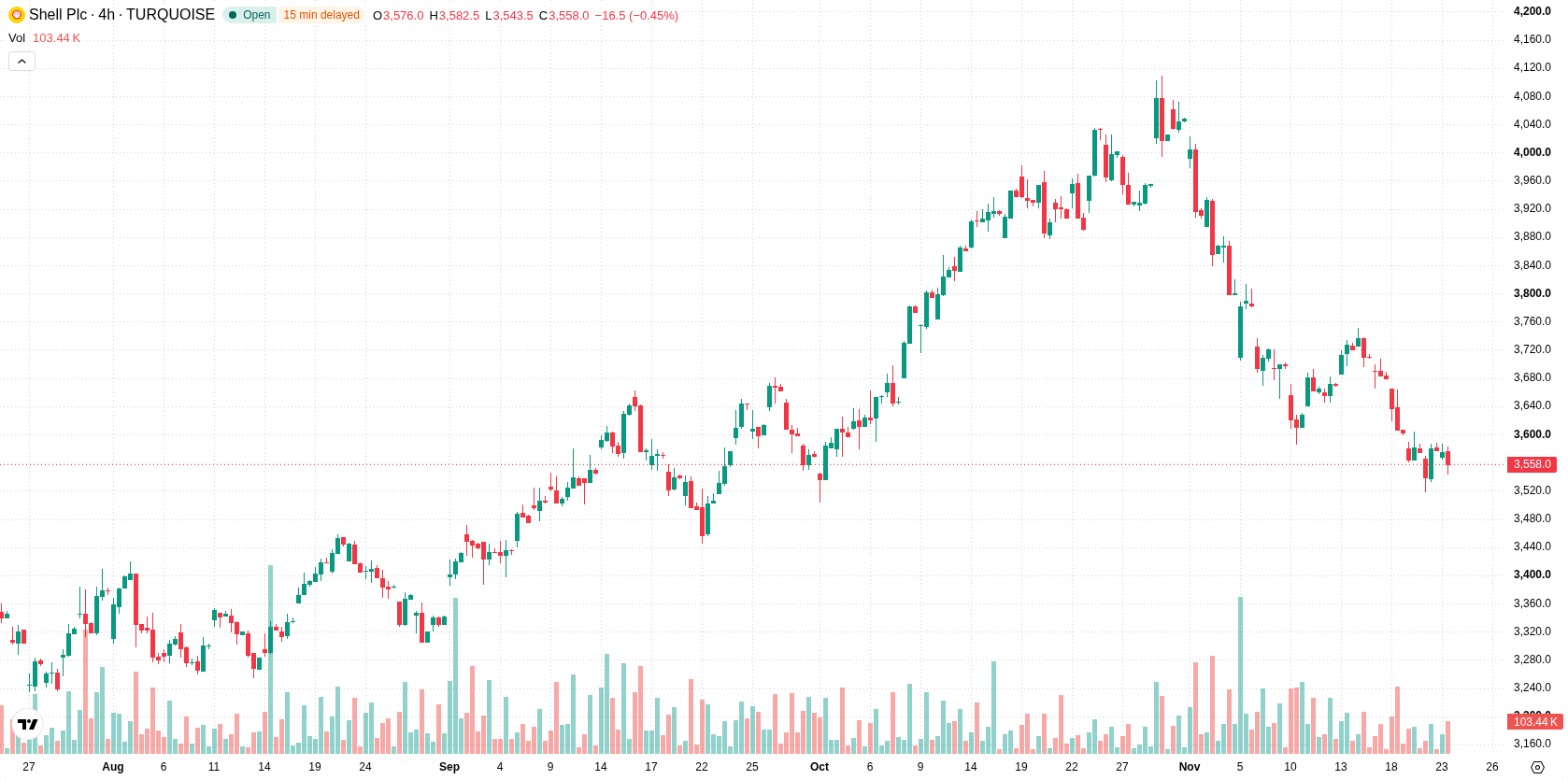
The 4H technical setup shows SHEL remains above its D1 SMA-200 at GBX3,355, suggesting a generally bullish longer-term posture. However, the stock is currently trading below both the D1 SMA-50 at GBX3,738 and the H4 SMA-20 at GBX3,648, indicating resistance ahead despite the upward bias.
Mixed signals are visible from the MACD and ADX, which both favor a sell scenario even as the broader trend aligns bullishly over the longer term. The H4 Ichimoku Kijun at GBX3,593 sets a short-term resistance level for upward moves.
External rate risks, support near GBX3,355, resistance around GBX3,594
External risks from U.S. monetary policy could drive renewed volatility for SHEL if inflation surprises again or if the Fed signals further aggressive tightening. Stabilization above resistance near GBX3,594 would be constructive, while failure to hold support around GBX3,355 may suggest increased pressure from higher funding costs. The technical landscape reinforces the need for caution as macro conditions play out.
Earlier, analysts noted that Shell's strengthened financial performance was tempered by mixed technical signals, leaving the stock subject to volatility from broader market forces. The current analysis adds the risk of higher U.S. funding costs as a key macro factor for future price action, with upcoming inflation data and central bank signals now critical for Shell's outlook.










-
 Afghanistan
-
 Albania
-
 Algeria
-
 Angola
-
 Argentina
-
 Armenia
-
 Australia
-
 Austria
-
 Azerbaijan
-
 Bahamas
-
 Bahrain
-
 Bangladesh
-
 Belarus
-
 Belgium
-
 Bolivia
-
 Botswana
-
 Brazil
-
 Brunei
-
 Bulgaria
-
 Cambodia
-
 Cameroon
-
 Canada
-
 Chile
-
 China
-
 Colombia
-
 Congo
-
 Costa Rica
-
 Cote d'Ivoire
-
 Croatia
-
 Cuba
-
 Cyprus
-
 Czechia
-
 DR Congo
-
 Denmark
-
 Dominican Republic
-
 Ecuador
-
 Egypt
-
 El Salvador
-
 Estonia
-
 Eswatini
-
 Ethiopia
-
 Finland
-
 France
-
 Georgia
-
 Germany
-
 Ghana
-
 Greece
-
 Haiti
-
 Hong Kong
-
 Hungary
-
 India
-
 Indonesia
-
 Iran, Islamic republic
-
 Iraq
-
 Ireland
-
 Israel
-
 Italy
-
 Jamaica
-
 Japan
-
 Jordan
-
 Kazakhstan
-
 Kenya
-
 Korea
-
 Kuwait
-
 Kyrgyzstan
-
 Laos
-
 Latvia
-
 Lebanon
-
 Lesotho
-
 Libya
-
 Lithuania
-
 Luxembourg
-
 Madagascar
-
 Malaysia
-
 Malta
-
 Mauritius
-
 Mexico
-
 Moldova
-
 Mongolia
-
 Montenegro
-
 Morocco
-
 Mozambique
-
 Myanmar
-
 Namibia
-
 Nepal
-
 Netherlands
-
 New Zealand
-
 Nigeria
-
 North Macedonia
-
 Norway
-
 Oman
-
 Pakistan
-
 Palestine
-
 Panama
-
 Papua New Guinea
-
 Paraguay
-
 Peru
-
 Philippines
-
 Poland
-
 Portugal
-
 Puerto Rico
-
 Qatar
-
 Reunion
-
 Romania
-
 Rwanda
-
 Saudi Arabia
-
 Serbia
-
 Singapore
-
 Slovakia
-
 Slovenia
-
 Somalia
-
 South Africa
-
 Spain
-
 Sri Lanka
-
 Sweden
-
 Switzerland
-
 Syria
-
 Taiwan
-
 Tajikistan
-
 Tanzania
-
 Thailand
-
 Trinidad and Tobago
-
 Tunisia
-
 Turkey
-
 UAE
-
 Uganda
-
 Ukraine
-
 United Kingdom
-
United States
-
 Uruguay
-
 Uzbekistan
-
 Venezuela
-
 Vietnam
-
 Yemen
-
 Zambia
-
 Zimbabwe
- Forex
- Crypto












