

Can Shell hold up against further US yield gains under macro-driven energy demand worries?

Shell (SHEL) stock is trading below its medium-term averages in a cautious session. Recent moves reflect concern that higher US yields may impact global borrowing costs and energy demand. Traders are watching US central bank policy and inflation trends for future risk signals.
 3605.00
3752.00
Highlights
- US bond yields saw the largest short-term jump in over a year and a half after higher-than-expected inflation and hawkish Federal Reserve commentary.
- Rising US yields threaten to increase global borrowing costs for energy companies such as Shell and could moderate demand for energy products.
- Shell stock faces increased macro headwinds with downside momentum signals, key support at GBX3,347 and resistance around GBX3,656.
US bond market volatility and Fed rate outlook drive funding risks
According to Bloomberg, on November 10, 2026, the US bond market saw a sharp decline after US inflation data came in above expectations and Federal Reserve officials indicated a willingness to consider more aggressive interest rate hikes, resulting in the largest jump in short-term yields in over a year and a half.
Rising US yields can translate to higher global borrowing costs, which may increase funding expenses for multinational companies in the energy sector such as Shell. Elevated financing costs and tightening financial conditions also have the potential to dampen economic activity and moderate demand for energy products.
Although the event has added a risk context for energy stocks, the current move in SHEL has been modest, and no corporate-specific news has offset this macro influence.
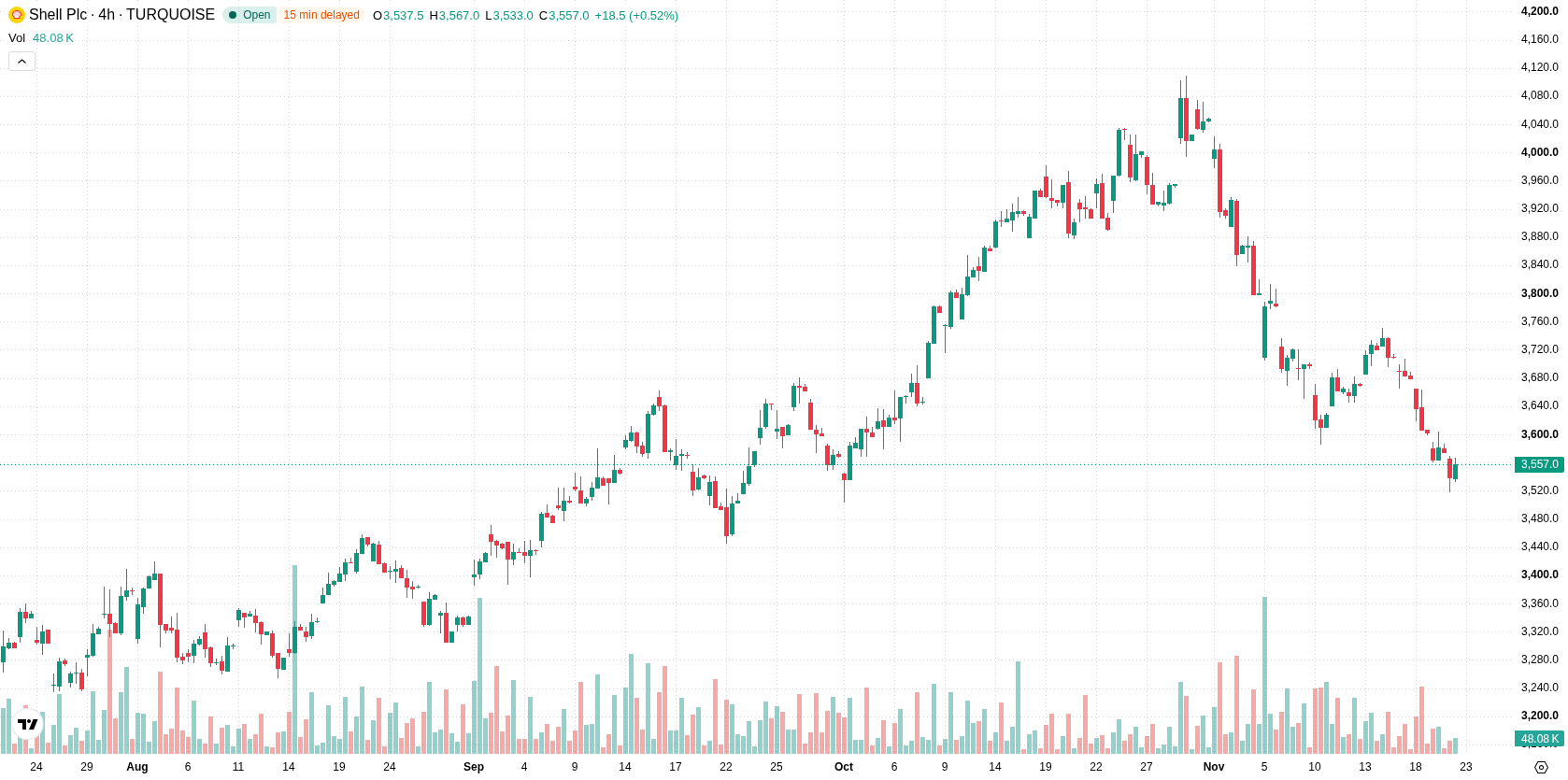
SHEL navigates macro pressures below short-term resistances
The latest 4H setup for SHEL reflects a mixed short-term outlook, with the price currently below the D1 SMA-50 at GBX3,737 while remaining above the D1 SMA-200 at GBX3,347. The H4 SMA-20 at GBX3,663 and the H4 Kijun at GBX3,655 are acting as nearby resistance levels under prevailing macro pressure.
Momentum signals are biased lower, as both MACD and ADX suggest sell conditions on the 4H chart. However, these indicators do not point to a decisive trend reversal, and price remains within the broader bullish alignment above the long-term average.
External yield shocks and monetary policy dictate next directional test
Further rises in US yields or additional hawkish Fed policy signals could increase headwinds for SHEL, especially if global demand expectations weaken. The GBX3,347 area, linked to the D1 SMA-200, serves as initial support, while resistance stands around GBX3,656 at the H4 Kijun. A break below support could expose further downside, whereas stabilization above resistance would ease immediate macro-driven pressures.
Earlier, analysts noted that declines in UK equities were driven largely by weakness in banks, energy producers, and miners, with Shell among those impacted by a risk-off global environment. The current analysis adds that US yields and central bank policy remain key macro factors, with further rate increases or tightening likely to dictate Shell’s near-term direction.











-
 Afghanistan
-
 Albania
-
 Algeria
-
 Angola
-
 Argentina
-
 Armenia
-
 Australia
-
 Austria
-
 Azerbaijan
-
 Bahamas
-
 Bahrain
-
 Bangladesh
-
 Belarus
-
 Belgium
-
 Bolivia
-
 Botswana
-
 Brazil
-
 Brunei
-
 Bulgaria
-
 Cambodia
-
 Cameroon
-
 Canada
-
 Chile
-
 China
-
 Colombia
-
 Congo
-
 Costa Rica
-
 Cote d'Ivoire
-
 Croatia
-
 Cuba
-
 Cyprus
-
 Czechia
-
 DR Congo
-
 Denmark
-
 Dominican Republic
-
 Ecuador
-
 Egypt
-
 El Salvador
-
 Estonia
-
 Eswatini
-
 Ethiopia
-
 Finland
-
 France
-
 Georgia
-
 Germany
-
 Ghana
-
 Greece
-
 Haiti
-
 Hong Kong
-
 Hungary
-
 India
-
 Indonesia
-
 Iran, Islamic republic
-
 Iraq
-
 Ireland
-
 Israel
-
 Italy
-
 Jamaica
-
 Japan
-
 Jordan
-
 Kazakhstan
-
 Kenya
-
 Korea
-
 Kuwait
-
 Kyrgyzstan
-
 Laos
-
 Latvia
-
 Lebanon
-
 Lesotho
-
 Libya
-
 Lithuania
-
 Luxembourg
-
 Madagascar
-
 Malaysia
-
 Malta
-
 Mauritius
-
 Mexico
-
 Moldova
-
 Mongolia
-
 Montenegro
-
 Morocco
-
 Mozambique
-
 Myanmar
-
 Namibia
-
 Nepal
-
 Netherlands
-
 New Zealand
-
 Nigeria
-
 North Macedonia
-
 Norway
-
 Oman
-
 Pakistan
-
 Palestine
-
 Panama
-
 Papua New Guinea
-
 Paraguay
-
 Peru
-
 Philippines
-
 Poland
-
 Portugal
-
 Puerto Rico
-
 Qatar
-
 Reunion
-
 Romania
-
 Rwanda
-
 Saudi Arabia
-
 Serbia
-
 Singapore
-
 Slovakia
-
 Slovenia
-
 Somalia
-
 South Africa
-
 Spain
-
 Sri Lanka
-
 Sweden
-
 Switzerland
-
 Syria
-
 Taiwan
-
 Tajikistan
-
 Tanzania
-
 Thailand
-
 Trinidad and Tobago
-
 Tunisia
-
 Turkey
-
 UAE
-
 Uganda
-
 Ukraine
-
 United Kingdom
-
United States
-
 Uruguay
-
 Uzbekistan
-
 Venezuela
-
 Vietnam
-
 Yemen
-
 Zambia
-
 Zimbabwe
- Forex
- Crypto












