

Tariff-related cost warning may deepen margin risk for Apple if policies tighten

Apple (AAPL) stock is trading higher. The main focus for traders is the company's recent warning of sharply increased tariff-related costs, which are set to negatively impact operating income. Market participants are closely watching for changes in U.S. trade policy or new tariff actions that could further affect AAPL's supply chain and earnings.
 353.78
356.42
Highlights
- Apple projects $1.4 billion in tariff costs for the December 2025 quarter, up from $800 million in July.
- Rising tariff expenses are increasing operating costs and reducing margins, with future impact tied to further trade policy changes.
- Apple stock trades above major moving averages but momentum remains neutral, with support near $350 important for trend resilience.
Tariff-driven cost increase and policy risk for Apple
According to Yahoo Finance, on October 30, 2025, Apple reported that its guidance for the December 2025 quarter includes an estimated $1.4 billion in tariff-related costs, significantly higher than the $800 million incurred in the prior July quarter.
These tariff costs directly increase Apple's operating expenses and reduce its operating income, putting pressure on profit margins. The identified channel is through higher input costs due to trade policy, which threaten to weigh on overall profitability and future earnings.
Although this presents a notable risk, there are no separate offsetting factors confirmed in the current data. The impact remains closely tied to the evolution of U.S. trade policy and any further tariff developments.
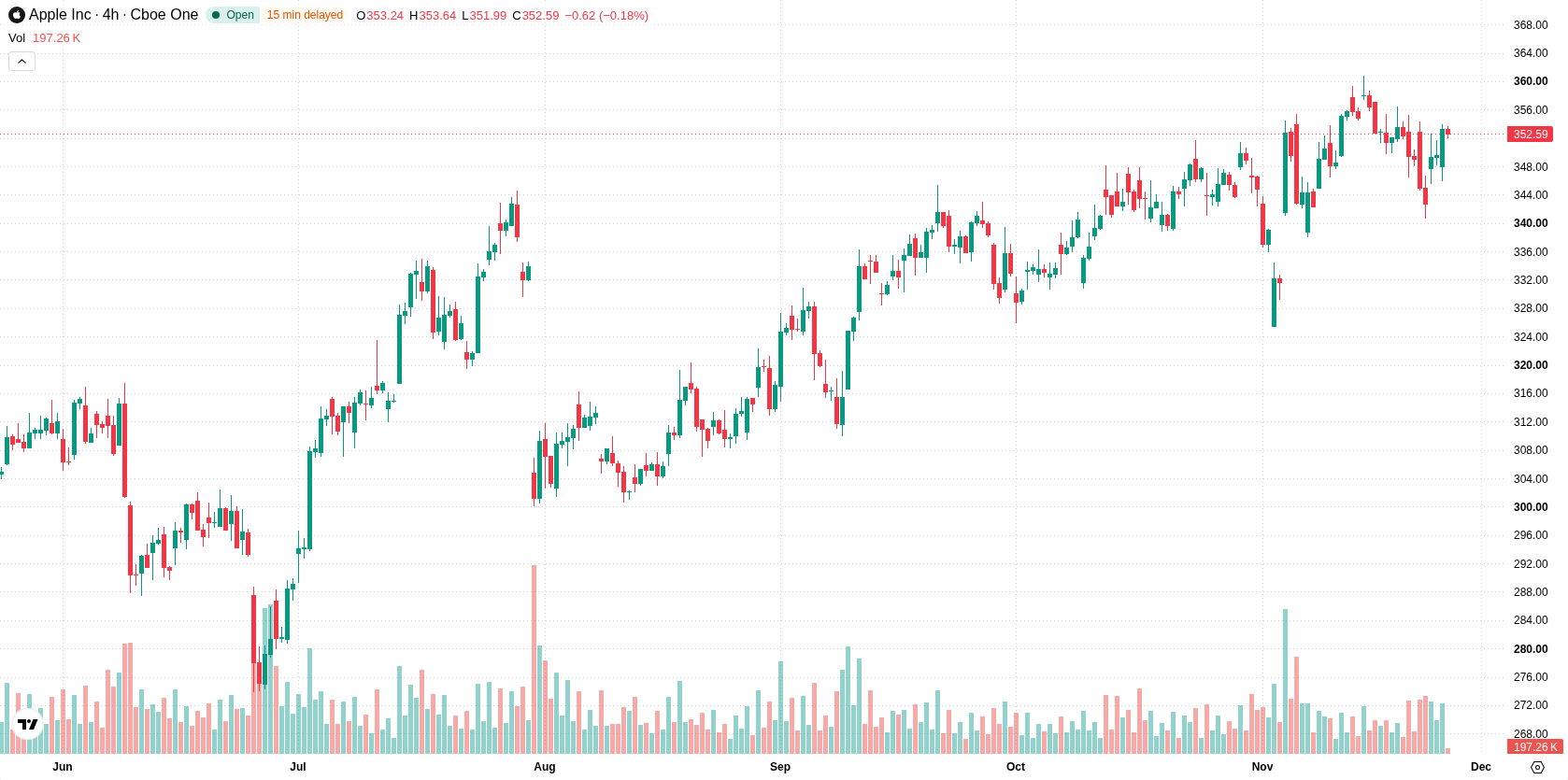
AAPL price holds above D1 moving averages, neutral momentum
On the 4H chart, the macro risk from tariffs emerges against a backdrop of bullish positioning, with the price currently above key daily and 4H simple moving averages. The D1 SMA-50 at $342.2 and the D1 SMA-200 at $303.6 both lie below current market levels, reflecting a supportive trend despite external pressures.
The MACD and ADX both indicate neutral momentum rather than a directional push, signaling that the uptrend is not seeing strongly reinforcing technical participation at this time. The H4 Kijun support is defined at $349.57, offering a reference level for near-term moves.
External tariff risk vs support near $350
Looking ahead, the primary risk for AAPL centers on further trade policy shifts that could either exacerbate or alleviate supply chain costs. Support remains around $350—close to the H4 Kijun—where stabilization would help maintain the current technical bias. A breakdown below this level could trigger additional pressure, while holding above it would indicate continued resilience in the face of external risks.
Earlier, analysts noted that Apple continued to attract buyers in profitable segments despite competitive and macroeconomic pressures. The current update adds a significant new risk, as increased tariff-related costs place direct pressure on Apple’s profitability, making future moves in U.S. trade policy the key factor to watch.











-
 Afghanistan
-
 Albania
-
 Algeria
-
 Angola
-
 Argentina
-
 Armenia
-
 Australia
-
 Austria
-
 Azerbaijan
-
 Bahamas
-
 Bahrain
-
 Bangladesh
-
 Belarus
-
 Belgium
-
 Bolivia
-
 Botswana
-
 Brazil
-
 Brunei
-
 Bulgaria
-
 Cambodia
-
 Cameroon
-
 Canada
-
 Chile
-
 China
-
 Colombia
-
 Congo
-
 Costa Rica
-
 Cote d'Ivoire
-
 Croatia
-
 Cuba
-
 Cyprus
-
 Czechia
-
 DR Congo
-
 Denmark
-
 Dominican Republic
-
 Ecuador
-
 Egypt
-
 El Salvador
-
 Estonia
-
 Eswatini
-
 Ethiopia
-
 Finland
-
 France
-
 Georgia
-
 Germany
-
 Ghana
-
 Greece
-
 Haiti
-
 Hong Kong
-
 Hungary
-
 India
-
 Indonesia
-
 Iran, Islamic republic
-
 Iraq
-
 Ireland
-
 Israel
-
 Italy
-
 Jamaica
-
 Japan
-
 Jordan
-
 Kazakhstan
-
 Kenya
-
 Korea
-
 Kuwait
-
 Kyrgyzstan
-
 Laos
-
 Latvia
-
 Lebanon
-
 Lesotho
-
 Libya
-
 Lithuania
-
 Luxembourg
-
 Madagascar
-
 Malaysia
-
 Malta
-
 Mauritius
-
 Mexico
-
 Moldova
-
 Mongolia
-
 Montenegro
-
 Morocco
-
 Mozambique
-
 Myanmar
-
 Namibia
-
 Nepal
-
 Netherlands
-
 New Zealand
-
 Nigeria
-
 North Macedonia
-
 Norway
-
 Oman
-
 Pakistan
-
 Palestine
-
 Panama
-
 Papua New Guinea
-
 Paraguay
-
 Peru
-
 Philippines
-
 Poland
-
 Portugal
-
 Puerto Rico
-
 Qatar
-
 Reunion
-
 Romania
-
 Rwanda
-
 Saudi Arabia
-
 Serbia
-
 Singapore
-
 Slovakia
-
 Slovenia
-
 Somalia
-
 South Africa
-
 Spain
-
 Sri Lanka
-
 Sweden
-
 Switzerland
-
 Syria
-
 Taiwan
-
 Tajikistan
-
 Tanzania
-
 Thailand
-
 Trinidad and Tobago
-
 Tunisia
-
 Turkey
-
 UAE
-
 Uganda
-
 Ukraine
-
 United Kingdom
-
United States
-
 Uruguay
-
 Uzbekistan
-
 Venezuela
-
 Vietnam
-
 Yemen
-
 Zambia
-
 Zimbabwe
- Forex
- Crypto












