Index Concentration And Why It Matters For Investors


Editorial Note: While we adhere to strict Editorial Integrity, this post may contain references to products from our partners. Here's an explanation for How We Make Money. None of the data and information on this webpage constitutes investment advice according to our Disclaimer.
Index concentration occurs when a small group of mega-cap stocks dominate the performance of an entire index like the S&P 500. While the index may appear diversified, gains or losses are often driven by just a handful of companies. This hidden imbalance creates risk, especially for passive investors who may not realize their portfolio is overly reliant on tech giants like Apple, Microsoft, or Nvidia.
The S&P 500 may appear strong on the surface, but a deeper look reveals that a handful of mega-cap tech stocks are driving most of the gains. Their size and influence can overshadow weakness in other sectors, creating the illusion of a broad market rally. In reality, many industries are struggling while the index moves higher. This can mislead passive investors into thinking the market is healthier than it actually is. It’s not just market noise — it’s a structural imbalance that often goes unnoticed until losses start piling up. Understanding what’s happening beneath the surface is key to protecting your portfolio.
Risk warning: All investments carry risk, including potential capital loss. Economic fluctuations and market changes affect returns, and 40-50% of investors underperform benchmarks. Diversification helps but does not eliminate risks. Invest wisely and consult professional financial advisors.
Understanding index concentration
If you own an index fund, you probably think your portfolio is well diversified. But that’s not always the case. When a few giant companies take up most of the space in an index, it’s called index concentration — and it means your money is riding more on those few names than you might think. That can be great when those stocks are rising, but risky when they’re not.
Definition and significance
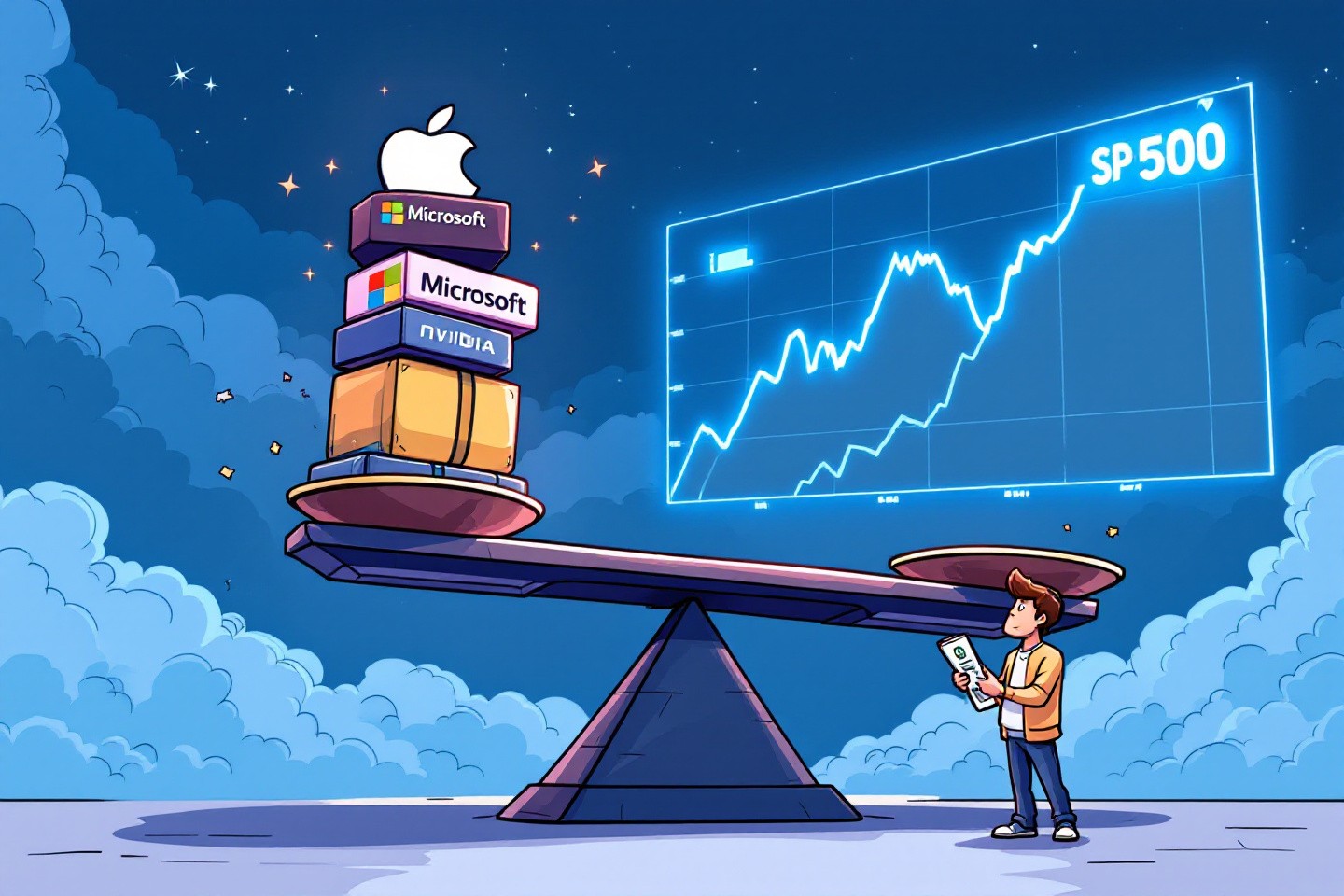
Index concentration happens when a small group of companies — usually the biggest by market cap — make up a large chunk of a stock index. This is especially common in indices like the S&P 500, where companies are weighted by size.
Here’s why it matters:
If the top five or six stocks go up, the whole index can look strong — even if the rest are flat.
But if those same leaders fall, they can pull the entire index down with them.
It also means your investment might not be as balanced as you think — you’re betting more on a few companies than you realize.
So even if you’re invested in “500 companies,” it might feel more like five doing all the work.
History doesn’t always repeat—but it often rhymes
This isn’t the first time markets have been led by a few big names:
The Nifty Fifty (1960s–70s). A group of popular growth stocks that led the market ended up crashing hard during the bear market of the 1970s.
Dot-com bubble (late 1990s–2000). Microsoft, Cisco, and other tech leaders made up a large portion of the S&P 500. When the bubble burst, the index plunged — even though many sectors weren’t directly involved.
Today’s “Magnificent Seven”. Apple, Microsoft, Nvidia, Amazon, Alphabet, Meta, and Tesla — now make up more than 25% of the S&P 500, and over 40% of the Nasdaq-100. Their weight hides weakness in sectors like energy, utilities, and small-cap industrials.
History shows that when just a few companies lead the charge, the market can look strong on the surface — but it might be more fragile than it appears.
The rise of mega-corporations in major indices
A handful of massive companies now dominate the stock market like never before. These aren't just familiar names — they’re the giants that have come to shape entire indices. For investors, this means that owning a broad index fund might not be as diversified as it seems — because a big chunk of that investment is riding on a few mega-cap stocks.
Dominance in the S&P 500
The S&P 500 is supposed to represent 500 companies — but lately, it feels like just five companies are doing most of the work.
Apple, Microsoft, Amazon, Nvidia, and Alphabet now make up more than a quarter of the index’s total value.
That means the market’s daily ups and downs are often driven by how these giants perform — not the broader economy.
If one of them has a great earnings report, it can lift the whole index. But if they stumble, the entire market can drop — even if hundreds of other companies are doing fine.
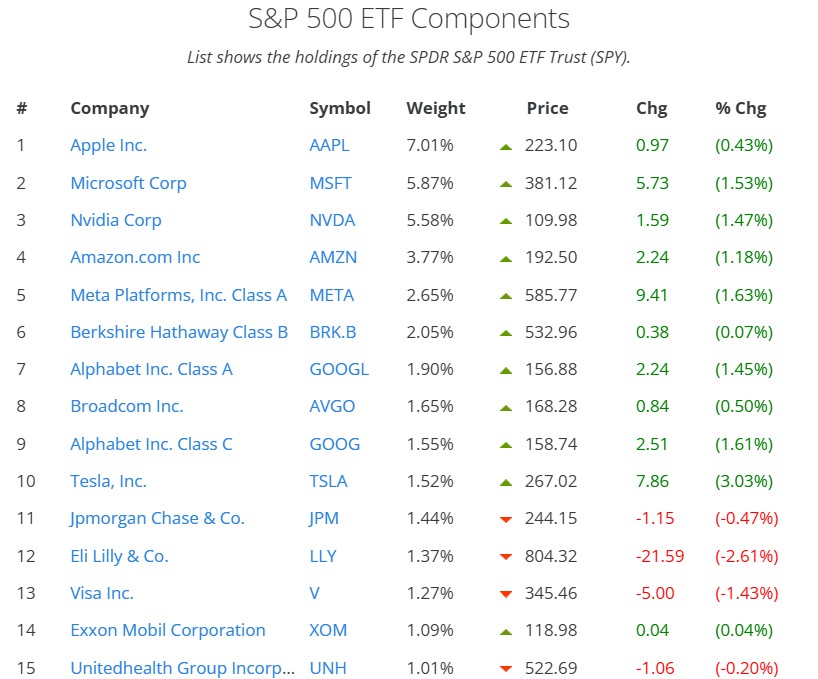
This kind of concentration makes it easy to mistake tech gains for overall market strength, which is why investors need to know who’s really moving the needle in their portfolios.
Impact on global indices
It’s not just American investors feeling the impact. These mega-companies have become so big, they’ve spilled over into global markets.
Funds and indices all over the world now include U.S. tech stocks as top holdings, even if they’re not tech-focused or U.S.-based.
This means that when Apple or Microsoft swings, investors in Europe, Asia, and beyond can feel the ripple effect.
Global stock funds — like the MSCI World Index — are heavily weighted toward the same handful of U.S. companies.
So even if you think you're diversified globally, you might be more connected to Big Tech than you realize.
Factors contributing to increased concentration
It’s not just luck that put a few companies at the top of the market. A mix of powerful forces — technological innovation and modern investing habits — have helped certain giants pull far ahead of the pack. And once they gained momentum, today’s markets helped them stay there.
Technological advancements
Tech leaders didn’t just grow — they redefined entire industries. Companies like Apple, Microsoft, and Nvidia built products and platforms that became central to everyday life, business, and even national infrastructure.
Once they dominated one area — like smartphones or search — they branched out into other markets and kept growing.
Their size lets them spend more on R&D, buy up smaller competitors, and launch new technologies faster than anyone else.
Investors now see them as essential to the future of tech, from AI to cloud to chips — and that drives their stock prices even higher.
These companies haven’t just benefited from innovation — they’ve used it to lock in their lead.
Market dynamics and investor behavior
Today’s investing landscape has changed. Most money now flows through index funds and ETFs, and that means size matters more than ever.
Bigger companies get a larger slice of index funds by default, so when more money goes into passive strategies, the biggest names benefit the most.
This creates a feedback loop: the more their prices rise, the more money gets funneled back into them.
On top of that, investors tend to chase what’s been working, so mega-cap stocks keep attracting more attention — and more dollars.
It’s a system that naturally favors the winners, making it hard for smaller companies to catch up and even harder for the big players to lose their lead.
Potential scenarios: stagnation or decline of mega-corporations
The big tech companies that have driven much of the market’s recent growth won’t stay on top forever. Like any business, they can slow down or even lose their edge. For investors, it’s useful to think through what that might look like and what it could mean for their money.
Impact on indices
When the largest companies in the market struggle, the whole index can feel it — even if smaller firms are doing fine.
What if growth hits a wall?
They weigh more, so they drag more. Since big companies make up most of the index, their slowdowns pull down overall returns.
Other sectors might shine — but it may not be enough. Even if areas like healthcare or manufacturing do well, they might not carry enough weight to balance out losses from tech.
Index funds aren't always low-risk. If you’re investing through broad-market funds, you're likely more tied to a few large companies than you realize.
Decline isn't just about bad earnings
Expectations matter. If a company was priced for non-stop growth, even steady results can disappoint investors.
Leadership and innovation count. A lack of new ideas or weak management can cause long-term problems.
Sentiment shifts quickly. When investors lose confidence, even once-loved stocks can fall fast.
Historical parallels
Big companies losing ground is nothing new. The past offers plenty of examples where leaders fell behind as markets changed.
Tech giants of yesterday
IBM in the '80s. It led the computer revolution but missed the shift to personal computing. Its market power faded even though tech as a whole kept moving forward.
GE’s fall from grace. For years, General Electric was considered one of the safest stocks — until its financial decisions and overreach caught up with it.
The phone leaders that missed the call. Nokia and BlackBerry ruled mobile before the smartphone era left them behind.
What this means for investors
No company stays king forever. Size doesn’t guarantee long-term success.
New leaders will always emerge. Markets don’t stand still. The next big names might not be household names — yet.
Review your exposure. Even in index funds, it pays to understand how much of your portfolio is tied up in a few major players.
We’ve curated a list of top stock brokers that offer the right tools and flexibility for investors looking to navigate index concentration risk effectively.
| eToro USA | SpeedTrader | Plus500 | TradeZero International | eOption | |
|---|---|---|---|---|---|
|
Foundation year |
2007 | 1999 | 2008 | 2008 | 2007 |
|
Account min. |
50 | 2,500 | 500 | 500 | No |
|
Demo |
Yes | Yes | Yes | Yes | Yes |
|
Deposit Fee |
No | $0 | No | $0 | Not specified |
|
Withdrawal fee |
No | $30/$75 | No | ACH - $0-5, Wire - $15-50 | Not specified |
|
Inactivity fee |
No | Not specified | $10 | $0 | Not specified |
|
Android |
Yes | Yes | Yes | Yes | Yes |
|
iOS |
Yes | Yes | Yes | Yes | Yes |
|
Regulation |
SEC, FINRA | FINRA, SIPC | CySEC, FCA, ASIC, FMA, FSCA, FSA Seychelles, EFSA, MAS, DFSA, SCB | Securities Commission of the Bahamas (Int); SEC, FINRA member, SIPC member (USA); Member firm of CIRO; member of CIPF (Canada); AFM, MiFID II (Europe) | FINRA, SIPC |
|
TU overall score |
9.3 | 9.2 | 7.7 | 7.51 | 7.5 |
|
Open an account |
Go to broker Your capital is at risk. |
Go to broker |
Go to broker 81% of retail CFD accounts lose money. |
Go to broker Your capital is at risk. |
Study review |
How the rise of mega-corporations affects global markets
In recent years, a small number of large companies have started to play an outsized role in the stock market. These massive businesses, especially in tech, now make up a big share of key indices. For anyone learning about investing, it's important to understand what this shift means and how it affects things like risk, diversification, and long-term strategy.
Dominance in the S&P 500
The S&P 500, traditionally viewed as a broad representation of the U.S. economy, has become increasingly concentrated. As of recent analyses, the top ten stocks by market capitalization account for approximately 36% of the index's total market cap, a significant rise from the historical average of around 20% over the past 45 years. This level of concentration is the highest since 1932, underscoring the growing influence of a few large firms.
How did this happen?
Massive growth in profits and size. Companies like Apple, Microsoft, Amazon, and others have expanded rapidly thanks to strong demand and digital business models.
Tech in everyday life. Services like cloud storage, smartphones, online shopping, and AI tools are now part of daily routines, helping these firms grow faster than others.
Stock buybacks. Many of these companies reduce the number of shares available, pushing up their earnings per share and stock prices.
Why this matters
Five companies drive a big chunk. Just five firms now make up over a quarter of the S&P 500's total weight.
Index funds are more tech-heavy than they look. Buying an S&P 500 fund means putting a large part of your money into a few tech giants.
Diversification is weaker. The benefit of spreading out risk is reduced when just a few companies are doing most of the heavy lifting.
Impact on global indices
The reach of these companies isn’t limited to U.S. markets. They now have a strong effect on how international markets move, too.
How it affects global markets
Widespread inclusion in funds. Many global ETFs include U.S. tech firms, so people investing abroad may still be heavily exposed to them.
Earnings reports drive markets worldwide. A big move in Apple’s stock after earnings can ripple through markets in Europe and Asia.
Similar tech exposure in Asia. Countries like South Korea and Taiwan, known for their own tech sectors, often follow the trends of U.S. tech stocks closely.
What it means for investors
Less real diversification. Even with money spread across regions, many investors are still depending on the same small group of companies.
Bigger reactions to tech news. Because these companies matter so much, their earnings and news can create bigger moves in markets around the world.
More thoughtful strategy needed. Looking at what sectors and companies you’re exposed to is more important now than just checking what countries you’ve invested in.
Real diversification begins by breaking down what’s actually driving your index returns

Here’s what most beginners miss, just because you’re in a 500-stock index doesn’t mean you’ve got 500 different places your returns are really coming from. When five companies make up over a fifth of the whole thing, you’re in something that looks spread out but really isn’t. Don’t just tweak your allocation — break it down. Look at how much the top names are contributing versus the rest. Is the whole index moving, or just being carried by a few heavy hitters? That single shift in thinking changes how you read the market.
And don’t just hedge your positions — fix the shape of your portfolio. Most people throw on some puts or inverse ETFs and call it a day. But if you're tied too closely to a small group of mega-caps, that won’t save you. Use smarter tools — like ratio spreads or rotating into under-owned sectors that don’t mimic Big Tech — to shift the weight in a smarter way. You’re not shorting the giants. You’re just refusing to let them control your entire game plan.
Conclusion
Index concentration is no longer a hidden risk — it’s a structural reality in today’s market. While the S&P 500 appears diversified, the truth is that a handful of mega-cap tech stocks are driving most of the returns. This creates hidden exposure for passive investors and weakens the protection diversification is supposed to offer. As more money flows into index funds, this imbalance may grow.
To manage long-term portfolio risk, investors need to go beyond market headlines and actively monitor how much of their performance depends on just a few dominant companies. True diversification means knowing where your returns really come from — and making sure they’re not all tied to the same giants.
FAQs
Can passive investing strategies exacerbate index concentration?
Yes, passive investing can increase index concentration by directing more capital to already large companies. This may cause a few dominant stocks to have an outsized influence on index performance.
Are there regulatory measures addressing mega-corporation dominance?
Some regulators are exploring antitrust actions, disclosure rules, and market structure reforms. However, concrete measures to limit the market dominance of mega-corporations remain limited and complex to implement.
What is the future outlook for index concentration trends?
If passive investing continues to grow, index concentration may rise further unless market dynamics shift. Innovation, competition, or regulatory changes could gradually rebalance index weights over time.
How much of the S&P 500 is controlled by mega-cap stocks?
As of 2026, the top 10 companies account for over 35% of the S&P 500’s total weight. Five firms alone contribute more than 25%, meaning the index is heavily influenced by their performance.
Editors' Top Picks and Insights






Related Articles
Team that worked on the article
Andrey Mastykin is an experienced author, editor, and content strategist who has been with Traders Union since 2020. As an editor, he is meticulous about fact-checking and ensuring the accuracy of all information published on the Traders Union platform.
Chinmay Soni is a financial analyst with more than 5 years of experience in working with stocks, Forex, derivatives, and other assets. As a founder of a boutique research firm and an active researcher, he covers various industries and fields, providing insights backed by statistical data.
Mirjan Hipolito is a journalist and news editor at Traders Union. She is an expert crypto writer with five years of experience in the financial markets.
Index in trading is the measure of the performance of a group of stocks, which can include the assets and securities in it.
Diversification is an investment strategy that involves spreading investments across different asset classes, industries, and geographic regions to reduce overall risk.
Cryptocurrency is a type of digital or virtual currency that relies on cryptography for security. Unlike traditional currencies issued by governments (fiat currencies), cryptocurrencies operate on decentralized networks, typically based on blockchain technology.
An investor is an individual, who invests money in an asset with the expectation that its value would appreciate in the future. The asset can be anything, including a bond, debenture, mutual fund, equity, gold, silver, exchange-traded funds (ETFs), and real-estate property.
Bitcoin is a decentralized digital cryptocurrency that was created in 2009 by an anonymous individual or group using the pseudonym Satoshi Nakamoto. It operates on a technology called blockchain, which is a distributed ledger that records all transactions across a network of computers.

-
 Afghanistan
-
 Albania
-
 Algeria
-
 Angola
-
 Argentina
-
 Armenia
-
 Australia
-
 Austria
-
 Azerbaijan
-
 Bahamas
-
 Bahrain
-
 Bangladesh
-
 Belarus
-
 Belgium
-
 Bolivia
-
 Botswana
-
 Brazil
-
 Brunei
-
 Bulgaria
-
 Cambodia
-
 Cameroon
-
 Canada
-
 Chile
Chile
-
 China
China
-
 Colombia
-
 Congo
Congo
-
 Costa Rica
-
 Cote d'Ivoire
-
 Croatia
-
 Cuba
Cuba
-
 Cyprus
-
 Czechia
-
 DR Congo
-
 Denmark
-
 Dominican Republic
-
 Ecuador
-
 Egypt
Egypt
-
 El Salvador
-
 Estonia
-
 Eswatini
-
 Ethiopia
-
 Finland
-
 France
-
 Georgia
-
 Germany
-
 Ghana
Ghana
-
 Greece
-
 Haiti
Haiti
-
 Hong Kong
-
 Hungary
-
 India
India
-
 Indonesia
-
 Iran, Islamic republic
-
 Iraq
Iraq
-
 Ireland
-
 Israel
-
 Italy
Italy
-
 Jamaica
-
 Japan
Japan
-
 Jordan
-
 Kazakhstan
-
 Kenya
Kenya
-
 Korea
Korea
-
 Kuwait
-
 Kyrgyzstan
-
 Laos
Laos
-
 Latvia
-
 Lebanon
-
 Lesotho
-
 Libya
Libya
-
 Lithuania
-
 Luxembourg
-
 Madagascar
-
 Malaysia
-
 Malta
Malta
-
 Mauritius
-
 Mexico
-
 Moldova
-
 Mongolia
-
 Montenegro
-
 Morocco
-
 Mozambique
-
 Myanmar
-
 Namibia
-
 Nepal
Nepal
-
 Netherlands
-
 New Zealand
-
 Nigeria
-
 North Macedonia
-
 Norway
-
 Oman
Oman
-
 Pakistan
-
 Palestine
-
 Panama
-
 Papua New Guinea
-
 Paraguay
-
 Peru
Peru
-
 Philippines
-
 Poland
-
 Portugal
-
 Puerto Rico
-
 Qatar
Qatar
-
 Reunion
-
 Romania
-
 Rwanda
-
 Saudi Arabia
-
 Serbia
-
 Singapore
-
 Slovakia
-
 Slovenia
-
 Somalia
-
 South Africa
-
 Spain
Spain
-
 Sri Lanka
-
 Sweden
-
 Switzerland
-
 Syria
Syria
-
 Taiwan
-
 Tajikistan
-
 Tanzania
-
 Thailand
-
 Trinidad and Tobago
-
 Tunisia
-
 Turkey
-
 UAE
UAE
-
 Uganda
-
 Ukraine
-
 United Kingdom
-
United States
-
 Uruguay
-
 Uzbekistan
-
 Venezuela
-
 Vietnam
-
 Yemen
Yemen
-
 Zambia
-
 Zimbabwe
- Forex
- Crypto