
Is it real to earn 100 dollars a day on trading?


Editorial Note: While we adhere to strict Editorial Integrity, this post may contain references to products from our partners. Here's an explanation for How We Make Money. None of the data and information on this webpage constitutes investment advice according to our Disclaimer.

Here are some tips on how you can make $100 a day in trading:
- Educate yourself about trading
- Develop a trading strategy
- Set realistic profit goals
- Manage risk carefully
- Start with sufficient capital
- Stick to your strategy
- Monitor and analyze your trades
- Stay disciplined and patient
- Continuously learn and adapt
The idea of earning $100 a day through trading can be very appealing, offering the potential for financial freedom and flexibility. While it's certainly possible to achieve this goal, it's crucial to understand that it requires discipline and a well-defined strategy. This article delves into the practical steps and considerations involved in Forex day trading and explores whether consistent daily earnings are a realistic possibility.
How to make $100 per day from trading Forex?
Remember one of the basic laws of technical analysis? That's right "price history repeats itself" To make $100 a day trading Forex using technical analysis, you can study patterns, trends, support/resistance levels on price charts to identify potential trading opportunities. By understanding how price action has behaved in the past, traders can make informed decisions on when to enter and exit trades. Utilizing technical indicators, such as moving averages, oscillators, and trend lines, can help in determining optimal entry and exit points.
Let’s see how you could make $100 in day trading. In this Forex trading example, we used a tool called MACD (Moving Average Convergence Divergence) to find buy and sell signals on the EUR/USD chart. MACD helps us see if the trend is getting stronger or weaker. Looking at the chart, when the MACD line crossed above the signal line near 1.0686, it meant we should buy EUR/USD because the uptrend was getting stronger. We entered the trade at 1.0686.
As the uptrend continued, when the MACD line crossed below the signal line near 1.0727, it was time to sell because the uptrend was losing strength. So, we exited the trade at 1.0727. From buying at 1.0686 and selling at 1.0727, we made a profit of 41 pips. If we traded with a standard lot size of 100,000 units and each pip was worth about $10 in the EUR/USD pair, our total profit would be $410.
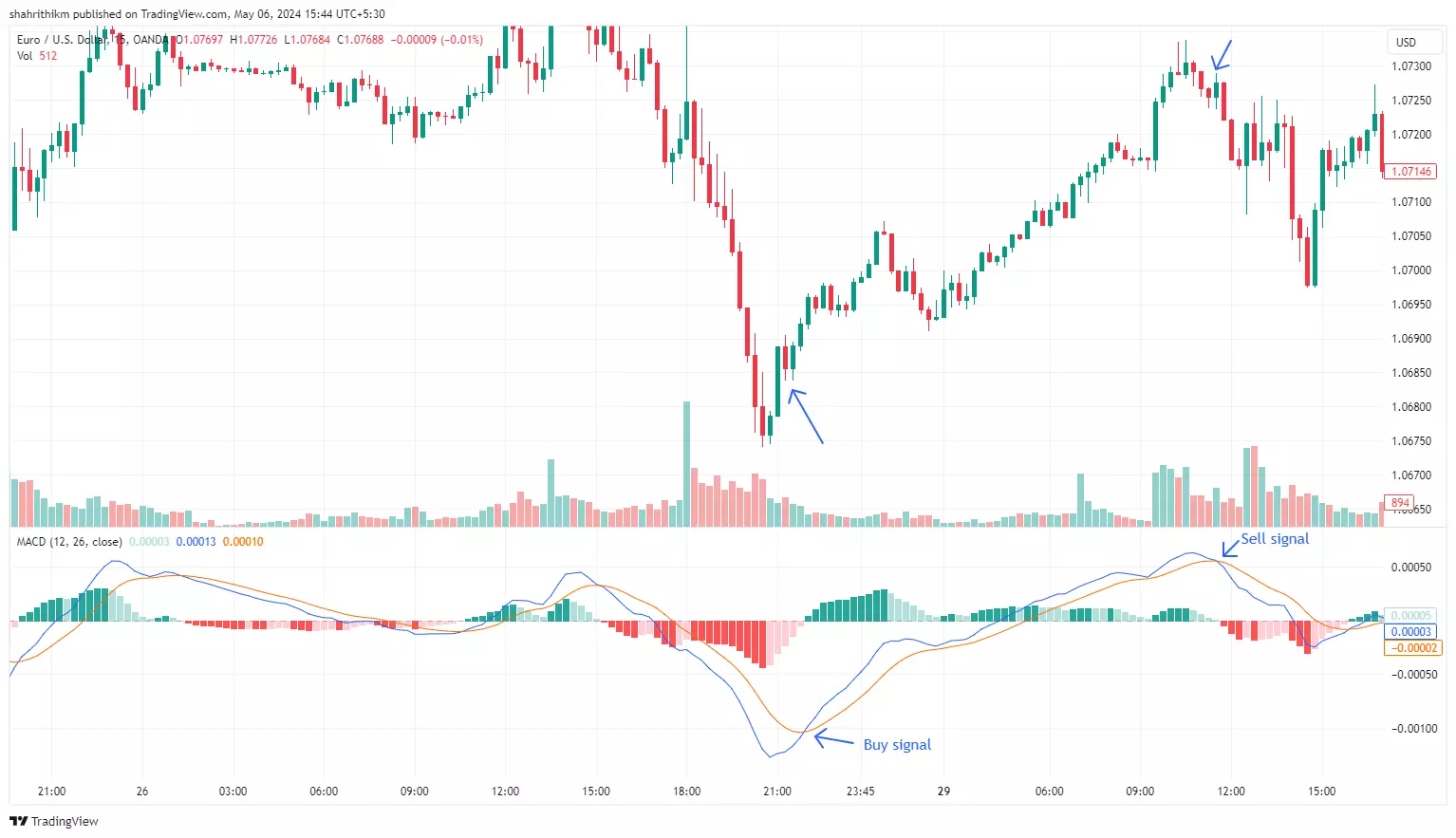 MACD Indicator strategy
Let’s use another indicator - Bollinger Bands. In this Forex trading instance, we applied the Bollinger Bands indicator to spot potential buying and selling opportunities on the EUR/USD chart. Bollinger Bands are tools used in technical analysis that show how much the market might move and where it could change direction.
The strategy is straightforward - we bought when the price fell below the lower Bollinger Band, suggesting the market might be too low and could bounce back up. On the other hand, we sold when the price rose above the upper Bollinger Band, indicating the market might be too high and could turn downwards. Observing the EUR/USD chart, we entered a buy position at 1.0687 when the price went under the lower Bollinger Band, signaling a buying opportunity. As the price continued to rise, it hit the upper Bollinger Band near 1.0699, signaling a sell opportunity. We then sold at 1.0699. From buying at 1.0687 and selling at 1.0699, we earned a profit of 12 pips. If we traded with a standard lot size of 100,000 units and each pip was worth about $10 in the EUR/USD pair, our total profit would be $120.
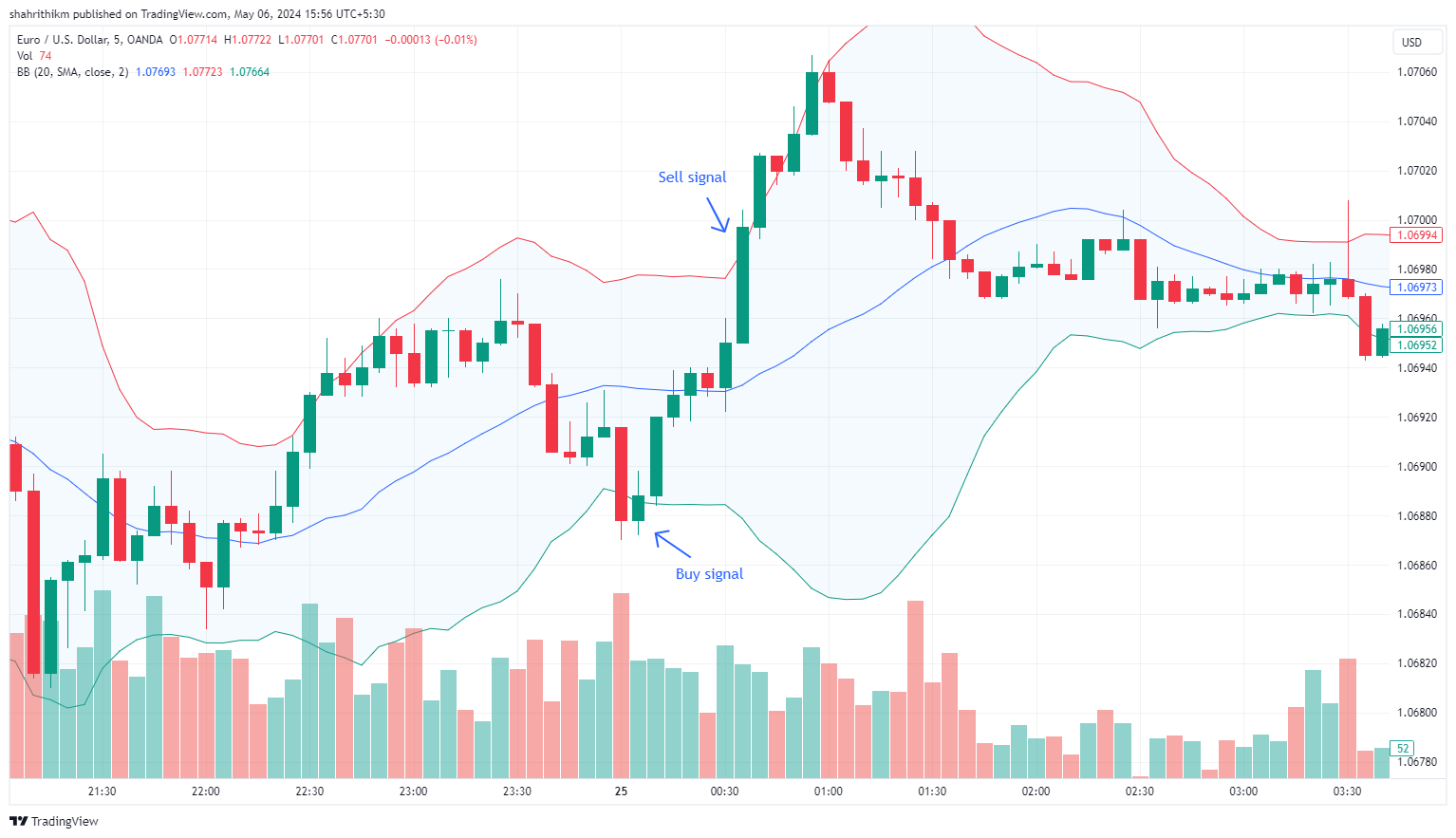 Bollinger band strategy
If you're keen on making $100 every day from Forex trading, understanding how compounding works could be your ticket to steady profits. We've put together a handy table to show you just how much you could earn monthly and yearly with different compounding rates.
| Compounding rate (%) | Daily profit ($) | Monthly profit ($) | Yearly profit ($) |
|---|---|---|---|
0% | $100 | $3,000 | $36,000 |
5% | $100 | $3,122 | $37,464 |
10% | $100 | $3,264 | $39,168 |
15% | $100 | $3,429 | $41,148 |
20% | $100 | $3,618 | $43,416 |
How much can you make day trading?
According to Glassdoor, Forex traders typically earn around $154,000 each year, which equals about $12,800 monthly. However, only a small percentage, about 1-1.6%, of day traders make profits that exceed their expenses. In contrast, nearly all, around 98-99%, of day traders end up losing money.
Zipia reports that the average yearly salary for a day trader in the United States is approximately $116,895, or around $56 per hour, with salaries ranging from $68,000 to $198,000 yearly. Comparably provides even higher estimates, stating that traders earn about $230,000 per year, including bonuses, or over $19,000 monthly. Bonuses are significant, often constituting about 75% of the trader's salary, and all traders typically receive bonuses annually.
Top traders can earn several times more than the average, with some reaching up to $163,000 per year, as found by Indeed.com. Moving to financial hubs like New York City can increase a trader's income by 50%, according to talent.com. Conversely, being located outside such areas can lower earnings, with traders outside the U.S. earning nearly $90,000 yearly, as per CryptoJobList.
Specialists in quantitative strategies, which involve financial markets, statistics, and mathematical modeling, have particularly high earning potential, as noted by ZipRecruiter. On average, traders in the U.S. earn around $13,000 monthly, which is 2.8 times higher than the average salary of $4,650 per month in 2023, indicating the demanding nature of trading in global financial markets.
Is it possible to get rich day trading?
Yes, it's possible to become wealthy through day trading, but most people who try end up failing. The key to success is overcoming the big challenges that cause many day traders to lose money.
Here are some of the main obstacles:
High market risk
Day trading means constantly buying and selling in short time periods, which exposes you to big market movements. Even a small price change can make you lose a lot of money.
Leverage effect
Lots of day traders use leverage, which makes both profits and losses bigger. This can make you rich faster, but it can also lead to serious financial problems.
Gambling mentality
If you approach day trading without a clear plan and control over your emotions, it can feel like gambling. Making decisions based on fear, greed, or impulse can quickly make you lose your money.
Lack of business plan and tested strategy
Successful day traders treat trading like any other business, with a solid plan and a strategy that's been proven to work well in different market situations.
Although getting rich from day trading is really hard, some people have done it. If you're thinking about trying it, it's important to know the risks and be very disciplined and careful.
How much can I make day trading starting with $500?
Starting with $500, your potential earnings from day trading depend on various factors such as your trading strategy, risk management, market conditions, and the assets you trade. Generally, with a smaller initial capital, it's crucial to manage risk carefully to avoid significant losses. While it's possible to make profits, aiming for a specific daily income like $100 might not be realistic or sustainable, especially with a smaller account size. It's important to focus on consistent growth and risk management rather than targeting a fixed daily profit.
How not to fail earning 100 dollars a day in Forex?
To avoid failure and successfully earn $100 a day in Forex, TU expert Ivan Andriyenko recommends following a step-by-step plan. Here's a comprehensive guide to help you achieve this goal:
Step 1: Education and training
Start by learning the basics of Forex trading. Understand things like analyzing the market, using technical tools, and managing risks. Practice on a demo account before using real money. This helps you learn without risking your cash.
Step 2: Choosing a broker
Pick a good broker, especially if you're new. Look for one with good conditions for trading, reliable support, and an easy-to-use platform. Here are some suggested brokers for beginners:
| zForex | Plus500 | OANDA | Trading.com USA | FOREX.com | |
|---|---|---|---|---|---|
|
Min. deposit, $ |
10 | 100 | No | 50 | 100 |
|
Tradable assets |
80 | 2800 | 129 | 69 | 5500 |
|
Standard EUR/USD spread |
0.3 | 0.7 | 0.3 | 1.1 | 1.0 |
|
Max. leverage |
1:1000 | 1:300 | 1:200 | 1:50 | 1:50 |
|
Max. Regulation Level |
Not regulated | Tier-1 | Tier-1 | Tier-1 | Tier-1 |
|
TU overall score |
8.05 | 7.57 | 6.89 | 6.15 | 6.87 |
|
Open an account |
Go to broker Your capital is at risk.
|
Go to broker 80% of retail CFD accounts lose money. |
Go to broker Your capital is at risk. |
Go to broker Your capital is at risk. |
Study review |
Step 3: Developing a trading strategy
Create and test your strategy using past data. Make sure it works well and helps you make money.
Choose a strategy that fits your style of trading and how you think. This helps you avoid making bad decisions because of your emotions.
Step 4: Risk management
Determine the percentage of your trading capital you're comfortable risking on each trade. It's generally advised not to risk more than 1-2% of your account per trade for a sustainable trading approach.
As an expert in this field, I believe that consistency is crucial for success in Forex trading. Remain disciplined and avoid impulsive decisions driven by emotions. Adhere to your strategy and adjust it as necessary based on market conditions.
Treat trading like a business, not a daily paycheck

From my experience, the goal of making $100 a day should not be treated as a fixed target – it should be viewed as a byproduct of a well-built trading process. When traders focus too much on the dollar amount, they often force trades, increase position size unnecessarily, or abandon their plan just to “hit the number.” That mindset usually leads to inconsistency.
If you want to aim for a daily income goal, I recommend first defining performance metrics you can control – such as risk per trade, win/loss ratio, and execution discipline. Once those variables are stable, profitability tends to follow naturally. In my view, it’s far more sustainable to target percentage-based growth rather than a fixed cash outcome, especially if your account size changes over time.
I also strongly advise traders to evaluate whether their capital realistically supports a $100 daily objective without excessive leverage. If reaching that amount requires overexposing your account, the risk profile becomes dangerous. Sustainable trading is about protecting capital first – income comes second.
My recommendation is simple: Treat trading like a business, not a daily paycheck. Track performance weekly or monthly, refine your edge gradually, and prioritize consistency over speed. Traders who survive long enough to compound their results are the ones who eventually reach – and exceed – daily profit targets.
Conclusion
Consistently earning $100 a day in Forex trading is a realistic goal for disciplined traders who implement solid risk management and proven strategies. By focusing on setups with high probability and tightly controlling losses, even those with modest capital can gradually scale their results. For example, leveraging tested technical indicators or employing strict stop-loss practices can significantly improve daily returns while minimizing downside risk. Ultimately, the fusion of knowledge, discipline, and patience stands as the true formula for trading success—reminding us that in the world of Forex, sustainable gains favor the well-prepared over the merely lucky.
FAQs
What are the main psychological challenges faced when trying to make $100 a day in trading?
How do different market conditions affect the feasibility of earning $100 daily in trading?
Why is it important to focus on percentage-based growth rather than fixed dollar targets in trading?
What role does ongoing education play in achieving reliable trading income?
Editors' Top Picks and Insights

Is Bitcoin right for you? Five traits shared by many cryptocurrency holders

Chasing hits: Why investors are losing interest in Netflix

Tokenized stocks in the spotlight: How do they work and are they worth trading?

Do politicians make the best stock traders?

Crypto test drive: How automakers are exploring digital assets

Lindsey Graham death: U.S. senator’s crypto legacy
Related Articles
Team that worked on the article
Parshwa is a content expert and finance professional possessing deep knowledge of stock and options trading, technical and fundamental analysis, and equity research. As a Chartered Accountant Finalist, Parshwa also has expertise in Forex, crypto trading, and personal taxation.
Dan Blystone began his trading career in 1998 as an arbitrage clerk on the floor of the Chicago Mercantile Exchange (CME). He later traded bond and Eurex futures at proprietary firms such as Altea Trading, gaining valuable experience in high-frequency trading and risk management.
Chinmay Soni is a financial analyst with more than 5 years of experience in working with stocks, Forex, derivatives, and other assets. As a founder of a boutique research firm and an active researcher, he covers various industries and fields, providing insights backed by statistical data.
Scalping in trading is a strategy where traders aim to make quick, small profits by executing numerous short-term trades within seconds or minutes, capitalizing on minor price fluctuations.
The Stochastic Oscillator is a technical indicator used in financial analysis to gauge the momentum of a security's price and identify overbought or oversold conditions by comparing the closing price to a specified price range over a defined period.
CFD is a contract between an investor/trader and seller that demonstrates that the trader will need to pay the price difference between the current value of the asset and its value at the time of contract to the seller.
Fundamental analysis is a method or tool that investors use that seeks to determine the intrinsic value of a security by examining economic and financial factors. It considers macroeconomic factors such as the state of the economy and industry conditions.
Crypto trading involves the buying and selling of cryptocurrencies, such as Bitcoin, Ethereum, or other digital assets, with the aim of making a profit from price fluctuations.

-
 Afghanistan
-
 Albania
-
 Algeria
-
 Angola
-
 Argentina
-
 Armenia
-
 Australia
-
 Austria
-
 Azerbaijan
-
 Bahamas
-
 Bahrain
-
 Bangladesh
-
 Belarus
-
 Belgium
-
 Bolivia
-
 Botswana
-
 Brazil
-
 Brunei
-
 Bulgaria
-
 Cambodia
-
 Cameroon
-
 Canada
-
 Chile
Chile
-
 China
China
-
 Colombia
-
 Congo
Congo
-
 Costa Rica
-
 Cote d'Ivoire
-
 Croatia
-
 Cuba
Cuba
-
 Cyprus
-
 Czechia
-
 DR Congo
-
 Denmark
-
 Dominican Republic
-
 Ecuador
-
 Egypt
Egypt
-
 El Salvador
-
 Estonia
-
 Eswatini
-
 Ethiopia
-
 Finland
-
 France
-
 Georgia
-
 Germany
-
 Ghana
Ghana
-
 Greece
-
 Haiti
Haiti
-
 Hong Kong
-
 Hungary
-
 India
India
-
 Indonesia
-
 Iran, Islamic republic
-
 Iraq
Iraq
-
 Ireland
-
 Israel
-
 Italy
Italy
-
 Jamaica
-
 Japan
Japan
-
 Jordan
-
 Kazakhstan
-
 Kenya
Kenya
-
 Korea
Korea
-
 Kuwait
-
 Kyrgyzstan
-
 Laos
Laos
-
 Latvia
-
 Lebanon
-
 Lesotho
-
 Libya
Libya
-
 Lithuania
-
 Luxembourg
-
 Madagascar
-
 Malaysia
-
 Malta
Malta
-
 Mauritius
-
 Mexico
-
 Moldova
-
 Mongolia
-
 Montenegro
-
 Morocco
-
 Mozambique
-
 Myanmar
-
 Namibia
-
 Nepal
Nepal
-
 Netherlands
-
 New Zealand
-
 Nigeria
-
 North Macedonia
-
 Norway
-
 Oman
Oman
-
 Pakistan
-
 Palestine
-
 Panama
-
 Papua New Guinea
-
 Paraguay
-
 Peru
Peru
-
 Philippines
-
 Poland
-
 Portugal
-
 Puerto Rico
-
 Qatar
Qatar
-
 Reunion
-
 Romania
-
 Rwanda
-
 Saudi Arabia
-
 Serbia
-
 Singapore
-
 Slovakia
-
 Slovenia
-
 Somalia
-
 South Africa
-
 Spain
Spain
-
 Sri Lanka
-
 Sweden
-
 Switzerland
-
 Syria
Syria
-
 Taiwan
-
 Tajikistan
-
 Tanzania
-
 Thailand
-
 Trinidad and Tobago
-
 Tunisia
-
 Turkey
-
 UAE
UAE
-
 Uganda
-
 Ukraine
-
 United Kingdom
-
United States
-
 Uruguay
-
 Uzbekistan
-
 Venezuela
-
 Vietnam
-
 Yemen
Yemen
-
 Zambia
-
 Zimbabwe
- Forex
- Crypto










