
ChainGPT Launchpad Overview


Editorial Note: While we adhere to strict Editorial Integrity, this post may contain references to products from our partners. Here's an explanation for How We Make Money. None of the data and information on this webpage constitutes investment advice according to our Disclaimer.
The ChainGPT launchpad is a crypto IDO platform where users stake CGPT tokens to gain tier based access to early token sales. Allocation depends on tier level, total demand, and user engagement through the Buzz system. The launchpad focuses on open whitelist IDOs, transparent vesting, and on-chain participation.
This guide explains how the ChainGPT launchpad works from a user perspective. You will learn what ChainGPT is, how staking and tiers affect access, how open whitelist IDOs and the Buzz system work, what fees and risks to expect, and who this launchpad is best suited for in 2026.
Risk warning: Cryptocurrency markets are highly volatile, with sharp price swings and regulatory uncertainties. Research indicates that 75-90% of traders face losses. Only invest discretionary funds and consult an experienced financial advisor.
What is ChainGPT?
ChainGPT is a Web3 infrastructure platform that combines blockchain tools with AI driven analytics. ChainGPT focuses on helping users analyze crypto data, understand smart contracts, and evaluate early-stage projects more efficiently.
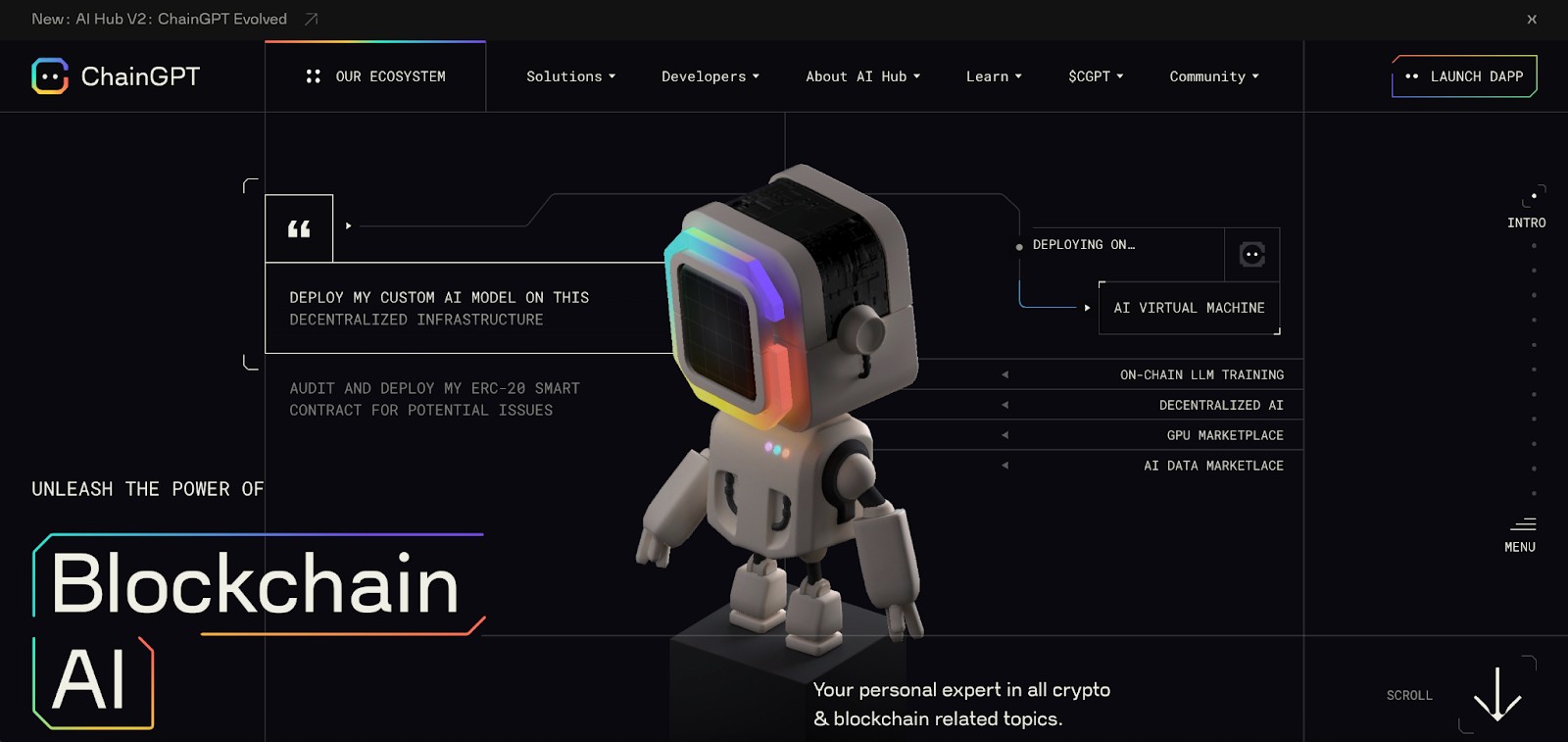
The ChainGPT crypto ecosystem includes tools for on-chain analysis, smart contract interaction, and automated insights. These products are built for traders and developers who want clearer data and better decision support, rather than speculation alone.
The launchpad is one part of this ecosystem. Because ChainGPT already serves users interested in infrastructure and long-term utility, the ChainGPT launchpad is structured around curation, staking, and tier based access instead of fast, hype driven sales.
In simple terms, ChainGPT provides the analytical and technical foundation, while ChainGPT Pad uses that foundation to host curated IDOs under clear and rule based conditions.
What is the ChainGPT Pad launchpad?
ChainGPT Pad is the official launchpad of the ChainGPT ecosystem. It is the platform where new crypto projects raise funds and distribute tokens to early users under predefined, transparent rules.
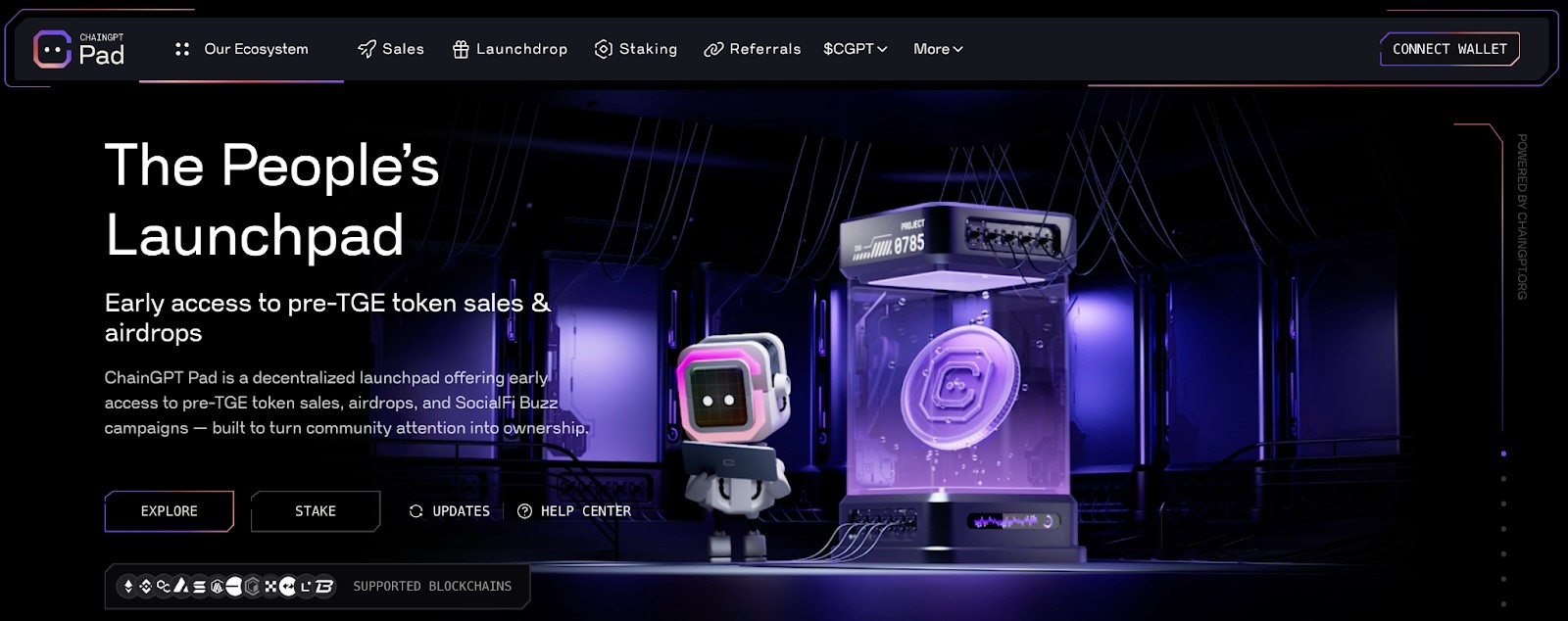
While users often use the terms interchangeably, ChainGPT Pad refers to the product itself, and ChainGPT launchpad describes the broader fundraising system around it. In practice, both point to the same experience for participants.
The platform operates in a non custodial way. Users connect their own wallets, stake CGPT tokens on-chain, and join IDOs directly through smart contracts. There is no exchange custody, no internal balances, and no off-platform settlement.
The core purpose of ChainGPT Pad is to structure early access. Instead of first come sales or random lotteries, the launchpad uses staking and tier levels to decide who can participate and how much they can allocate. This helps manage demand while giving committed users predictable access.
Key characteristics of ChainGPT Pad include:
curated project selection rather than open submissions;
tier based eligibility through CGPT staking;
open whitelist IDO participation;
clear allocation and vesting terms shown before each sale.
The platform is designed for users who want a rule-based, repeatable way to access early token launches without relying on speed or speculation alone.
How the ChainGPT launchpad works
The ChainGPT launchpad follows a structured process that stays largely the same across different IDOs. This consistency helps users plan ahead and reduces uncertainty around participation.
Project review and announcement
Projects are reviewed internally before being approved for launch. Once accepted, upcoming IDOs are announced in advance, giving users time to stake CGPT and reach the required ChainGPT Pad tiers.
Whitelist and eligibility phase
Projects are screened internally before being approved. Once accepted, details of the sale are published early so users can prepare for the upcoming ChainGPT Pad IDO whitelist by staking CGPT and meeting tier requirements.
Sale and allocation
During the sale window, eligible users commit funds. Final allocation is not fixed upfront. It depends on tier level, total demand, and, in some cases, engagement scores from the Buzz system.
Token distribution and vesting
After the sale, tokens are distributed according to the vesting schedule published before the IDO. This usually includes a partial unlock at TGE, followed by linear vesting over time.
This step-by-step flow explains why preparation matters. Users who understand the process and maintain their tier status are better positioned than those who try to join at the last moment.

ChainGPT Pad tiers and staking model
Access to the ChainGPT launchpad is built around a tier based system that relies on staking CGPT tokens. This model is designed to reward preparation and long-term participation rather than speed or one time activity.
To join an upcoming ChainGPT Pad IDO whitelist, users must stake a minimum amount of CGPT. The size of the stake determines the tier level, which then defines eligibility and allocation limits for each IDO.
How ChainGPT Pad tiers work
Each tier represents a different access level. Higher tiers usually unlock earlier access and higher allocation caps, while lower tiers may have stricter limits or delayed entry. Tier requirements are published clearly and updated in real time on the dashboard.
What tier level affects
Your ChainGPT Pad tiers status influences:
eligibility for specific IDOs;
maximum allocation size;
priority during oversubscribed sales;
access to special pools or side allocations, when available.
Why staking early matters
Tier levels are not meant to be temporary boosts. Users who stake CGPT early and maintain their tier are better positioned for repeated participation across multiple IDOs. Last-minute staking often leads to missed whitelists or reduced allocation.
In practice, the staking model turns ChainGPT Pad into a system that favors consistency. Users who treat tier management as part of their strategy tend to get more predictable results when joining any of the upcoming ChainGPT Pad IDO.
ChainGPT Pad open whitelist IDO model
Most sales on the ChainGPT launchpad follow an open whitelist structure. This means users do not compete in a lottery or race to submit transactions. Instead, access is determined by eligibility and tier status.
To join an upcoming ChainGPT Pad IDO whitelist, users must meet the minimum tier requirement before the whitelist window closes. Once qualified, they are allowed to participate in the sale, but allocation is not guaranteed upfront.
How allocation works
When an IDO attracts more demand than available supply, allocations are adjusted after the sale:
higher tiers receive priority;
lower tiers may receive reduced amounts;
final allocation is calculated proportionally.
This approach avoids first come mechanics while still controlling oversubscription.
Why this model is used
The format is designed to balance fairness and demand. It allows broad participation while preventing a small number of users from capturing most of the supply through speed or automation.
What users should expect
An open whitelist does not mean fixed results. Even after qualifying, the final amount received can change based on total participation. Understanding this helps set realistic expectations before joining any upcoming IDO on ChainGPT Pad. This model suits users who prefer structured access and are comfortable with flexible allocation rather than guaranteed amounts.
ChainGPT Pad v3 Buzz system explained
The Buzz system on ChainGPT Pad is an engagement based feature that works alongside staking and tier levels. Its role is to help rank users when demand for an IDO exceeds available allocation.
The Buzz system applies when users prepare for an upcoming IDO on ChainGPT Pad. It does not assume an active sale and does not function independently from staking.
How the Buzz system on ChainGPT Pad works
Users earn Buzz points by completing verified engagement actions linked to launchpad campaigns. These actions are defined by the platform and tracked directly on the dashboard.
What the Buzz system affects
Buzz points may be used as a secondary factor when:
multiple users qualify for the same IDO;
participants hold the same tier level;
total demand exceeds supply.
What the Buzz system does not replace
The Buzz system on ChainGPT Pad:
does not remove CGPT staking requirements;
does not guarantee allocation;
does not override tier eligibility.
In practice, the Buzz system helps fine tune allocation outcomes during oversubscribed IDOs. It rewards active participation while keeping staking and tiers as the primary access criteria.
ChainGPT Pad’s interface
ChainGPT Pad’s interface is designed to keep all IDO related actions in one place. Users do not need to switch between tools or pages to manage staking, tiers, or whitelist status.
When preparing for an upcoming ChainGPT Pad IDO, the interface clearly shows whether you meet eligibility requirements. This helps users avoid missing a whitelist due to incomplete staking or tier issues.
The dashboard typically includes:
connected wallet status;
current CGPT stake and tier level;
eligibility for upcoming IDOs;
whitelist progress and remaining steps;
allocation and vesting details after participation.
Why the interface matters
Clear visibility reduces errors. Users can track deadlines, confirm eligibility, and understand their position before and after an IDO. This is especially useful for users who plan to participate in multiple launches over time.
Although the ChainGPT launchpad is an on-chain platform, the interface is built to remain accessible. Most actions are guided, and users do not need to interact manually with smart contracts.
Overall, ChainGPT Pad’s interface supports a structured and predictable IDO experience, which aligns with the platform’s tier based access model.
Fees and opportunity cost on ChainGPT Pad
ChainGPT Pad does not charge a direct participation fee for using the launchpad. However, taking part in IDOs still involves indirect costs that users should understand before committing capital.
CGPT staking exposure
Access to the platform is based on staking CGPT tokens. While staked, CGPT remains exposed to market price movements. This means your overall outcome depends not only on IDO performance but also on how CGPT behaves during the staking period.
On-chain transaction costs
Because ChainGPT Pad operates on-chain, users pay standard network fees when staking, adjusting tiers, joining sales, and claiming tokens. These fees vary by network conditions and are not controlled by the platform.
Vesting and liquidity constraints
Most IDOs hosted on the ChainGPT launchpad include vesting schedules. Tokens often unlock gradually, which limits immediate liquidity and affects how quickly positions can be adjusted after distribution.
Capital lockup and opportunity cost
Staking CGPT and holding vested tokens ties up capital for extended periods. During this time, those funds cannot be used for other trades or investments, which is an important consideration for active traders.
In practice, the cost of using ChainGPT Pad is defined more by capital commitment and timing than by explicit platform fees. Understanding these trade-offs helps users decide how the launchpad fits into their broader trading strategy.
Risks and warnings
Using ChainGPT Pad involves higher risk than trading established crypto assets. Even with curation, outcomes are uncertain. The main risks to consider are:
Early-stage volatility. Tokens lau nched through the ChainGPT launchpad can experience sharp price swings sh ortly after listing, regardless of initial demand.
Allocation uncertainty. Meeting eligibility requirements does not guarantee a fixed allocation. Oversubscribed sales may reduce final token amounts.
Vesting limitations. Gradual unlock schedules can restrict liquidity and delay the ability to react to market changes.
CGPT price exposure. Staking CGPT means overall results are influenced by CGPT price movements, not only IDO performance.
Smart contract risk. Participation relies on on-chain execution, which carries technical and security risks even on well-reviewed platforms.
Market conditions. Broader market trends often have a stronger impact on outcomes than project fundamentals.
ChainGPT launchpad review: pros and cons
- Pros
- Cons
Curated project selection. Projects are reviewed before listing, which helps reduce exposure to low-effort or copy-paste launches.
Clear tier structure. The tiers system on ChainGPT Pad makes eligibility and allocation rules predictable.
Open whitelist access. Most IDOs use an open whitelist model instead of lotteries or first come sales.
On-chain transparency. Staking, eligibility, and vesting rules are visible and verifiable.
Engagement incentives. The Buzz system adds a non-capital based way to improve positioning in oversubscribed sales.
CGPT dependency. Access requires staking CGPT, which adds token price exposure.
No guaranteed allocation. Even eligible users may receive reduced allocations in high-demand launches.
Learning curve. On-chain participation can be challenging for users new to Web3 tools.
Vesting delays. Gradual token unlocks limit immediate liquidity.
Market sensitivity. Launch outcomes depend heavily on broader market conditions, not only platform quality.
Overall, the ChainGPT launchpad works best as part of a broader crypto strategy. It rewards preparation and consistency rather than speed or hype-driven participation.
As users explore IDOs through the ChainGPT launchpad, many also think about where they will trade, store, or rebalance tokens after distribution. A short comparison of crypto exchanges available in your region helps place the launchpad into a complete trading flow, from early access to post listing activity. This context makes it easier to plan how ChainGPT Pad fits alongside your regular exchange use without changing your core strategy.
| Coinbase | OKX | BTCC | Cryptohopper | Crypto.com | |
|---|---|---|---|---|---|
|
Min. Deposit, $ |
10 | 10 | 10 | No | 1 |
|
Coins Supported |
400+ | 600+ | 399 | 1000 | 400+ |
|
Spot Taker fee, % |
0.5 | 0.1 | 0.3 | 0 | 0.5 |
|
Spot Maker Fee, % |
0.5 | 0.08 | 0.2 | 0 | 0.25 |
|
Alerts |
Yes | Yes | No | Yes | Yes |
|
Copy trading |
No | Yes | Yes | Yes | No |
|
TU overall score |
8.5 | 8.46 | 8.08 | 7.8 | 7.76 |
|
Open an account |
Go to broker Your capital is at risk. |
Go to broker Your capital is at risk. |
Go to broker Your capital is at risk.
|
Go to broker Your capital is at risk. |
Go to broker Your capital is at risk. |
Structured preparation beats reactive participation

From my perspective as someone who reviews IDO platforms regularly, the ChainGPT launchpad stands out for how clearly it separates preparation from participation. Instead of encouraging users to rush into individual launches, it pushes them to think in terms of tiers, staking duration, and repeated access. This changes behavior in a positive way. Users who maintain their CGPT position and understand how allocation scales tend to approach IDOs more calmly and make better decisions.
I also see value in how the platform combines staking with engagement. The Buzz system does not overpower the tier model, which keeps capital commitment as the main filter while still rewarding active users. That balance reduces randomness without creating unrealistic expectations. For traders who are willing to plan ahead and accept vesting and volatility as part of early access, ChainGPT Pad offers a structured and disciplined way to approach IDOs rather than a shortcut to fast returns.
Conclusion
In conclusion, the ChainGPT Launchpad has established itself as a comprehensive platform for navigating token launches, combining CGPT staking, tiered participation, and innovative features like the Buzz system. Its open whitelist IDOs and transparent fee structure offer flexibility and accessibility to both seasoned investors and newcomers. However, potential users should remain vigilant about associated risks, such as market volatility and project quality, before committing funds. Ultimately, ChainGPT empowers users with tools and opportunities to participate in early-stage crypto projects, making due diligence and active engagement the real keys to success.
FAQs
How does project selection work on the ChainGPT Launchpad?
What risks should users consider before using the ChainGPT Launchpad?
How does the open whitelist model differ from lottery or first-come sales on ChainGPT Launchpad?
Why is maintaining tier status important for repeated IDO participation on ChainGPT Pad?
Editors' Top Picks and Insights






Related Articles
Team that worked on the article
Aleksandra Chaikina has been a contributor to Traders Union since 2021. With over 15 years of experience in copywriting and more than 5 years focused on financial content, she specializes in producing detailed guides, analytics, and comparative reviews across various sectors, including cryptocurrencies, Forex, investment strategies, and financial technologies.
Dan Blystone began his trading career in 1998 as an arbitrage clerk on the floor of the Chicago Mercantile Exchange (CME). He later traded bond and Eurex futures at proprietary firms such as Altea Trading, gaining valuable experience in high-frequency trading and risk management.
Chinmay Soni is a financial analyst with more than 5 years of experience in working with stocks, Forex, derivatives, and other assets. As a founder of a boutique research firm and an active researcher, he covers various industries and fields, providing insights backed by statistical data.
Bitcoin is a decentralized digital cryptocurrency that was created in 2009 by an anonymous individual or group using the pseudonym Satoshi Nakamoto. It operates on a technology called blockchain, which is a distributed ledger that records all transactions across a network of computers.
Cryptocurrency is a type of digital or virtual currency that relies on cryptography for security. Unlike traditional currencies issued by governments (fiat currencies), cryptocurrencies operate on decentralized networks, typically based on blockchain technology.
Risk management is a risk management model that involves controlling potential losses while maximizing profits. The main risk management tools are stop loss, take profit, calculation of position volume taking into account leverage and pip value.
Volatility refers to the degree of variation or fluctuation in the price or value of a financial asset, such as stocks, bonds, or cryptocurrencies, over a period of time. Higher volatility indicates that an asset's price is experiencing more significant and rapid price swings, while lower volatility suggests relatively stable and gradual price movements.
Copy trading is an investing tactic where traders replicate the trading strategies of more experienced traders, automatically mirroring their trades in their own accounts to potentially achieve similar results.

-
 Afghanistan
-
 Albania
-
 Algeria
-
 Angola
-
 Argentina
-
 Armenia
-
 Australia
-
 Austria
-
 Azerbaijan
-
 Bahamas
-
 Bahrain
-
 Bangladesh
-
 Belarus
-
 Belgium
-
 Bolivia
-
 Botswana
-
 Brazil
-
 Brunei
-
 Bulgaria
-
 Cambodia
-
 Cameroon
-
 Canada
-
 Chile
Chile
-
 China
China
-
 Colombia
-
 Congo
Congo
-
 Costa Rica
-
 Cote d'Ivoire
-
 Croatia
-
 Cuba
Cuba
-
 Cyprus
-
 Czechia
-
 DR Congo
-
 Denmark
-
 Dominican Republic
-
 Ecuador
-
 Egypt
Egypt
-
 El Salvador
-
 Estonia
-
 Eswatini
-
 Ethiopia
-
 Finland
-
 France
-
 Georgia
-
 Germany
-
 Ghana
Ghana
-
 Greece
-
 Haiti
Haiti
-
 Hong Kong
-
 Hungary
-
 India
India
-
 Indonesia
-
 Iran, Islamic republic
-
 Iraq
Iraq
-
 Ireland
-
 Israel
-
 Italy
Italy
-
 Jamaica
-
 Japan
Japan
-
 Jordan
-
 Kazakhstan
-
 Kenya
Kenya
-
 Korea
Korea
-
 Kuwait
-
 Kyrgyzstan
-
 Laos
Laos
-
 Latvia
-
 Lebanon
-
 Lesotho
-
 Libya
Libya
-
 Lithuania
-
 Luxembourg
-
 Madagascar
-
 Malaysia
-
 Malta
Malta
-
 Mauritius
-
 Mexico
-
 Moldova
-
 Mongolia
-
 Montenegro
-
 Morocco
-
 Mozambique
-
 Myanmar
-
 Namibia
-
 Nepal
Nepal
-
 Netherlands
-
 New Zealand
-
 Nigeria
-
 North Macedonia
-
 Norway
-
 Oman
Oman
-
 Pakistan
-
 Palestine
-
 Panama
-
 Papua New Guinea
-
 Paraguay
-
 Peru
Peru
-
 Philippines
-
 Poland
-
 Portugal
-
 Puerto Rico
-
 Qatar
Qatar
-
 Reunion
-
 Romania
-
 Rwanda
-
 Saudi Arabia
-
 Serbia
-
 Singapore
-
 Slovakia
-
 Slovenia
-
 Somalia
-
 South Africa
-
 Spain
Spain
-
 Sri Lanka
-
 Sweden
-
 Switzerland
-
 Syria
Syria
-
 Taiwan
-
 Tajikistan
-
 Tanzania
-
 Thailand
-
 Trinidad and Tobago
-
 Tunisia
-
 Turkey
-
 UAE
UAE
-
 Uganda
-
 Ukraine
-
 United Kingdom
-
United States
-
 Uruguay
-
 Uzbekistan
-
 Venezuela
-
 Vietnam
-
 Yemen
Yemen
-
 Zambia
-
 Zimbabwe
- Forex
- Crypto










- What is ChainGPT?
- How the ChainGPT launchpad works
- ChainGPT Pad tiers and staking model
- ChainGPT Pad open whitelist IDO model
- ChainGPT Pad v3 Buzz system explained
- ChainGPT Pad’s interface
- Fees and opportunity cost on ChainGPT Pad
- Risks and warnings
- ChainGPT launchpad review: pros and cons
- Expert opinion
- Conclusion
- FAQs


