
BenPay Review: All-in-One Web3 App For DeFi, Wallet, And Payments


Editorial Note: While we adhere to strict Editorial Integrity, this post may contain references to products from our partners. Here's an explanation for How We Make Money. None of the data and information on this webpage constitutes investment advice according to our Disclaimer.
BenPay is a non-custodial Web3 application. It is best suited for users who want to manage DeFi earning, self-custody, and crypto payments within a single mobile app. It combines a non-custodial wallet, multi-chain yield access, staking, and a crypto card with high spending limits.
Decentralized finance tools often require users to manage separate wallets, bridges, staking platforms, and payment solutions. This fragmentation increases complexity and operational risk, especially for users who interact across multiple blockchains.
BenPay enters this space as an all-in-one Web3 application that combines asset control, DeFi access, and real-world spending functionality. This review examines how well BenPay integrates these components, where it simplifies crypto usage, and what trade-offs users should consider before relying on it as a primary Web3 finance app.
What is BenPay and how it works
BenPay is a non-custodial Web3 application that brings together a crypto wallet, decentralized finance access, staking, and payment functionality within a single mobile platform. In simple terms, BenPay is designed to help users manage, earn, and spend crypto assets without handing control over to a centralized provider.
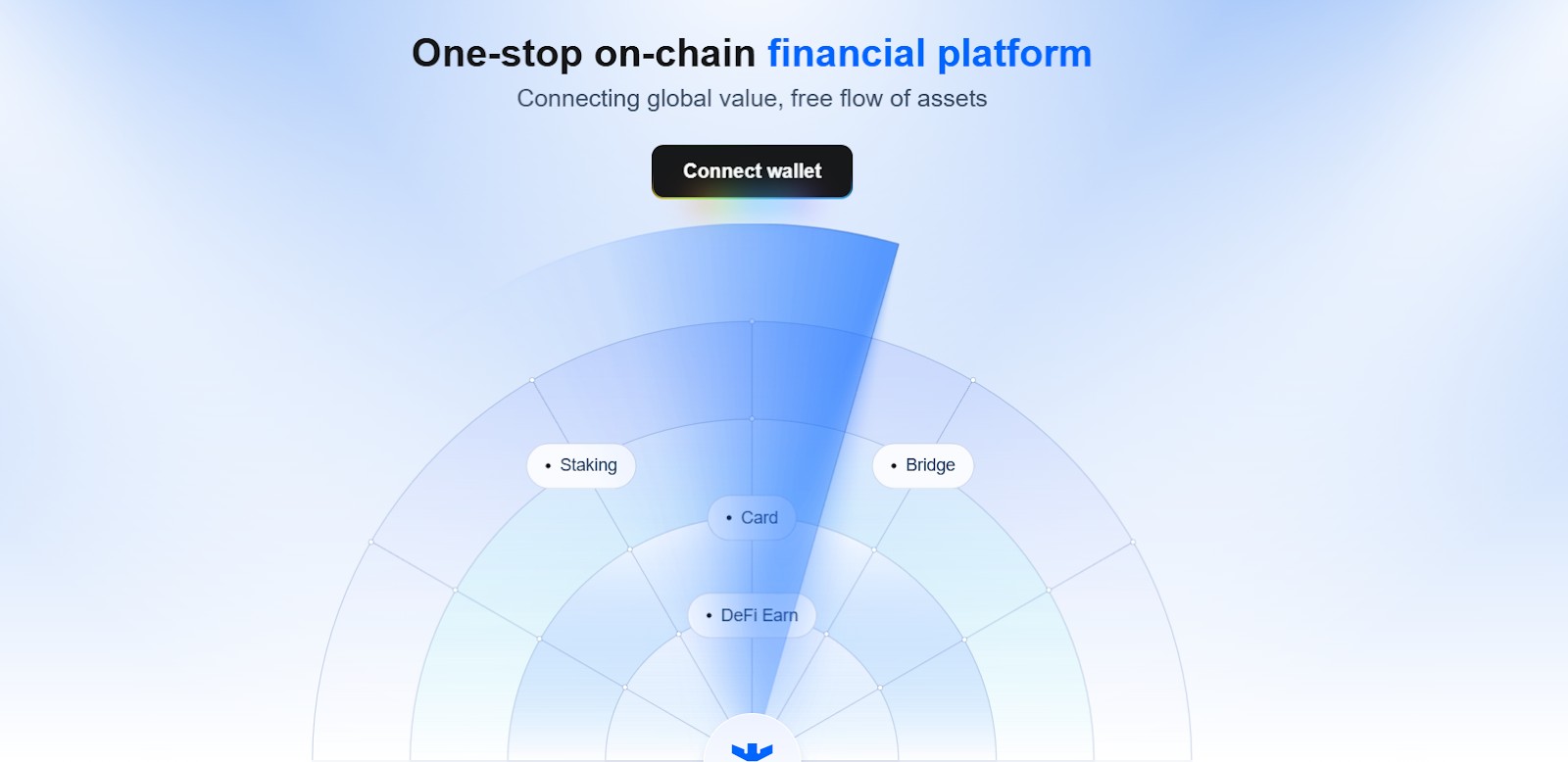
At the core of the platform is a self-custodial wallet. Users retain full ownership of their private keys, and BenPay does not hold or control funds on their behalf. Every transaction, whether it involves DeFi participation, asset transfers, or card spending, requires direct authorization from the user’s wallet.
BenPay functions as an access layer rather than a financial intermediary. It connects users to decentralized protocols and blockchain networks while presenting those interactions through a unified interface. This allows users to move assets across chains, allocate funds to DeFi strategies, or stake tokens without switching between multiple apps or external wallets.
The app supports more than 100 tokens across several blockchain networks. While this design improves convenience, it also means responsibility remains with the user. Security, transaction approvals, and risk decisions are handled at the wallet level, which aligns with Web3 principles but requires a basic understanding of self-custody.
BenPay DeFi Earn
To evaluate BenPay based on DeFi Earn, the key question is not how many protocols are supported, but how effectively the app simplifies access without removing user control. BenPay acts as a DeFi aggregator, allowing users to deploy assets across multiple decentralized protocols through a single interface instead of managing each protocol separately.
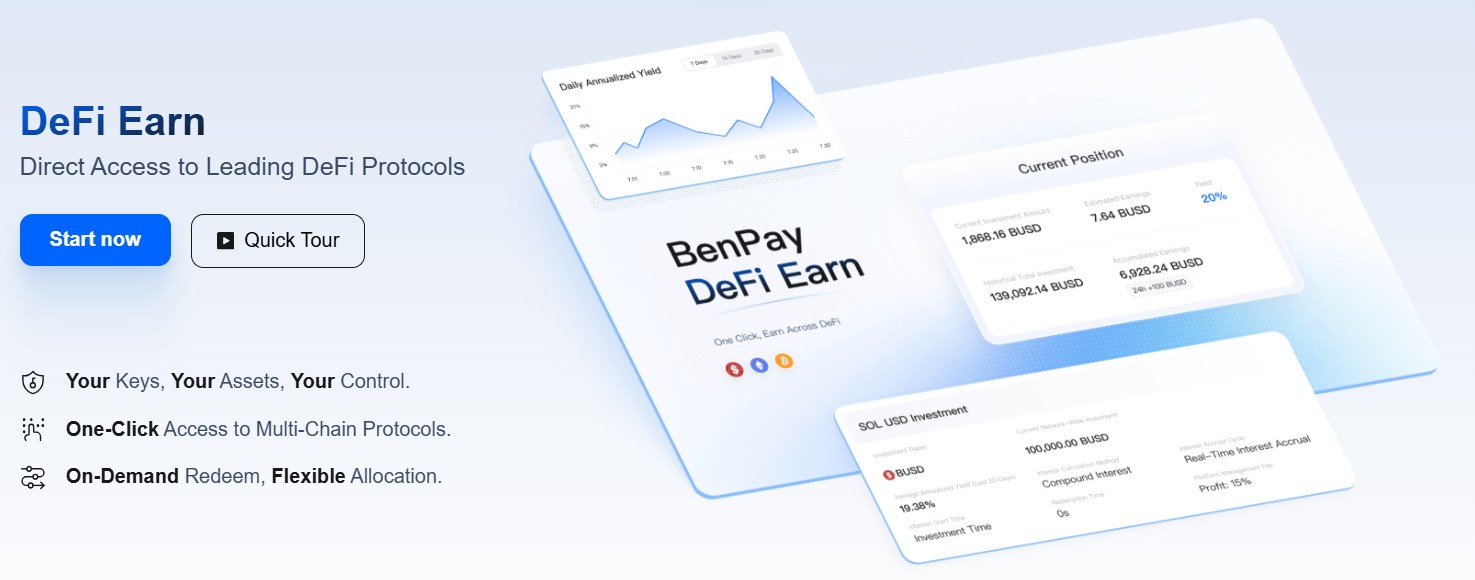
From a usability standpoint, the strongest advantage is automation. BenPay removes the need to manually bridge assets, connect wallets, or interact with complex smart contract interfaces. Funds can be allocated across supported networks with minimal setup, which lowers the barrier for users who want exposure to DeFi yields but lack technical experience.
Risk management, however, remains largely user-driven. BenPay does not eliminate protocol-level risk, smart contract risk, or market volatility. While the app streamlines execution, yields still depend on the underlying DeFi protocols and prevailing market conditions. There are no guaranteed returns, and performance can vary significantly across chains and strategies.
Overall, when users evaluate BenPay on DeFi Earn, the feature works best as a convenience layer rather than a yield optimizer. It is well suited for users who value ease of access and diversified deployment over manual fine-tuning of DeFi strategies. More advanced users may still prefer direct protocol interaction for granular control, but BenPay offers a practical entry point for managed DeFi exposure.
BenPay self-custodial Web3 wallet
To evaluate BenPay on a self-custodial Web3 wallet, the main factor to consider is control. BenPay follows a non-custodial model, meaning users retain ownership of their private keys and authorize every transaction themselves. The platform does not store funds, recover keys, or act on behalf of the user, which aligns with core Web3 security principles.
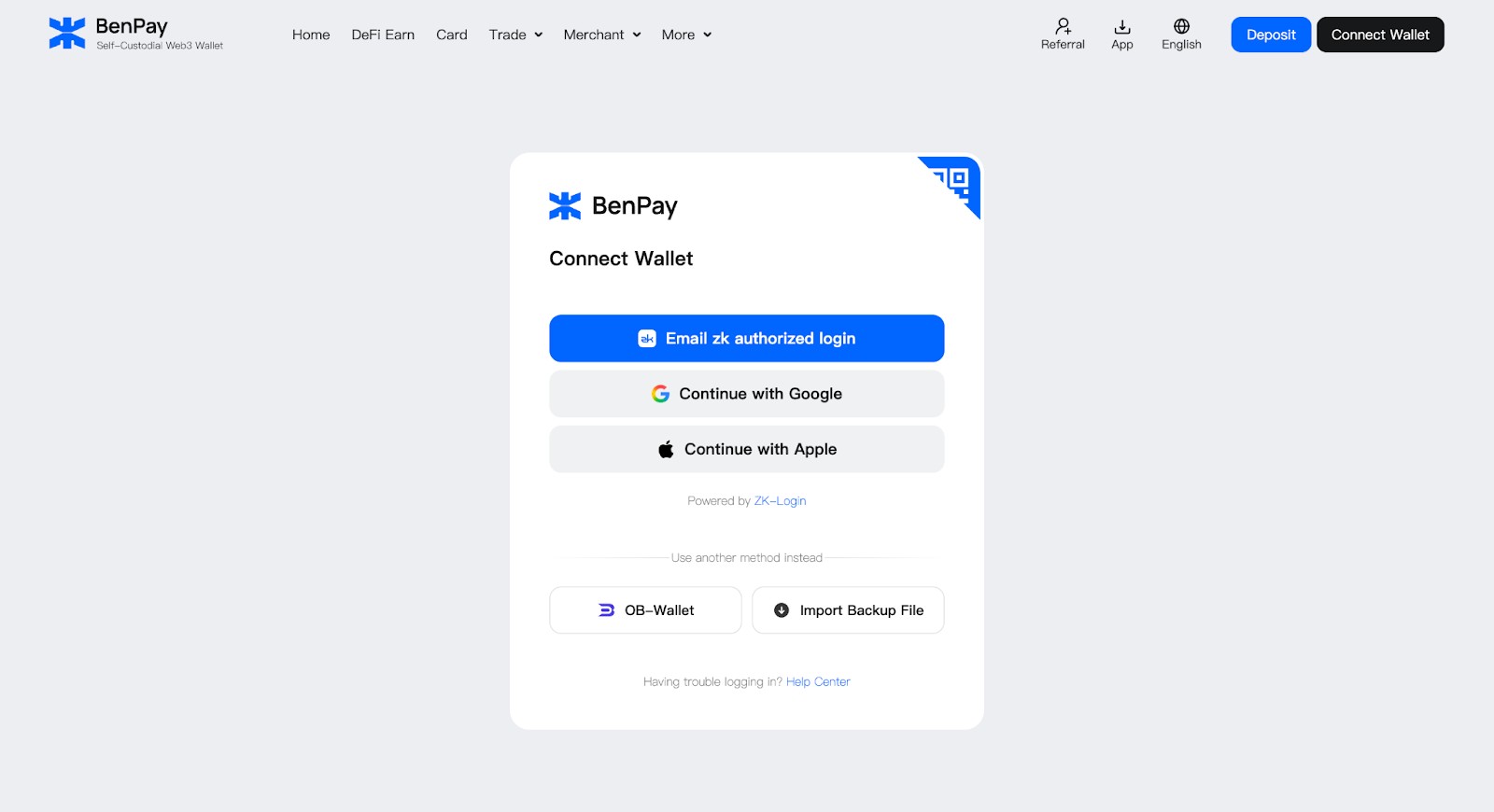
From a usability perspective, BenPay strikes a balance between autonomy and accessibility. Wallet functions such as sending assets, approving DeFi transactions, or authorizing card spending are integrated into a single interface. This reduces friction compared to managing separate wallets and dApps, while still preserving user-level control over assets.
The trade-off is responsibility. Because the wallet is fully self-custodial, users are solely responsible for key management, backups, and transaction approvals. There is no account recovery mechanism if access credentials are lost. This makes BenPay suitable for users who understand the basics of self-custody, but potentially risky for those unfamiliar with wallet security practices.
Overall, when users evaluate BenPay on a self-custodial Web3 wallet, it performs well as a consolidated access point for Web3 activity. It does not simplify security at the cost of control, but it also does not shield users from the inherent responsibilities of managing their own crypto assets.
BenPay card review
The BenPay card is designed to bridge on-chain assets with everyday spending, allowing users to pay directly from their self-custodial wallet. Unlike many crypto cards tied to custodial accounts, BenPay authorizes payments at the wallet level, which preserves user control over funds until a transaction is approved.
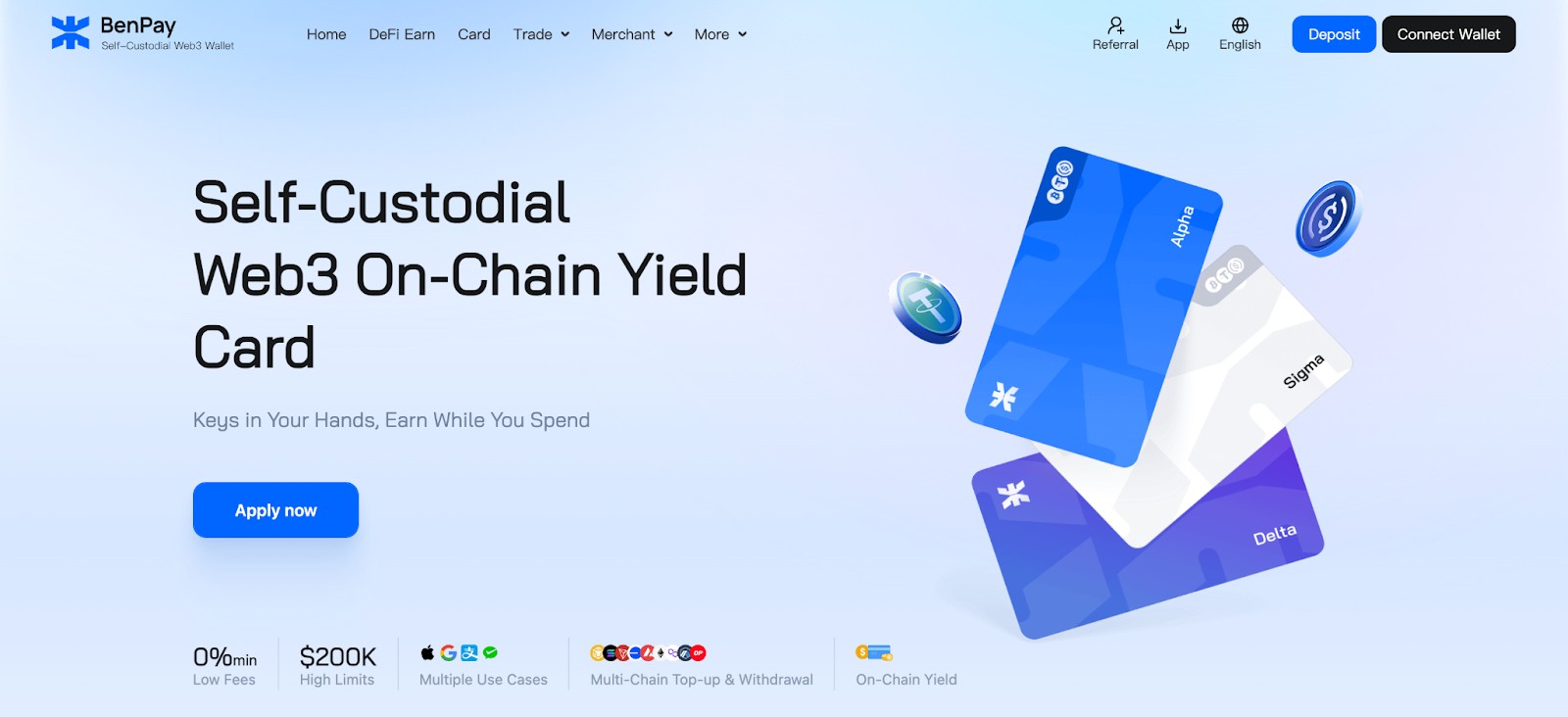
From a usability standpoint, the card works well for users who frequently move between crypto and fiat. Payments are converted instantly at the point of sale, and the card can be used online, in physical stores, or for recurring subscriptions. Compatibility with Apple Pay and Google Pay further improves practicality for daily use.
When evaluating limits and fees, the card stands out for its high ceiling. A spending limit of up to $200,000 makes it suitable for large transactions or frequent usage, while the absence of monthly maintenance fees reduces friction for long-term use. These factors differentiate the BenPay card from many competitors that impose lower caps or recurring charges.
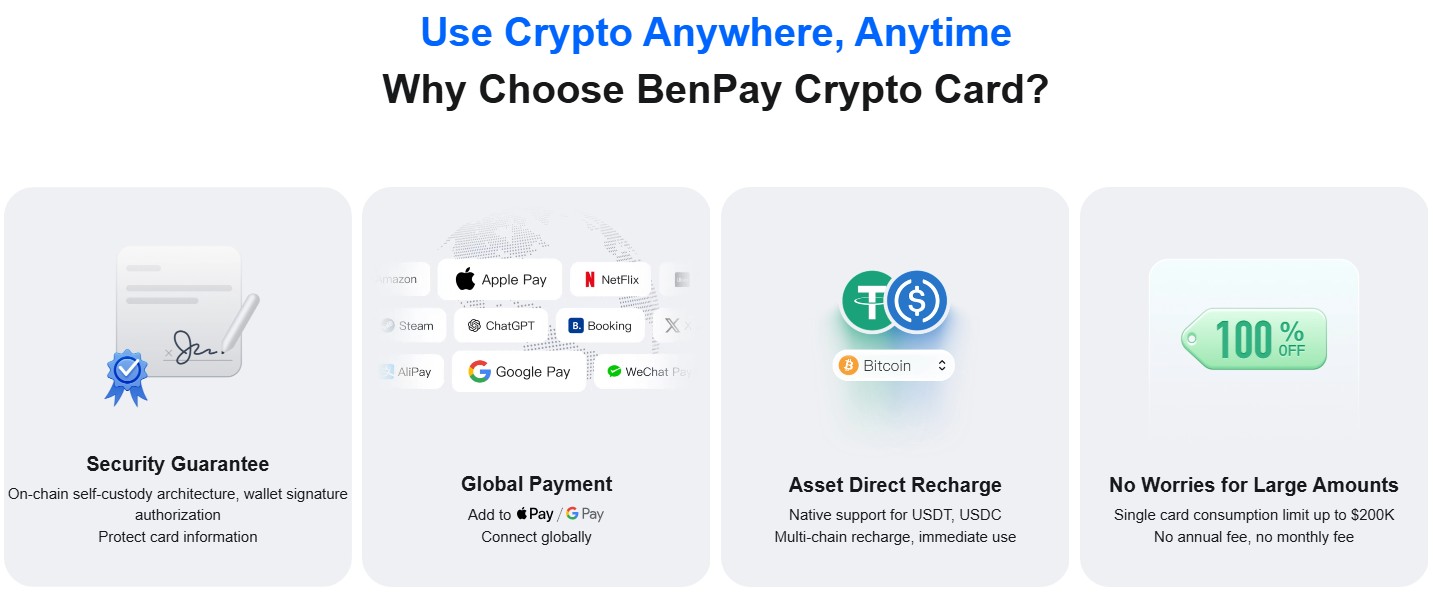
In a broader review of the BenPay card, the main consideration is volatility management. Since spending draws from crypto balances, users must be mindful of market conditions and conversion timing. For those who regularly realize gains or prefer to spend crypto without routing funds through centralized exchanges, the BenPay card offers a flexible and transparent payment solution.
Cross-chain bridge and staking
BenPay’s cross-chain bridge is designed to reduce friction when moving assets between blockchains. Instead of relying on centralized transfers, the bridge connects supported networks directly, allowing users to route liquidity without leaving the app. This is particularly useful for users who actively deploy assets across ecosystems rather than keeping funds on a single chain.
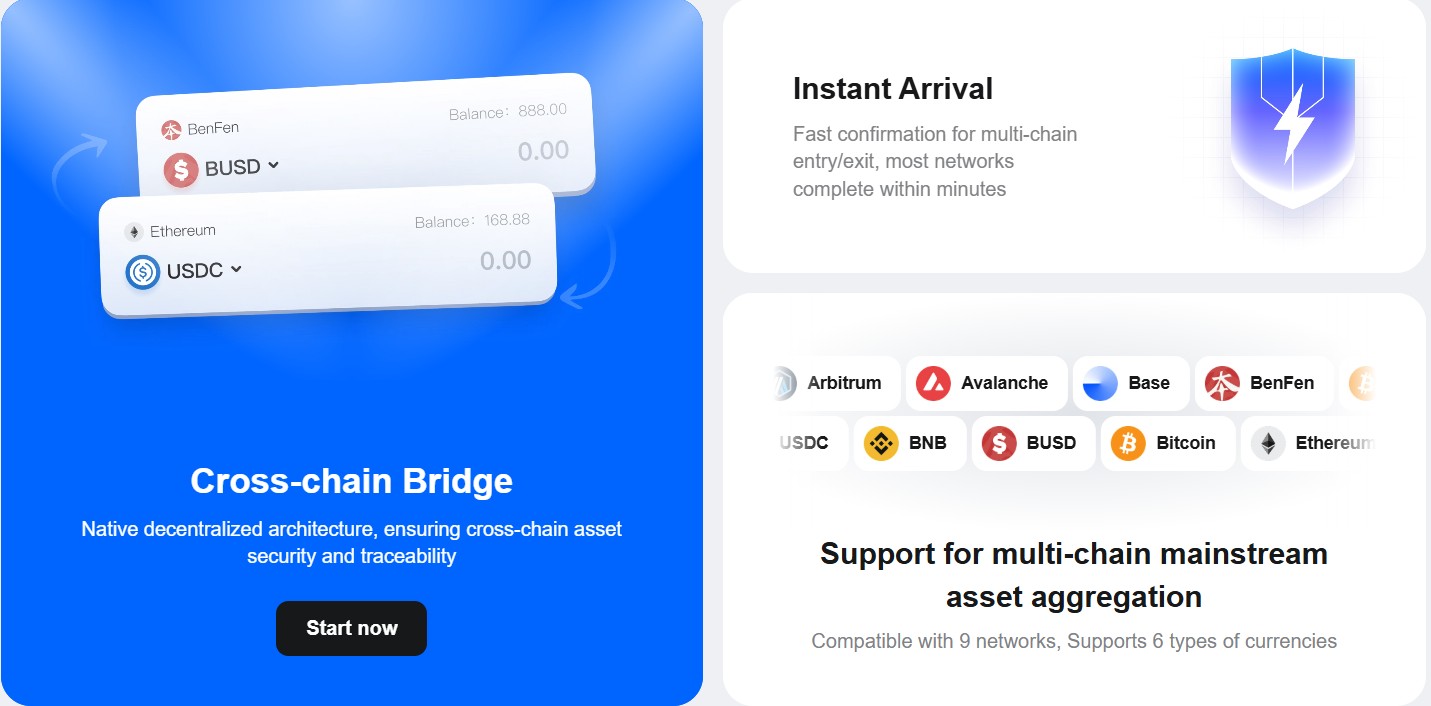
From a practical standpoint, the bridge supports multiple major networks, which simplifies portfolio rebalancing and DeFi participation. Transactions are initiated and approved through the self-custodial wallet, maintaining user control throughout the process. However, as with any cross-chain activity, users remain exposed to network congestion, bridge latency, and smart contract risk, which are not eliminated by the interface.
Staking within BenPay focuses on accessibility rather than complexity. Users can stake supported tokens directly from the wallet, view real-time yield metrics, and withdraw without fixed lock-up periods. This flexibility makes staking more approachable for users who want yield exposure without committing funds long term.
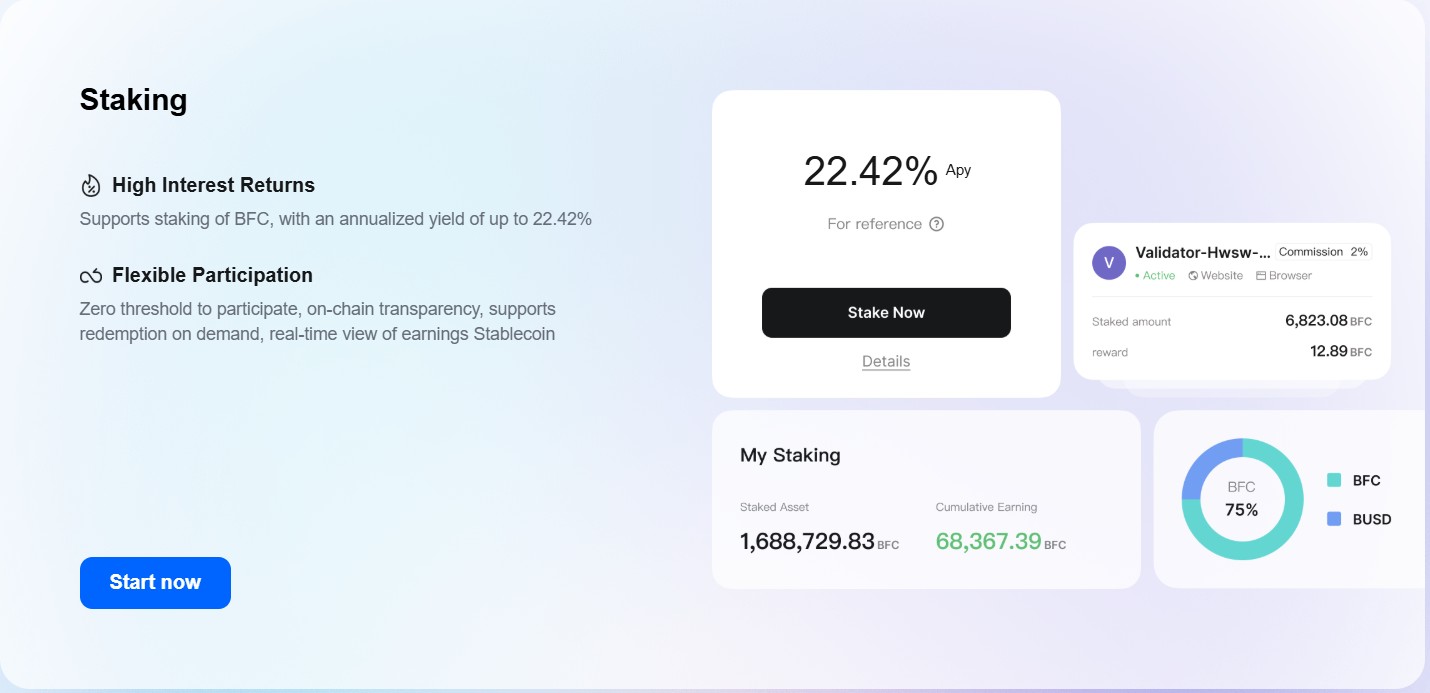
Overall, the bridge and staking features complement BenPay’s broader goal of consolidation. They do not introduce new mechanics to Web3, but they significantly reduce the operational effort required to move assets and earn yield across chains, which is where most of the value lies for everyday users.
BenPay app experience and user interface
The BenPay mobile app serves as the central control point for all wallet, DeFi, staking, bridge, and card functions. Its main strength lies in consolidation. Users do not need to connect external wallets, switch between dApps, or manage multiple interfaces to complete common Web3 actions.
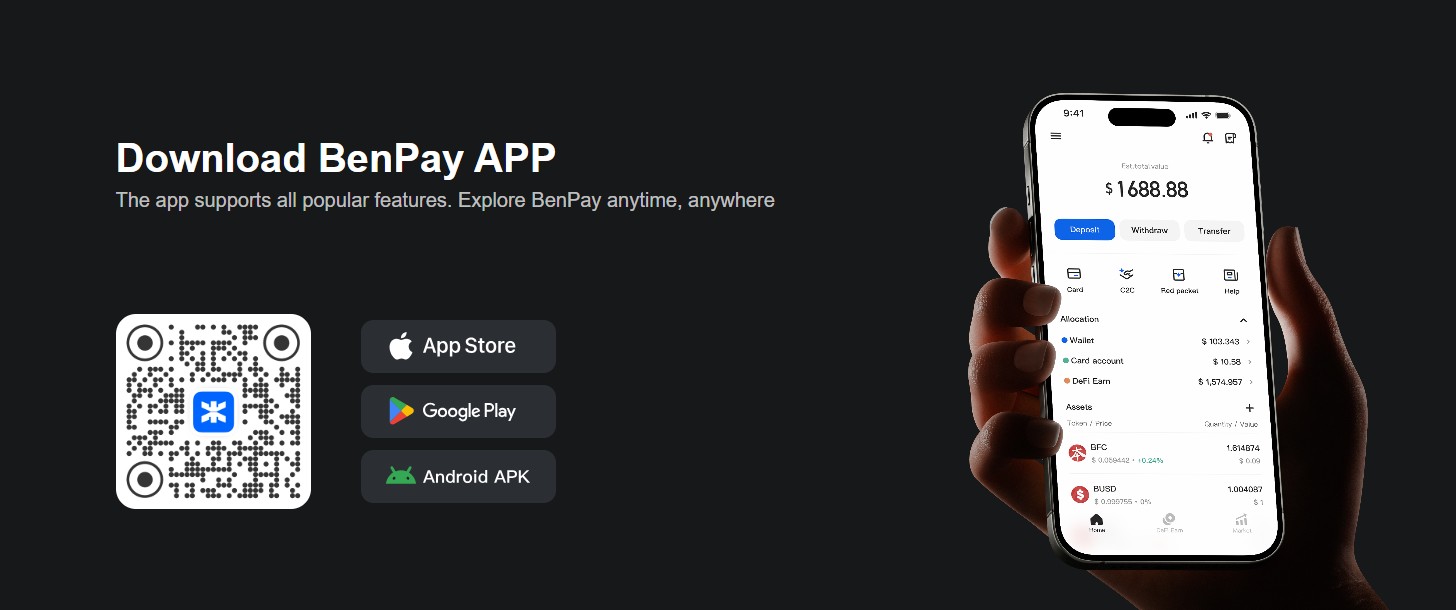
Navigation is structured around core activities such as asset management, earning, transfers, and spending. Most actions can be completed within a few steps, which reduces friction for users who are new to DeFi or cross-chain transactions. Security actions, including transaction approvals, are clearly separated from browsing or monitoring features, helping prevent accidental execution.
Login options such as mnemonic-based access and modern authentication methods support both experienced users and those transitioning from more traditional apps. However, as with any self-custodial setup, usability depends on how well users manage backups and credentials outside the app.
From a performance perspective, the app prioritizes stability over visual complexity. It does not attempt to gamify DeFi interactions or overwhelm users with analytics. Instead, it focuses on making core actions reliable and repeatable, which aligns well with BenPay’s positioning as a practical, all-in-one Web3 tool.
Is BenPay legit?
Yes. BenPay operates under a U.S.-registered entity and holds a Money Services Business license issued by FinCEN. This does not regulate DeFi activity itself, but it does impose compliance obligations on payment-related services and business operations.
Key compliance points include:
U.S. MSB registration. BenPay is registered as a Money Services Business with FinCEN, which requires adherence to AML and reporting standards.
Separation of custody and access. User funds remain in self-custodial wallets, meaning BenPay does not directly hold or manage customer assets.
Card-related oversight. The crypto card operates within regulated payment rails, adding accountability for transaction processing.
Operational transparency. A registered U.S. entity provides clearer legal jurisdiction compared to offshore-only Web3 apps.
The MSB license does not guarantee investment safety or eliminate DeFi risk, but it does add a layer of operational accountability that many decentralized apps lack. For users who value a balance between self-custody and regulatory clarity, this structure offers a more transparent operating environment than fully unregistered platforms.
How BenPay compares to other platforms
When assessing all-in-one crypto platforms, it’s important to compare how each solution handles core functions like DeFi access, wallet control, payments, and cross-chain support. BenPay combines these features into a single app, aiming to reduce reliance on multiple tools. Below is a side-by-side look at how BenPay stacks up against other platforms offering similar services.
| Feature | BenPay | Crypto.com Card | Trust Wallet |
|---|---|---|---|
| DeFi Integration | Yes | No | Limited |
| Self-Custody | Full | Partial | Yes |
| Cross-Chain | 9 Networks | 2 Networks | Manual |
| Max Card Limit | $200,000 | $25,000 | N/A |
| Mobile App | Unified | Multiple Apps | Wallet only |
BenPay offers a stronger blend of DeFi access and card usability than many of its competitors.
Who should use BenPay?
BenPay is built for users who want to reduce the number of tools they use to manage crypto, while still keeping full control over their assets. It is not designed for every type of crypto user, but it fits several profiles well.
BenPay is most suitable for:
Active DeFi users. Those who regularly move assets across chains or deploy funds into yield strategies without wanting to manage multiple dApps and bridges.
Self-custody–focused users. Investors who prefer to control private keys themselves and avoid custodial wallets or centralized exchanges.
Crypto spenders. Users who want to spend crypto directly via a card with high limits and no monthly fees, without first converting assets on an exchange.
Remote professionals and freelancers. Individuals who receive crypto income and need a practical way to both manage assets and handle everyday expenses.
Intermediate Web3 users. Those who understand basic wallet security and DeFi concepts but want a more streamlined experience.
BenPay may be less suitable for:
Beginners with no self-custody experience. Users unfamiliar with private key management may find the responsibility challenging.
Highly specialized traders. Those who rely on advanced DeFi tools, custom smart contract interactions, or exchange-based features may prefer dedicated platforms.
In short, BenPay works best for users who value consolidation, autonomy, and practical usability over highly customized or experimental setups.
As users explore DeFi tools and self-custodial wallets, many also look for reliable trading venues to complement their setup. Reviewing some of the best crypto exchanges can help users choose platforms that fit their local requirements and provide easy access to buying, selling, or converting assets before moving them into a Web3 app like BenPay. This connection helps create a smoother flow between exchanges and self-managed crypto tools.
| Coinbase | OKX | BTCC | Cryptohopper | Crypto.com | |
|---|---|---|---|---|---|
|
Min. Deposit, $ |
10 | 10 | 10 | No | 1 |
|
Coins Supported |
400+ | 600+ | 399 | 1000 | 400+ |
|
Spot Taker fee, % |
0.5 | 0.1 | 0.3 | 0 | 0.5 |
|
Spot Maker Fee, % |
0.5 | 0.08 | 0.2 | 0 | 0.25 |
|
Alerts |
Yes | Yes | No | Yes | Yes |
|
Copy trading |
No | Yes | Yes | Yes | No |
|
TU overall score |
8.5 | 8.46 | 8.08 | 7.8 | 7.76 |
|
Open an account |
Go to broker Your capital is at risk. |
Go to broker Your capital is at risk. |
Go to broker Your capital is at risk.
|
Go to broker Your capital is at risk. |
Go to broker Your capital is at risk. |
Best for active users who value self-custody and consolidation

From my perspective, BenPay works best when it is treated as an operational layer rather than a speculative tool. Its real strength is not any single feature, but the way it reduces friction between self-custody, DeFi participation, and real-world spending. For traders or active crypto users who regularly move assets across chains and want to deploy capital without juggling multiple apps, this consolidation can meaningfully simplify daily workflows.
That said, BenPay is not a shortcut around Web3 responsibility. Users still need to understand self-custody, transaction approvals, and DeFi risk. I generally recommend starting with smaller amounts to test the bridge, staking, and card behavior in live conditions. When used deliberately and with proper risk awareness, BenPay can function as a reliable all-in-one tool for managing both on-chain activity and crypto-based payments.
Conclusion
BenPay stands out as a comprehensive Web3 platform that effectively consolidates wallet management, DeFi access, staking, and real-world crypto payments within a single, self-custodial app. Its strongest advantage is reducing operational complexity for active users who frequently move assets across chains and need practical tools for both earning and spending crypto. For example, BenPay’s high-limit crypto card and hands-on DeFi aggregator streamline everything from daily purchases to deploying capital in multiple protocols without sacrificing user control. Ultimately, BenPay's value lies in its ability to simplify the crypto experience while empowering users to maintain autonomy and responsibility over their digital assets.
FAQs
How does BenPay support cross-chain asset transfers for DeFi users?
What self-custody responsibilities do BenPay users need to manage?
What user profiles are best suited for using BenPay as their primary crypto management tool?
How does BenPay address regulatory compliance while maintaining decentralized features?
Editors' Top Picks and Insights






Related Articles
Team that worked on the article
Aleksandra Chaikina has been a contributor to Traders Union since 2021. With over 15 years of experience in copywriting and more than 5 years focused on financial content, she specializes in producing detailed guides, analytics, and comparative reviews across various sectors, including cryptocurrencies, Forex, investment strategies, and financial technologies.
Dan Blystone began his trading career in 1998 as an arbitrage clerk on the floor of the Chicago Mercantile Exchange (CME). He later traded bond and Eurex futures at proprietary firms such as Altea Trading, gaining valuable experience in high-frequency trading and risk management.
Chinmay Soni is a financial analyst with more than 5 years of experience in working with stocks, Forex, derivatives, and other assets. As a founder of a boutique research firm and an active researcher, he covers various industries and fields, providing insights backed by statistical data.
Copy trading is an investing tactic where traders replicate the trading strategies of more experienced traders, automatically mirroring their trades in their own accounts to potentially achieve similar results.
Yield refers to the earnings or income derived from an investment. It mirrors the returns generated by owning assets such as stocks, bonds, or other financial instruments.
Bitcoin is a decentralized digital cryptocurrency that was created in 2009 by an anonymous individual or group using the pseudonym Satoshi Nakamoto. It operates on a technology called blockchain, which is a distributed ledger that records all transactions across a network of computers.
Cryptocurrency is a type of digital or virtual currency that relies on cryptography for security. Unlike traditional currencies issued by governments (fiat currencies), cryptocurrencies operate on decentralized networks, typically based on blockchain technology.
Volatility refers to the degree of variation or fluctuation in the price or value of a financial asset, such as stocks, bonds, or cryptocurrencies, over a period of time. Higher volatility indicates that an asset's price is experiencing more significant and rapid price swings, while lower volatility suggests relatively stable and gradual price movements.

-
 Afghanistan
-
 Albania
-
 Algeria
-
 Angola
-
 Argentina
-
 Armenia
-
 Australia
-
 Austria
-
 Azerbaijan
-
 Bahamas
-
 Bahrain
-
 Bangladesh
-
 Belarus
-
 Belgium
-
 Bolivia
-
 Botswana
-
 Brazil
-
 Brunei
-
 Bulgaria
-
 Cambodia
-
 Cameroon
-
 Canada
-
 Chile
Chile
-
 China
China
-
 Colombia
-
 Congo
Congo
-
 Costa Rica
-
 Cote d'Ivoire
-
 Croatia
-
 Cuba
Cuba
-
 Cyprus
-
 Czechia
-
 DR Congo
-
 Denmark
-
 Dominican Republic
-
 Ecuador
-
 Egypt
Egypt
-
 El Salvador
-
 Estonia
-
 Eswatini
-
 Ethiopia
-
 Finland
-
 France
-
 Georgia
-
 Germany
-
 Ghana
Ghana
-
 Greece
-
 Haiti
Haiti
-
 Hong Kong
-
 Hungary
-
 India
India
-
 Indonesia
-
 Iran, Islamic republic
-
 Iraq
Iraq
-
 Ireland
-
 Israel
-
 Italy
Italy
-
 Jamaica
-
 Japan
Japan
-
 Jordan
-
 Kazakhstan
-
 Kenya
Kenya
-
 Korea
Korea
-
 Kuwait
-
 Kyrgyzstan
-
 Laos
Laos
-
 Latvia
-
 Lebanon
-
 Lesotho
-
 Libya
Libya
-
 Lithuania
-
 Luxembourg
-
 Madagascar
-
 Malaysia
-
 Malta
Malta
-
 Mauritius
-
 Mexico
-
 Moldova
-
 Mongolia
-
 Montenegro
-
 Morocco
-
 Mozambique
-
 Myanmar
-
 Namibia
-
 Nepal
Nepal
-
 Netherlands
-
 New Zealand
-
 Nigeria
-
 North Macedonia
-
 Norway
-
 Oman
Oman
-
 Pakistan
-
 Palestine
-
 Panama
-
 Papua New Guinea
-
 Paraguay
-
 Peru
Peru
-
 Philippines
-
 Poland
-
 Portugal
-
 Puerto Rico
-
 Qatar
Qatar
-
 Reunion
-
 Romania
-
 Rwanda
-
 Saudi Arabia
-
 Serbia
-
 Singapore
-
 Slovakia
-
 Slovenia
-
 Somalia
-
 South Africa
-
 Spain
Spain
-
 Sri Lanka
-
 Sweden
-
 Switzerland
-
 Syria
Syria
-
 Taiwan
-
 Tajikistan
-
 Tanzania
-
 Thailand
-
 Trinidad and Tobago
-
 Tunisia
-
 Turkey
-
 UAE
UAE
-
 Uganda
-
 Ukraine
-
 United Kingdom
-
United States
-
 Uruguay
-
 Uzbekistan
-
 Venezuela
-
 Vietnam
-
 Yemen
Yemen
-
 Zambia
-
 Zimbabwe
- Forex
- Crypto












