
Is Tesla Undervalued Or Overvalued?



Editorial Note: While we adhere to strict Editorial Integrity, this post may contain references to products from our partners. Here's an explanation for How We Make Money. None of the data and information on this webpage constitutes investment advice according to our Disclaimer.
Tesla’s stock is priced for big future breakthroughs – in EVs, AI, energy storage, and robotaxis – rather than today’s profits. That means the valuation already assumes rapid progress across multiple segments. If Tesla executes quickly, the stock can justify its premium. If progress slows, even slightly, the price can fall because expectations are so high.
Asking how much Tesla is worth today is not only about how many cars it sells. It depends on whether investors see Tesla as a car company or as a tech business that can shape energy, AI and mobility. Right now, the stock trades as if every part of the plan will work and progress will stay fast. But when a company is expected to lead in so many areas at once, the stock does not need to crash to fall. It just needs time to catch up to reality.
Risk warning: All investments carry risk, including potential capital loss. Economic fluctuations and market changes affect returns, and 40-50% of investors underperform benchmarks. Diversification helps but does not eliminate risks. Invest wisely and consult professional financial advisors.
Understanding Tesla
Tesla is no longer only a carmaker. It now works across energy, software, robotics and AI, which shapes how investors judge the business. With a market cap that has moved far above early estimates, Tesla is often seen as a company built around future potential rather than current output. But even with bold plans and strong brand power, is Tesla overvalued or does the long-term story still support its price?
The company has seen massive swings in stock price over the past few years, driven by strong vehicle deliveries, promises of autonomous driving, and expansion into solar and battery storage. But as competition grows and profit margins tighten, the debate around Tesla’s valuation has picked up again.
In this article we look at financials, market trends, and analyst views so you can judge whether TSLA valuation still makes sense or if Tesla intrinsic value sits below today’s price.
Tesla's current market position

Tesla has become one of the most recognized and debated companies in global markets. Once viewed as a risky startup disrupting the auto industry, it is now a leader in electric vehicles, energy solutions, and autonomous driving technology. But as its stock trades at high multiples, understanding its business scale and market presence is key to evaluating whether the price still makes sense.
Overview of Tesla Inc. and its market capitalization
Tesla operates across multiple segments, positioning itself as more than just an automaker. It combines hardware, software, energy, and AI into a single business model aimed at reshaping transportation and energy infrastructure.
Core business segments
Electric vehicles (EVs). Tesla’s Model 3 and Model Y remain the main revenue drivers, while the S, X and Cybertruck support a smaller share. Future models are expected to target lower-priced segments.
Energy and storage. Tesla’s energy business includes Solar Roof, Powerwall and large Megapack systems. The segment is growing faster than before, but it is still smaller than vehicles.
Autonomous driving. Its Full Self-Driving (FSD) software continues to develop and generate subscription-based revenue, though widespread approval is still pending
AI and robotics. Tesla’s long-term ambitions include humanoid robots (Optimus) and AI systems to support autonomous mobility and manufacturing.
Market valuation
Market Cap. As of late 2025, Tesla’s market cap has moved back toward the trillion-dollar range, driven by stronger sentiment around AI and future robotaxi potential.
Positioning. It remains one of the most valuable public companies and continues to attract investors who treat it like a tech business rather than a manufacturer.
Valuation. The stock trades at much higher multiples than legacy automakers because the market values Tesla as an AI and software platform. This is why debates about TSLA’s valuation often focus on long-term optionality more than current earnings.
Tesla’s valuation is driven by expectations of what the company could become over the next decade, not by its current vehicle sales. This broad vision brings strong interest but also raises questions about how fast Tesla can deliver results, which is why TSLA valuation discussions focus heavily on execution risk and slower timelines.
Recent stock performance
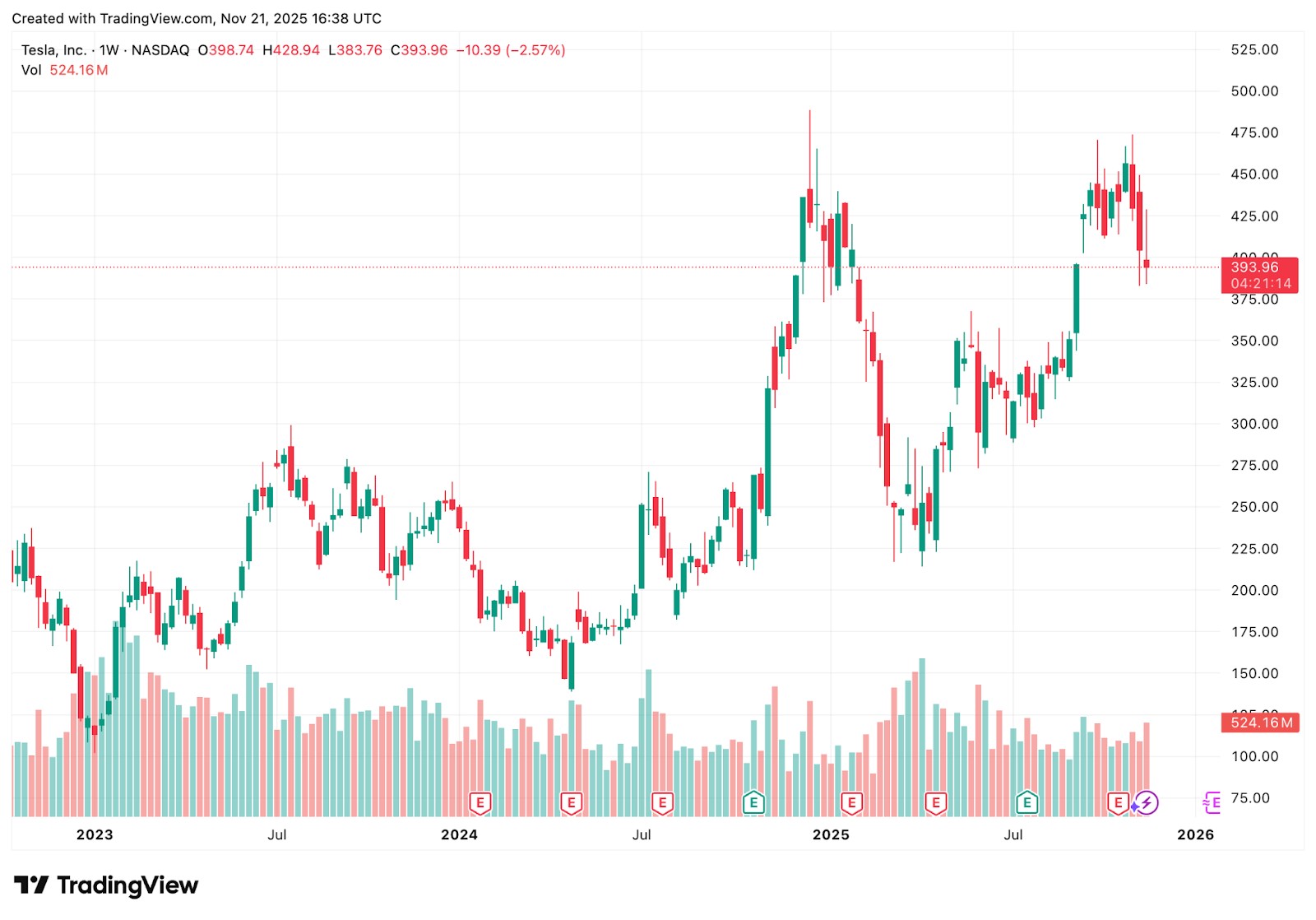
Tesla’s stock has seen major swings over the past two years as investors reacted to delivery numbers, margin trends, and progress in FSD and AI.
Performance highlights
Past. Tesla moved through periods of tighter margins and price adjustments, then recovered as demand improved and investors shifted attention to long-term AI and robotaxi plans. The stock trades closer to the $400 range in late 2025, below its late-2024 peak but well above its mid-2025 lows.
Future. Its forward valuation remains high and continues to shape discussions about TSLA valuation, and whether the company can grow fast enough to match expectations.
Tesla’s recent price moves have been driven by steady delivery strength in major regions, including China and North America, along with growing optimism about future FSD monetization and possible licensing deals that could lift TSLA valuation over time. Stronger-than-expected growth in energy storage, especially Megapack demand, also supported sentiment as investors looked beyond vehicles for new revenue sources and long-term valuation upside. At the same time, updates on Tesla’s AI progress and the development of its robotics platform increased market attention, with many investors viewing these efforts bolstering Tesla’s intrinsic value.
Tesla’s recent movements show that the stock is still driven by sentiment and expectations rather than steady fundamentals. The price reacts quickly to changes in demand, updates on FSD progress and shifts in AI or energy storage outlook, which keeps debates around TSLA valuation active. This also means the stock can rise fast on future-focused news but can fall just as quickly when timelines stretch or deliveries slow. For investors, the message is clear: even with strong long-term potential, Tesla’s valuation depends heavily on how quickly the company can turn its ideas into real earnings.
Valuation of Tesla
Tesla’s stock has always been about more than just car sales. Investors see it as a play on the future of mobility, automation, energy, and artificial intelligence. But with slowing margin growth and increasing competition, many are asking whether the current price is still justified. To break it down, we’ll look at Tesla’s fundamentals, what valuation models say, and how the stock is behaving in the market.
Tesla fundamental analysis
Tesla has long been viewed through a different lens than traditional automakers. While other car companies are valued on sales and margins, Tesla is often treated more like a tech firm, with investors pricing in future innovation rather than current earnings. This makes it important to look at the numbers closely to see what is really supporting the stock.
Price to earnings (P/E) ratio
Tesla’s P/E ratio reflects its status as a growth company, but it also sets a high bar for performance.
Where the ratio stands
As of November 2025, Tesla’s trailing P/E is over 280x, and its forward P/E estimates range between 170x and 250x. This remains dramatically higher than legacy automakers whose P/E multiples typically sit in the single digits to low double-digits. And even compared with many technology firms, the multiple is steep given the flux in growth rates.
Investors are paying for what Tesla might become, not only what it is today. The extremely high P/E only holds if earnings accelerate significantly and new business lines (software, energy, robotaxis) scale quickly.
The P/E shows that investors expect large future gains, but those gains must appear fast for valuation to stay supported. If earnings growth slows, the gap between Tesla’s share price and intrinsic value can widen quickly.
Price to earnings growth (PEG) ratio
The PEG ratio puts earnings growth into context, helping to show if the high P/E is justified.
Tesla’s PEG breakdown
Tesla’s PEG ratio now sits in the 5 to 8 range, with many sources placing it near 5.1. A PEG above 1 suggests the stock trades at a premium, and a PEG above 2 signals that it is expensive compared with its expected earnings growth. With Tesla sitting far above that level, investors are paying a high price for future growth, which puts pressure on Tesla’s intrinsic value to be supported by faster earnings gains.
Tesla’s high PEG matters because it shows the stock price is built on strong expectations that require fast and consistent earnings growth. When a company trades at a PEG far above 2, even small delays in profit expansion can create sharp reactions in the market. This is why many investors stay focused on how quickly Tesla can convert new products and software into real revenue, since slow progress can put pressure on TSLA and lead to doubt about long term its valuation strength.
Investors should consider that a PEG in the 5 to 8 range leaves very little room for mistakes. If growth slows or margins weaken, the valuation can adjust much faster than the business itself. This gap between price and performance is important when judging Tesla intrinsic value and deciding whether the stock reflects achievable results or expectations that may take longer to realize.
Operating margins and free cash flow
Tesla’s operating margin has dropped to about 5.3% on a trailing basis and came in near 5.8% for Q3 2025, which is a clear decline from levels above 11% a year earlier. Free cash flow has also tightened, coming in around 4 to 6 billion dollars for 2025 as the company increased spending on factories, batteries and AI compute.
The decline in margins and the tighter free cash flow matter because they reduce the cushion Tesla once had when earnings growth slowed. Lower profitability makes the stock more sensitive to any delay in new products or software revenue, which increases the pressure on TSLA’s valuation to be supported by faster results. Investors should consider that with operating margins near recent lows and free cash flow held down by heavy spending, the valuation leaves little room for slow progress. This makes it important to judge whether Tesla’s intrinsic value still matches the pace of growth the market expects.
Tesla intrinsic valuation
Valuation models attempt to estimate Tesla’s true worth based on future earnings, and most suggest the stock is priced for long-term success, not present performance.
What the models show
Most valuation models show that Tesla is priced far more on future expectations than current earnings. According to recent data, the fair value from DCF models is roughly $170 per share, while the stock trades near $404. This implies a downside of around 58% based on those models.
Relative comparisons
Tesla’s trailing P/E is about 246x and its forward P/E is near 194x, which is far above the single digit to low double digit levels of Ford and GM. This gap shows that Tesla valuation already prices in strong future growth, so the durability of the valuation depends on Tesla turning new software and energy lines into higher earnings that justify the premium.
Tesla technical analysis
Tesla’s chart shows recovery and momentum, but some indicators suggest caution at these levels.

What the charts are saying
The stock is sitting slightly above the 200-day EMA, which is near 359, and this keeps the long term trend positive but not strong. The RSI is sitting around 42, which shows weak momentum and no strong buying pressure at the moment. The chart shows clear resistance near 410 to 415, which matches the recent pullback, and strong support remains in the 230 to 210 zone, which has held multiple times in the past year.
Momentum and sentiment
Volume. Volume is steady and not showing a major shift, which means buyers are active but not aggressive at current prices.
Volatility. Volatility is moderate and most moves are driven by reactions near the 200-day EMA and the 410 zone.
What traders are watching
A break above 415 would be an early signal of strength while a fall below 230 would shift the trend sharply lower.
Analyst perspectives and market sentiment
Tesla remains one of the most followed and most debated stocks because analysts see both strong long term potential and meaningful execution risks. Some analysts still believe in its long-term vision across electric vehicles, AI, and energy. Others argue the current price already assumes success in areas that are far from guaranteed. While opinions are split, most agree that Tesla’s stock is driven just as much by future potential as by current performance.
Bullish viewpoints
Supporters of Tesla’s valuation see the company as more than an automaker. They view it as a platform for innovation across mobility, energy, and AI.
Why some analysts remain optimistic
First-mover advantage in EVs. Tesla continues to lead global electric vehicle sales and maintains strong brand recognition in key markets like the US and China.
Monetization potential of FSD. Tesla’s Full Self-Driving (FSD) software could become a major recurring revenue stream, with potential for licensing or subscription growth.
AI and robotics optionality. Bulls argue Tesla’s work on Dojo (its AI training supercomputer) and the Optimus robot could add long-term upside that is not yet fully priced in.
Energy and storage scaling. Growth in Megapack and Powerwall deployments is expanding Tesla’s footprint beyond cars.
The bullish case
Supporters argue the valuation is high because the company has more optionality than any automaker and may grow like a tech business instead.
Bearish viewpoints
Others see Tesla’s valuation as stretched, especially with rising EV competition, shrinking margins, and the uncertainty of new business lines.
What cautious analysts are highlighting
High valuation despite margin pressure. Bearish analysts point to lower margins and say the valuation assumes earnings growth that the company has not yet proven.
Competitive landscape. New EV models from BYD, Ford, Hyundai, and others are cutting into Tesla’s market share, especially in price-sensitive segments.
Execution risk. Tesla’s ambitious goals in robotics, AI, and autonomy sound compelling but remain years away from producing meaningful revenue.
CEO focus and volatility. Elon Musk’s divided attention across multiple ventures sometimes raises concerns about operational consistency.
Critics believe the stock price reflects the best case scenario and does not leave room for slower progress.
Consensus and price targets
Despite the differing views, Tesla remains widely covered, and analyst targets reflect a cautious optimism, with more calls for stabilization than runaway upside.
What Wall Street is forecasting
Outlook. The current analyst consensus places the average price target near $290 to $310, with bullish targets near $380 and the lowest near $200.
Rating. Most analysts now hold a hold rating, with fewer strong buy calls than earlier years.
This range shows that analysts see a wide set of outcomes. Some believe Tesla can grow into its valuation while others think the price already reflects years of future earnings.
If you decide that Tesla fits your long term plan, the next step is choosing where to actually buy and hold your shares. That is where the list of best stock brokers for investing in stocks below can help. Comparing a few reliable brokers side by side makes it easier to open an account, place your first TSLA trade, and manage the rest of your equity portfolio in one place.
| eToro USA | Plus500 | eOption | Revolut | Fidelity | |
|---|---|---|---|---|---|
|
Stocks |
Yes | Yes | Yes | Yes | Yes |
|
Account min. |
50 | EUR500 | No | No | No |
|
Demo |
Yes | Yes | Yes | No | Yes |
|
Research and data |
Yes | Yes | Yes | Yes | Yes |
|
Basic stock/ETF fee |
No | $0.006 | $0 | 0.12%-0.25% | No |
|
Deposit Fee |
No | No | Not specified | No | $0 |
|
Withdrawal fee |
No | No | Not specified | No charge up to a limit | $0 |
|
Open an account |
Yes | Yes | Yes | Yes | Yes |
The real threat to Tesla’s valuation is not competition, it is time

When I analyze Tesla now, I start with the pace at which the company turns new ideas into real earnings. Tesla has meaningful strengths in software, energy storage and automation, but the market is asking for quick results across all of these areas at the same time. This creates pressure when margins soften or when cash flow becomes tighter.
In my view, TSLA valuation should be judged on how consistently Tesla improves these fundamentals rather than on bold long term plans. If FSD adoption grows, if energy storage becomes a steady contributor and if manufacturing efficiency improves, the current price can make sense. If these parts slow down, Tesla’s valuation and its intrinsic value may shift lower until earnings catch up. Investors should focus on the rhythm of progress, because that rhythm drives the stock more than the size of the vision.
Conclusion
Tesla’s valuation continues to defy traditional metrics, grounded more in its ambitious future projections than in current earnings. While skeptics point to its high price-to-earnings ratio, believers see untapped potential in AI, energy solutions, and autonomous driving. The company’s leadership in EV innovation and moves like the full self-driving beta rollout reinforce its reputation as a first mover. Ultimately, Tesla’s stock isn’t just a bet on cars—it’s a wager on redefining entire industries, making its valuation as much about vision as about numbers. For investors, the critical question remains: do you believe in the scale of Tesla’s future, or is the dream already priced in?
FAQs
How does Tesla’s diversification into AI, energy, and robotics influence its overall valuation?
What role does execution speed play in sustaining Tesla’s current stock price?
Why is Tesla’s price-to-earnings (P/E) ratio so much higher than that of other automakers?
How could changes in Tesla’s operating margins affect its valuation outlook?
Editors' Top Picks and Insights

Bitcoin price prediction and Bollinger Bands: Can BTC recover after falling to $63,000?

FIFA World Cup on blockchain: Where football meets crypto

Aliens, Satoshi, and Bitcoin: How the extraterrestrial theory emerged

Blockchain nation in crisis: How a power struggle split Liberland

Shifting priorities: Governments back mining as businesses turn to AI
Intel's comeback: Apple, Trump and the AI bet
Related Articles
Team that worked on the article
Ashutosh Sureka is a finance professional specializing in financial research, credit assessment, and equity analysis.
Dan Blystone began his trading career in 1998 as an arbitrage clerk on the floor of the Chicago Mercantile Exchange (CME). He later traded bond and Eurex futures at proprietary firms such as Altea Trading, gaining valuable experience in high-frequency trading and risk management.
Chinmay Soni is a financial analyst with more than 5 years of experience in working with stocks, Forex, derivatives, and other assets. As a founder of a boutique research firm and an active researcher, he covers various industries and fields, providing insights backed by statistical data.
Fundamental analysis is a method or tool that investors use that seeks to determine the intrinsic value of a security by examining economic and financial factors. It considers macroeconomic factors such as the state of the economy and industry conditions.
Volatility refers to the degree of variation or fluctuation in the price or value of a financial asset, such as stocks, bonds, or cryptocurrencies, over a period of time. Higher volatility indicates that an asset's price is experiencing more significant and rapid price swings, while lower volatility suggests relatively stable and gradual price movements.
Index in trading is the measure of the performance of a group of stocks, which can include the assets and securities in it.
Xetra is a German Stock Exchange trading system that the Frankfurt Stock Exchange operates. Deutsche Börse is the parent company of the Frankfurt Stock Exchange.
Day trading involves buying and selling financial assets within the same trading day, with the goal of profiting from short-term price fluctuations, and positions are typically not held overnight.

-
 Afghanistan
-
 Albania
-
 Algeria
-
 Angola
-
 Argentina
-
 Armenia
-
 Australia
-
 Austria
-
 Azerbaijan
-
 Bahamas
-
 Bahrain
-
 Bangladesh
-
 Belarus
-
 Belgium
-
 Bolivia
-
 Botswana
-
 Brazil
-
 Brunei
-
 Bulgaria
-
 Cambodia
-
 Cameroon
-
 Canada
-
 Chile
Chile
-
 China
China
-
 Colombia
-
 Congo
Congo
-
 Costa Rica
-
 Cote d'Ivoire
-
 Croatia
-
 Cuba
Cuba
-
 Cyprus
-
 Czechia
-
 DR Congo
-
 Denmark
-
 Dominican Republic
-
 Ecuador
-
 Egypt
Egypt
-
 El Salvador
-
 Estonia
-
 Eswatini
-
 Ethiopia
-
 Finland
-
 France
-
 Georgia
-
 Germany
-
 Ghana
Ghana
-
 Greece
-
 Haiti
Haiti
-
 Hong Kong
-
 Hungary
-
 India
India
-
 Indonesia
-
 Iran, Islamic republic
-
 Iraq
Iraq
-
 Ireland
-
 Israel
-
 Italy
Italy
-
 Jamaica
-
 Japan
Japan
-
 Jordan
-
 Kazakhstan
-
 Kenya
Kenya
-
 Korea
Korea
-
 Kuwait
-
 Kyrgyzstan
-
 Laos
Laos
-
 Latvia
-
 Lebanon
-
 Lesotho
-
 Libya
Libya
-
 Lithuania
-
 Luxembourg
-
 Madagascar
-
 Malaysia
-
 Malta
Malta
-
 Mauritius
-
 Mexico
-
 Moldova
-
 Mongolia
-
 Montenegro
-
 Morocco
-
 Mozambique
-
 Myanmar
-
 Namibia
-
 Nepal
Nepal
-
 Netherlands
-
 New Zealand
-
 Nigeria
-
 North Macedonia
-
 Norway
-
 Oman
Oman
-
 Pakistan
-
 Palestine
-
 Panama
-
 Papua New Guinea
-
 Paraguay
-
 Peru
Peru
-
 Philippines
-
 Poland
-
 Portugal
-
 Puerto Rico
-
 Qatar
Qatar
-
 Reunion
-
 Romania
-
 Rwanda
-
 Saudi Arabia
-
 Serbia
-
 Singapore
-
 Slovakia
-
 Slovenia
-
 Somalia
-
 South Africa
-
 Spain
Spain
-
 Sri Lanka
-
 Sweden
-
 Switzerland
-
 Syria
Syria
-
 Taiwan
-
 Tajikistan
-
 Tanzania
-
 Thailand
-
 Trinidad and Tobago
-
 Tunisia
-
 Turkey
-
 UAE
UAE
-
 Uganda
-
 Ukraine
-
 United Kingdom
-
United States
-
 Uruguay
-
 Uzbekistan
-
 Venezuela
-
 Vietnam
-
 Yemen
Yemen
-
 Zambia
-
 Zimbabwe
- Forex
- Crypto











