
S&P/ASX 200 Index: Definition, importance



Editorial Note: While we adhere to strict Editorial Integrity, this post may contain references to products from our partners. Here's an explanation for How We Make Money. None of the data and information on this webpage constitutes investment advice according to our Disclaimer.

Here are some key facts and figures about the S&P/ASX 200:
- ASX 200: Market-cap-weighted index of the 200 largest companies on the Australian Securities Exchange.
- Inclusion criteria: Companies must meet minimum market capitalization and liquidity requirements set by the ASX.
- Average long-term annual return: Around 5.12% since 2000, with 60% of returns from dividends.
- Invest via ETFs or mutual funds tracking the ASX 200 index.
- Notable historic shifts: Major declines during the Global Financial Crisis (-38.4% in 2008) and the COVID-19 pandemic crash (hitting low of 4,800 after peaking at 7,199 in early 2020).
The ASX 200 is a key indicator of how the Australian stock market is performing. It tracks the biggest 200 companies listed on the Australian Securities Exchange (ASX) and helps investors understand the overall health of Australia's economy and how different industries are performing. In this guide, the experts at TU will explain how the ASX 200 is calculated, what influences its movements, and how traders can use it to make investment decisions.
What is the ASX 200 Index?
The S&P/ASX 200 Index stands as the primary measure of institutional investment within Australia's stock market. It includes the 200 most significant stocks based on float-adjusted market capitalization. This index, one among several others managed by S&P Dow Jones in Australian markets, serves as the leading benchmark in this category.
For a company to be part of the ASX 200, it must have its shares listed on the stock exchange, either as ordinary or preferred shares. Unlike ordinary shares, preferred shares lack voting rights but offer fixed dividends. Hybrid stocks, blending equities and fixed-income features, are not considered for inclusion.
Membership in the index is reserved for ASX-listed companies that possess both substantial size and liquidity. Liquidity, in this context, refers to the ease with which a company's shares can be traded on the Australian stock exchange. It is gauged by the regularity of share trading and the volume of trades.
The financials sector holds the greatest weightage within the index, chiefly represented by Australia's major banks: Commonwealth Bank of Australia (ASX: CBA), National Australia Bank Ltd (ASX: NAB), Westpac Banking Corporation (ASX: WBC), and Australian and New Zealand Banking Group Ltd (ASX: ANZ).
Following closely is the materials sector, housing resource companies like BHP Group Ltd (ASX: BHP) and Rio Tinto Limited (ASX: RIO), among others.
 5Y performance of the S&P/ASX 200
What are the ASX 200 trading hours?
The cash equity market operates from 10:00 AM to 4:00 PM (Sydney time).
Trading for SPI ASX 200 Index Futures and Options is available from 5:10 PM to 08:00 AM and resumes from 09:50 AM to 04:30 PM during the period from the second Sunday in March to the first Sunday in November. Similarly, trading hours are from 05:10 PM to 07:00 AM and then from 09:50 AM to 04:30 PM from the second Sunday in March to the first Sunday in November.
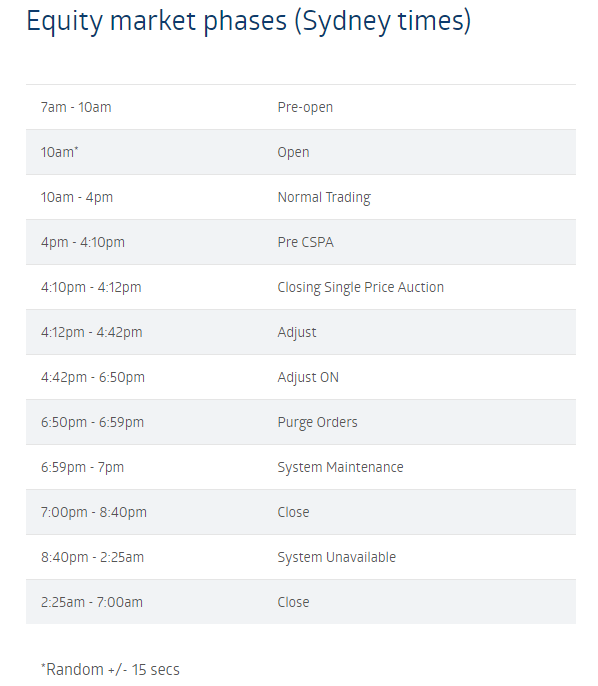 Equity market phases
How is the ASX 200 calculated?
To be part of the ASX 200, a security must be listed on the ASX and categorized as an ordinary or preferred equity stock, excluding bonds or warrants. The security's average daily market capitalization over the previous six months must be deemed institutionally investable and meet a minimum size requirement. Adequate liquidity and a minimum public float, representing shares available for public trading, are also essential criteria.
The ASX 200 is weighted based on market value and adjusted for float. Market capitalization is computed by multiplying the last traded price of each company's shares by the total publicly tradable securities. It undergoes quarterly rebalancing, wherein S&P Dow Jones, the index creator, assesses the index's composition against the top 200 companies by market capitalization and liquidity, making additions or deletions as necessary.
This index consists of a fixed number of constituents, and its numerical value signifies the total weighted market capitalization of these constituents relative to a base period. For instance, a rise from 5,000 to 5,500 indicates a 10% increase in the total weighted market capitalization of its constituents.
The impact of share price movements of large companies on the index level is greater than that of small companies due to the application of weighting based on market capitalization.
The ASX 200 started with a value of 3,133.3 points when established in 2000, matching the value of the broader All Ordinaries index at the time. The All Ordinaries index, tracking approximately 500 ASX-listed companies, was assigned a value of 500 points upon its inception in 1980.
Top 10 ASX 200 components
| Constituent | Symbol | Sector |
|---|---|---|
| BHP Group Ltd | BHP | Materials |
| Commonwealth Bank Australia | CBA | Financials |
| CSL Ltd | CSL | Health Care |
| National Australia Bank Ltd | NAB | Financials |
| Westpac Banking Corp | WBC | Financials |
| ANZ Group Holdings Ltd | ANZ | Financials |
| Wesfarmers Ltd | WES | Consumer Discretionary |
| Macquarie Group Ltd | MQG | Financials |
| Goodman Group | GMG | Real Estate |
| Woodside Energy Group Ltd | WDS | Energy |
The top 50% of companies account for about 94% of the total value of the index. Here is the sector-wise breakdown of the ASX 200:
 Sector Breakdown
How to trade the S&P/ASX 200?
Trading the S&P/ASX 200 offers various methods, each with distinct features, benefits, and drawbacks:
Exchange-Traded Funds (ETFs)
Reputable managed funds and exchange-traded funds (ETFs) like SPDR S&P/ASX 200 Fund (STW), iShares Core S&P/ASX 200 ETF (IOZ), and BetaShares Australia 200 ETF (ASX: A200) track the index, providing diversification across 200 holdings with one trade. This option is favored by investors seeking long-term investments, as markets tend to outperform active fund managers over extended periods.
- Pros:
- Cons:
- ETFs offer a cost-effective means to invest in the ASX 200 index.
- They provide diversification by tracking index performance.
- ETFs are easily traded and offer exposure to dividends.
- Less flexibility compared to CFDs.
- May not suit short-term trading strategies.
Futures and Options
- Pros:
- Cons:
- Futures enable investors to hedge against risk and profit from market movements.
- They offer leverage, allowing traders to control larger positions with less capital.
- Futures and options can serve speculative purposes.
- Requires a good understanding of market dynamics and risk management.
- Investors don't own the underlying asset when trading futures.
Contracts for Difference (CFDs)
Contract for Difference (CFD) is a cost-effective and efficient way to trade the ASX 200. Brokers usually offer CFDs based on the Cash Index (AUS 200) and the underlying Futures contract (SPI 200). The choice between Cash CFD (AUS 200) and Futures CFD (SPI 200) depends on the trader's style. Short-term traders may prefer AUS 200 due to its low spreads, while long-term traders might opt for SPI 200 to avoid swap charges.
- Pros:
- Cons:
- CFDs offer flexibility and profit potential in both rising and falling markets.
- Traders can benefit from price fluctuations without owning the asset.
- Popular for achieving long-term trading goals.
- Involves risk due to leverage.
- Traders need to closely monitor positions due to overnight funding costs.
Best stock brokers 2026



S&P/ASX 200 trading: tips from trader
When trading the S&P/ASX 200, here are some useful tips:
Analyze charts
Study price charts to understand market sentiment and forecast future performance. Historical data has many valuable insights for making well-informed trading decisions.
Select a trading style
Align your trading style with your goals and preferences, whether it's day trading, swing trading, or scalping. Each style caters to different timeframes and levels of risk.
Use trading signals
Incorporate trading signals to receive alerts for optimal entry and exit points. These signals can assist in making timely and strategic trades based on prevailing market conditions.
Stay informed
Stay updated with economic news and events that could impact the ASX 200. Factors such as interest rate decisions and earnings reports can influence market movements and guide your trading choices.
Conduct technical analysis
Use technical analysis techniques to identify patterns and trends in the market. Utilize indicators available on trading platforms to make data-driven trading decisions.
Consider dollar-cost averaging
For risk-averse investors, dollar-cost averaging can be a strategy to spread investments over time, reducing the impact of market volatility. This method helps manage risk and solve concerns associated with lump-sum investments.
Use ETFs for diversification
Exchange-Traded Funds (ETFs) provide a cost-effective means to invest in the ASX 200 while offering diversification benefits. ETFs track the index's performance and can be utilized for long-term investment objectives.
What moves the price of the ASX 200?
Economic events
Decisions made by the Reserve Bank of Australia regarding interest rates can have a significant impact on the ASX 200. Changes in interest rates influence borrowing costs and the overall economic outlook. Additionally, the release of key economic data like GDP, employment figures, and inflation reports can shape market sentiment and affect the index's performance.
News reports
The ASX 200 can be influenced by corporate earnings announcements and guidance provided by major companies within the index. Investors react to the financial health and future prospects of these companies. Moreover, geopolitical events, trade negotiations, and policy changes can impact the index by affecting the business environment and investor confidence.
Earnings
Quarterly and annual results, forecasts, or company news can all sway the share price of a company, thus influencing the ASX 200's value. Given the index's dominance by a small group of companies, particularly in the Financials and Materials sectors, it's important to closely monitor their performance.
Currency fluctuations
Significant fluctuations in the value of the Australian Dollar can affect the ASX 200's price. A strong Australian Dollar may pose challenges for exporters, leading to lower share prices. Conversely, a weaker currency can benefit exporters and boost their share prices.
Commodity prices
As Australia is a major commodities exporter, movements in the global commodities market can significantly impact the ASX 200. Increases in commodity prices tend to lift the share prices of mining companies, while declines in the commodity market can depress their share prices.
Expert opinion

In addition to the usual trading methods we've covered, I suggest exploring something called sector rotation when dealing with the ASX 200 index. Sector rotation means moving your investments between different parts of the economy depending on how well they're expected to do.
To do this, you look at trends and economic signs specific to each sector. This helps you figure out which sectors are likely to grow, so you can adjust where you put your money.
For example, when the economy is doing well, sectors like technology and consumer spending usually do better. But during tough times, things like utilities and basic consumer goods tend to do better, while other sectors might struggle.
By paying attention to these patterns and adjusting your investments accordingly, you might be able to make better returns and manage risks more effectively with the ASX 200 index.
Conclusion
In summary, the ASX 200 Index serves as a key indicator of Australia's stock market performance, comprising the largest 200 companies listed on the Australian Securities Exchange (ASX). It provides investors with insights into the overall health of the Australian economy and allows them to track the performance of a diverse range of sectors.
The index is calculated based on market capitalization and is regularly reviewed to ensure it accurately reflects the top 200 companies by size and liquidity. Traders can access the ASX 200 through various methods, including ETFs, futures, options, and CFDs, each offering its own benefits and considerations.
Factors influencing the price movements of the ASX 200 include economic events, news reports, corporate earnings, currency fluctuations, and commodity prices.
The S&P/ASX index is a good option for those looking to invest in the Australian economy.
ASX 200 has historically delivered strong returns over the long term, but investors should be prepared for short-term volatility.
FAQs
What is the ASX 200?
The ASX 200 is a stock market index that represents the performance of the largest 200 companies listed on the Australian Securities Exchange (ASX). It serves as a benchmark for the overall performance of the Australian stock market.
How is the ASX 200 index calculated?
The ASX 200 index is calculated based on the market capitalization of its constituent companies. Market capitalization is determined by multiplying the price of each company's shares by the total number of shares outstanding. The index is weighted by market capitalization, meaning that companies with higher market values have a greater impact on the index's movements.
What is the difference between ASX 100 and ASX 200?
The ASX 100 and ASX 200 are both stock market indices representing different segments of the Australian stock market. The ASX 100 includes the largest 100 companies listed on the ASX by market capitalization, while the ASX 200 includes the largest 200 companies. Therefore, the ASX 200 is a broader index that includes a larger number of companies compared to the ASX 100.
What does the ASX stand for?
The ASX stands for the Australian Securities Exchange. It is the primary stock exchange in Australia where publicly traded companies list their shares for trading. The ASX facilitates the buying and selling of securities, including stocks, bonds, and derivatives, providing a platform for investors to participate in the Australian financial markets.
Editors' Top Picks and Insights

From “Holy Trinity” to WLD crash: How Arthur Hayes became a market-moving seller

The world's first trillionaire: How Musk built his fortune on electric cars, space and AI

How precious-metals mining revival is reshaping portfolios in 2026
Bitcoin price prediction after CPI rise: Is BTC headed for deeper losses?

Five years with Bitcoin: How El Salvador changed after legalizing BTC

Crypto on the court: How NBA Finals became a showcase for Ledger
Related Articles
Team that worked on the article
Chinmay Soni is a financial analyst with more than 5 years of experience in working with stocks, Forex, derivatives, and other assets. As a founder of a boutique research firm and an active researcher, he covers various industries and fields, providing insights backed by statistical data.
Dr. BJ Johnson is a PhD in English Language and an editor with over 15 years of experience. He earned his degree in English Language in the U.S and the UK.
Mirjan Hipolito is a journalist and news editor at Traders Union. She is an expert crypto writer with five years of experience in the financial markets.
CFD is a contract between an investor/trader and seller that demonstrates that the trader will need to pay the price difference between the current value of the asset and its value at the time of contract to the seller.
SIPC is a nonprofit corporation created by an act of Congress to protect the clients of brokerage firms that are forced into bankruptcy.
Copy trading is an investing tactic where traders replicate the trading strategies of more experienced traders, automatically mirroring their trades in their own accounts to potentially achieve similar results.
Index in trading is the measure of the performance of a group of stocks, which can include the assets and securities in it.
Options trading is a financial derivative strategy that involves the buying and selling of options contracts, which give traders the right (but not the obligation) to buy or sell an underlying asset at a specified price, known as the strike price, before or on a predetermined expiration date. There are two main types of options: call options, which allow the holder to buy the underlying asset, and put options, which allow the holder to sell the underlying asset.

-
 Afghanistan
-
 Albania
-
 Algeria
-
 Angola
-
 Argentina
-
 Armenia
-
 Australia
-
 Austria
-
 Azerbaijan
-
 Bahamas
-
 Bahrain
-
 Bangladesh
-
 Belarus
-
 Belgium
-
 Bolivia
-
 Botswana
-
 Brazil
-
 Brunei
-
 Bulgaria
-
 Cambodia
-
 Cameroon
-
 Canada
-
 Chile
Chile
-
 China
China
-
 Colombia
-
 Congo
Congo
-
 Costa Rica
-
 Cote d'Ivoire
-
 Croatia
-
 Cuba
Cuba
-
 Cyprus
-
 Czechia
-
 DR Congo
-
 Denmark
-
 Dominican Republic
-
 Ecuador
-
 Egypt
Egypt
-
 El Salvador
-
 Estonia
-
 Eswatini
-
 Ethiopia
-
 Finland
-
 France
-
 Georgia
-
 Germany
-
 Ghana
Ghana
-
 Greece
-
 Haiti
Haiti
-
 Hong Kong
-
 Hungary
-
 India
India
-
 Indonesia
-
 Iran, Islamic republic
-
 Iraq
Iraq
-
 Ireland
-
 Israel
-
 Italy
Italy
-
 Jamaica
-
 Japan
Japan
-
 Jordan
-
 Kazakhstan
-
 Kenya
Kenya
-
 Korea
Korea
-
 Kuwait
-
 Kyrgyzstan
-
 Laos
Laos
-
 Latvia
-
 Lebanon
-
 Lesotho
-
 Libya
Libya
-
 Lithuania
-
 Luxembourg
-
 Madagascar
-
 Malaysia
-
 Malta
Malta
-
 Mauritius
-
 Mexico
-
 Moldova
-
 Mongolia
-
 Montenegro
-
 Morocco
-
 Mozambique
-
 Myanmar
-
 Namibia
-
 Nepal
Nepal
-
 Netherlands
-
 New Zealand
-
 Nigeria
-
 North Macedonia
-
 Norway
-
 Oman
Oman
-
 Pakistan
-
 Palestine
-
 Panama
-
 Papua New Guinea
-
 Paraguay
-
 Peru
Peru
-
 Philippines
-
 Poland
-
 Portugal
-
 Puerto Rico
-
 Qatar
Qatar
-
 Reunion
-
 Romania
-
 Rwanda
-
 Saudi Arabia
-
 Serbia
-
 Singapore
-
 Slovakia
-
 Slovenia
-
 Somalia
-
 South Africa
-
 Spain
Spain
-
 Sri Lanka
-
 Sweden
-
 Switzerland
-
 Syria
Syria
-
 Taiwan
-
 Tajikistan
-
 Tanzania
-
 Thailand
-
 Trinidad and Tobago
-
 Tunisia
-
 Turkey
-
 UAE
UAE
-
 Uganda
-
 Ukraine
-
 United Kingdom
-
United States
-
 Uruguay
-
 Uzbekistan
-
 Venezuela
-
 Vietnam
-
 Yemen
Yemen
-
 Zambia
-
 Zimbabwe
- Forex
- Crypto










