
How To Use The Stochastic Oscillator In Binary Options Trading



Editorial Note: While we adhere to strict Editorial Integrity, this post may contain references to products from our partners. Here's an explanation for How We Make Money. None of the data and information on this webpage constitutes investment advice according to our Disclaimer.
The stochastic oscillator in binary options is best used by spotting momentum shifts just before price hits the 80 or 20 zones. Instead of waiting for the obvious overbought or oversold signal, watch how %K and %D behave when speed changes and hesitation appears. That pause before the turn often gives the cleanest entry, catching the move as it starts rather than after it is already crowded. Timing that subtle shift is what makes the indicator effective in short expiries.
Many people look at the stochastic oscillator and wait for it to touch 80 or 20, thinking that is the trade. But what really makes a clean entry in binary options is the sudden change in movement that happens just before that point. The shift in speed tells you where the crowd is getting nervous. In a setup where timing is everything, if you are reading the obvious signal, you are already behind. The trade lives in the moment just before it turns.
Risk warning: Binary options trading is highly risky and may result in a total loss of funds. These speculative instruments often lack strong regulation, with over 80% of traders losing their capital. Invest only what you can afford to lose and seek professional advice.
Introduction to the stochastic oscillator in binary options
The stochastic oscillator measures where the current price sits compared to its recent range. It is especially popular in short-duration setups because it highlights overbought and oversold areas quickly. Traders who study binary options trading strategies for the stochastic oscillator often find it useful for timing precise entries and exits. Understanding how to interpret stochastic oscillator signals is the first step to using it effectively in trading.

What is the stochastic oscillator and how does it work?
The stochastic oscillator compares the closing price of an asset to the range of prices over a set number of periods, typically 14. It consists of two lines: %K (the fast line) and %D (a smoothed version of %K).
When the lines are above 80, the market is considered overbought.
When the lines are below 20, the market is considered oversold.
Crossovers between %K and %D often signal potential entries for traders.
This design makes the stochastic oscillator one of the most straightforward tools to apply in the very fast, quickly evolving binary options trading, since signals are quick and easy to read.
Why is it popular among binary options traders
Binary traders prefer the stochastic oscillator because it provides frequent, clear setups in short-term markets. Unlike trend-following tools that lag, the stochastic reacts quickly to price changes, making it suitable for 1-minute, 5-minute, and 15-minute expiry trades.
Here is why it is so widely used in binary options trading:
| Feature | Benefit for binary traders |
|---|---|
| Overbought/oversold signals | Provide clear zones to anticipate reversals |
| Fast crossovers | Quick entries and exits ideal for short expiries |
| Versatility | Works across Forex, commodities, indices, and stocks |
This mix of speed and adaptability makes the stochastic oscillator strategy for binary options trading one of the most applied momentum approaches.
Benefits of using stochastic in short-duration trades
The main advantage of the stochastic indicator strategy is its responsiveness. For traders who need decisions within minutes, it gives direct information on when price may be reversing or consolidating:
helps spot short pullbacks that align with the main trend;
generates multiple trading opportunities during the day;
offers early reversal warnings through stochastic divergence (where price makes new highs or lows but the oscillator does not).
By using stochastic in short durations, traders can combine frequent signals with binary expiry times, making their strategies sharper and more flexible.
Key components of the stochastic oscillator
To apply a stochastic oscillator strategy on binary options effectively, traders need to understand how the indicator is built and what its signals mean. The stochastic oscillator centers on two moving lines and a set of thresholds that define when the market is stretched. Recognizing these parts makes interpreting stochastic oscillator signals much easier.
Understanding %K and %D lines
The stochastic oscillator is made up of two lines called %K and %D.
%K line. The fast line, directly tracking where the current close sits within the recent price range.
%D line. The smoothed moving average of %K, making it slower and steadier.
Note: When the %K line crosses above or below the %D line, traders receive early entry or exit cues. These crossovers form the base of many stochastic strategy setups.
Overbought and oversold thresholds
The stochastic oscillator uses two zones, above 80 and below 20, to define when the market is stretched.
| Zone | Market condition | Trading implication |
|---|---|---|
| Above 80 | Overbought | Price may be ready to pull back, favoring put trades |
| Below 20 | Oversold | Price may be ready to bounce, favoring call trades |
These thresholds help traders by offering clear points to anticipate short-term reversals.
How signals are generated in trending vs ranging markets
One of the strengths of the stochastic oscillator is its ability to work in both trending and sideways conditions, though signals are interpreted differently.
In trending markets, traders use crossovers that align with the main trend. For example, in an uptrend, call trades are favored when the oscillator leaves the oversold zone.
In ranging markets, traders rely more on repeated moves between overbought and oversold levels, taking short-expiry trades when reversals occur.
Best stochastic oscillator strategies for binary options
Below are some of the most widely used strategies in binary options trading using the stochastic oscillator.
Overbought/oversold reversal strategy
This is the classic way traders use the stochastic oscillator. When the indicator moves above 80, the market is considered overbought and may be ready for a pullback. When it moves below 20, it is oversold and may be ready for a bounce.

For binary options, traders enter put trades after overbought conditions are confirmed and call trades after oversold conditions. This works best on shorter expiries such as 5-minute setups, especially when reversals align with visible support and resistance levels.
Crossover confirmation strategy
This approach uses %K and %D line crossovers as entry signals. A %K crossing above %D suggests a potential upward move (call), while a %K crossing below %D indicates a possible downward move (put).

This strategy is useful because crossovers act as confirmation of a change in direction, reducing the chance of false early entries.
| Signal type | Formation | Trading implication |
|---|---|---|
| Bullish crossover | %K crosses above %D in oversold area | Suggests call entry |
| Bearish crossover | %K crosses below %D in overbought area | Suggests put entry |
Pairing stochastic with other indicators for better accuracy
Many traders improve accuracy by combining the stochastic oscillator with other tools. These combinations help filter false stochastic oscillator signals, confirm market direction, and refine entries in both trending and ranging conditions.
Using RSI with stochastic to filter false signals
RSI and stochastic both measure momentum, but they do so differently. When combined, they help reduce false entries. For example, if the stochastic moves out of the oversold zone but RSI remains below 50, the signal may be weak. If both agree, the probability of success increases.
This makes the duo particularly useful for short-duration trades, where even one false signal can impact overall results. Many traders apply this combination in stochastic oscillator binary options setups with 5-minute or 15-minute expiries.
Bollinger bands and stochastic in ranging markets
Bollinger bands show volatility and boundaries of price movement, which pairs well with stochastic in sideways markets. Together, they help identify when reversals are more likely inside consolidation phases.
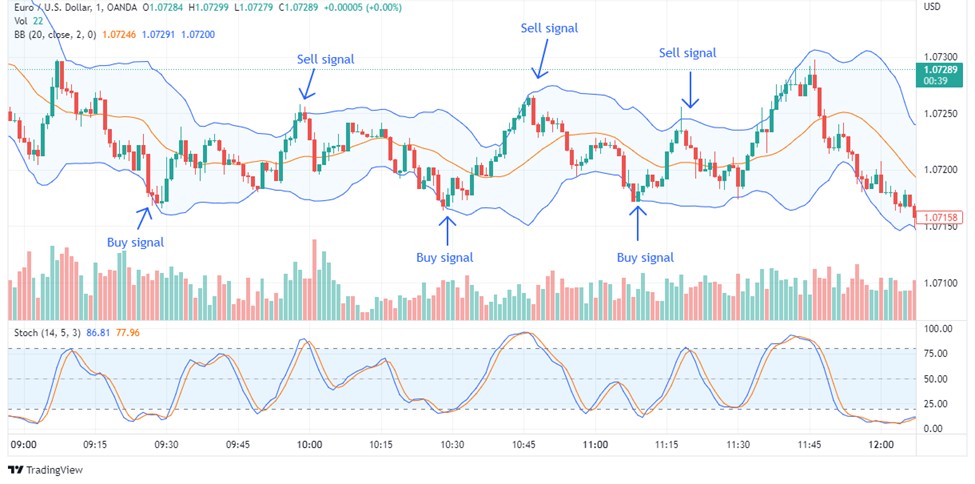
This pairing works best in calm sessions where markets move sideways rather than trending.
| Market condition | Bollinger role | Stochastic role | Trade setup |
|---|---|---|---|
| Ranging market | Defines upper and lower bands | Confirms overbought/oversold zones | Call at lower band + oversold, Put at upper band + overbought |
MACD and stochastic combo for trend entry setups
MACD filters broader trend direction, while stochastic provides precise entry timing. For instance, when MACD shows bullish momentum and the stochastic rises from oversold, traders get both trend confirmation and entry alignment.
This setup avoids counter-trend trades, making it one of the stronger filters for a stochastic indicator strategy. It is especially useful for longer expiries such as 15 minutes or 30 minutes, where waiting for alignment pays off.
Price action confirmation with candlestick patterns
Candlestick formations give direct context to oscillator signals. A bullish engulfing candle forming at the same time as a bullish stochastic crossover provides much stronger evidence than the indicator alone. Similarly, a pin bar rejecting resistance alongside an overbought stochastic adds conviction for a put trade.
For many traders, combining candlesticks with any stochastic oscillator strategy makes the system feel less mechanical and more grounded in market behavior.
To trade effectively with the stochastic oscillator, you need a broker that supports accurate charting and advanced technical setups. The table below highlights platforms that give traders the right tools to apply this momentum indicator with confidence.
| Currency pairs | Crypto | Stocks | Min. deposit, $ | Max. leverage | TradingView | MT5 | cTrader | Regulation | TU overall score | Open an account | |
|---|---|---|---|---|---|---|---|---|---|---|---|
| 120 | Yes | Yes | 1 | 1:30 | Yes | Yes | Yes | CNMV | 5.46 | Study review | |
| 90 | Yes | Yes | No | 1:500 | Yes | Yes | Yes | ASIC, FCA, DFSA, BaFin, CMA, SCB, CySec | 9.25 | Go to broker Your capital is at risk.
|
|
| 90 | Yes | Yes | 1 | 1:500 | Yes | Yes | Yes | ASIC, VFSC, FSA | 9.2 | Go to broker Your capital is at risk. |
|
| 70 | Yes | Yes | 100 | 1:500 | No | Yes | Yes | FCA, CYSEC, FSCA, SCB, FSA (Seychelles) | 8.6 | Go to broker Your capital is at risk. |
|
| 61 | Yes | Yes | 200 | 1:500 | Yes | Yes | Yes | ASIC, CySEC, FSA (Seychelles), The Financial Commission | 8.05 | Go to broker Your capital is at risk. |
Mastering the hidden layers of stochastic setups

Beginners often use the stochastic oscillator like a traffic signal, but the key is to look for hesitation, not just reversal. When the %K line slows just before it hits the top level and curves while volume drops, that is the window where you actually have time. Price often tricks impatient traders by pausing and luring them in. The smart trader watches that pause and waits for the moment it snaps back into motion. That is your entry with clarity, not guesswork.
Also, stop using stochastic, as it only matters at the extremes. The space between 40 and 60 is where the setup quietly builds. Watch how %K and %D behave there. If they squeeze close together and then suddenly part while the price stays flat, that is the warm-up phase before the move. Many of the best binary option trades do not start with the signal. They begin with the rhythm just before it.
Conclusion
The stochastic oscillator is not about reacting to obvious signals. It is about recognizing how pressure builds and where traders get lured into early moves. In binary options, timing is survival. The ones who win are not always those with the best indicators but those who know how the indicators mislead others. The edge comes from seeing what the average eye skips and stepping in with clarity just before the market makes up its mind.
FAQs
Should I use a stochastic oscillator during news events?
No, it's best to avoid using the stochastic oscillator during major news events. Sudden price spikes can distort overbought and oversold readings, leading to unreliable or delayed signals.
Do stochastic signals work on crypto binary options?
Yes, stochastic signals can work well on crypto binary options, especially on trending or ranging setups. However, due to high volatility, it's important to combine it with support, resistance, or price action filters.
How do I backtest a stochastic strategy for binary trades?
Backtest by applying the stochastic oscillator to historical charts, define clear entry and expiry rules, and log the outcomes of each trade. Use tools like TradingView’s bar replay or manual review to measure win rate and risk consistency.
How do I avoid fake signals from the stochastic oscillator in a flat market?
To filter out false signals, avoid using stochastic when the price is stuck in a tight range with low volume. Combine it with trend filters like moving averages or wait for a breakout confirmation before entering trades.
Editors' Top Picks and Insights

U.S. Bitcoin reserve: Trump’s unrealized crypto promise

Aiming for leadership: Payment giants prepare a new stablecoin

Proof of Reserves: the new standard for cryptocurrency exchanges

Three trends that could reshape the crypto market over the next decade

Trump financial disclosure: How the president's crypto income became a U.S. ethics issue

Code red: What's behind Bitcoin’s sharp selloff?
Related Articles
Team that worked on the article
Viktoras Karapetjanc is a seasoned financial trader, market analyst, and content creator with over 20 years of expertise in Forex, cryptocurrency, and stock markets. As a contributor to the Traders Union website, he provides in-depth analysis, data-driven strategies, and educational content to empower traders of all levels.
Dan Blystone began his trading career in 1998 as an arbitrage clerk on the floor of the Chicago Mercantile Exchange (CME). He later traded bond and Eurex futures at proprietary firms such as Altea Trading, gaining valuable experience in high-frequency trading and risk management.
Chinmay Soni is a financial analyst with more than 5 years of experience in working with stocks, Forex, derivatives, and other assets. As a founder of a boutique research firm and an active researcher, he covers various industries and fields, providing insights backed by statistical data.
Binary options trading is a financial trading method where traders speculate on the price movement of various assets, such as stocks, currencies, or commodities, by predicting whether the price will rise or fall within a specified time frame, often as short as a few minutes. Unlike traditional trading, binary options have only two possible outcomes: a fixed payout if the trader's prediction is correct or a loss of the invested amount if the prediction is wrong.
CFD is a contract between an investor/trader and seller that demonstrates that the trader will need to pay the price difference between the current value of the asset and its value at the time of contract to the seller.
Cryptocurrency is a type of digital or virtual currency that relies on cryptography for security. Unlike traditional currencies issued by governments (fiat currencies), cryptocurrencies operate on decentralized networks, typically based on blockchain technology.
Copy trading is an investing tactic where traders replicate the trading strategies of more experienced traders, automatically mirroring their trades in their own accounts to potentially achieve similar results.
Options trading is a financial derivative strategy that involves the buying and selling of options contracts, which give traders the right (but not the obligation) to buy or sell an underlying asset at a specified price, known as the strike price, before or on a predetermined expiration date. There are two main types of options: call options, which allow the holder to buy the underlying asset, and put options, which allow the holder to sell the underlying asset.

-
 Afghanistan
-
 Albania
-
 Algeria
-
 Angola
-
 Argentina
-
 Armenia
-
 Australia
-
 Austria
-
 Azerbaijan
-
 Bahamas
-
 Bahrain
-
 Bangladesh
-
 Belarus
-
 Belgium
-
 Bolivia
-
 Botswana
-
 Brazil
-
 Brunei
-
 Bulgaria
-
 Cambodia
-
 Cameroon
-
 Canada
-
 Chile
Chile
-
 China
China
-
 Colombia
-
 Congo
Congo
-
 Costa Rica
-
 Cote d'Ivoire
-
 Croatia
-
 Cuba
Cuba
-
 Cyprus
-
 Czechia
-
 DR Congo
-
 Denmark
-
 Dominican Republic
-
 Ecuador
-
 Egypt
Egypt
-
 El Salvador
-
 Estonia
-
 Eswatini
-
 Ethiopia
-
 Finland
-
 France
-
 Georgia
-
 Germany
-
 Ghana
Ghana
-
 Greece
-
 Haiti
Haiti
-
 Hong Kong
-
 Hungary
-
 India
India
-
 Indonesia
-
 Iran, Islamic republic
-
 Iraq
Iraq
-
 Ireland
-
 Israel
-
 Italy
Italy
-
 Jamaica
-
 Japan
Japan
-
 Jordan
-
 Kazakhstan
-
 Kenya
Kenya
-
 Korea
Korea
-
 Kuwait
-
 Kyrgyzstan
-
 Laos
Laos
-
 Latvia
-
 Lebanon
-
 Lesotho
-
 Libya
Libya
-
 Lithuania
-
 Luxembourg
-
 Madagascar
-
 Malaysia
-
 Malta
Malta
-
 Mauritius
-
 Mexico
-
 Moldova
-
 Mongolia
-
 Montenegro
-
 Morocco
-
 Mozambique
-
 Myanmar
-
 Namibia
-
 Nepal
Nepal
-
 Netherlands
-
 New Zealand
-
 Nigeria
-
 North Macedonia
-
 Norway
-
 Oman
Oman
-
 Pakistan
-
 Palestine
-
 Panama
-
 Papua New Guinea
-
 Paraguay
-
 Peru
Peru
-
 Philippines
-
 Poland
-
 Portugal
-
 Puerto Rico
-
 Qatar
Qatar
-
 Reunion
-
 Romania
-
 Rwanda
-
 Saudi Arabia
-
 Serbia
-
 Singapore
-
 Slovakia
-
 Slovenia
-
 Somalia
-
 South Africa
-
 Spain
Spain
-
 Sri Lanka
-
 Sweden
-
 Switzerland
-
 Syria
Syria
-
 Taiwan
-
 Tajikistan
-
 Tanzania
-
 Thailand
-
 Trinidad and Tobago
-
 Tunisia
-
 Turkey
-
 UAE
UAE
-
 Uganda
-
 Ukraine
-
 United Kingdom
-
United States
-
 Uruguay
-
 Uzbekistan
-
 Venezuela
-
 Vietnam
-
 Yemen
Yemen
-
 Zambia
-
 Zimbabwe
- Forex
- Crypto











