
Why Adding Bitcoin To Corporate Balance Sheets Is Becoming The New Normal



Editorial Note: While we adhere to strict Editorial Integrity, this post may contain references to products from our partners. Here's an explanation for How We Make Money. None of the data and information on this webpage constitutes investment advice according to our Disclaimer.
More than 145 public companies now hold Bitcoin on their balance sheets, turning it from an experimental reserve asset into a fast-growing corporate trend. Firms like Strategy (formerly MicroStrategy) and Metaplanet have seen triple- and quadruple-digit stock gains after adopting Bitcoin treasury strategies. Analysts expect Bitcoin to become a mainstream corporate reserve within the next five years as confidence in fiat currencies declines and institutional adoption accelerates.
Over the past few years, a quiet revolution has been unfolding in corporate finance. Once considered a speculative gamble, holding Bitcoin as part of a company’s treasury reserve is now gaining legitimacy among both public and private enterprises. This shift reflects a growing awareness of Bitcoin’s resilience as a store of value in an era of mounting inflation, rising sovereign debt, and currency debasement.
From tech innovators to traditional businesses, forward-thinking CFOs are re-evaluating what it means to preserve wealth on their balance sheets. The narrative is no longer just about risk – it’s about opportunity. As global markets confront economic uncertainty, Bitcoin is emerging not only as a hedge against fiat decline but also as a powerful strategic asset that redefines corporate treasury management for the digital age.
When corporate vision meets bitcoin
Strategy (formerly MicroStrategy) was a ho-hum tech company on the Nasdaq that provided business intelligence and mobile software and delivered acceptable returns – nothing too exciting – to its shareholders.
The stock price ranged between $11 and $18 for much of the decade between 2011 and 2020. Then something remarkable happened. Founder Michael Saylor became a bitcoin evangelist, recognising its potential to hold value and reverse the insidious erosion of inflation that is built into fiat currencies. He started adding bitcoin (BTC) to the Strategy balance sheet.
This is what happened to the stock price:
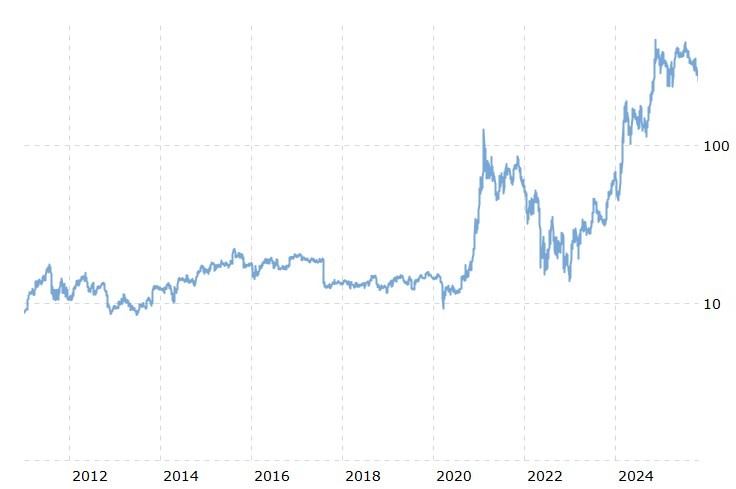
Stockholders were richly rewarded for Saylor’s vision, though he has been criticised for going all-in on bitcoin – even borrowing massively to acquire more BTC – in the belief that Strategy represents a unique wealth preservation vehicle for the digital age.
The company raised debt and equity to buy over 130,000 BTC by late 2021, positioning BTC as its primary treasury reserve asset. Saylor was venerated during the bitcoin bull run, then ridiculed during the 2022 crash, when BTC dropped 70%. At the time, it seemed to be a risky, even reckless, approach to managing company cash. Saylor stuck to his vision, arguing that volatility is a feature of bitcoin and required a long-term view. Barely a year later, he was again vindicated as bitcoin smashed through its previous high, continuing its bull run to above $110,000 by November 2025.
Strategy’s stock price exploded from around $15 in 2020 to $270 today, gifting a 1,700% windfall to stockholders in five years.

Saylor was the pioneer. Others soon followed. Take a look at the table below showing the 10 largest bitcoin treasury companies that are public companies, and then look at their stock price performance over 12 months. It’s clear who’s winning this race to the top.
Michael Saylor Latest News

Market confidence in Strategy improves after Michael Saylor outlines support for liquidity

Denying Bitcoin access to banks and companies undercuts its benefits, Michael Saylor argues

Michael Saylor: Recommended reading list for leaders interested in Bitcoin and technology
Michael Saylor news on Bitcoin reserves transparency leaves Strategy steady near support

Michael Saylor: Bitcoin Security Consortium launches with $15 million in developer support
Michael Saylor liquidity news lifts Strategy as traders weigh $96.20 price recovery
| Rank | Company | Ticker | # BTC held | 12 month % stock gain |
|---|---|---|---|---|
| 1 | Strategy | MSTR | 640,418 | +285% |
| 2 | MARA Holdings | MARA | 53,250 | +112% |
| 3 | XXI | CEP | 43,514 | +198% |
| 4 | Metaplanet | 3350 | 30,823 | +1,250% |
| 5 | Bitcoin Standard Treas. | CEPO | 30,021 | +76% |
| 6 | Bullish | BLSH | 24,000 | +145% |
| 7 | Riot Platforms | RIOT | 19,287 | +98% |
| 8 | Trump Media & Tech | DJT | 18,430 | +320% |
| 9 | Galaxy Digital | GLXY | 17,102 | +156% |
| 10 | CleanSpark | CLSK | 13,011 | +89% |
The best performer of the above bunch is Metaplanet, once a plodding Japanese hotel operator that began stacking bitcoin in 2024. It now holds almost 31,000 BTC and that alone caused its stock price to shoot up by 1,250% over the last year.
Some 145 public companies have now adopted bitcoin reserve strategies. Collectively they hold more than one million BTC, valued at about $113 billion at current prices. This equates to 4.86% of bitcoin's total 21 million supply.
What’s even more impressive is the rate at which corporate treasurers are adopting bitcoin, with a nearly 50% year-on-year increase in total bitcoin held. Just in October 2025, there were 26 new companies announcing bitcoin reserve strategies, including media company Rumble, Hong Kong-based construction group Ming Shing, Trump Media & Technology, GameStop, SolarBank and Nasdaq healthcare company Prenetics.
Pat Hourigan, CEO of Frictionless Markets, which is launching a bitcoin treasury reserve company on the Nairobi Stock Exchange, explains why this is a “must-have” for all companies, whether public or not.
Bitcoin has ranked as the world’s best-performing asset in 11 of the past 15 years. It remains the most influential asset within the cryptocurrency ecosystem, drawing the highest levels of liquidity and sustained investor support across global markets.
Hourigan concedes there are other assets available to corporate CFOs, such as gold, equities, real estate – and, of course, fiat (such as U.S. dollars).
Efficiency Group chief economist Dawie Roodt argues that fiat currencies like the South African rand and U.S. dollar eventually go the way of the dodo. The U.S. dollar has lost 96.5% of its purchasing power since 1913, and the rand has lost 97% of its value since coming into being in1961. South Africans have discovered that they can switch from rands to U.S. dollars as a way to preserve wealth, but even that is not a long-term strategy, because currency debasement is baked into the DNA of all fiat currencies.
So why put bitcoin on your corporate balance sheet?
“When companies keep large cash reserves on their balance sheets, that money inevitably loses value over time – and that’s not accidental,” explains Hourigan. “Central banks continuously expand the money supply, and in the case of the United States, sovereign debt is approaching $38 trillion. As interest rates begin to decline, this pace of monetary expansion is likely to accelerate even further in the coming years.”
As interest rates ease, we can expect to see another $6-7 trillion being added to U.S. sovereign debt, and that will further debase the USD.
So why should companies consider holding Bitcoin on their balance sheets? “Quite simply, because it has demonstrated exceptional resilience as a long-term store of value,” Hourigan explains. “Over the past three to five years, Bitcoin has outperformed every major index, commodity, and even leading corporations. It has delivered stronger returns than Nvidia, the top AI firms, and even Apple – making it one of the most dominant assets from a corporate treasury standpoint.”
Bitcoin is a self-sovereign digital asset that empowers corporate treasurers to own and custody their own assets – rather than entrust that to a bank or fund manager. The number of ways to do this is multiplying by the week. There’s a growing list of bitcoin exchange traded funds (ETFs) such as iShares Bitcoin Trust (BlackRock), which was the fastest growing ETF in history and now has assets under management of $98 billion. Then there are similar funds run by Fidelity, Grayscale, ARK and Bitwise.
All of these emerged from relaxed regulations in the U.S. allowing institutional investors – under pressure from clients – to gain exposure to the world’s best performing asset.
Johannesburg Stock Exchange-listed Africa Bitcoin Company co-founder Stafford Masie has been spreading his bitcoin bible code to the boardrooms of South Africa: “In the same way a bank or an insurance company props up their balance sheet with government bonds and gold and oil reserves, we want to do the same thing – but with the hardest asset known to man and that will ever exist. That’s bitcoin.”
Bitcoin treasury adoption is on the verge of going mainstream

It’s clear from the stats that the bitcoin reserve strategy has moved from the fringes to slightly outside of centre when it comes to corporate treasury planning. The rate of company adoption is growing fast, and we believe it will, indeed, soon become mainstream. It’s not there yet. What may trigger a more rapid rate of adoption is further weakening of the USD combined with a serious market correction. With names like Michael Saylor and Donald Trump endorsing this strategy, we can conceivably see this becoming mainstream in the next five years.
Conclusion
The rapid adoption of Bitcoin by over 145 public companies signals a paradigm shift in corporate treasury management, positioning BTC as the modern equivalent of gold for digital-era balance sheets. As companies like MicroStrategy and Tesla lead the way, the normalization of holding Bitcoin reflects growing confidence in its long-term value and resilience against inflation. This trend underscores a powerful takeaway: forward-thinking organizations are embracing Bitcoin not just as a hedge, but as a strategic asset for future growth. In an increasingly digitized financial landscape, stacking Bitcoin is becoming less of a bold experiment and more of a prudent corporate standard.
FAQs
What factors are motivating companies to add Bitcoin to their balance sheets?
What risks do businesses face when allocating reserves to Bitcoin?
How widespread is corporate adoption of Bitcoin as a reserve asset?
What are the practical steps companies are taking to hold Bitcoin on their balance sheets?
Editors' Top Picks and Insights

Bitcoin mining is getting greener, but the debate isn't over

Asia's largest IPO: How CXMT became China's most valuable company

Global fintech in 2026: Three trends that matter

From Jesus Christ to aliens: Polymarket's most absurd prediction markets

Hunting crypto owners: Why criminals have gone offline

BitMEX is shutting down: Why Trump could not save the exchange
Related Articles
Team that worked on the article
Ciaran Ryan is a veteran financial journalist based in South Africa, where he covers cryptocurrency, mining, stock markets, and governance for Moneyweb. He also hosts the weekly Moneyweb Crypto Podcast.
Dan Blystone began his trading career in 1998 as an arbitrage clerk on the floor of the Chicago Mercantile Exchange (CME). He later traded bond and Eurex futures at proprietary firms such as Altea Trading, gaining valuable experience in high-frequency trading and risk management.
Chinmay Soni is a financial analyst with more than 5 years of experience in working with stocks, Forex, derivatives, and other assets. As a founder of a boutique research firm and an active researcher, he covers various industries and fields, providing insights backed by statistical data.
Bitcoin is a decentralized digital cryptocurrency that was created in 2009 by an anonymous individual or group using the pseudonym Satoshi Nakamoto. It operates on a technology called blockchain, which is a distributed ledger that records all transactions across a network of computers.
Volatility refers to the degree of variation or fluctuation in the price or value of a financial asset, such as stocks, bonds, or cryptocurrencies, over a period of time. Higher volatility indicates that an asset's price is experiencing more significant and rapid price swings, while lower volatility suggests relatively stable and gradual price movements.
An investor is an individual, who invests money in an asset with the expectation that its value would appreciate in the future. The asset can be anything, including a bond, debenture, mutual fund, equity, gold, silver, exchange-traded funds (ETFs), and real-estate property.
Index in trading is the measure of the performance of a group of stocks, which can include the assets and securities in it.
CFD is a contract between an investor/trader and seller that demonstrates that the trader will need to pay the price difference between the current value of the asset and its value at the time of contract to the seller.

-
 Afghanistan
-
 Albania
-
 Algeria
-
 Angola
-
 Argentina
-
 Armenia
-
 Australia
-
 Austria
-
 Azerbaijan
-
 Bahamas
-
 Bahrain
-
 Bangladesh
-
 Belarus
-
 Belgium
-
 Bolivia
-
 Botswana
-
 Brazil
-
 Brunei
-
 Bulgaria
-
 Cambodia
-
 Cameroon
-
 Canada
-
 Chile
Chile
-
 China
China
-
 Colombia
-
 Congo
Congo
-
 Costa Rica
-
 Cote d'Ivoire
-
 Croatia
-
 Cuba
Cuba
-
 Cyprus
-
 Czechia
-
 DR Congo
-
 Denmark
-
 Dominican Republic
-
 Ecuador
-
 Egypt
Egypt
-
 El Salvador
-
 Estonia
-
 Eswatini
-
 Ethiopia
-
 Finland
-
 France
-
 Georgia
-
 Germany
-
 Ghana
Ghana
-
 Greece
-
 Haiti
Haiti
-
 Hong Kong
-
 Hungary
-
 India
India
-
 Indonesia
-
 Iran, Islamic republic
-
 Iraq
Iraq
-
 Ireland
-
 Israel
-
 Italy
Italy
-
 Jamaica
-
 Japan
Japan
-
 Jordan
-
 Kazakhstan
-
 Kenya
Kenya
-
 Korea
Korea
-
 Kuwait
-
 Kyrgyzstan
-
 Laos
Laos
-
 Latvia
-
 Lebanon
-
 Lesotho
-
 Libya
Libya
-
 Lithuania
-
 Luxembourg
-
 Madagascar
-
 Malaysia
-
 Malta
Malta
-
 Mauritius
-
 Mexico
-
 Moldova
-
 Mongolia
-
 Montenegro
-
 Morocco
-
 Mozambique
-
 Myanmar
-
 Namibia
-
 Nepal
Nepal
-
 Netherlands
-
 New Zealand
-
 Nigeria
-
 North Macedonia
-
 Norway
-
 Oman
Oman
-
 Pakistan
-
 Palestine
-
 Panama
-
 Papua New Guinea
-
 Paraguay
-
 Peru
Peru
-
 Philippines
-
 Poland
-
 Portugal
-
 Puerto Rico
-
 Qatar
Qatar
-
 Reunion
-
 Romania
-
 Rwanda
-
 Saudi Arabia
-
 Serbia
-
 Singapore
-
 Slovakia
-
 Slovenia
-
 Somalia
-
 South Africa
-
 Spain
Spain
-
 Sri Lanka
-
 Sweden
-
 Switzerland
-
 Syria
Syria
-
 Taiwan
-
 Tajikistan
-
 Tanzania
-
 Thailand
-
 Trinidad and Tobago
-
 Tunisia
-
 Turkey
-
 UAE
UAE
-
 Uganda
-
 Ukraine
-
 United Kingdom
-
United States
-
 Uruguay
-
 Uzbekistan
-
 Venezuela
-
 Vietnam
-
 Yemen
Yemen
-
 Zambia
-
 Zimbabwe
- Forex
- Crypto












