
El Salvador’s Bitcoin Portfolio: Insights & Market Impact


Editorial Note: While we adhere to strict Editorial Integrity, this post may contain references to products from our partners. Here's an explanation for How We Make Money. None of the data and information on this webpage constitutes investment advice according to our Disclaimer.
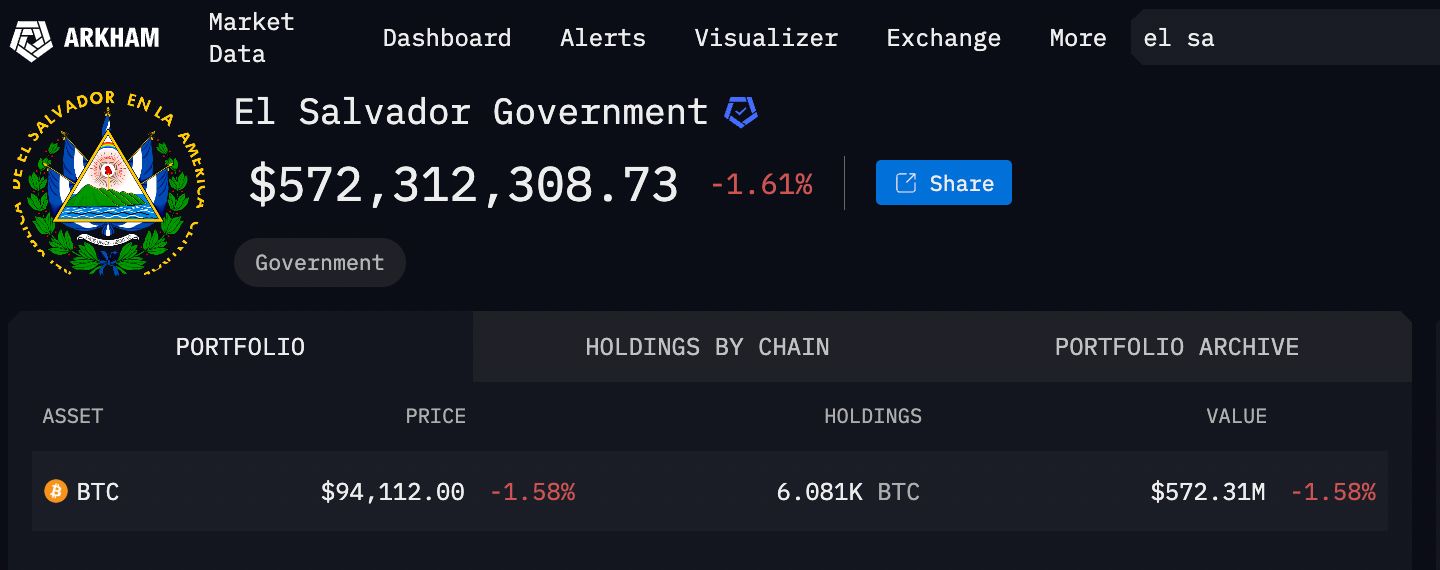
El Salvador currently holds approximately 6,081K BTC as part of its national reserves, consistently increasing its holdings since making bitcoin legal tender in 2021. The government continues to acquire bitcoin through direct market purchases and geothermal-powered mining, reinforcing its commitment to a crypto-integrated economic model.
El Salvador made history in 2021 by becoming the first country to adopt Bitcoin as legal tender. Since then, its government has actively expanded its bitcoin holdings, positioning the country as a pioneer in national cryptocurrency investments.
While the move has sparked debates, El Salvador’s bitcoin strategy has continued evolving with new acquisitions, infrastructure projects, and economic policies. This article explores the nation’s bitcoin reserves, how they are acquired and stored, their impact, and the risks and opportunities ahead.
El Salvador’s bitcoin reserves: an overview
El Salvador's bitcoin reserves stand at approximately 6,081K BTC, valued at around $572.312 million, given the current bitcoin price of $94,112. This reflects a significant appreciation from the initial investment, resulting in substantial unrealized gains.
In December 2024, El Salvador secured a $1.4 billion loan agreement with the International Monetary Fund (IMF). As part of this deal, the government agreed to modify its bitcoin policies, including making bitcoin adoption voluntary for businesses and discontinuing its use for tax payments. Despite these policy adjustments, the government has continued to increase its bitcoin holdings, adding 11 bitcoins in December 2024 and an additional 12 bitcoins in January 2025. Stacy Herbert, director of El Salvador's National Bitcoin Office, indicated that the country plans to continue acquiring bitcoin, potentially at an accelerated pace.
However, domestic adoption of bitcoin remains limited. Surveys indicate that by 2024, only 8.1% of Salvadorans had used bitcoin for transactions, and the majority of the population continues to prefer the U.S. dollar for daily use.
How much bitcoin does El Salvador have?
As of early 2025, El Salvador holds approximately 6,08K BTC, with ongoing acquisitions. For a long time, there was a short break only from February 17 to 24. This is due to a possible adjustment of the approach to Bitcoin after the loan agreement with the International Monetary Fund (IMF) in the amount of 1.4 billion dollars. However, on February 24, 2025, El Salvador changed its mind and bought 7 bitcoins at once.

El Salvador’s bitcoin reserves have grown through direct purchases, including large-scale buys during market downturns. The government has also acquired bitcoin through mining operations, leveraging the country’s natural geothermal energy.
While the total valuation of the reserves depends on bitcoin fluctuating market price, El Salvador’s holdings are currently valued at over $617 million, reinforcing its long-term investment strategy rather than short-term trading.
How El Salvador acquires and stores bitcoin
Acquisition methods
Direct purchases
The Salvadoran government actively acquires bitcoin through direct market purchases. In December 2024, the government added 11 bitcoins to its reserves, followed by an additional 12 bitcoins in January 2025.Mining operations
El Salvador uses geothermal energy from its volcanoes for bitcoin mining. This approach helps offset electricity costs while promoting sustainable cryptocurrency mining. By May 2024, the country had mined nearly 474 bitcoins using geothermal energy from the Tecapa volcano.
Storage and security measures
Cold storage
In March 2024, President Nayib Bukele announced the transfer of 5,689 bitcoins to a cold wallet stored in a physical vault within the country. Keeping the assets offline minimizes the risk of hacking and unauthorized access.Custodial wallets
The government launched the Chivo wallet to facilitate bitcoin transactions for its citizens. However, due to security concerns and an agreement with the International Monetary Fund (IMF) in December 2024, the government has reduced its involvement with the Chivo wallet, and its operations are being phased out.
The impact of bitcoin in El Salvador
El Salvador’s bitcoin adoption has had significant economic and social impacts. One major benefit is financial inclusion — many Salvadorans without access to traditional banking can now use bitcoin for transactions and savings.
Additionally, the move has attracted foreign investment, particularly from crypto enthusiasts and entrepreneurs. Bitcoin tourism has grown, with visitors interested in seeing the country’s digital asset initiatives firsthand.
However, bitcoin volatility has also created challenges. The fluctuating value of El Salvador’s reserves means economic risks, especially if bitcoin prices decline for extended periods.
Bitcoin City and other crypto initiatives
El Salvador has ambitious plans for Bitcoin City, a tax-free economic hub powered by renewable energy. This initiative aims to attract crypto businesses and investors, positioning the country as a global blockchain innovation center.
The government has also launched bitcoin-backed bonds, known as "Volcano Bonds," to fund infrastructure and energy projects. These bonds are designed to provide investors with exposure to bitcoin while supporting national development.
Beyond Bitcoin City, El Salvador is investing in educational programs to enhance blockchain literacy, ensuring its citizens understand the benefits and risks of cryptocurrency.
Risks and controversies surrounding El Salvador’s crypto strategy
Below are some risks and controversies:
Bitcoin price volatility
Bitcoin’s price fluctuations pose financial risks for the country. If prices drop significantly, El Salvador’s reserves may lose value, impacting public funds and economic stability.
International concerns
Global financial organizations, including the IMF, have criticized El Salvador’s bitcoin adoption. They warn that reliance on cryptocurrency could create financial instability and complicate international monetary relations.
Adoption challenges
Despite government efforts, bitcoin usage among Salvadorans remains mixed. Many businesses still prefer traditional currency, and concerns over transaction security and usability persist. Find out what currency El Salvador uses today, with a breakdown of the U.S. Dollar, the historic Colón, and Bitcoin’s role as legal tender.

El Salvador's cryptocurrency strategy has undergone significant developments since its initial adoption of bitcoin as legal tender in September 2021. Here’s the El Salvador’s strategy:
Government bitcoin purchases
The Salvadoran government has been actively acquiring bitcoin to strengthen its financial reserves. Despite an agreement with the International Monetary Fund (IMF) in December 2024 to limit Bitcoin-related activities, the government continued its acquisitions. In early 2025, El Salvador purchased an additional 52 bitcoins, bringing its total holdings to over 6,08K BTC, valued at nearly $600 million at that time. This ongoing investment reflects the government's belief in bitcoin long-term value and its commitment to integrating cryptocurrency into the national economy.
Bitcoin mining expansion
El Salvador has leveraged its geothermal energy resources to power bitcoin mining operations. By utilizing energy from its volcanoes, the country has mined nearly 474 bitcoins since 2021, contributing to its state crypto holdings. This sustainable approach not only reduces mining costs but also aligns with global efforts to promote environmentally friendly cryptocurrency practices. Additionally, President Nayib Bukele has proposed innovative initiatives, such as a "rent your own volcano" program, allowing international investors to participate in geothermal-powered bitcoin mining.
Regulatory framework
To comply with the IMF agreement and address economic considerations, El Salvador has revised its regulatory framework concerning bitcoin. In January 2025, the government amended the Bitcoin Law, making BTC acceptance by businesses voluntary and discontinuing its use for tax payments. These changes aim to balance the benefits of cryptocurrency integration with the need for financial stability and international cooperation. Despite these adjustments, the government continues to support bitcoin education and maintains its strategic reserves, indicating an ongoing commitment to the cryptocurrency sector.
Here are some of the best crypto exchanges to start trading with:
| Coinbase | OKX | BTCC | Cryptohopper | Crypto.com | |
|---|---|---|---|---|---|
|
Coins Supported |
400+ | 600+ | 399 | 1000 | 400+ |
|
Min. Deposit, $ |
10 | 10 | 10 | No | 1 |
|
Demo account |
No | Yes | Yes | No | No |
|
Spot Taker fee, % |
0.5 | 0.1 | 0.3 | 0 | 0.5 |
|
Spot Maker Fee, % |
0.5 | 0.08 | 0.2 | 0 | 0.25 |
|
Deposit fee |
No | No | No | No | No |
|
Withdrawal fee |
Fixed fee - 25 USD PayPal - 1.5% USDC - 10 USD | 0.0004 BTC 2.6 USDT | 0.0004 BTC 0.005 ETH 6%. if there was no futures trading | No | 0.0005 BTC |
|
Open an account |
Go to broker Your capital is at risk. |
Go to broker Your capital is at risk. |
Go to broker Your capital is at risk.
|
Go to broker Your capital is at risk. |
Go to broker Your capital is at risk. |
Consider the long-term economic stability of bitcoin adoption

I’ve seen how countries experiment with cryptocurrency, and while El Salvador’s bitcoin strategy is groundbreaking, long-term economic stability must remain a priority. Bitcoin’s price volatility means national reserves could experience significant fluctuations. To mitigate risks, the government should consider diversifying its crypto portfolio or setting up a sovereign wealth fund that balances bitcoin with other assets.
Another key factor is ensuring bitcoin integration benefits everyday Salvadorans. Financial inclusion is a strong motivator for this strategy, but real success depends on usability. More education and improved infrastructure — like better wallets with lower transaction fees — would encourage wider adoption. Additionally, ensuring that businesses, especially small ones, can easily accept and convert bitcoin into fiat when needed will strengthen confidence.
Looking ahead, El Salvador must also navigate global financial relations carefully. International lenders and institutions have raised concerns, and to maintain credibility, the government should establish a transparent reporting system for bitcoin reserves and usage. By addressing these challenges proactively, El Salvador has a better chance of turning its bold experiment into a sustainable financial model.
Conclusion
El Salvador’s bold venture into bitcoin by 2026 exemplifies how a nation’s strategic embrace of cryptocurrency can redefine both its financial landscape and global reputation. The government’s deliberate acquisition strategy, combined with accumulating reserves amid market volatility, demonstrates a calculated risk with the potential for substantial rewards. As seen in El Salvador’s integration of bitcoin into public initiatives and tourism, the nation has sparked both international investment and debate about the sustainability of crypto-centric policies. Ultimately, El Salvador’s journey underscores that transformative economic change often requires visionary risk-taking—those willing to innovate may shape the future, rather than simply adapt to it.
FAQs
How has bitcoin price volatility affected El Salvador’s crypto portfolio valuation over time?
What role does geothermal energy play in El Salvador’s bitcoin mining operations?
How widespread is public adoption of bitcoin for everyday transactions in El Salvador?
What future initiatives are planned to further integrate cryptocurrency into El Salvador’s economy?
Editors' Top Picks and Insights





Related Articles
Team that worked on the article
Alamin Morshed is a contributor at Traders Union. He specializes in writing articles for businesses that want to improve their Google search rankings to compete with their competition.
Dan Blystone began his trading career in 1998 as an arbitrage clerk on the floor of the Chicago Mercantile Exchange (CME). He later traded bond and Eurex futures at proprietary firms such as Altea Trading, gaining valuable experience in high-frequency trading and risk management.
Chinmay Soni is a financial analyst with more than 5 years of experience in working with stocks, Forex, derivatives, and other assets. As a founder of a boutique research firm and an active researcher, he covers various industries and fields, providing insights backed by statistical data.
Index in trading is the measure of the performance of a group of stocks, which can include the assets and securities in it.
Bitcoin is a decentralized digital cryptocurrency that was created in 2009 by an anonymous individual or group using the pseudonym Satoshi Nakamoto. It operates on a technology called blockchain, which is a distributed ledger that records all transactions across a network of computers.
CFD is a contract between an investor/trader and seller that demonstrates that the trader will need to pay the price difference between the current value of the asset and its value at the time of contract to the seller.
Risk management is a risk management model that involves controlling potential losses while maximizing profits. The main risk management tools are stop loss, take profit, calculation of position volume taking into account leverage and pip value.
An investor is an individual, who invests money in an asset with the expectation that its value would appreciate in the future. The asset can be anything, including a bond, debenture, mutual fund, equity, gold, silver, exchange-traded funds (ETFs), and real-estate property.

-
 Afghanistan
-
 Albania
-
 Algeria
-
 Angola
-
 Argentina
-
 Armenia
-
 Australia
-
 Austria
-
 Azerbaijan
-
 Bahamas
-
 Bahrain
-
 Bangladesh
-
 Belarus
-
 Belgium
-
 Bolivia
-
 Botswana
-
 Brazil
-
 Brunei
-
 Bulgaria
-
 Cambodia
-
 Cameroon
-
 Canada
-
 Chile
Chile
-
 China
China
-
 Colombia
-
 Congo
Congo
-
 Costa Rica
-
 Cote d'Ivoire
-
 Croatia
-
 Cuba
Cuba
-
 Cyprus
-
 Czechia
-
 DR Congo
-
 Denmark
-
 Dominican Republic
-
 Ecuador
-
 Egypt
Egypt
-
 El Salvador
-
 Estonia
-
 Eswatini
-
 Ethiopia
-
 Finland
-
 France
-
 Georgia
-
 Germany
-
 Ghana
Ghana
-
 Greece
-
 Haiti
Haiti
-
 Hong Kong
-
 Hungary
-
 India
India
-
 Indonesia
-
 Iran, Islamic republic
-
 Iraq
Iraq
-
 Ireland
-
 Israel
-
 Italy
Italy
-
 Jamaica
-
 Japan
Japan
-
 Jordan
-
 Kazakhstan
-
 Kenya
Kenya
-
 Korea
Korea
-
 Kuwait
-
 Kyrgyzstan
-
 Laos
Laos
-
 Latvia
-
 Lebanon
-
 Lesotho
-
 Libya
Libya
-
 Lithuania
-
 Luxembourg
-
 Madagascar
-
 Malaysia
-
 Malta
Malta
-
 Mauritius
-
 Mexico
-
 Moldova
-
 Mongolia
-
 Montenegro
-
 Morocco
-
 Mozambique
-
 Myanmar
-
 Namibia
-
 Nepal
Nepal
-
 Netherlands
-
 New Zealand
-
 Nigeria
-
 North Macedonia
-
 Norway
-
 Oman
Oman
-
 Pakistan
-
 Palestine
-
 Panama
-
 Papua New Guinea
-
 Paraguay
-
 Peru
Peru
-
 Philippines
-
 Poland
-
 Portugal
-
 Puerto Rico
-
 Qatar
Qatar
-
 Reunion
-
 Romania
-
 Rwanda
-
 Saudi Arabia
-
 Serbia
-
 Singapore
-
 Slovakia
-
 Slovenia
-
 Somalia
-
 South Africa
-
 Spain
Spain
-
 Sri Lanka
-
 Sweden
-
 Switzerland
-
 Syria
Syria
-
 Taiwan
-
 Tajikistan
-
 Tanzania
-
 Thailand
-
 Trinidad and Tobago
-
 Tunisia
-
 Turkey
-
 UAE
UAE
-
 Uganda
-
 Ukraine
-
 United Kingdom
-
United States
-
 Uruguay
-
 Uzbekistan
-
 Venezuela
-
 Vietnam
-
 Yemen
Yemen
-
 Zambia
-
 Zimbabwe
- Forex
- Crypto












