
How Much Can You Earn From Cryptocurrency?


Editorial Note: While we adhere to strict Editorial Integrity, this post may contain references to products from our partners. Here's an explanation for How We Make Money. None of the data and information on this webpage constitutes investment advice according to our Disclaimer.
Is crypto profitable? It depends entirely on your method, strategy, and risk approach. Conservative traders typically earn 2-5% per month. Moderate strategies can reach 5-15%. Aggressive trading may push past 30%, but with significantly higher risk. Passive methods like staking return 4-10% annually. There is no single answer to how much you can earn from crypto - context always matters more than the headline number.
Cryptocurrency is one of the most talked-about financial markets of the past decade, and for good reason. Can you still make money with crypto? Yes - but results vary wildly depending on what you do and how you do it. Some people make consistent monthly income. Others lose capital in weeks. How much money you can make with crypto depends on your earning method, starting capital, risk management, and market timing. This article walks you through each major earning method, realistic return ranges, the key factors that drive results, and the risks every beginner needs to understand before putting money in.
Risk warning: Cryptocurrency markets are highly volatile, with sharp price swings and regulatory uncertainties. Research indicates that 75-90% of traders face losses. Only invest discretionary funds and consult an experienced financial advisor.
How much can you earn from cryptocurrency in a month?
Monthly crypto income is not about chasing the highest possible return. It is about having a clear strategy and managing risk consistently. How much can you make from crypto depends heavily on which approach you take. The table below shows realistic monthly return ranges by strategy type.
| Strategy | Monthly return | Risk level | Leverage used | Risk per trade |
|---|---|---|---|---|
| Conservative | 2-5% | Low | None or minimal | 0.5-1% |
| Moderate | 5-15% | Medium | Moderate | 1-2% |
| Aggressive | 20-30%+ | High | High | 3-5%+ |
Conservative strategy
A conservative approach prioritizes capital preservation over fast growth. Traders stick to spot trading with little or no leverage, use strict stop losses, and risk no more than 0.5-1% of their deposit per trade. Entries are selective and infrequent.
How much can you make in crypto with this approach? Typically 2-5% per month. On a $1,000 deposit that is $20-$50. Modest, but this approach holds up during unfavorable market periods and avoids the deep drawdowns that wipe out beginners.
Moderate strategy
A moderate strategy accepts more risk in exchange for higher potential returns. It may involve moderate leverage, 1-2% risk per trade, and more active participation in the market. Temporary drawdowns are expected as part of the process.
Under favorable conditions, how much profit can you make from crypto with this strategy? Around 5-15% per month. But results fluctuate. A strong month can be followed by a flat or losing one, especially during sideways markets.
Aggressive strategy
An aggressive strategy targets maximum short-term returns. It involves high leverage, frequent trades, fast entries and exits, and risk levels of 3-5% or more per trade. Experience, discipline, and emotional control are non-negotiable here.
In good months, returns can exceed 20-30%. But the downside risk is equally steep. Can you really make money with crypto this way long-term? Only if you combine it with strict capital rules. Without them, a few bad trades can erase weeks of gains.
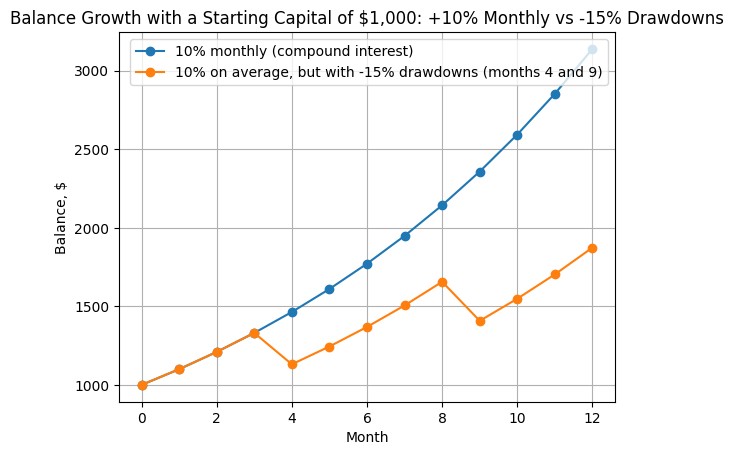
Example: Starting with $1,000 at a 10% average monthly return, but with two losing months of 15% each, your year-end result will depend far more on how well you manage those losing months than on the winning ones. Drawdown control matters as much as return chasing.
What determines cryptocurrency earnings?
How much money crypto can make you is never just a question of market conditions. Two traders starting with the same capital and trading the same asset can end up with completely different results. The difference almost always comes down to the factors below.
Chosen strategy. Active trading, passive income methods, or a combination each carry different return ranges and risk profiles.
Capital size. A 10% monthly return on $500 looks very different from the same return on $50,000.
Risk management. How much you lose on bad trades directly determines how long you last in the market.
Market conditions. Trending markets reward active traders. Sideways or bear markets favor passive and conservative approaches.
Fees and costs. Trading fees, slippage, and withdrawal charges quietly reduce your net returns over time.
Psychological stability. Discipline and emotional control consistently separate profitable traders from unprofitable ones.
Experience and consistency. Systematic analysis and learning from mistakes compound into a real edge over time.
Is crypto profitable in the long run? For most people, the answer depends less on the market and more on how well they manage these factors. A modest but consistent approach nearly always outperforms an aggressive one without structure.
Main ways to earn with cryptocurrency
There is no single answer to how much you can earn from crypto because the method you choose shapes everything - your time commitment, risk exposure, and realistic return range. Below are the main earning methods available today, from active trading to fully passive income.
| Method | Involvement | Monthly return range | Risk level |
|---|---|---|---|
| Trading | High | 3-30%+ | High |
| Buy and hold | Low | Varies by cycle | Medium |
| Staking | Low | 0.3-1.5% (4-19% annually) | Low-Medium |
| Crypto lending | Low | 0.7-1.2% (8-15% annually) | Medium |
| Copy trading | Low-Medium | Varies by trader | Medium |
| Arbitrage | Medium-High | 0.5-3% per cycle | Low-Medium |
| Mining | Medium | Varies by setup | Medium |
| NFTs | Medium | Highly variable | Very High |
| Play-to-earn | Medium | $10-$300/month | High |
Crypto trading
Trading is the most active and potentially highest-earning method in the crypto market. How much money can you make with crypto through trading depends on your strategy, discipline, and the conditions you are trading in. Returns can range from losses to several thousand dollars a month.
How it works:
you open and close positions to profit from price movements;
common strategies include scalping, day trading, swing trading, and automated algorithmic trading;
positions can be held for seconds, hours, or days depending on the strategy used.
Key risks:
leverage amplifies both gains and losses;
frequent trading increases fee drag on returns;
emotional decision-making is the most common cause of losses.
Trading profitability depends heavily on platform quality, execution speed, and fee structure. Below are the best crypto exchanges for traders offering competitive fees, reliable execution, and strong security.
| Coinbase | Kraken | OKX | BTCC | Crypto.com | |
|---|---|---|---|---|---|
|
Number of cryptocurrencies |
400+ | 400+ | 600+ | 399 | 400+ |
|
Min. Deposit, $ |
10 | 10 | 10 | 10 | 1 |
|
Spot Taker fee, % |
0.5 | 0.4 | 0.1 | 0.3 | 0.5 |
|
Spot Maker Fee, % |
0.5 | 0.25 | 0.08 | 0.2 | 0.25 |
|
Staking |
Yes | Yes | Yes | Yes | Yes |
|
Copy trading |
No | Yes | Yes | Yes | No |
|
NFT |
Yes | Yes | Yes | Yes | Yes |
|
Open an account |
Go to broker Your capital is at risk. |
Go to broker Your capital is at risk. |
Go to broker Your capital is at risk. |
Go to broker Your capital is at risk.
|
Go to broker Your capital is at risk. |
Buy and hold
Buy and hold means purchasing cryptocurrency and holding it long term with the expectation that its value grows over time. Can you still make money with crypto this way? Yes, but results depend almost entirely on which asset you choose and when you enter.
How it works:
buy Bitcoin, Ethereum, or large-cap altcoins at a chosen entry point;
hold without frequent trading through full market cycles;
take profit months or years later when the price appreciates.
How much you can earn:
during bull markets, returns can reach dozens or even hundreds of percent;
during bear markets or prolonged sideways movement, expect extended drawdown periods with no current income;
past Bitcoin cycles have shown returns exceeding 1,000% from cycle lows to highs, though past performance does not guarantee future results.
Staking
Staking means locking your crypto assets in a Proof of Stake network to help validate transactions and earn rewards in return. It is one of the more accessible passive income methods in crypto.
How it works:
hold a supported cryptocurrency in a staking-compatible wallet or exchange account;
earn rewards for contributing to network security and transaction validation;
rewards are distributed automatically, usually on a daily or weekly basis.
How much you can earn from staking:
Ethereum (ETH): approximately 3-4% annually as of 2025-2026;
Solana (SOL): approximately 5-7% annually;
Cosmos (ATOM): up to 15-19% annually, though with higher inflation risk;
most major coins fall in the 4-10% annual range.
Important! Staking yields are expressed as annual percentages. Your actual monthly income will be much smaller. If the staked asset drops in price, nominal rewards may not offset your loss in dollar terms.
Crypto lending
Crypto lending lets you earn interest by lending your assets to borrowers through a platform or protocol. It is one of the most straightforward passive income methods and is often overlooked by beginners.
How it works:
deposit crypto or stablecoins into a lending platform;
borrowers pay interest, and you receive a share of that interest as yield;
stablecoin lending tends to offer more predictable returns since there is no price volatility on the principal.
How much you can earn:
stablecoin lending on established platforms currently offers 8-15% annually;
volatile asset lending yields vary and carry additional price risk;
monthly equivalent on stablecoins is roughly 0.7-1.2%.
Important! Always use established, audited platforms. Lending protocols carry smart contract risk and, in some cases, counterparty risk if the platform is centralized.
Copy trading
Copy trading lets you automatically replicate the trades of experienced traders through specialized platforms. It is a popular entry point for people who want market exposure without managing trades themselves.
How it works:
select a signal provider whose strategy matches your risk appetite;
their trades are automatically mirrored in your account;
fees are typically split between you and the trader you copy.
How much you can earn:
returns depend entirely on the trader you follow;
a conservative signal provider might target around 5-10% per month;
past performance does not guarantee future results, and losses are also copied.
Tip: When choosing a trader to copy, evaluate their maximum drawdown history, not just their headline return. A trader with 50% drawdowns is not worth following even with high monthly gains.
Crypto arbitrage
Arbitrage means exploiting price differences for the same asset across different exchanges or markets. Because it does not rely on predicting price direction, it is considered lower risk than directional trading.
How it works:
identify a price gap for the same asset between two or more exchanges;
buy where the price is lower and sell where it is higher;
account for fees, transfer time, and liquidity before executing.
How much you can earn:
profit per cycle is typically small, ranging from a fraction of a percent to around 3%;
consistent returns require high capital, fast execution, and low fees;
automated bots are commonly used to capture arbitrage opportunities at scale.
Mining
Mining is the process of using computational hardware to validate transactions on Proof of Work networks like Bitcoin and earn block rewards in return.
How it works:
purchase and set up ASIC miners or GPU rigs;
connect to the network directly or through a mining pool;
earn cryptocurrency rewards for completed computations.
How much you can earn:
income depends on hardware power, electricity cost, and current network difficulty;
as of 2025-2026, Bitcoin mining at home is rarely profitable for small operators due to industrial competition and high energy costs;
mining smaller Proof of Work altcoins remains viable in some cases but carries higher price volatility risk.
NFTs
NFTs are unique digital tokens representing ownership of a digital asset. Income comes from buying undervalued assets and reselling them at a higher price, or from creator royalties on secondary sales.
How it works:
buy or create an NFT, wait for demand to increase, and sell at a profit;
creators can earn ongoing royalties each time their NFT is resold;
most activity is concentrated in a small number of high-demand collections.
How much you can earn:
successful trades on sought-after collections can return multiples of the original purchase price;
the NFT market has contracted significantly since its 2021-2022 peak and most NFTs today have little to no liquidity;
this is a very high-risk, trend-dependent segment with no guaranteed income.
Important! The NFT market is low-liquidity and highly speculative. Only allocate capital you are fully prepared to lose.
Play-to-earn
Play-to-earn games reward players with crypto tokens or NFTs for completing in-game tasks. The model peaked around 2021-2022 and has since contracted sharply, with many projects collapsing entirely.
How it works:
complete tasks, battles, or quests to earn in-game tokens or NFTs;
sell earned assets on secondary markets for real value;
reinvest earnings to progress faster and increase output.
How much you can earn:
monthly income typically ranges from $10 to a few hundred dollars for active players in viable projects;
earnings are unstable and closely tied to the game's token price and active user base;
as interest in a project declines, token value and earning potential drop sharply.
How to earn consistently with cryptocurrency
Stable crypto income is not built on a few lucky trades. It comes from a systematic approach applied consistently over time. Even the best strategy fails without structure, discipline, and clear rules for managing losses.
Here are practical steps to build more consistent results in crypto:
Define your role in the market. Decide whether you are an active trader, a long-term investor, or a combination of both. Mixing approaches without a clear plan leads to poor decisions in both directions.
Set loss limits by period, not just by trade. Daily or weekly loss caps prevent a single bad run from erasing weeks of gains.
Measure your strategy by drawdowns, not peaks. A strategy that earns 20% but draws down 40% is worse than one that earns 10% with a 10% drawdown.
Withdraw part of your profits regularly. Partial withdrawals reduce emotional pressure and lock in real results rather than leaving everything exposed to the next trade.
Adapt to market conditions. A strategy built for trending markets will underperform in sideways or bear conditions. Recognizing the shift early saves capital.
Focus on fewer instruments. Trading a small number of assets well beats spreading attention across dozens poorly.
Keep trading and investment capital separate. Mixing the two leads to impulsive decisions and makes it harder to track real performance.
Consistency in crypto is not about how fast your capital grows. It is about how reliably you protect it during losing periods and how systematically you build on winning ones.
Risks and warnings
The crypto market offers real earning opportunities, but it is also one of the most high-risk financial environments available to retail investors. Even experienced traders go through extended losing periods. Understanding where losses come from before you start is more valuable than any strategy.
Key risks every crypto participant should know:
High volatility. Prices can move 20-30% in either direction within days or even hours, turning a winning position into a loss with no warning.
Leverage misuse. Trading with high leverage without proper risk controls is the fastest way to lose an entire deposit. Leverage magnifies losses just as much as gains.
Emotional decision-making. FOMO, panic selling, and revenge trading after losses are responsible for more losses than bad market conditions.
Platform and security risks. Exchange hacks, wallet vulnerabilities, and smart contract exploits have resulted in billions of dollars in losses across the industry.
Scams and fraud. Fake tokens, rug pulls, and pseudo-investment schemes are widespread. If a project promises guaranteed returns, treat it as a red flag.
Regulatory risk. Laws around crypto vary significantly by country and continue to change. Service restrictions, tax obligations, and outright bans in certain jurisdictions can affect your ability to operate.
Important! Cryptocurrency is not a get-rich-quick tool. Approach it as a serious financial activity that requires preparation, risk management, and ongoing education.
Structure your capital before chasing returns

Most people come to crypto asking how much they can earn. That is the wrong first question. Early in my experience working with this market, I made the same mistake - focusing on return targets before building any real risk structure. What changed my results was not finding a better strategy but learning to treat each month as a risk budget, not a profit target. I allocate a fixed percentage I am willing to lose, and I never cross it regardless of how strong a setup looks. That single habit has done more for my long-term performance than any indicator or trading system.
One thing I would tell anyone starting out is to separate your crypto capital into three distinct pools. One portion goes toward active trading or higher-risk opportunities. A second portion sits in more conservative instruments like staking or stablecoin lending. The third is a reserve you do not touch. This structure removes a lot of the emotional pressure that causes most beginners to overtrade or panic sell. You already know which capital is at risk and which is not.
Conclusion
Earning potential from cryptocurrency is substantial yet unpredictable, hinging on factors like market volatility and investment strategy. While some investors have amassed impressive wealth through timely trades and holding promising coins, others have faced significant losses during downturns. It is crucial to approach cryptocurrency not as a guaranteed path to riches but as a high-risk, high-reward opportunity requiring careful research and risk management. Ultimately, the digital asset market rewards those who are informed, patient, and disciplined—making knowledge your most valuable currency.
FAQs
What factors influence monthly earnings from cryptocurrency?
Is it possible to generate a steady income with cryptocurrency investments each month?
How does the choice of cryptocurrency asset affect potential monthly returns?
What are some common risks associated with earning income from cryptocurrency monthly?
Editors' Top Picks and Insights






Related Articles
Team that worked on the article
Aleksandra Chaikina has been a contributor to Traders Union since 2021. With over 15 years of experience in copywriting and more than 5 years focused on financial content, she specializes in producing detailed guides, analytics, and comparative reviews across various sectors, including cryptocurrencies, Forex, investment strategies, and financial technologies.
Ciaran Ryan is a veteran financial journalist based in South Africa, where he covers cryptocurrency, mining, stock markets, and governance for Moneyweb. He also hosts the weekly Moneyweb Crypto Podcast.
Chinmay Soni is a financial analyst with more than 5 years of experience in working with stocks, Forex, derivatives, and other assets. As a founder of a boutique research firm and an active researcher, he covers various industries and fields, providing insights backed by statistical data.
A bear market is a period of time in which an investment asset, such as stocks, bonds, or commodities, experiences a decline in price for an extended period of time.
Copy trading is an investing tactic where traders replicate the trading strategies of more experienced traders, automatically mirroring their trades in their own accounts to potentially achieve similar results.
Crypto trading involves the buying and selling of cryptocurrencies, such as Bitcoin, Ethereum, or other digital assets, with the aim of making a profit from price fluctuations.
Forex leverage is a tool enabling traders to control larger positions with a relatively small amount of capital, amplifying potential profits and losses based on the chosen leverage ratio.
Cryptocurrency is a type of digital or virtual currency that relies on cryptography for security. Unlike traditional currencies issued by governments (fiat currencies), cryptocurrencies operate on decentralized networks, typically based on blockchain technology.

-
 Afghanistan
-
 Albania
-
 Algeria
-
 Angola
-
 Argentina
-
 Armenia
-
 Australia
-
 Austria
-
 Azerbaijan
-
 Bahamas
-
 Bahrain
-
 Bangladesh
-
 Belarus
-
 Belgium
-
 Bolivia
-
 Botswana
-
 Brazil
-
 Brunei
-
 Bulgaria
-
 Cambodia
-
 Cameroon
-
 Canada
-
 Chile
-
 China
-
 Colombia
-
 Congo
-
 Costa Rica
-
 Cote d'Ivoire
-
 Croatia
-
 Cuba
-
 Cyprus
-
 Czechia
-
 DR Congo
-
 Denmark
-
 Dominican Republic
-
 Ecuador
-
 Egypt
-
 El Salvador
-
 Estonia
-
 Eswatini
-
 Ethiopia
-
 Finland
-
 France
-
 Georgia
-
 Germany
-
 Ghana
-
 Greece
-
 Haiti
-
 Hong Kong
-
 Hungary
-
 India
-
 Indonesia
-
 Iran, Islamic republic
-
 Iraq
-
 Ireland
-
 Israel
-
 Italy
-
 Jamaica
-
 Japan
-
 Jordan
-
 Kazakhstan
-
 Kenya
-
 Korea
-
 Kuwait
-
 Kyrgyzstan
-
 Laos
-
 Latvia
-
 Lebanon
-
 Lesotho
-
 Libya
-
 Lithuania
-
 Luxembourg
-
 Madagascar
-
 Malaysia
-
 Malta
-
 Mauritius
-
 Mexico
-
 Moldova
-
 Mongolia
-
 Montenegro
-
 Morocco
-
 Mozambique
-
 Myanmar
-
 Namibia
-
 Nepal
-
 Netherlands
-
 New Zealand
-
 Nigeria
-
 North Macedonia
-
 Norway
-
 Oman
-
 Pakistan
-
 Palestine
-
 Panama
-
 Papua New Guinea
-
 Paraguay
-
 Peru
-
 Philippines
-
 Poland
-
 Portugal
-
 Puerto Rico
-
 Qatar
-
 Reunion
-
 Romania
-
 Rwanda
-
 Saudi Arabia
-
 Serbia
-
 Singapore
-
 Slovakia
-
 Slovenia
-
 Somalia
-
 South Africa
-
 Spain
-
 Sri Lanka
-
 Sweden
-
 Switzerland
-
 Syria
-
 Taiwan
-
 Tajikistan
-
 Tanzania
-
 Thailand
-
 Trinidad and Tobago
-
 Tunisia
-
 Turkey
-
 UAE
-
 Uganda
-
 Ukraine
-
 United Kingdom
-
United States
-
 Uruguay
-
 Uzbekistan
-
 Venezuela
-
 Vietnam
-
 Yemen
-
 Zambia
-
 Zimbabwe
- Forex
- Crypto












