
How To Track Your Forex Trading Performance


Editorial Note: While we adhere to strict Editorial Integrity, this post may contain references to products from our partners. Here's an explanation for How We Make Money. None of the data and information on this webpage constitutes investment advice according to our Disclaimer.
To track your Forex trading performance:
If you are a trader seeking to improve your performance, then a Forex trade journal is a must-have tool. A trade journal is a record of all your trades, including the currency pair traded, trade size, entry and exit prices, profit or loss, and your reasoning for each trade.
By keeping a trade journal, you can identify your strengths and weaknesses, track your progress over time, and improve your overall trading performance. The absence of a trading journal can also hinder long-term improvement, as it becomes challenging to track progress, refine strategies, and achieve consistent profitability.
Basics on tracking trading results
Maintaining a detailed trading journal is essential for new traders to refine their strategies and manage risk effectively. Documenting trade details, analyzing metrics like Profit Factor, and using advanced tools can guide them towards necessary changes required in their trading strategy. Regularly reviewing performance fosters disciplined, data-driven decisions, enabling gradual improvement and consistent profitability in Forex trading.
Plan your goals and performance benchmarks
The first step in creating a Forex trade journal is to plan your goals and performance benchmarks. For example, check out this complete guide to building out a comprehensive trading plan.
Such a plan will help you crystalize answers to key questions. What do you hope to achieve with your trading? Do you have a specific profit target in mind? Do you want to improve your win rate? Once you know your goals, you can set specific performance benchmarks to track and monitor your progress.
For example, you might set a goal of making a profit of 10% per month. To track your progress towards this goal, you would need to track your monthly profits and losses. You could also set a benchmark for your win rate, such as aiming for a win rate of 60%.
Create a trade journal
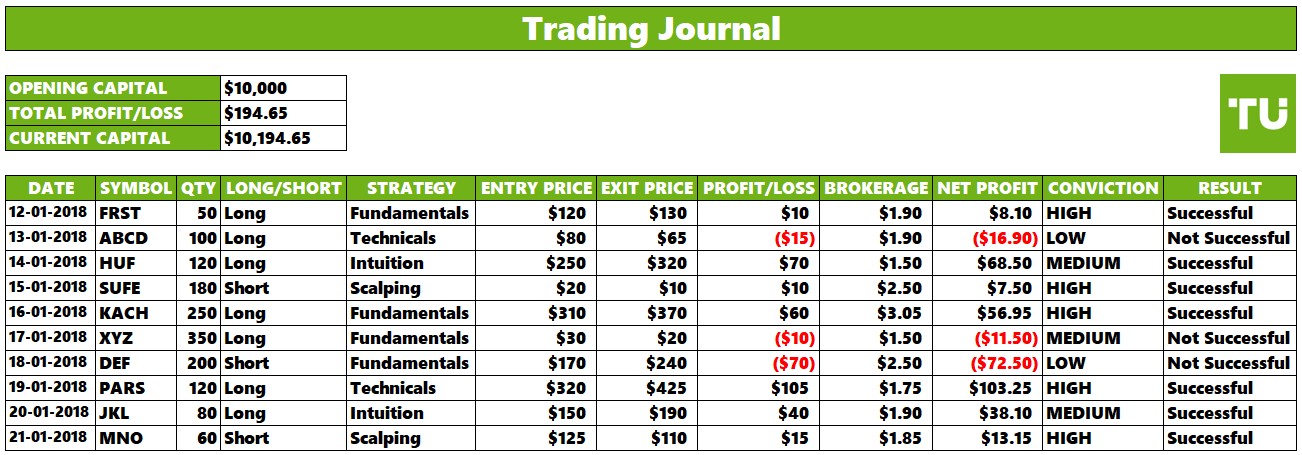
To create an effective journal, you must record every trade that you make. This includes the following information:
Date and time of trade.
Currency pair traded.
Trade direction (long or short).
Trade size.
Entry price.
Exit price.
Profit or loss.
Reasoning for trade.
You can record your trades in a physical notebook, a spreadsheet, or a dedicated trading journal app. Also, note that most trading platforms provide a built-in trading journal. We have explained the entire process of creating a free trading journal in excel (with template) in this article.
Regularly monitor how actual results are aligned with planned goals
Once you have a few weeks or months of trades recorded in your journal, you can start to review them regularly. This will help identify trends and patterns in your trading. For example, you may find that you are more profitable when trading certain currency pairs or trading during certain times of day. You may also find that you are more likely to make losing trades when you are feeling stressed or emotional.
By reviewing your journal regularly, you can understand your trading habits and make the necessary adjustments to improve your performance.
Find the causes of problems and correct them
If you find any problems in your trading, you can use your journal to help you identify the causes and correct them. For example, if you find that you are making a lot of losing trades on a particular currency pair, you may need to change your trading strategy or avoid trading that pair altogether.
You can also use your journal to identify any emotional problems that are affecting your trading. For example, if you find that you are more likely to make losing trades when you are feeling stressed, you may need to develop some coping mechanisms to help you manage your emotions.
Important metrics for tracking your Forex trade
Profit factor. The profit factor is a key metric in Forex trading, calculated by dividing total profits from winning trades by total losses from losing trades. A ratio above 1.0 indicates profitability, while a ratio below 1.0 signals losses outweigh profits. It is ideal to aim for a profit factor of above 1.5.
Maximum drawdown (MDD). MDD assesses the risk and potential loss associated with a trading strategy. It is calculated as the largest peak-to-trough decline or loss in the value of a trading account during a specific period, typically expressed as a percentage.
Recovery factor. Recovery factor helps in assessing the risk and profitability of a trading strategy. It quantifies the ability of a trading system or strategy to recover from losses and generate profits. The recovery factor is typically expressed as a ratio and calculated as follows:
Recovery Factor = (Net Profit / Maximum Drawdown)
Profitability. Profitability directly reflects the success and effectiveness of a trading strategy. It measures the ability of a trader or trading system to generate profits from trading activities and is typically quantified as the net profit earned from all trades over a specific period.
Sharpe ratio. The Sharpe Ratio helps in evaluating the risk-adjusted performance of a trading strategy. It was developed by Nobel laureate William F. Sharpe and is used widely in the financial industry to assess the return on investment relative to the risk taken. The Sharpe Ratio is calculated as follows:
Sharpe Ratio = (Average Return of the Strategy - Risk-Free Rate) / Standard Deviation of Returns
Discover why backtests rarely match live trading results and how the Deflated Sharpe Ratio protects against costly curve-fitting mistakes.
Win rate. This is the percentage of winning trades relative to the total number of trades. A high win rate is indicative of a strategy's ability to produce winning trades consistently.
Best Forex brokers for tracking trading performance
Automatic journaling is the most convenient way of tracking trading performance. We suggest opening an account with a broker that offers a MetaTrader 4 Forex platform, as it has a built-in trader’s journal. The top options with this feature are listed below:
| MT4 | MT5 | TradingView | Demo | Min. deposit, $ | Min Spread EUR/USD, pips | Max Spread EUR/USD, pips | Deposit fee, % | Withdrawal fee, % | Regulation level | Open an account | |
|---|---|---|---|---|---|---|---|---|---|---|---|
| Yes | Yes | Yes | Yes | No | 0.1 | 0.5 | No | No | Tier-1 | Go to broker Your capital is at risk. |
|
| Yes | Yes | Yes | Yes | 100 | 0.7 | 1.2 | No | No | Tier-1 | Study review | |
| Yes | No | Yes | Yes | 1 | 0.6 | 1.2 | No | No | Tier-1 | Study review | |
| Yes | No | No | Yes | 5000 | No | No | No | 3 | Tier-1 | Study review | |
| Yes | Yes | No | Yes | 5 | 0.7 | 1.2 | No | No | Tier-1 | Go to broker Your capital is at risk. |
Tools and software for tracking trading performance
To optimize the process of monitoring trading results, traders can leverage various applications, programs, and platforms. These resources not only save time but also deliver valuable insights into trading patterns and performance metrics. Here are some popular options traders use:
MetaTrader
As already discussed MetaTrader 4 (MT4) and its successor MetaTrader 5 (MT5) include built-in analytical functions allowing traders to watch their performance and analyze their trading history.
Myfxbook
As an online Forex analytics platform, Myfxbook permits traders to track, analyze, and compare their trading outcomes. By linking one's account, users gain access to:
Detailed stats on profit, loss, and risk.
Performance charts and graphs.
Automated system evaluation.
Social and copy trading.
TradingView
A popular charting and social media site for traders, TradingView supplies a range of performance tracking functions, such as:
Advanced charts across timeframes with customizable indicators.
Real-time market data and news.
Social features for sharing ideas and strategies.
Price, volume, and technical alerts and notifications.
Paper trading to test without risk.
Edgewonk
Designed to enhance decision-making and pattern identification, Edgewonk is a trading journal and analysis software offering:
Customizable journals for recording and reviewing trades.
Visual representations of stats and metrics.
Identification of strategy strengths and weaknesses.
Simulation for testing and modifying plans.
TradeBench
As a cloud-based analytics platform, TradeBench allows performance tracking, analysis, and optimization via imported trade data from various brokers, including:
Comprehensive reporting and analytics.
Journaling and note-taking.
Risk management tools and review.
Trade simulation and backtesting.
Each tool caters to different needs, so incorporating one or more into one's routine can effectively monitor and dissect performance for improved decisions and outcomes.
How journaling decisions and risk-to-reward analysis can enhance your Forex performance

One smart way to track your Forex trading performance is by paying attention to why you make certain decisions, not just focusing on profits or losses. Many traders only track the results, but noting down your trade entries, exits, and the reasoning behind each move is just as important. Were you following a solid strategy, or did you act on a hunch? By maintaining a journal that captures the why behind each trade, you can spot habits in your decision-making and refine your strategy over time. This helps you see if you’re following a disciplined approach or if emotions are guiding your trades.
Another key method is evaluating your risk vs reward with every trade. Instead of focusing only on the profit, calculate the potential reward for the amount you're risking. For example, if you’re aiming for a 3:1 ratio, you’re looking to gain three times what you risk on each trade. Tracking this helps you see if you’re consistently choosing trades that give you a good risk/reward balance. It also helps you recognize when you’ve risked too much for a smaller potential reward, refining your strategy and minimizing emotional, short-term decisions.
Conclusion
Mastering the art of tracking your Forex trading performance is crucial to achieving consistent success in the markets. By diligently maintaining a detailed trade journal and regularly analyzing key metrics—such as win rates, risk-reward ratios, and drawdowns—you can gain invaluable insights into your trading strengths and areas for improvement. Leveraging advanced tools like trading analytics platforms amplifies your ability to spot patterns and optimize strategies. Ultimately, the discipline of precise performance tracking transforms every trade into a learning opportunity, underscoring the powerful truth: what gets measured, gets improved.
FAQs
How often should I review my Forex trading journal to maximize improvement?
What are common mistakes traders make when tracking Forex trading performance?
How do analytical tools and software enhance Forex trading performance tracking?
How can tracking the reasoning behind trade decisions benefit Forex traders?
Editors' Top Picks and Insights





Related Articles
Team that worked on the article
Peter Emmanuel Chijioke is a professional personal finance, Forex, crypto, blockchain, NFT, and Web3 writer and a contributor to the Traders Union website. As a computer science graduate with a robust background in programming, machine learning, and blockchain technology, he possesses a comprehensive understanding of software, technologies, cryptocurrency, and Forex trading.
Dan Blystone began his trading career in 1998 as an arbitrage clerk on the floor of the Chicago Mercantile Exchange (CME). He later traded bond and Eurex futures at proprietary firms such as Altea Trading, gaining valuable experience in high-frequency trading and risk management.
Chinmay Soni is a financial analyst with more than 5 years of experience in working with stocks, Forex, derivatives, and other assets. As a founder of a boutique research firm and an active researcher, he covers various industries and fields, providing insights backed by statistical data.
Risk management is a risk management model that involves controlling potential losses while maximizing profits. The main risk management tools are stop loss, take profit, calculation of position volume taking into account leverage and pip value.
Backtesting is the process of testing a trading strategy on historical data. It allows you to evaluate the strategy's performance in the past and identify its potential risks and benefits.
Forex trading, short for foreign exchange trading, is the practice of buying and selling currencies in the global foreign exchange market with the aim of profiting from fluctuations in exchange rates. Traders speculate on whether one currency will rise or fall in value relative to another currency and make trading decisions accordingly. However, beware that trading carries risks, and you can lose your whole capital.
Ethereum is a decentralized blockchain platform and cryptocurrency that was proposed by Vitalik Buterin in late 2013 and development began in early 2014. It was designed as a versatile platform for creating decentralized applications (DApps) and smart contracts.
CFD is a contract between an investor/trader and seller that demonstrates that the trader will need to pay the price difference between the current value of the asset and its value at the time of contract to the seller.

-
 Afghanistan
-
 Albania
-
 Algeria
-
 Angola
-
 Argentina
-
 Armenia
-
 Australia
-
 Austria
-
 Azerbaijan
-
 Bahamas
-
 Bahrain
-
 Bangladesh
-
 Belarus
-
 Belgium
-
 Bolivia
-
 Botswana
-
 Brazil
-
 Brunei
-
 Bulgaria
-
 Cambodia
-
 Cameroon
-
 Canada
-
 Chile
Chile
-
 China
China
-
 Colombia
-
 Congo
Congo
-
 Costa Rica
-
 Cote d'Ivoire
-
 Croatia
-
 Cuba
Cuba
-
 Cyprus
-
 Czechia
-
 DR Congo
-
 Denmark
-
 Dominican Republic
-
 Ecuador
-
 Egypt
Egypt
-
 El Salvador
-
 Estonia
-
 Eswatini
-
 Ethiopia
-
 Finland
-
 France
-
 Georgia
-
 Germany
-
 Ghana
Ghana
-
 Greece
-
 Haiti
Haiti
-
 Hong Kong
-
 Hungary
-
 India
India
-
 Indonesia
-
 Iran, Islamic republic
-
 Iraq
Iraq
-
 Ireland
-
 Israel
-
 Italy
Italy
-
 Jamaica
-
 Japan
Japan
-
 Jordan
-
 Kazakhstan
-
 Kenya
Kenya
-
 Korea
Korea
-
 Kuwait
-
 Kyrgyzstan
-
 Laos
Laos
-
 Latvia
-
 Lebanon
-
 Lesotho
-
 Libya
Libya
-
 Lithuania
-
 Luxembourg
-
 Madagascar
-
 Malaysia
-
 Malta
Malta
-
 Mauritius
-
 Mexico
-
 Moldova
-
 Mongolia
-
 Montenegro
-
 Morocco
-
 Mozambique
-
 Myanmar
-
 Namibia
-
 Nepal
Nepal
-
 Netherlands
-
 New Zealand
-
 Nigeria
-
 North Macedonia
-
 Norway
-
 Oman
Oman
-
 Pakistan
-
 Palestine
-
 Panama
-
 Papua New Guinea
-
 Paraguay
-
 Peru
Peru
-
 Philippines
-
 Poland
-
 Portugal
-
 Puerto Rico
-
 Qatar
Qatar
-
 Reunion
-
 Romania
-
 Rwanda
-
 Saudi Arabia
-
 Serbia
-
 Singapore
-
 Slovakia
-
 Slovenia
-
 Somalia
-
 South Africa
-
 Spain
Spain
-
 Sri Lanka
-
 Sweden
-
 Switzerland
-
 Syria
Syria
-
 Taiwan
-
 Tajikistan
-
 Tanzania
-
 Thailand
-
 Trinidad and Tobago
-
 Tunisia
-
 Turkey
-
 UAE
UAE
-
 Uganda
-
 Ukraine
-
 United Kingdom
-
United States
-
 Uruguay
-
 Uzbekistan
-
 Venezuela
-
 Vietnam
-
 Yemen
Yemen
-
 Zambia
-
 Zimbabwe
- Forex
- Crypto












