
Mycelium Wallet Review 2026


Editorial Note: While we adhere to strict Editorial Integrity, this post may contain references to products from our partners. Here's an explanation for How We Make Money. None of the data and information on this webpage constitutes investment advice according to our Disclaimer.
Mycelium Wallet is a non-custodial Bitcoin wallet designed for mobile users who want full control over private keys. It supports 1 primary asset (BTC) directly, offers HD wallet architecture, SegWit transactions, watch-only accounts, and hardware wallet integration. Users can customize transaction fees and store funds offline through cold storage setups, making Mycelium a security-focused solution for long-term Bitcoin holders.
This Mycelium wallet review explores the wallet’s key features, including its security framework, fee structure, supported coins, and real-world performance. Whether you prioritize self-custody or focus primarily on Bitcoin, this overview provides a clear understanding of how the Mycelium Bitcoin wallet fits into a broader crypto strategy.
When assessing Mycelium crypto solutions, users typically consider factors such as security design, usability, and overall reliability before selecting a wallet.
Risk warning: Cryptocurrency markets are highly volatile, with sharp price swings and regulatory uncertainties. Research indicates that 75-90% of traders face losses. Only invest discretionary funds and consult an experienced financial advisor.
What is a Mycelium wallet?

The Mycelium crypto wallet is a mobile-based solution primarily built for storing and managing Bitcoin. It first appeared in 2008 as a secure mobile payment project and has since grown into one of the most established and trusted wallets in the cryptocurrency world. Today, many users still refer to it simply as the Mycelium wallet, while long-time holders recognize it as an early version of the Mycelium Bitcoin wallet built specifically for mobile use.
Unlike many newer wallets that focus on DeFi integrations and modern interface design, the Mycelium wallet takes a more practical approach. It gives users full control over private keys, flexible fee settings, and compatibility with hardware wallets. As a non-custodial solution, it ensures that users retain ownership of their funds, making it a relevant option for those who prioritize security and independence.
Those exploring what the Mycelium wallet is known for will find a set of advanced tools designed with privacy and control in mind. Features such as Tor integration, HD wallet functionality, and local backup options make it particularly appealing to experienced Bitcoin users and those focused on financial independence.
Security is another common consideration, with many users asking whether the Mycelium wallet is safe. If access to a device is lost, funds can be restored through the built-in Mycelium wallet recovery process, provided the backup information is securely stored.
Mycelium wallet security: Is it safe?
Security is one of the core strengths of the Mycelium wallet, supported by a long track record and features that give users full control over their funds. Many newcomers evaluating how safe the Mycelium wallet is focus on these built-in protections when choosing a mobile Bitcoin wallet.
Core security features
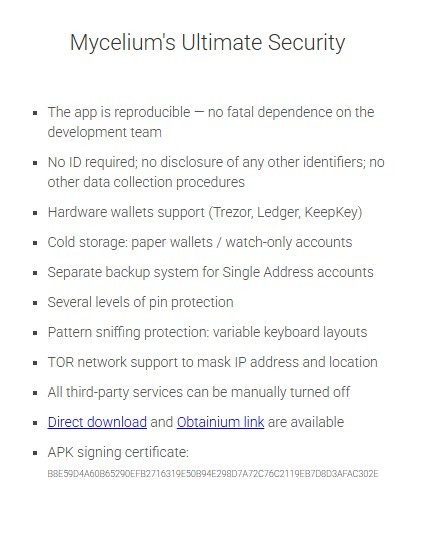
The Mycelium wallet is widely used in the crypto community, but its main advantages come from several underlying security features that may not be immediately visible to beginners. Due to this design, the Mycelium crypto wallet is often chosen by users who prioritize self-custody and stronger privacy controls.
Full control of private keys. Mycelium does not store keys online, which means only the user has access to their funds.
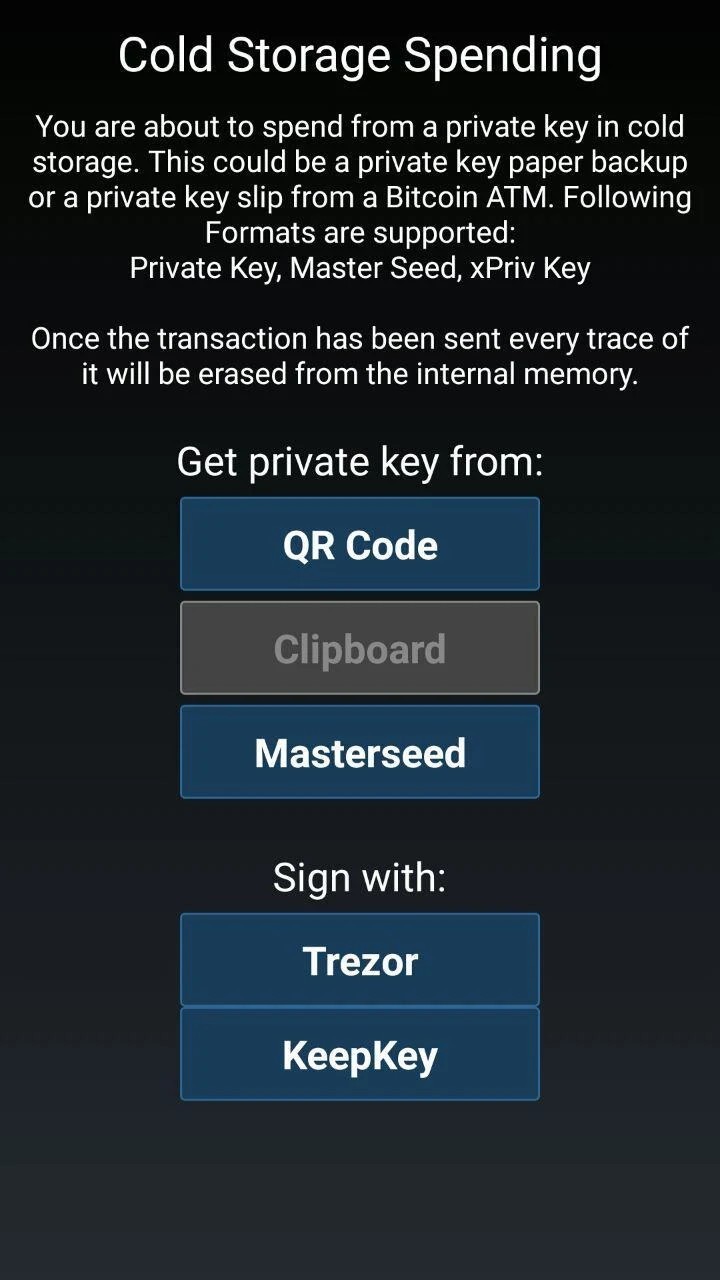
Support for offline cold storage. The wallet can be connected to hardware devices such as Trezor, allowing coins to be managed without direct internet exposure. In this setup, it can function as a Mycelium cold wallet.
Watch-only accounts. This mode allows users to monitor balances without the ability to send funds, reducing the risk of accidental transactions, especially when using the Mycelium wallet Android app for tracking purposes.
No cloud-based backups. Mycelium relies on local seed storage rather than third-party cloud services, which limits external risks. Fund recovery depends on the Mycelium wallet backup phrase created during setup.
Flexible fee control. Users can manually adjust transaction fees, giving more control over confirmation speed and costs. This is often noted when comparing Mycelium wallet fees with other mobile wallets.
Deterministic address generation. The wallet creates a new receiving address for each transaction, improving privacy and making activity harder to trace. This is one reason the Bitcoin wallet Mycelium is used by privacy-focused users.
Built-in Tor support. Advanced users can route connections through Tor to help mask IP addresses and add an extra layer of privacy. While some ask whether the Mycelium wallet can be hacked, overall security largely depends on how well the device and recovery phrase are protected.
Mycelium wallet supported coins
Here is a closer look at Mycelium wallet supported coins and what they mean in practice, especially for beginners evaluating whether the wallet fits their needs.
Bitcoin. Mycelium is built primarily around Bitcoin, with features that go beyond basic storage. It includes native SegWit support, an HD wallet structure, and customizable transaction fees, which can be useful during periods of network congestion. Because of this strong focus, the Mycelium Bitcoin wallet is often viewed as a dedicated solution for long-term BTC holders.
Ethereum. Mycelium does not offer native Ethereum support. However, advanced users can rely on third-party integrations or external tools to track ETH balances. This can create confusion for those searching for a Mycelium wallet Ethereum solution, as the wallet remains largely Bitcoin-focused in its core functionality.
ERC-20 tokens. These tokens are not supported directly within the app. In some cases, users connect hardware wallets such as Trezor to manage tokens indirectly. This setup may lead to the assumption that the Mycelium wallet supported coins list is broader than what is actually stored in the mobile interface.
FIO token. Mycelium supports FIO addresses, allowing users to replace complex wallet strings with readable names. This can simplify transactions, particularly for users managing multiple Bitcoin addresses.
Tether (USDT on Omni). The wallet supports the Omni Layer version of USDT rather than the Ethereum-based standard. This is relevant for users working with Bitcoin-based token systems or specific trading setups. Some users also ask whether Mycelium supports Bitcoin Cash, but the wallet is designed mainly around the Bitcoin network.
Litecoin. While not supported for full storage, Litecoin can be added in watch-only mode. This allows users to monitor balances without enabling transactions, which can be useful for tracking funds held elsewhere.
ETH testnet tokens. This is not widely documented, but some developers use Mycelium with custom backend tools to simulate ETH test transactions. As a result, the wallet has found niche use in testing and development environments. Developers experimenting with such integrations sometimes reference these setups when writing a Mycelium Bitcoin wallet review that focuses on technical capabilities rather than standard user features.
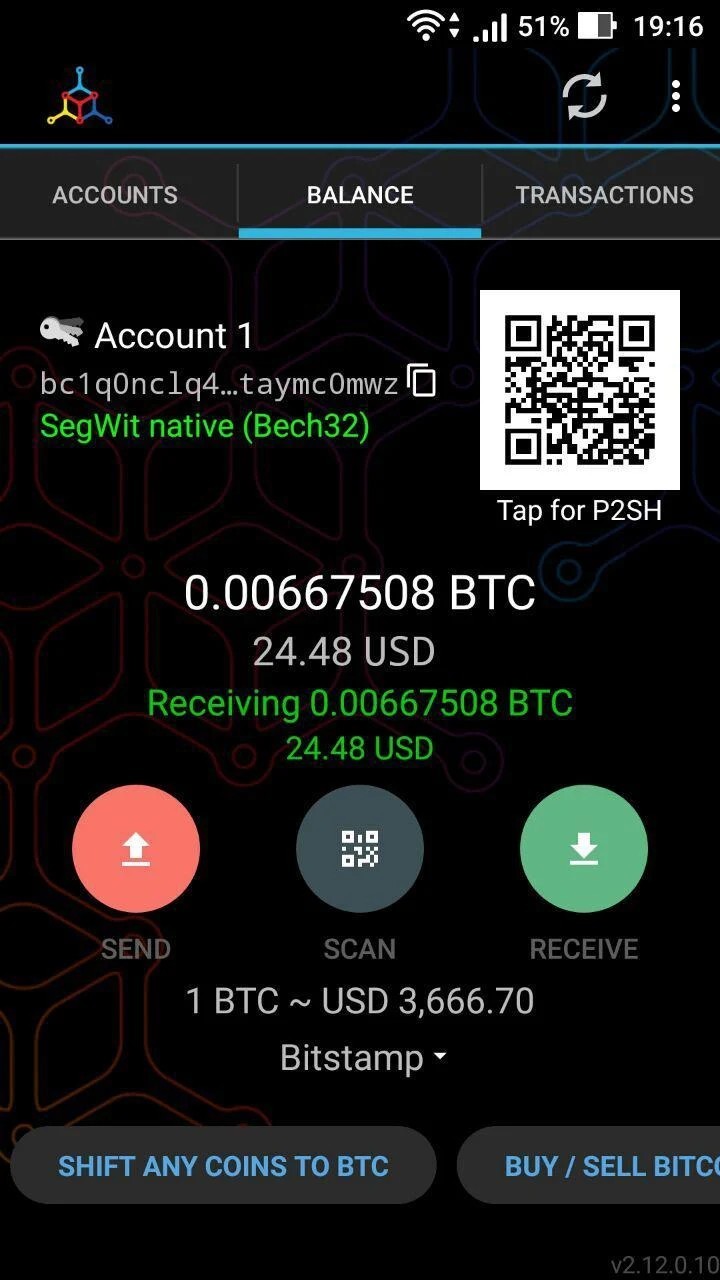
Total supported coins: around 6 directly, with additional assets accessible indirectly through integrations. Mycelium prioritizes security and transparency over broad multi-asset support, which is why it tends to attract long-term Bitcoin users and developers rather than those focused on holding a wide range of altcoins. Because of this approach, many experienced users view the Mycelium crypto wallet as a specialized solution designed primarily for Bitcoin, rather than a full multi-chain wallet.
Pricing and fees
Basic plan: Free but not frictionless
The Mycelium wallet is free to install and use, but transactions require Bitcoin network miner fees. These fees are not fixed and depend on network congestion, typically measured in satoshis per byte. Within the Mycelium Bitcoin wallet, users can manually adjust fee levels, choosing between slower confirmations or faster processing.
Although the wallet itself is free, certain actions may involve additional costs. For example, users exploring whether they can buy Bitcoin on Mycelium will find that purchases are handled through external providers or exchanges rather than directly within the app.
Paid plan: Premium tools through third parties
There is no official paid subscription for the wallet. However, Mycelium can connect to external services that may charge their own fees. This is why users researching options to buy Bitcoin through the Mycelium wallet often encounter service charges and, in some cases, identity verification requirements.
The wallet also supports integration with external hardware devices for enhanced security. When paired with devices such as Trezor or Ledger, a Mycelium hardware wallet setup allows users to keep private keys offline while managing transactions through the mobile interface.
User interface & experience
The Mycelium crypto wallet is clearly built with experienced users in mind. Its interface might not have the sleek polish of modern apps like ZenGo or Trust Wallet, but what it lacks in design, it makes up for with depth and robust features.
What to expect:
The Mycelium wallet Android interface focuses on functionality over visual design, providing detailed transaction data and advanced settings.
Beginners may initially find the range of options overwhelming, although overall navigation remains straightforward once familiar with the layout.
During setup, users must save a backup phrase, which is essential for Mycelium wallet recovery if the device is lost or replaced.
The wallet includes real-time balance tracking, transaction history, and an address book for managing frequent contacts.
Additional security can be achieved by connecting hardware devices or using setups sometimes referred to as a Mycelium wallet desktop workflow, where the mobile app is paired with external storage solutions.
In summary, the Mycelium wallet provides a practical interface designed for users who want full control over their funds. It may not appeal to casual traders or those focused on NFTs, but it remains suitable for long-term Bitcoin holders and more technically experienced users.
Because the wallet does not handle direct fiat purchases, many users first buy Bitcoin on an exchange and then transfer it to their Mycelium wallet. The table below highlights several beginner-friendly exchanges that can simplify this process.
| OKX | Coinbase | Crypto.com | Cryptohopper | BTCC | |
|---|---|---|---|---|---|
|
Demo account |
Yes | No | No | No | Yes |
|
Min. Deposit, $ |
10 | 10 | 1 | No | 10 |
|
Coins Supported |
600+ | 400+ | 400+ | 1000 | 399 |
|
Spot Taker fee, % |
0.1 | 0.5 | 0.5 | 0 | 0.3 |
|
Spot Maker Fee, % |
0.08 | 0.5 | 0.25 | 0 | 0.2 |
|
Alerts |
Yes | Yes | Yes | Yes | No |
|
Copy trading |
Yes | No | No | Yes | Yes |
|
TU overall score |
8.48 | 7.84 | 7.8 | 7.76 | 7.6 |
|
Open an account |
Go to broker Your capital is at risk. |
Go to broker Your capital is at risk. |
Go to broker Your capital is at risk. |
Go to broker Your capital is at risk. |
Go to broker Your capital is at risk.
|
Unlock hidden privacy layers and fee-saving tactics in Mycelium Wallet 2026

Many users start with the Mycelium wallet simply to store Bitcoin, but there is a more advanced setup that is often overlooked. By combining cold storage spending with manual fee controls, it is possible to sign transactions offline on one device and broadcast them from another. While this may sound technical at first, it becomes manageable with practice and significantly improves privacy while keeping private keys offline. This approach is one reason the Mycelium hardware wallet setup is often recommended for users seeking stronger security.
Another useful feature is manual fee adjustment. The wallet allows users to set transaction fees based on current network conditions, which can help reduce costs. Checking a mempool tracker before sending funds and adjusting the sat/vByte rate accordingly can make transactions more efficient without unnecessary delays. This becomes especially relevant when moving funds between platforms, such as when users transfer Bitcoin from Coinbase to Mycelium to store assets in a self-custody wallet.
Conclusion
The Mycelium wallet stands out as a top choice for security-conscious Bitcoin holders who value full control over their private keys and advanced privacy options. Its robust feature set, such as manual fee adjustments and hardware wallet integration, enables users to customize their experience while maintaining maximum asset protection. Although its focus is almost exclusively on Bitcoin and the interface may seem technical to beginners, experienced users will find its functionality and transparency particularly valuable. Ultimately, Mycelium proves that prioritizing security and self-custody can offer both peace of mind and practical advantages in the ever-evolving world of cryptocurrency.
FAQs
What types of transactions does Mycelium Wallet support, and how flexible is fee customization?
Does Mycelium Wallet support altcoins or tokens beyond Bitcoin?
How do cold storage and offline signing work with Mycelium Wallet?
Are there any subscription costs or hidden fees associated with using Mycelium Wallet?
Editors' Top Picks and Insights





Related Articles
Team that worked on the article
Aleksandra Chaikina has been a contributor to Traders Union since 2021. With over 15 years of experience in copywriting and more than 5 years focused on financial content, she specializes in producing detailed guides, analytics, and comparative reviews across various sectors, including cryptocurrencies, Forex, investment strategies, and financial technologies.
Dan Blystone began his trading career in 1998 as an arbitrage clerk on the floor of the Chicago Mercantile Exchange (CME). He later traded bond and Eurex futures at proprietary firms such as Altea Trading, gaining valuable experience in high-frequency trading and risk management.
Chinmay Soni is a financial analyst with more than 5 years of experience in working with stocks, Forex, derivatives, and other assets. As a founder of a boutique research firm and an active researcher, he covers various industries and fields, providing insights backed by statistical data.
Cryptocurrency is a type of digital or virtual currency that relies on cryptography for security. Unlike traditional currencies issued by governments (fiat currencies), cryptocurrencies operate on decentralized networks, typically based on blockchain technology.
Copy trading is an investing tactic where traders replicate the trading strategies of more experienced traders, automatically mirroring their trades in their own accounts to potentially achieve similar results.
Bitcoin is a decentralized digital cryptocurrency that was created in 2009 by an anonymous individual or group using the pseudonym Satoshi Nakamoto. It operates on a technology called blockchain, which is a distributed ledger that records all transactions across a network of computers.
Xetra is a German Stock Exchange trading system that the Frankfurt Stock Exchange operates. Deutsche Börse is the parent company of the Frankfurt Stock Exchange.
Yield refers to the earnings or income derived from an investment. It mirrors the returns generated by owning assets such as stocks, bonds, or other financial instruments.

-
 Afghanistan
-
 Albania
-
 Algeria
-
 Angola
-
 Argentina
-
 Armenia
-
 Australia
-
 Austria
-
 Azerbaijan
-
 Bahamas
-
 Bahrain
-
 Bangladesh
-
 Belarus
-
 Belgium
-
 Bolivia
-
 Botswana
-
 Brazil
-
 Brunei
-
 Bulgaria
-
 Cambodia
-
 Cameroon
-
 Canada
-
 Chile
Chile
-
 China
China
-
 Colombia
-
 Congo
Congo
-
 Costa Rica
-
 Cote d'Ivoire
-
 Croatia
-
 Cuba
Cuba
-
 Cyprus
-
 Czechia
-
 DR Congo
-
 Denmark
-
 Dominican Republic
-
 Ecuador
-
 Egypt
Egypt
-
 El Salvador
-
 Estonia
-
 Eswatini
-
 Ethiopia
-
 Finland
-
 France
-
 Georgia
-
 Germany
-
 Ghana
Ghana
-
 Greece
-
 Haiti
Haiti
-
 Hong Kong
-
 Hungary
-
 India
India
-
 Indonesia
-
 Iran, Islamic republic
-
 Iraq
Iraq
-
 Ireland
-
 Israel
-
 Italy
Italy
-
 Jamaica
-
 Japan
Japan
-
 Jordan
-
 Kazakhstan
-
 Kenya
Kenya
-
 Korea
Korea
-
 Kuwait
-
 Kyrgyzstan
-
 Laos
Laos
-
 Latvia
-
 Lebanon
-
 Lesotho
-
 Libya
Libya
-
 Lithuania
-
 Luxembourg
-
 Madagascar
-
 Malaysia
-
 Malta
Malta
-
 Mauritius
-
 Mexico
-
 Moldova
-
 Mongolia
-
 Montenegro
-
 Morocco
-
 Mozambique
-
 Myanmar
-
 Namibia
-
 Nepal
Nepal
-
 Netherlands
-
 New Zealand
-
 Nigeria
-
 North Macedonia
-
 Norway
-
 Oman
Oman
-
 Pakistan
-
 Palestine
-
 Panama
-
 Papua New Guinea
-
 Paraguay
-
 Peru
Peru
-
 Philippines
-
 Poland
-
 Portugal
-
 Puerto Rico
-
 Qatar
Qatar
-
 Reunion
-
 Romania
-
 Rwanda
-
 Saudi Arabia
-
 Serbia
-
 Singapore
-
 Slovakia
-
 Slovenia
-
 Somalia
-
 South Africa
-
 Spain
Spain
-
 Sri Lanka
-
 Sweden
-
 Switzerland
-
 Syria
Syria
-
 Taiwan
-
 Tajikistan
-
 Tanzania
-
 Thailand
-
 Trinidad and Tobago
-
 Tunisia
-
 Turkey
-
 UAE
UAE
-
 Uganda
-
 Ukraine
-
 United Kingdom
-
United States
-
 Uruguay
-
 Uzbekistan
-
 Venezuela
-
 Vietnam
-
 Yemen
Yemen
-
 Zambia
-
 Zimbabwe
- Forex
- Crypto












