
The Swiss Franc: A Quiet Safe Haven Asset



Editorial Note: While we adhere to strict Editorial Integrity, this post may contain references to products from our partners. Here's an explanation for How We Make Money. None of the data and information on this webpage constitutes investment advice according to our Disclaimer.
The Swiss franc has been a uniquely profitable FX investment since the turn of the century. It has vastly outperformed the US dollar, the pound, the euro, and the yen. Switzerland has pursued independent political and monetary policies that have maintained a strong currency, supported by a strong overall economy.
While the US dollar (USD), the Chinese yuan (CNY), and the euro (EUR) keep slugging it out on the global economic stage, the Swiss franc (CHF) quietly remains one of the strongest, most stable, and most profitable currencies in the world.
Looking for a strong currency to invest in? Well, thus far into the 21st century, the Swiss franc would have been one of the best bets you could have made. Let’s take just a quick glance at its performance to easily see how true that statement is. Since the turn of the century, and especially since the 2008 financial crisis, the Swiss franc has gained substantially in value versus every other major currency:
The euro is down nearly 50% versus the franc since the 2008 financial crisis.
The US dollar, despite remaining strong versus most other major currencies, has fallen by more than 30% against the Swiss franc over that same time span and is down approximately 20% versus the franc in just the past five years.
The British pound and the Japanese yen have fared even worse measured against the franc, both showing losses of more than 50% versus CHF since the turn of the century.
Monthly chart of USD/CHF, dating back to 2002
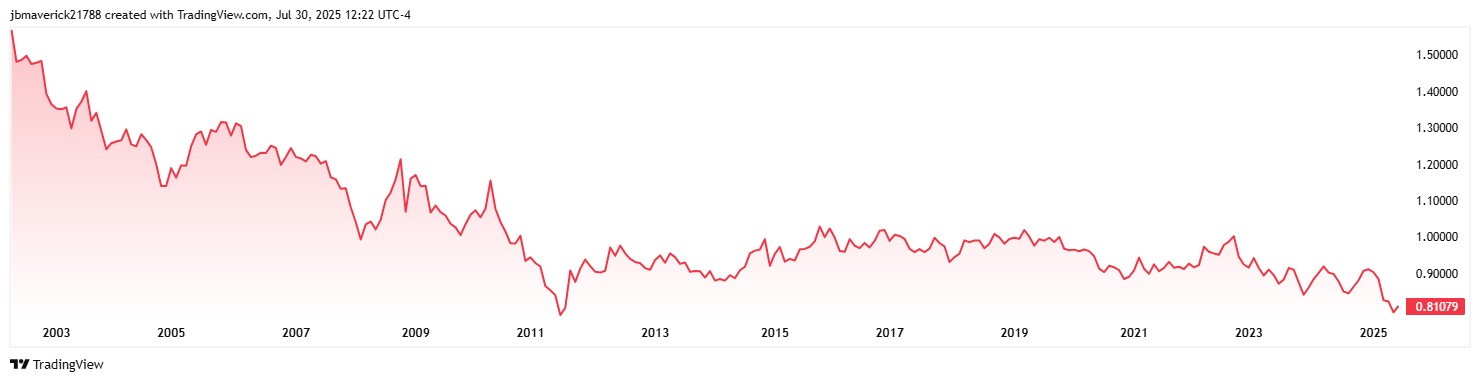
In an era of increased global economic uncertainty and volatility, the Swiss franc has frequently shown itself as an island of stability and financial strength. Why? – Well, the answer is really pretty simple. The Swiss franc has been an island of stability and financial strength because Switzerland itself has historically been an island of stability and financial strength.
The financial strength of Switzerland and the Swiss franc
The 8th most frequently traded currency worldwide, the Swiss franc has steadfastly held its ground. While the other western European countries have adopted the euro, Switzerland has refused to follow the crowd. Not being a part of the European Union has enabled Switzerland to, among other things, evade the EU’s current debt crisis. The Swiss franc is still the only currency accepted in Switzerland.
The franc is so strong that some investors may mistakenly believe that it’s backed by gold. It’s not – However, Switzerland, ever financially prudent, does maintain one of the largest amounts of gold reserves worldwide. Depending on who you listen to, its gold hoard ranks somewhere between the 5th and 7th largest in the world – not bad for a relatively small country.
A solid economic foundation
Switzerland can boast a strong overall economy that continually attracts foreign investors, low inflation, a relatively small national debt, a positive current account balance, and political stability. What’s not to like? All of those factors combine to make the Swiss franc a currency that’s attractive to investors.
The world’s premier financial industry
The Swiss banking industry has been renowned and respected for centuries. We all know that the ultra-rich, when seeking to protect their wealth, have often sought the safe haven of a Swiss bank account. Swiss banks remain among the most trusted financial institutions found anywhere on the globe.
International neutrality and internal political stability
Switzerland’s consistent foreign policy is another key to its economic success and the strength and stability of the Swiss franc. Switzerland is famously neutral, refusing to take sides in global political battles, favoring neither East nor West. That stance has helped to keep Switzerland itself politically stable, rather than politically torn apart like the US, the UK, and much of the rest of the world. That neutrality and political stability is reassuring to investors, more and more of whom have come to view the Swiss franc as a safe haven asset, safe from the political and economic turmoil that has afflicted EU members such as France, Greece, and Spain.
Fiscal responsibility
The Swiss government and the Swiss National Bank (SNB), by their policies and actions, also help Switzerland to stand in stark contrast to many of its neighbors – to many other countries, period. The Swiss governmental and financial authorities are often described using terms that are rarely, if ever, applied to other countries – terms such as “transparent” and “fiscally responsible”. By its timely actions and monetary policies, the directors of the SNB have consistently shown themselves to be wiser and more financially adroit than those directing the actions of other central banks, driving the franc to continually increasing value.
Low inflation helps the Swiss franc retain value
Inflation is the killer of fiat currencies, continually eating away at their purchasing power and thus, their value.
The citizens of Switzerland have enjoyed living in one of the few developed nations that hasn’t been absolutely rocked by inflation in recent years. The Swiss National Bank has deftly stepped into the foreign exchange market, shoring up the Swiss franc with purchases, whenever necessary, to put out the fires of inflation before they become a conflagration. While the US and the EU have largely relied on manipulating interest rates in a series of – mostly failed – attempts to control inflation, the SNB has had great success by, instead, taking direct action in the Forex market.
Just how successful have the Swiss been at keeping inflation at a bare minimum? – Amazingly successful. While the US and other Western countries were being ravaged by inflation rates of 9-10% or more in 2022, inflation in Switzerland only rose barely over 2%. That’s actually on the high end of things for Switzerland, where the average rate of annual inflation has tracked at just 2.4% for more than half a century (since 1960).
And the inflation numbers have only continued getting better. For the five-year period from 2019 to 2024, the average annual inflation rate in Switzerland was a modest 1.2%. The latest numbers, the year-over-year rate for June, 2025, are barely a blip – 0.08% inflation. Economists’ current projections for future inflation are for average annual inflation of 0.60% to 1.5%.
CHF deserves greater portfolio weighting for institutional investors and long-term capital allocators

From a macroeconomic standpoint, the Swiss franc (CHF) remains one of the few currencies that offer genuine insulation against systemic global shocks. Its resilience is no longer simply a historical pattern but an actively maintained equilibrium, supported by exceptional policy execution from the Swiss National Bank (SNB) and Switzerland’s political architecture. For institutional investors and long-term capital allocators seeking a hedge against fiat devaluation or geopolitical turbulence, CHF deserves greater portfolio weighting – not merely as a defensive asset, but as a strategic store of value.
Looking forward, continued monetary divergence between Switzerland and inflation-vulnerable economies like the U.S., U.K., and eurozone suggests the CHF will likely appreciate further in relative terms. Even marginal rate shifts in those economies – without corresponding inflation control – may only enhance the Swiss franc’s appeal. The environment of 2025 and beyond favors currencies rooted in fiscal restraint and political neutrality, and CHF checks both boxes with consistency.
Unless there is a structural realignment in the global monetary system, the Swiss franc will remain an outperformer among major fiat currencies. Investors seeking currency exposure with embedded risk mitigation should not underestimate CHF’s potential to deliver both capital preservation and selective alpha.
Conclusion
The Swiss franc has been a uniquely profitable foreign exchange asset since the turn of the century. Meanwhile, other fiat currencies have deteriorated in value so badly that more and more financial analysts are predicting the collapse of the entire fiat currency system.
The franc’s outperformance is no mystery. Several prominent factors have contributed to its success. Among them are the following:
Consistently low inflation.
A stable banking system, combined with political stability
Financial independence (Switzerland refusing to join the EU).
Political neutrality.
Small national debt.
There are plenty of good reasons why Forex investors may well want to consider including the Swiss franc in their investment portfolios.
FAQs
How has the Swiss franc performed over the past 10 years?
Over the past 10 years, the Swiss franc has arguably been the strongest currency on the board. It has increased significantly in value versus every other major currency – gaining approximately 30-50% against the US dollar, the euro, the British pound, and the Japanese yen.
Is the Swiss franc a gold-backed currency?
Despite the strength and stability that it exhibits, the Swiss franc is not directly backed by gold. It’s another fiat currency, just like the US dollar or the euro. However, it may be indirectly supported in value by the fact that Switzerland does maintain a substantial stockpile of gold reserves.
How have the monetary policies of the Swiss National Bank (SNB), Switzerland’s central bank, affected the value of the Swiss franc?
The Swiss National Bank doesn’t hesitate to intervene on behalf of the nation’s currency. Its monetary policies tend to differ from those of other Western nations, in that the SNB is more likely to use currency market interventions – rather than interest rate adjustments – to protect the value of the Swiss franc. For example, it has tamped down inflation by purchasing large amounts of the franc in the Forex market – and sold francs when surges in the exchange rate threatened Swiss exports or tourism.
What are the key factors that contribute to the Swiss franc’s value as a currency?
There are several positive factors that help the Swiss franc to retain strength and increase in value. These factors include a strong economy overall, the stability of the Swiss government and the Swiss banking system, a relatively low national debt, an economic environment that is friendly to foreign investors, and the Swiss National Bank’s successful intervention to prevent excessively high inflation rates.
Editors' Top Picks and Insights

FIFA World Cup on blockchain: Where football meets crypto

Aliens, Satoshi, and Bitcoin: How the extraterrestrial theory emerged

Blockchain nation in crisis: How a power struggle split Liberland

Shifting priorities: Governments back mining as businesses turn to AI

Intel's comeback: Apple, Trump and the AI bet

Bitcoin price prediction based on RSI: Is BTC poised for a new rally?
Related Articles
Team that worked on the article
Johnathan M. is a U.S.-based writer and investor, a contributor to the Traders Union website.
One of the most widely respected and quoted currency experts, Marc Chandler has been analyzing and advising on the global capital markets for more than 30 years. Throughout his career on Wall Street, Chandler has advised private businesses, hedge funds and asset managers on navigating the foreign exchange market.
Chinmay Soni is a financial analyst with more than 5 years of experience in working with stocks, Forex, derivatives, and other assets. As a founder of a boutique research firm and an active researcher, he covers various industries and fields, providing insights backed by statistical data.
Forex trading, short for foreign exchange trading, is the practice of buying and selling currencies in the global foreign exchange market with the aim of profiting from fluctuations in exchange rates. Traders speculate on whether one currency will rise or fall in value relative to another currency and make trading decisions accordingly. However, beware that trading carries risks, and you can lose your whole capital.
Forex leverage is a tool enabling traders to control larger positions with a relatively small amount of capital, amplifying potential profits and losses based on the chosen leverage ratio.
CFD is a contract between an investor/trader and seller that demonstrates that the trader will need to pay the price difference between the current value of the asset and its value at the time of contract to the seller.
Index in trading is the measure of the performance of a group of stocks, which can include the assets and securities in it.
Volatility refers to the degree of variation or fluctuation in the price or value of a financial asset, such as stocks, bonds, or cryptocurrencies, over a period of time. Higher volatility indicates that an asset's price is experiencing more significant and rapid price swings, while lower volatility suggests relatively stable and gradual price movements.

-
 Afghanistan
-
 Albania
-
 Algeria
-
 Angola
-
 Argentina
-
 Armenia
-
 Australia
-
 Austria
-
 Azerbaijan
-
 Bahamas
-
 Bahrain
-
 Bangladesh
-
 Belarus
-
 Belgium
-
 Bolivia
-
 Botswana
-
 Brazil
-
 Brunei
-
 Bulgaria
-
 Cambodia
-
 Cameroon
-
 Canada
-
 Chile
Chile
-
 China
China
-
 Colombia
-
 Congo
Congo
-
 Costa Rica
-
 Cote d'Ivoire
-
 Croatia
-
 Cuba
Cuba
-
 Cyprus
-
 Czechia
-
 DR Congo
-
 Denmark
-
 Dominican Republic
-
 Ecuador
-
 Egypt
Egypt
-
 El Salvador
-
 Estonia
-
 Eswatini
-
 Ethiopia
-
 Finland
-
 France
-
 Georgia
-
 Germany
-
 Ghana
Ghana
-
 Greece
-
 Haiti
Haiti
-
 Hong Kong
-
 Hungary
-
 India
India
-
 Indonesia
-
 Iran, Islamic republic
-
 Iraq
Iraq
-
 Ireland
-
 Israel
-
 Italy
Italy
-
 Jamaica
-
 Japan
Japan
-
 Jordan
-
 Kazakhstan
-
 Kenya
Kenya
-
 Korea
Korea
-
 Kuwait
-
 Kyrgyzstan
-
 Laos
Laos
-
 Latvia
-
 Lebanon
-
 Lesotho
-
 Libya
Libya
-
 Lithuania
-
 Luxembourg
-
 Madagascar
-
 Malaysia
-
 Malta
Malta
-
 Mauritius
-
 Mexico
-
 Moldova
-
 Mongolia
-
 Montenegro
-
 Morocco
-
 Mozambique
-
 Myanmar
-
 Namibia
-
 Nepal
Nepal
-
 Netherlands
-
 New Zealand
-
 Nigeria
-
 North Macedonia
-
 Norway
-
 Oman
Oman
-
 Pakistan
-
 Palestine
-
 Panama
-
 Papua New Guinea
-
 Paraguay
-
 Peru
Peru
-
 Philippines
-
 Poland
-
 Portugal
-
 Puerto Rico
-
 Qatar
Qatar
-
 Reunion
-
 Romania
-
 Rwanda
-
 Saudi Arabia
-
 Serbia
-
 Singapore
-
 Slovakia
-
 Slovenia
-
 Somalia
-
 South Africa
-
 Spain
Spain
-
 Sri Lanka
-
 Sweden
-
 Switzerland
-
 Syria
Syria
-
 Taiwan
-
 Tajikistan
-
 Tanzania
-
 Thailand
-
 Trinidad and Tobago
-
 Tunisia
-
 Turkey
-
 UAE
UAE
-
 Uganda
-
 Ukraine
-
 United Kingdom
-
United States
-
 Uruguay
-
 Uzbekistan
-
 Venezuela
-
 Vietnam
-
 Yemen
Yemen
-
 Zambia
-
 Zimbabwe
- Forex
- Crypto












