
Tesla's Cryptocurrency Portfolio: A Comprehensive Overview


Editorial Note: While we adhere to strict Editorial Integrity, this post may contain references to products from our partners. Here's an explanation for How We Make Money. None of the data and information on this webpage constitutes investment advice according to our Disclaimer.
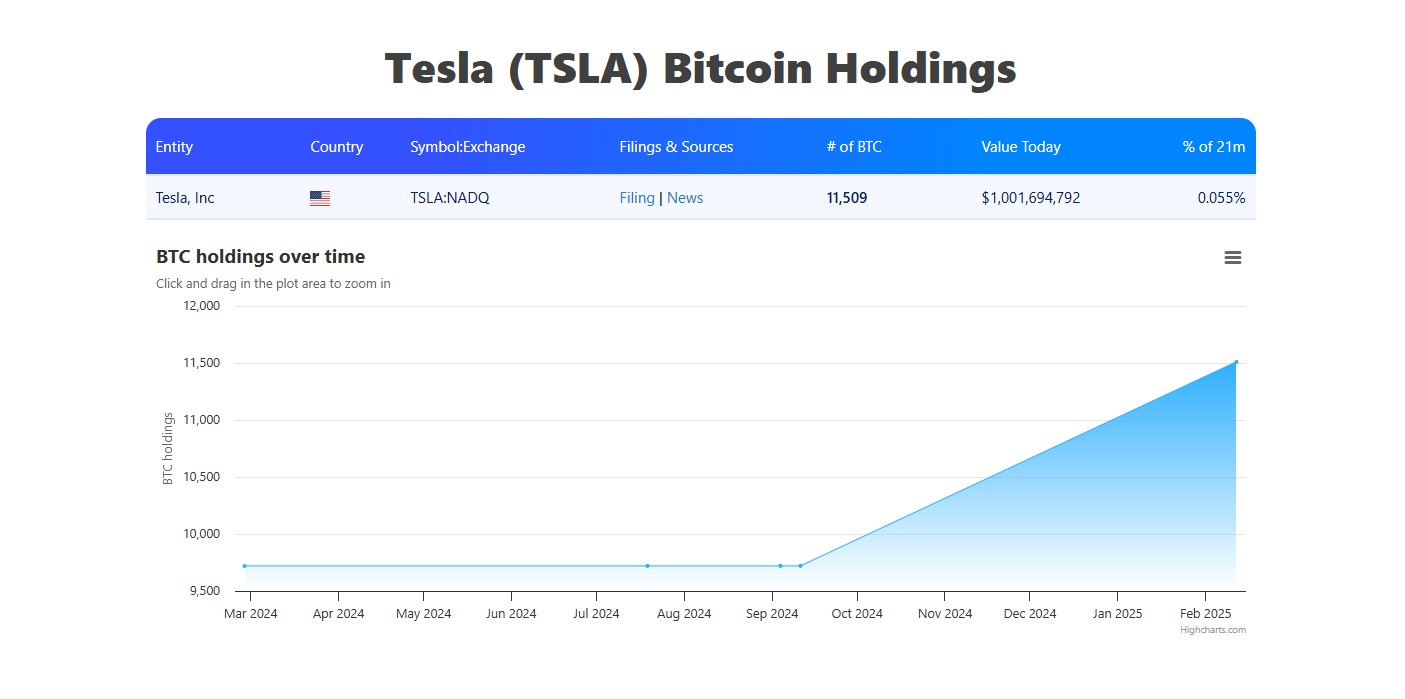
Tesla's crypto portfolio mainly holds 11,509 BTC, worth about $1.02 billion. The company first bought $1.5 billion in Bitcoin in early 2021, getting 43,200 BTC at around $38,833 each. In 2022, Tesla sold 75% of its Bitcoin, cutting down its stash to 9,720 BTC. By the end of 2024, Tesla added more Bitcoin, bringing the total to 11,509 BTC. In the fourth quarter of 2024, Tesla announced a $600 million profit from its Bitcoin, boosting its quarterly profits to $2.3 billion. The company also accepts DOGE for merchandise purchases but hasn't shared how much it owns.
Tesla Inc. (TSLA) continues to be a significant institutional participant in the cryptocurrency market. The company holds approximately 11,509 Bitcoin (BTC), valued at around $1.07 billion, and has reported a $600 million profit from these holdings in the fourth quarter of 2024, following new accounting rules. Tesla also accepts Dogecoin (DOGE) for certain merchandise purchases, reflecting its innovative approach to integrating digital assets. This article provides an in-depth analysis of Tesla's cryptocurrency holdings, financial implications, and future outlook.

Tesla’s Bitcoin holdings
Tesla's significant investment in Bitcoin has made headlines and shaped corporate attitudes towards cryptocurrency. Below is a detailed overview of Tesla's Bitcoin activities and their financial implications.
Investment and current value
Initial purchase. In February 2021, Tesla invested $1.5 billion in Bitcoin, acquiring approximately 43,200 BTC. This significant move marked one of the largest corporate investments in cryptocurrency at the time, boosting market confidence in Bitcoin's institutional adoption.
Sales activity. By June 2022, Tesla sold about 75% of its Bitcoin holdings, approximately 32,480 BTC, for $936 million amid liquidity concerns during the crypto market downturn. This sale reduced its total Bitcoin holdings to 9,720 BTC, contributing to the company's financial liquidity during a challenging economic environment.
Subsequent acquisitions. As of December 31, 2024, Tesla's Bitcoin holdings increased to 11,509 BTC. The company has not disclosed the exact dates or amounts of these acquisitions but maintains its position as one of the largest corporate Bitcoin holders.
Current valuation. With Bitcoin trading at approximately $87,193, Tesla's Bitcoin holdings are valued at around $1 billion. This represents a significant unrealized profit compared to its original investment. Tesla's ability to hold through market fluctuations demonstrates its long-term commitment to cryptocurrency as a treasury asset.
Financial impact of Bitcoin holdings
Q4 2024 gains. Tesla reported a $600 million gain from its Bitcoin holdings in the fourth quarter of 2024, mainly because of Bitcoin's price surge past $90,000 during that time. This gain made up about 26% of Tesla's net income for the quarter.
New accounting rules. In December 2023, the Financial Accounting Standards Board set new guidelines that let companies report digital assets at their current market value. This change allowed Tesla to show its cryptocurrency holdings more clearly on its balance sheet.
Potential future gains. As more institutional investors adopt Bitcoin, Tesla's Bitcoin holdings might continue to grow in value, providing possible financial gains and flexibility for the company in 2025 and beyond.
Dogecoin transactions and acceptance
Dogecoin payments. Since January 2022, Tesla has accepted DOGE as payment for select merchandise, including apparel, accessories, and novelty items in its online store. As of now, Tesla has not expanded this payment option to include energy products like solar panels or Powerwall systems. The company emphasizes that it only accepts Dogecoin and cannot process payments made with other digital assets.
Annual Dogecoin transactions.Tesla has not publicly disclosed the total volume of Dogecoin transactions it processes annually. While the company accepts DOGE for certain merchandise, specific figures regarding transaction volumes remain undisclosed.
Potential for expansion. Elon Musk has suggested the possibility of accepting Dogecoin for vehicle purchases in the future. However, as of now, Tesla has not officially confirmed any plans to implement such a payment option.
DOGE holdings. Tesla has not publicly disclosed the amount of Dogecoin it holds on its balance sheet. While Elon Musk has expressed support for Dogecoin, the company's specific holdings remain confidential.
Tesla’s use of Bitcoin as a treasury asset and its acceptance of Dogecoin for payments highlight how cryptocurrencies are moving from speculative instruments to real-world financial tools. For individual investors looking to gain exposure to assets like BTC or DOGE, choosing a reliable cryptocurrency exchange is a key first step. The table below compares popular crypto exchanges that support trading and holding major digital assets.
| Coinbase | OKX | BTCC | Cryptohopper | Crypto.com | |
|---|---|---|---|---|---|
|
Demo account |
No | Yes | Yes | No | No |
|
Coins Supported |
400+ | 600+ | 399 | 1000 | 400+ |
|
Min. Deposit, $ |
10 | 10 | 10 | No | 1 |
|
Spot leverage |
1:3 | 1:10 | 1:1 | No | 1:3 |
|
Spot Maker Fee, % |
0.5 | 0.08 | 0.2 | 0 | 0.25 |
|
Spot Taker fee, % |
0.5 | 0.1 | 0.3 | 0 | 0.5 |
|
TU overall score |
8.5 | 8.46 | 8.08 | 7.8 | 7.76 |
|
Open an account |
Go to broker Your capital is at risk. |
Go to broker Your capital is at risk. |
Go to broker Your capital is at risk.
|
Go to broker Your capital is at risk. |
Go to broker Your capital is at risk. |
Ethical considerations and market influence
When Tesla dipped into Bitcoin, it wasn’t just about diversifying cash reserves — it was a calculated move with ripple effects across the crypto market. Here’s something most people overlook: Tesla’s involvement pushed corporate Bitcoin adoption forward by years. Before their purchase, institutions hesitated over regulatory uncertainty. But Tesla’s move signaled to Wall Street that Bitcoin wasn’t just a speculative asset; it was balance-sheet material. This had a direct impact on Bitcoin’s price cycles — Tesla’s initial buy-in helped drive Bitcoin past $60K in early 2021, but when they sold a chunk, it triggered one of the sharpest pullbacks in history. Understanding how corporate whales like Tesla influence liquidity can give traders an edge in timing market swings.
On the ethical side, Tesla’s decision to accept then reject Bitcoin due to environmental concerns wasn’t just PR — it reshaped mining trends. After Elon Musk’s criticism, miners scrambled to increase their use of renewable energy, with Bitcoin’s sustainable energy use rising from 37% to over 50% within months. But here’s the kicker: Tesla’s rejection of Bitcoin actually sped up the industry’s shift to cleaner mining, proving that corporate influence can push entire markets toward ethical reform. Investors watching Tesla’s moves should not just focus on what they buy, but also on how their statements can reshape industries overnight.
Market reactions
When Tesla first bought Bitcoin in 2021, the price shot up nearly 20% in a single day. But here’s the real kicker — whenever Tesla changes how much crypto it holds, it’s not just about the numbers. When the company offloaded 75% of its Bitcoin in 2022, Bitcoin didn’t just dip; it lost half its value over the next few months. Why? It wasn’t just Tesla selling — it made other big investors rethink their positions. That’s why beginners shouldn’t just focus on what Tesla buys or sells, but also on how other major players react.
And Tesla’s influence isn’t just on Bitcoin. When it added BTC to its balance sheet, stocks like Strategy (MSTR) and even Ethereum started bouncing around more than usual. The weirdest part? Dogecoin jumped 30% in the weeks after, not because of any real changes, but because traders started guessing that Tesla might get involved with other cryptos. That means keeping an eye on Tesla isn’t just about Bitcoin — it can help you predict moves in other parts of the market, too.
Future outlook: What’s next for Tesla in crypto?

Tesla has shaken up the crypto market before, but what comes next could be even bigger. Here’s what smart investors should keep an eye on.
Tesla might use Bitcoin for supplier payments. The company briefly accepted BTC for car sales, but the real game-changer would be using Bitcoin to pay its global suppliers. If Tesla starts paying manufacturers in BTC, other companies might feel pressured to follow. That could be the tipping point for Bitcoin’s use in global trade.
Elon’s AI projects could bring blockchain into the mix. Tesla is all-in on AI, but AI needs secure, tamper-proof ways to share data. Blockchain could be the missing piece. If Tesla connects its AI work with blockchain tech, it might lead to automated smart contracts or a new way to verify AI-generated data. That could shake up both industries at once.
Tesla’s energy business could tokenize power trading. Tesla’s solar panels and batteries are popping up everywhere, but what if homeowners could sell extra power like a cryptocurrency? Blockchain could let people trade solar energy without going through a utility company. If Tesla builds that system, it could completely change how home energy is sold.
A Tesla-backed stablecoin isn’t impossible. If Tesla wants more control over crypto payments, launching its own digital coin could be a logical next step. Maybe it starts as a way to pay for Tesla services or Supercharging. If that takes off, it could evolve into something much bigger, turning Tesla into a financial player as well.
More Dogecoin experiments are coming. Right now, Tesla accepts Dogecoin for merch, but what if you could use it to pay for charging your car? Or unlock premium software features? Dogecoin’s low fees make it perfect for small payments, and Tesla could be the company that finally gives it a real-world use case.
Tesla could leverage Bitcoin’s Lightning Network. The biggest reason Tesla stopped accepting Bitcoin was slow transactions and high fees. The Lightning Network fixes that by making BTC payments almost instant and dirt cheap. If Tesla adopts Lightning, it could bring Bitcoin payments back — this time, for good.
Risks and warnings
Market volatility
Bitcoin’s price fluctuations affect Tesla’s balance sheet, creating financial uncertainty.
In 2022, Tesla’s Bitcoin sale was partly due to liquidity concerns caused by BTC’s decline.
Regulatory scrutiny
SEC and accounting regulators continue monitoring corporate crypto holdings.
Changes in accounting policies may impact how Tesla reports future crypto-related gains or losses.
Environmental & Reputational risk
Bitcoin’s environmental impact remains controversial.
Tesla’s reputation is linked to its sustainability efforts, making BTC involvement a delicate balance.
Tesla’s Bitcoin strategy and the hidden accounting challenge

When Tesla jumped into the cryptocurrency world by buying a large amount of Bitcoin in early 2021, it experienced both ups and downs. The company initially bought $1.5 billion in Bitcoin but later sold much of it, citing the need for cash during the COVID-19 pandemic. This situation highlights how unpredictable digital currencies can be and emphasizes the need for companies to manage their cash flow carefully when dealing with such investments. For newcomers, it's important to realize that while digital currencies might offer high profits, they also carry significant risks that can affect a company's financial health.
Tesla's experience also points out the accounting challenges of owning cryptocurrencies. Current accounting rules require companies to report losses when the value of their crypto assets drops, but they can't report gains until they sell the asset. This mismatch can cause fluctuations in reported earnings and might not truly represent the company's financial status. As a beginner, it's key to understand that bringing cryptocurrencies into a company's finances needs careful thought about accounting rules and a strong plan to manage risks.
Conclusion
Tesla's approach to managing its crypto portfolio demonstrates the company's calculated risk-taking in the evolving digital asset space. With its current Bitcoin holdings reflecting both strategic investment and adaptability to market conditions, Tesla continues to influence industry perceptions about corporate involvement in cryptocurrencies. The company's decision to uphold significant Bitcoin reserves—even amid market volatility—highlights a commitment to innovation and financial diversification. Ultimately, Tesla's steadfast presence in the crypto sector sends a clear message: bold moves from industry leaders can help shape the future of global financial landscapes.
FAQs
How do new accounting standards impact Tesla’s reporting of its crypto holdings?
What influence does Tesla’s crypto activity have on the broader cryptocurrency market?
Why did Tesla reduce its Bitcoin holdings in 2022, and what were the consequences?
What are some potential real-world applications for Tesla’s cryptocurrency involvement beyond direct investment?
Editors' Top Picks and Insights






Related Articles
Team that worked on the article
Mikhail Vnuchkov joined Traders Union as an author in 2020. He began his professional career as a journalist-observer at a small online financial publication, where he covered global economic events and discussed their impact on the segment of financial investment, including investor income.
Dan Blystone began his trading career in 1998 as an arbitrage clerk on the floor of the Chicago Mercantile Exchange (CME). He later traded bond and Eurex futures at proprietary firms such as Altea Trading, gaining valuable experience in high-frequency trading and risk management.
Chinmay Soni is a financial analyst with more than 5 years of experience in working with stocks, Forex, derivatives, and other assets. As a founder of a boutique research firm and an active researcher, he covers various industries and fields, providing insights backed by statistical data.
Bitcoin is a decentralized digital cryptocurrency that was created in 2009 by an anonymous individual or group using the pseudonym Satoshi Nakamoto. It operates on a technology called blockchain, which is a distributed ledger that records all transactions across a network of computers.
Forex leverage is a tool enabling traders to control larger positions with a relatively small amount of capital, amplifying potential profits and losses based on the chosen leverage ratio.
Diversification is an investment strategy that involves spreading investments across different asset classes, industries, and geographic regions to reduce overall risk.
Ethereum is a decentralized blockchain platform and cryptocurrency that was proposed by Vitalik Buterin in late 2013 and development began in early 2014. It was designed as a versatile platform for creating decentralized applications (DApps) and smart contracts.
Xetra is a German Stock Exchange trading system that the Frankfurt Stock Exchange operates. Deutsche Börse is the parent company of the Frankfurt Stock Exchange.

-
 Afghanistan
-
 Albania
-
 Algeria
-
 Angola
-
 Argentina
-
 Armenia
-
 Australia
-
 Austria
-
 Azerbaijan
-
 Bahamas
-
 Bahrain
-
 Bangladesh
-
 Belarus
-
 Belgium
-
 Bolivia
-
 Botswana
-
 Brazil
-
 Brunei
-
 Bulgaria
-
 Cambodia
-
 Cameroon
-
 Canada
-
 Chile
Chile
-
 China
China
-
 Colombia
-
 Congo
Congo
-
 Costa Rica
-
 Cote d'Ivoire
-
 Croatia
-
 Cuba
Cuba
-
 Cyprus
-
 Czechia
-
 DR Congo
-
 Denmark
-
 Dominican Republic
-
 Ecuador
-
 Egypt
Egypt
-
 El Salvador
-
 Estonia
-
 Eswatini
-
 Ethiopia
-
 Finland
-
 France
-
 Georgia
-
 Germany
-
 Ghana
Ghana
-
 Greece
-
 Haiti
Haiti
-
 Hong Kong
-
 Hungary
-
 India
India
-
 Indonesia
-
 Iran, Islamic republic
-
 Iraq
Iraq
-
 Ireland
-
 Israel
-
 Italy
Italy
-
 Jamaica
-
 Japan
Japan
-
 Jordan
-
 Kazakhstan
-
 Kenya
Kenya
-
 Korea
Korea
-
 Kuwait
-
 Kyrgyzstan
-
 Laos
Laos
-
 Latvia
-
 Lebanon
-
 Lesotho
-
 Libya
Libya
-
 Lithuania
-
 Luxembourg
-
 Madagascar
-
 Malaysia
-
 Malta
Malta
-
 Mauritius
-
 Mexico
-
 Moldova
-
 Mongolia
-
 Montenegro
-
 Morocco
-
 Mozambique
-
 Myanmar
-
 Namibia
-
 Nepal
Nepal
-
 Netherlands
-
 New Zealand
-
 Nigeria
-
 North Macedonia
-
 Norway
-
 Oman
Oman
-
 Pakistan
-
 Palestine
-
 Panama
-
 Papua New Guinea
-
 Paraguay
-
 Peru
Peru
-
 Philippines
-
 Poland
-
 Portugal
-
 Puerto Rico
-
 Qatar
Qatar
-
 Reunion
-
 Romania
-
 Rwanda
-
 Saudi Arabia
-
 Serbia
-
 Singapore
-
 Slovakia
-
 Slovenia
-
 Somalia
-
 South Africa
-
 Spain
Spain
-
 Sri Lanka
-
 Sweden
-
 Switzerland
-
 Syria
Syria
-
 Taiwan
-
 Tajikistan
-
 Tanzania
-
 Thailand
-
 Trinidad and Tobago
-
 Tunisia
-
 Turkey
-
 UAE
UAE
-
 Uganda
-
 Ukraine
-
 United Kingdom
-
United States
-
 Uruguay
-
 Uzbekistan
-
 Venezuela
-
 Vietnam
-
 Yemen
Yemen
-
 Zambia
-
 Zimbabwe
- Forex
- Crypto












