
A Complete Guide To The cTrader Copy Trading


Editorial Note: While we adhere to strict Editorial Integrity, this post may contain references to products from our partners. Here's an explanation for How We Make Money. None of the data and information on this webpage constitutes investment advice according to our Disclaimer.
cTrader Copy is a built-in copy trading feature within the cTrader platform that allows investors to automatically replicate trades of experienced strategy providers in real time. It uses an equity-to-equity model, ensuring proportional risk and position sizing. Users can monitor performance, manage risk, and start or stop copying at any time.
Copy trading has made it easier for everyday users to participate in financial markets without needing advanced skills or experience. cTrader Copy is one of the most transparent and flexible copy trading platforms available today, built directly into the cTrader environment. It connects investors looking to replicate proven strategies with strategy providers who want to monetise their performance.
This guide covers everything you need to know about cTrader Copy, including how it works, its fee structure, key risks and how to choose the right broker.
Risk warning: Forex trading carries high risks, with potential losses including your entire deposit. Market fluctuations, economic instability, and geopolitical factors impact outcomes. Studies show that 70-80% of traders lose money. Consult a financial advisor before trading.
What is cTrader Copy?
cTrader Copy is a fully integrated copy trading module built directly into the cTrader platform. It connects two types of users: strategy providers, who share their live trading activity, and investors, who automatically replicate those trades in real time.
The system runs on an equity-to-equity model. This means trade sizes are copied proportionally, based on the ratio between the investor's equity and the strategy provider's equity. Here is how that looks in practice:
| Account | Equity | Provider trade size | Copied trade size |
|---|---|---|---|
| Strategy provider | $4,000 | 4 lots | - |
| Investor | $1,000 | - | 1 lot |
Investor equity / Provider equity x Provider volume = Copied volume
So a $1,000 investor copying a $4,000 provider gets exactly 25% of every position, keeping risk proportional at all times. If either side deposits or withdraws funds, the platform recalculates and adjusts all open positions automatically.
A few important things to know about how cTrader Copy operates:
cTrader Copy does not copy trades on stocks or shares. Only Forex, indices, commodities and similar instruments are supported;
each investor gets a dedicated copy trading account, separate from their main trading account. All deposits and withdrawals on this account are managed through the investor's cTrader ID;
when you stop copying a strategy, all open positions in your copy trading account are closed automatically;
cTrader Copy is broker-neutral within the cTrader environment, meaning the same strategy can be followed across different supported brokers.
Unlike traditional PAMM and MAM systems, cTrader Copy gives investors full visibility into open trades, performance history and fee structures before committing any funds.
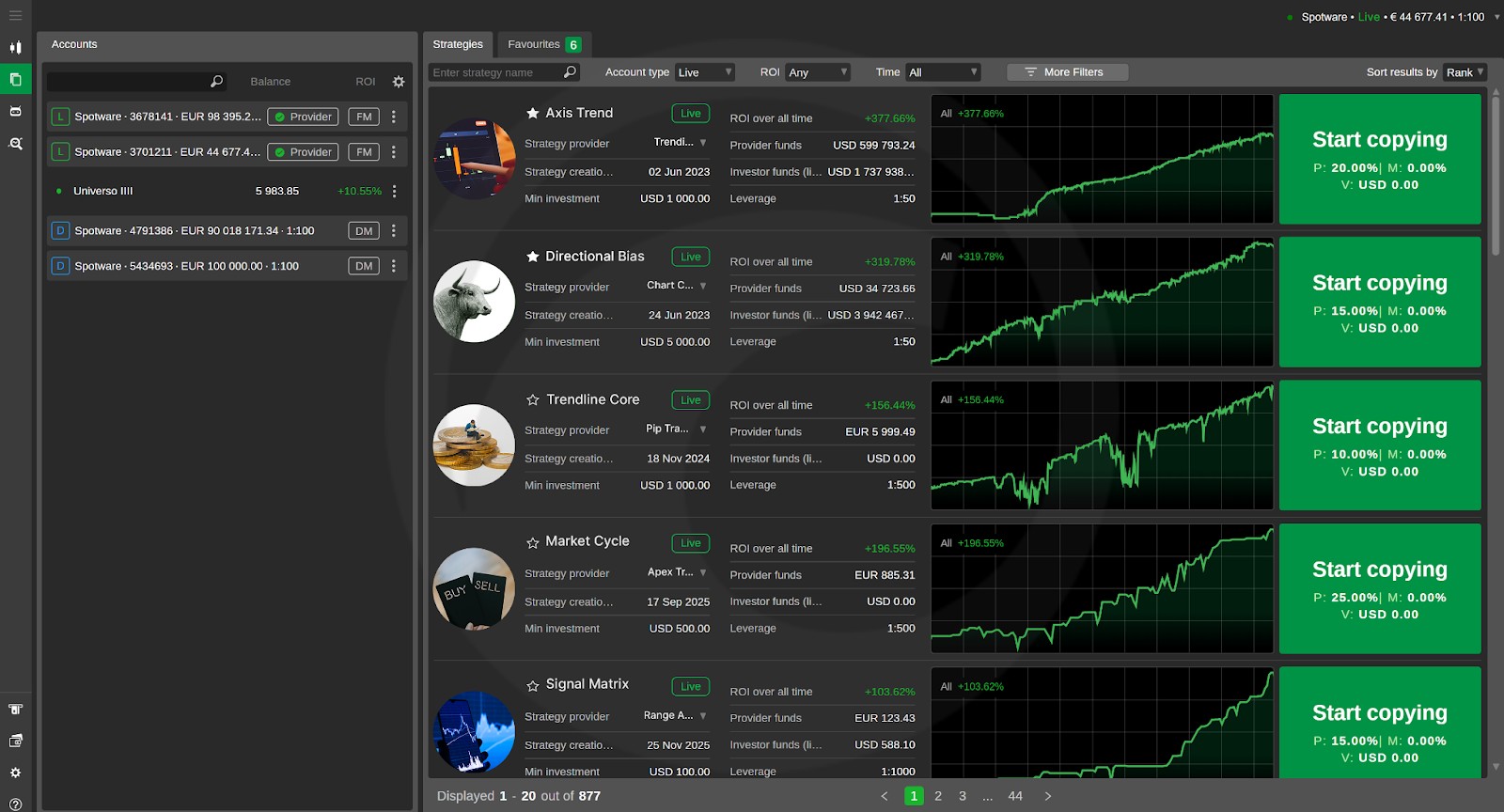
How cTrader Copy works
Getting started with cTrader Copy is straightforward. Users log in with their cTrader ID, navigate to the Copy tab and can start replicating a strategy in just two clicks. Here is the full process:
Step 1: Browse and evaluate strategies
Open the Copy tab and browse the strategy list. Each strategy shows key data including ROI, drawdown, profit factor, active investors and fee structure. You can filter by account type, performance period and other criteria to find strategies that match your investment goals.
Step 2: Check fees and conditions
Before committing, review the fee breakdown shown directly on the Start Copying button. This includes the performance fee, management fee and volume fee, along with the minimum investment required.
Step 3: Allocate funds and start copying
Select an account linked to your cTrader ID, enter the amount you want to invest and confirm. The funds move into a dedicated copy trading account and the system begins replicating the strategy provider's trades automatically.
Step 4: Monitor your investment
Track open positions, profit and loss, and ROI in real time through the Investment Stats section. You can also enable email statements to stay updated on your account activity.
Step 5: Adjust or stop at any time
You can change your allocation, set an equity stop loss or stop copying whenever you choose. There are no lock-in periods. When you stop, all open positions in your copy trading account are closed automatically and your remaining funds return to your main account.
Key features of cTrader Copy
cTrader Copy packs a strong set of tools for both investors and strategy providers. Here is what makes it stand out:
Real-time trade replication. Trades are copied instantly as the strategy provider executes them, with no manual input needed from the investor.
Equity-to-equity model. Position sizes are calculated proportionally based on the investor's equity relative to the provider's equity, keeping risk balanced at all times.
Transparent performance data. Every strategy shows full metrics including ROI, drawdown, profit factor, trade history and open positions before you commit any funds.
Flexible risk controls. Investors can adjust their allocation, set an equity stop loss and exit a strategy at any time without restrictions.
No lock-in periods. There are no minimum holding requirements. Users can start or stop copying freely at any point.
Cross-broker access. The same strategy can be followed across different brokers within the cTrader environment, giving investors more flexibility in choosing a broker.
Built-in fee models. Strategy providers can set a performance fee, management fee or volume fee, all visible to investors upfront before copying begins.
Full multi-platform access. cTrader Copy is available on Windows, Mac, web browser, iOS and Android. All settings, accounts and strategies sync automatically across devices through the user's cTrader ID, so investors can monitor and manage their investments from anywhere without losing continuity.
Fee structure of cTrader Copy
The cTrader Copy fee structure is fully transparent and set by each strategy provider. Investors can review all costs before starting, which helps compare different copy trading strategies and estimate net returns.
There are three main types of fees in cTrader Copy trading:
Performance fee. A percentage of net profit generated by the strategy, usually calculated using a high-water mark so investors are not charged twice on the same gains.
Management fee. A fixed annual percentage of the invested funds, charged regularly regardless of whether the strategy is profitable.
Volume fee. A fee based on trading activity, typically charged per traded lot, meaning higher trading frequency can increase total costs.
How fees impact returns
Fees can significantly affect your final profit, especially when combining multiple fee types. For example, a high performance fee may be acceptable for strong strategies, but adding a management fee and volume fee can reduce net returns over time.
What to check before copying a strategy
Total fee combination. Always evaluate how performance, management, and volume fees work together.
High-water mark usage. Confirm the strategy uses a fair profit calculation method.
Minimum investment requirement. Some strategies require a higher entry amount to participate.
Fee transparency. All costs should be clearly visible before you start copying.
Benefits of cTrader Copy
cTrader Copy trading offers a balanced mix of accessibility, transparency, and control, making it one of the more advanced copy trading platforms. It is designed to suit both beginners and experienced market participants.
Here are the main benefits of using cTrader Copy:
Easy access to financial markets. Beginners can participate in Forex copy trading and other markets without needing advanced trading knowledge.
Transparent strategy data. Investors can analyse ROI, drawdown, and full trading history before allocating funds.
Flexible risk management. Users can control allocation, set an equity stop loss, and exit strategies at any time.
No lock-in restrictions. Funds are not tied up, allowing investors to stop copying whenever needed.
Cross-broker flexibility. Strategies can be followed across multiple brokers within the cTrader ecosystem.
Passive income potential. Investors can earn returns by copying experienced traders without active involvement.
Monetisation for traders. Strategy providers can earn through performance, management, and volume-based fees.
Full control of funds. Investors keep ownership of their capital at all times within their own trading accounts.
Integrated trading environment. All copy trading features are built directly into cTrader, eliminating the need for third-party tools.
Who is cTrader Copy best for
cTrader Copy trading is designed for a wide range of users, from beginners to professional traders. Its flexibility and transparency make it suitable for different trading styles and goals within the broader copy trading platform space.
Here is who benefits the most from cTrader Copy:
Beginners. New traders can enter Forex copy trading without deep market knowledge by following experienced strategy providers and learning from real-time trades.
Passive investors. Users looking for hands-off exposure to the markets can allocate funds and let strategies run without actively managing trades.
Experienced traders. Advanced users can diversify their portfolios by combining manual trading with copy trading strategies or analysing other traders’ approaches.
Strategy providers. Skilled traders can monetise their performance by offering strategies and earning through fees while retaining full control of their accounts.
Mobile-first users. Traders who prefer managing investments on the go benefit from full functionality across mobile and web platforms.
In short, cTrader Copy is best suited for users who want a mix of automation, transparency, and control within a modern social trading platform, whether they are investing passively or actively trading.
Risks and warnings
Before using cTrader Copy, consider the following risks:
Performance risk. Past results do not guarantee future returns, and even top-performing copy trading strategies can experience losses.
Strategy dependency. Investors rely entirely on the decisions of strategy providers, which may not always match their personal risk tolerance.
Market volatility. Sudden price movements in Forex trading, indices, or commodities can lead to rapid drawdowns.
Drawdown risk. High-return strategies often involve higher risk, which can result in significant equity declines during losing periods.
Execution differences. Slippage or broker-related factors may cause slight differences between provider and investor results.
Over-diversification or concentration. Copying too many strategies or relying on a single provider can both increase overall portfolio risk.
Fee impact. High combined fees can reduce net profitability, even if the strategy performs well.
Emotional decision-making. Frequently switching strategies based on short-term results can lead to poor long-term outcomes.
Copy trading is not risk-free. You can lose part or all of your invested capital. Always start with an amount you can afford to lose and evaluate strategies carefully before committing funds.
Understanding these copy trading risks is essential for using cTrader Copy responsibly and building a more sustainable investment approach.
Choosing a broker for cTrader Copy
While cTrader Copy provides the technology for copy trading, your overall experience depends heavily on the broker you choose. Trading conditions, execution quality, and available strategies can vary significantly between brokers offering the cTrader platform.
Here are the key factors to consider when selecting a broker for cTrader Copy trading:
Regulation and safety. Choose a broker regulated by a reputable authority to ensure fund protection and fair trading conditions.
Execution quality. Fast and reliable execution is critical in copy trading platforms to minimise slippage between provider and investor trades.
Spreads and commissions. Lower trading costs help improve net returns, especially when copying high-frequency strategies.
Full cTrader integration. Not all brokers support the complete cTrader Copy functionality, so confirm access to all features.
Strategy availability. Some brokers offer a wider pool of copy trading strategies, giving more options to diversify.
Account types and minimum deposit. Check entry requirements and whether the broker supports flexible funding for copy trading accounts.
Deposit and withdrawal conditions. Smooth and fast transactions are important for managing your invested capital efficiently.
Customer support. Reliable support can be important when dealing with account or platform-related issues.
Even though cTrader Copy supports cross-broker strategy following, your actual trading results can still vary depending on your broker’s pricing and execution.
If you’re planning to use cTrader Copy in real conditions, the broker you choose becomes just as important as the strategy itself. Access to cTrader, execution quality, and trading costs can directly influence how closely your results match the provider. To help you get started, here are some of the best cTrader brokers.
| Pepperstone | Fusion Markets | GTCFX | FxPro | IC.com | |
|---|---|---|---|---|---|
|
Currency pairs |
90 | 90 | 150 | 70 | 61 |
|
Min. deposit, $ |
No | 1 | 30 | 100 | 200 |
|
Max. leverage |
1:500 | 1:500 | 1:1000 | 1:500 | 1:5000 |
|
TradingView |
Yes | Yes | No | No | Yes |
|
cTrader |
Yes | Yes | Yes | Yes | Yes |
|
Regulation |
ASIC, FCA, DFSA, BaFin, CMA, SCB, CySec | ASIC, VFSC, FSA | VFSC, FSC, FCA, ASIC | FCA, CYSEC, FSCA, SCB, FSA (Seychelles) | FSA (Seychelles) |
|
TU overall score |
9.3 | 9.25 | 9.2 | 8.9 | 8.55 |
|
Open an account |
Go to broker Your capital is at risk.
|
Go to broker Your capital is at risk. |
Go to broker Your capital is at risk. |
Go to broker Your capital is at risk. |
Go to broker Your capital is at risk. |
Clear, flexible, but requires discipline

I have used cTrader Copy as part of a broader trading setup, and what stands out most is its level of transparency. Being able to review detailed metrics like drawdown, equity curve, and full trade history before committing capital makes a real difference. It feels more structured and data-driven compared to many other copy trading platforms where key information is often limited or unclear.
At the same time, I do not see it as a “set and forget” solution. Results depend heavily on the strategy you choose and how you manage risk on your side. In my experience, cTrader Copy trading works best when you diversify across a few solid strategies and avoid chasing short-term performance.
Conclusion
cTrader Copy stands out as an advanced, transparent copy trading platform that gives investors full control and real-time visibility into every aspect of their chosen strategies. The platform’s equity-to-equity model ensures proportional risk, while features like detailed performance statistics and flexible risk controls empower users to make informed decisions. For example, beginners can confidently replicate expert traders, and experienced users can diversify across multiple strategies, all while maintaining ownership of their capital. Ultimately, success with cTrader Copy relies not just on the technology, but on the discipline and thoughtfulness with which traders select strategies and manage risk.
FAQs
Is cTrader Copy suitable for trading assets other than Forex, such as stocks or cryptocurrencies?
How does the equity-to-equity model in cTrader Copy help manage trading risks?
Can cTrader Copy be accessed and managed across different devices and operating systems?
What are the main risks to consider before starting with cTrader Copy trading?
Editors' Top Picks and Insights






Related Articles
Team that worked on the article
Viktoras Karapetjanc is a seasoned financial trader, market analyst, and content creator with over 20 years of expertise in Forex, cryptocurrency, and stock markets. As a contributor to the Traders Union website, he provides in-depth analysis, data-driven strategies, and educational content to empower traders of all levels.
Dan Blystone began his trading career in 1998 as an arbitrage clerk on the floor of the Chicago Mercantile Exchange (CME). He later traded bond and Eurex futures at proprietary firms such as Altea Trading, gaining valuable experience in high-frequency trading and risk management.
Chinmay Soni is a financial analyst with more than 5 years of experience in working with stocks, Forex, derivatives, and other assets. As a founder of a boutique research firm and an active researcher, he covers various industries and fields, providing insights backed by statistical data.
Bitcoin is a decentralized digital cryptocurrency that was created in 2009 by an anonymous individual or group using the pseudonym Satoshi Nakamoto. It operates on a technology called blockchain, which is a distributed ledger that records all transactions across a network of computers.
Risk management is a risk management model that involves controlling potential losses while maximizing profits. The main risk management tools are stop loss, take profit, calculation of position volume taking into account leverage and pip value.
Forex trading, short for foreign exchange trading, is the practice of buying and selling currencies in the global foreign exchange market with the aim of profiting from fluctuations in exchange rates. Traders speculate on whether one currency will rise or fall in value relative to another currency and make trading decisions accordingly. However, beware that trading carries risks, and you can lose your whole capital.
Volatility refers to the degree of variation or fluctuation in the price or value of a financial asset, such as stocks, bonds, or cryptocurrencies, over a period of time. Higher volatility indicates that an asset's price is experiencing more significant and rapid price swings, while lower volatility suggests relatively stable and gradual price movements.
Cryptocurrency is a type of digital or virtual currency that relies on cryptography for security. Unlike traditional currencies issued by governments (fiat currencies), cryptocurrencies operate on decentralized networks, typically based on blockchain technology.

-
 Afghanistan
-
 Albania
-
 Algeria
-
 Angola
-
 Argentina
-
 Armenia
-
 Australia
-
 Austria
-
 Azerbaijan
-
 Bahamas
-
 Bahrain
-
 Bangladesh
-
 Belarus
-
 Belgium
-
 Bolivia
-
 Botswana
-
 Brazil
-
 Brunei
-
 Bulgaria
-
 Cambodia
-
 Cameroon
-
 Canada
-
 Chile
Chile
-
 China
China
-
 Colombia
-
 Congo
Congo
-
 Costa Rica
-
 Cote d'Ivoire
-
 Croatia
-
 Cuba
Cuba
-
 Cyprus
-
 Czechia
-
 DR Congo
-
 Denmark
-
 Dominican Republic
-
 Ecuador
-
 Egypt
Egypt
-
 El Salvador
-
 Estonia
-
 Eswatini
-
 Ethiopia
-
 Finland
-
 France
-
 Georgia
-
 Germany
-
 Ghana
Ghana
-
 Greece
-
 Haiti
Haiti
-
 Hong Kong
-
 Hungary
-
 India
India
-
 Indonesia
-
 Iran, Islamic republic
-
 Iraq
Iraq
-
 Ireland
-
 Israel
-
 Italy
Italy
-
 Jamaica
-
 Japan
Japan
-
 Jordan
-
 Kazakhstan
-
 Kenya
Kenya
-
 Korea
Korea
-
 Kuwait
-
 Kyrgyzstan
-
 Laos
Laos
-
 Latvia
-
 Lebanon
-
 Lesotho
-
 Libya
Libya
-
 Lithuania
-
 Luxembourg
-
 Madagascar
-
 Malaysia
-
 Malta
Malta
-
 Mauritius
-
 Mexico
-
 Moldova
-
 Mongolia
-
 Montenegro
-
 Morocco
-
 Mozambique
-
 Myanmar
-
 Namibia
-
 Nepal
Nepal
-
 Netherlands
-
 New Zealand
-
 Nigeria
-
 North Macedonia
-
 Norway
-
 Oman
Oman
-
 Pakistan
-
 Palestine
-
 Panama
-
 Papua New Guinea
-
 Paraguay
-
 Peru
Peru
-
 Philippines
-
 Poland
-
 Portugal
-
 Puerto Rico
-
 Qatar
Qatar
-
 Reunion
-
 Romania
-
 Rwanda
-
 Saudi Arabia
-
 Serbia
-
 Singapore
-
 Slovakia
-
 Slovenia
-
 Somalia
-
 South Africa
-
 Spain
Spain
-
 Sri Lanka
-
 Sweden
-
 Switzerland
-
 Syria
Syria
-
 Taiwan
-
 Tajikistan
-
 Tanzania
-
 Thailand
-
 Trinidad and Tobago
-
 Tunisia
-
 Turkey
-
 UAE
UAE
-
 Uganda
-
 Ukraine
-
 United Kingdom
-
United States
-
 Uruguay
-
 Uzbekistan
-
 Venezuela
-
 Vietnam
-
 Yemen
Yemen
-
 Zambia
-
 Zimbabwe
- Forex
- Crypto












