
Mantle price prediction for 2030: Can Bybit integration push MNT to $5?

Bybit, Mantle, and Aave officially launched Aave V3 on Mantle mainnet this week, announced at Mantle RWA Day during Consensus Hong Kong. Mantle allocated 8 million MNT to incentivize lending and borrowing, while the Aave Liquidity Committee contributed 1.5 million GHO for stablecoin liquidity.
Highlights
- Mantle currently trades near $0.61, down roughly 79% from its all-time high of $2.89 reached in 2024.
- Long-term forecasts for 2030 range from $3 to $6 if CeDeFi integration and RWA tokenization drive adoption.
- MNT benefits from $4.2 billion treasury, 37% TVL growth in Q4, Solana integration, and Robinhood listing.
This transitions Mantle into a fully operational DeFi lending market with plans to funnel Bybit's 70+ million users into on-chain markets through integrated "Earn" products and strategic spot listings.
Messari's Q4 2025 report revealed Mantle's $4.2 billion community-owned treasury drove a 37.3% quarter-over-quarter increase in DeFi TVL, lifting on-chain TVL from $242.3 million to $332.7 million.
The Mantle Index Four fund managed approximately $173 million in assets, delivering a 27.9% year-to-date return. Q4 expansion included USDT0 for stablecoin settlement, xStocks tokenized equities with Bybit, and QCDT regulated yield-bearing RWA product.
Technical structure shows extended downtrend
The daily chart reveals MNT in a sustained downtrend with Bollinger Bands at $0.92 upper band and $0.51 lower band, with price consolidating near the midband at $0.72. All major EMAs (20, 50, 100, 200) sit overhead between $0.71 and $1.07, confirming bearish structure.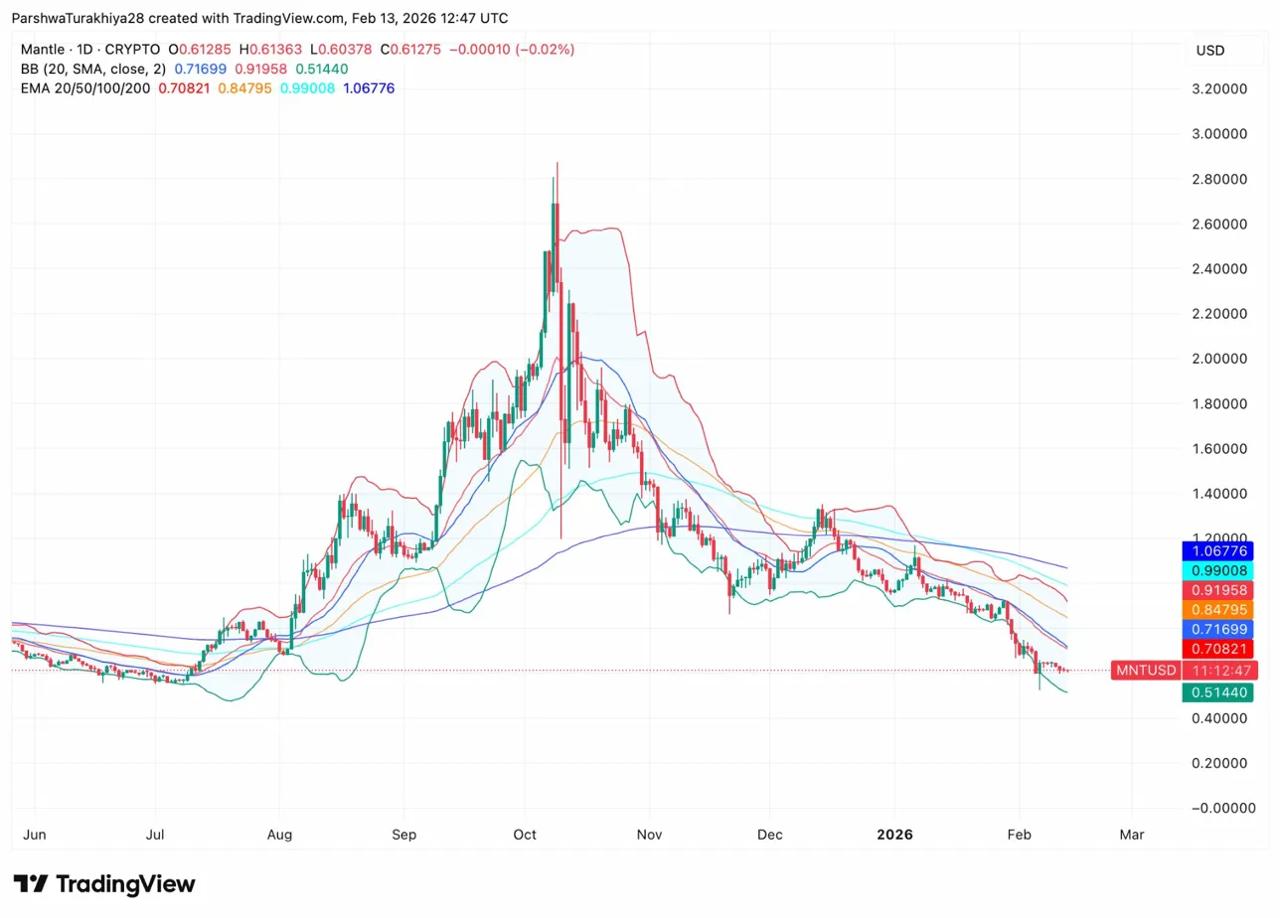
MNT price dynamics (Source: TradingView)
Price action has formed consecutive lower highs since October 2024's spike to $2.89, with recent selling pressure accelerating into February. MNT needs to reclaim $0.90-$1.00 resistance to shift technical sentiment toward reversal.
Mantle's 2030 outlook depends on CeDeFi execution
Looking ahead to 2030, Mantle's case hinges on whether Bybit successfully funnels exchange liquidity into on-chain DeFi markets. If the CeDeFi flywheel executes and RWA tokenization scales, MNT could realistically trade between $3 and $6 by 2030. MNT went live on Solana on January 27 via the Super Portal, enabling DeFi access with up to 115% APR on Solana-based pools. This breaks the single-chain liquidity trap by making MNT natively interoperable across Ethereum and Solana.MNT functions as a core platform asset within Bybit for trading, fee payments, VIP programs, and institutional products. Robinhood listed MNT in January 2026, expanding retail access beyond crypto-native exchanges. The 2026 roadmap includes expanded Bybit spot pairs, options trading, and deeper DeFi collaboration. However, execution risk remains high as the CeDeFi model is unproven at scale.
What investors should monitor
TVL growth and Aave V3 utilization metrics on Mantle provide real adoption signals. Investors should track Bybit's "Earn" product integration timeline and whether exchange users migrate to on-chain lending. RWA product deployment progress and institutional partnerships matter for the tokenization thesis. Solana Super Portal bridge volume offers cross-chain adoption insights.Analyst Viktoras Karapetjanc noted:
Institutions don't adopt isolated execution layers, they adopt ecosystems that coordinate capital, liquidity, and distribution. Mantle's treasury and Bybit relationship create that coordination."By 2030, MNT's valuation will reflect whether the CeDeFi flywheel converted exchange liquidity into sustainable on-chain activity or remained a marketing narrative.
Recently we discussed that Mantle launched Aave V3 on mainnet with 8 million MNT incentives, activating the infrastructure for Bybit's 70 million users to access DeFi lending markets.








-
 Afghanistan
-
 Albania
-
 Algeria
-
 Angola
-
 Argentina
-
 Armenia
-
 Australia
-
 Austria
-
 Azerbaijan
-
 Bahamas
-
 Bahrain
-
 Bangladesh
-
 Belarus
-
 Belgium
-
 Bolivia
-
 Botswana
-
 Brazil
-
 Brunei
-
 Bulgaria
-
 Cambodia
-
 Cameroon
-
 Canada
-
 Chile
Chile
-
 China
China
-
 Colombia
-
 Congo
Congo
-
 Costa Rica
-
 Cote d'Ivoire
-
 Croatia
-
 Cuba
Cuba
-
 Cyprus
-
 Czechia
-
 DR Congo
-
 Denmark
-
 Dominican Republic
-
 Ecuador
-
 Egypt
Egypt
-
 El Salvador
-
 Estonia
-
 Eswatini
-
 Ethiopia
-
 Finland
-
 France
-
 Georgia
-
 Germany
-
 Ghana
Ghana
-
 Greece
-
 Haiti
Haiti
-
 Hong Kong
-
 Hungary
-
 India
India
-
 Indonesia
-
 Iran, Islamic republic
-
 Iraq
Iraq
-
 Ireland
-
 Israel
-
 Italy
Italy
-
 Jamaica
-
 Japan
Japan
-
 Jordan
-
 Kazakhstan
-
 Kenya
Kenya
-
 Korea
Korea
-
 Kuwait
-
 Kyrgyzstan
-
 Laos
Laos
-
 Latvia
-
 Lebanon
-
 Lesotho
-
 Libya
Libya
-
 Lithuania
-
 Luxembourg
-
 Madagascar
-
 Malaysia
-
 Malta
Malta
-
 Mauritius
-
 Mexico
-
 Moldova
-
 Mongolia
-
 Montenegro
-
 Morocco
-
 Mozambique
-
 Myanmar
-
 Namibia
-
 Nepal
Nepal
-
 Netherlands
-
 New Zealand
-
 Nigeria
-
 North Macedonia
-
 Norway
-
 Oman
Oman
-
 Pakistan
-
 Palestine
-
 Panama
-
 Papua New Guinea
-
 Paraguay
-
 Peru
Peru
-
 Philippines
-
 Poland
-
 Portugal
-
 Puerto Rico
-
 Qatar
Qatar
-
 Reunion
-
 Romania
-
 Rwanda
-
 Saudi Arabia
-
 Serbia
-
 Singapore
-
 Slovakia
-
 Slovenia
-
 Somalia
-
 South Africa
-
 Spain
Spain
-
 Sri Lanka
-
 Sweden
-
 Switzerland
-
 Syria
Syria
-
 Taiwan
-
 Tajikistan
-
 Tanzania
-
 Thailand
-
 Trinidad and Tobago
-
 Tunisia
-
 Turkey
-
 UAE
UAE
-
 Uganda
-
 Ukraine
-
 United Kingdom
-
United States
-
 Uruguay
-
 Uzbekistan
-
 Venezuela
-
 Vietnam
-
 Yemen
Yemen
-
 Zambia
-
 Zimbabwe
- Forex
- Crypto











