
Injective price prediction for 2030: Dual ETF filings and supply squeeze target $50

Injective jumped over 20% on February 21 as three catalysts converged within 72 hours. A governance-approved mainnet upgrade, a fresh $2 million accumulation by NYSE-listed Pineapple Financial, and activation of a new dynamic gas fee mechanism drove the move. The biggest structural shift is IIP-617, the "INJ Supply Squeeze," which passed governance with 99.96% staker support in January 2026. The upgrade permanently cuts new INJ issuance and increases the burn rate to 8%.
Highlights
- Injective trades near $3.43, below all major moving averages with RSI at 47.37 showing neutral momentum building.
- Price forecasts for 2030 range from $40 to $60 if dual ETF approvals land and supply squeeze compounds with usage growth.
- INJ gets support from IIP-617 deflationary mechanics, Pineapple's 7M token treasury (7% of supply), and dual ETF filings under SEC review.
The new burn rate works alongside the Community BuyBack program, which has already removed 6.85 million INJ, about 6% of circulating supply, through monthly burns since 2021. With all 100 million INJ already in circulation and no future emission, every burn is permanent.
Days before the rally, governance approved IIP-619, upgrading Injective's real-time EVM architecture with 99.99% support. The proposal targets deeper Chainlink oracle integration for real-time price feeds. On February 20, IIP-620 passed, introducing dynamic gas fees that reduce volatility during congestion.
Technical structure shows consolidation after sharp bounce
The daily chart shows INJ attempting recovery after a sustained downtrend, with price consolidating near $3.43 below all major moving averages between $3.43 and $7.17. RSI at 47.37 shows neutral momentum building after the February 21 spike.
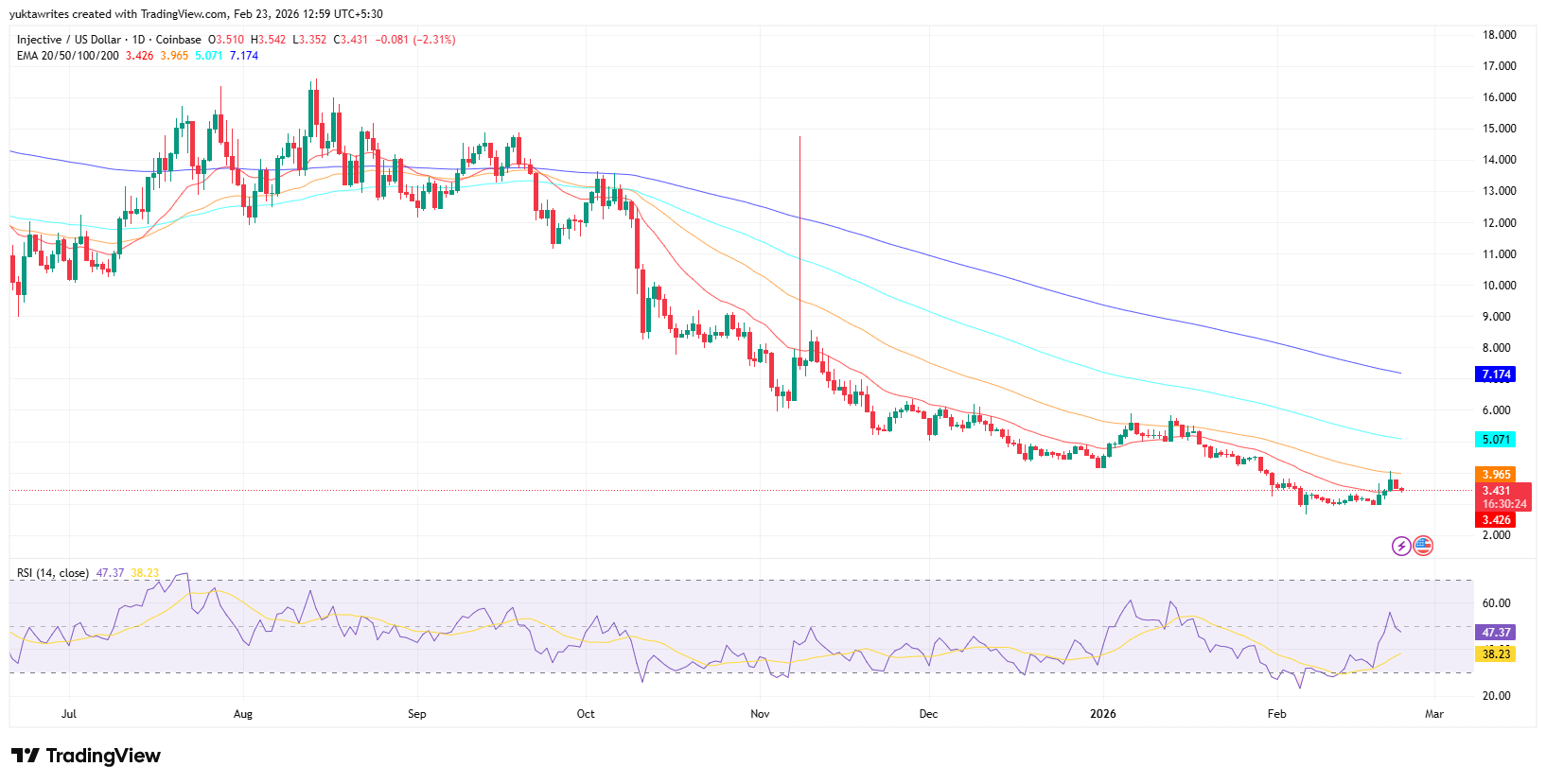
INJ price dynamics (Source: TradingView)
The price action has been making lower lows since August 2024, with the current level testing immediate resistance around $3.5 to $3.65. Getting back above the 20-day EMA at $3.43 is the first hurdle. Reclaiming $4 to $4.5 would signal stabilization, while a break below $3.2 risks testing the $2.8 to $3 support zone.
Injective 2030 outlook depends on ETF approval and usage growth
The 2030 case rests on whether the Supply Squeeze compounds as network usage grows and whether either ETF filing gets approved. NYSE-listed Pineapple Financial completed a $2 million open-market purchase of 560,647 INJ on February 19, bringing total holdings to 7.02 million INJ, representing 7% of total supply. The company maintains $20.79 million in capital reserves for continued accumulation. Both Canary Capital and 21Shares filed for Injective ETFs with the SEC. Canary's proposal is structured as a staked INJ ETF, allowing institutional exposure while earning staking yield.
Injective's product expansion supports the institutional positioning. The November 2025 native EVM launch created a dual-execution environment where Ethereum-based apps run alongside Cosmos-native dApps. Tokenized physical gold launched in January 2026 for 24/7 trading. The protocol supports perpetual derivatives for pre-IPO companies including OpenAI. Santiment data placed Injective 10th in monthly real-world asset development activity. However, INJ trades near $3.86 with a $386 million market cap, still down over 90% from its all-time high near $52.
What investors should monitor
The SEC review timeline for Canary and 21Shares ETF filings is the primary institutional catalyst. Pineapple Financial's continued accumulation from its $20.79 million capital reserve signals ongoing conviction. Monthly burn data from the Community BuyBack program shows whether the 8% burn rate is compounding supply reduction. Network usage metrics and fee revenue growth validate whether the dual-VM architecture is attracting developers.
Analyst Anton Kharitonov observed:
"Injective presents a compelling structural case with zero future token dilution, an 8% burn rate, and a publicly traded company holding 7% of supply. Two ETF filings are currently under SEC review. The disparity between infrastructure maturity and the current $386 million market capitalization suggests significant undervaluation if institutional adoption accelerates."
By 2030, INJ's price will reflect whether the Supply Squeeze compounded meaningfully with usage growth, whether ETF approval unlocked institutional capital, and whether Pineapple's treasury strategy became a broader adoption pattern.
Recently we discussed that Injective passed IIP-617 Supply Squeeze with 99.96% support, increasing burn rate to 8% while Pineapple Financial accumulated $2 million in INJ tokens bringing total holdings to 7% of supply.


Latest Injective News





-
 Afghanistan
-
 Albania
-
 Algeria
-
 Angola
-
 Argentina
-
 Armenia
-
 Australia
-
 Austria
-
 Azerbaijan
-
 Bahamas
-
 Bahrain
-
 Bangladesh
-
 Belarus
-
 Belgium
-
 Bolivia
-
 Botswana
-
 Brazil
-
 Brunei
-
 Bulgaria
-
 Cambodia
-
 Cameroon
-
 Canada
-
 Chile
Chile
-
 China
China
-
 Colombia
-
 Congo
Congo
-
 Costa Rica
-
 Cote d'Ivoire
-
 Croatia
-
 Cuba
Cuba
-
 Cyprus
-
 Czechia
-
 DR Congo
-
 Denmark
-
 Dominican Republic
-
 Ecuador
-
 Egypt
Egypt
-
 El Salvador
-
 Estonia
-
 Eswatini
-
 Ethiopia
-
 Finland
-
 France
-
 Georgia
-
 Germany
-
 Ghana
Ghana
-
 Greece
-
 Haiti
Haiti
-
 Hong Kong
-
 Hungary
-
 India
India
-
 Indonesia
-
 Iran, Islamic republic
-
 Iraq
Iraq
-
 Ireland
-
 Israel
-
 Italy
Italy
-
 Jamaica
-
 Japan
Japan
-
 Jordan
-
 Kazakhstan
-
 Kenya
Kenya
-
 Korea
Korea
-
 Kuwait
-
 Kyrgyzstan
-
 Laos
Laos
-
 Latvia
-
 Lebanon
-
 Lesotho
-
 Libya
Libya
-
 Lithuania
-
 Luxembourg
-
 Madagascar
-
 Malaysia
-
 Malta
Malta
-
 Mauritius
-
 Mexico
-
 Moldova
-
 Mongolia
-
 Montenegro
-
 Morocco
-
 Mozambique
-
 Myanmar
-
 Namibia
-
 Nepal
Nepal
-
 Netherlands
-
 New Zealand
-
 Nigeria
-
 North Macedonia
-
 Norway
-
 Oman
Oman
-
 Pakistan
-
 Palestine
-
 Panama
-
 Papua New Guinea
-
 Paraguay
-
 Peru
Peru
-
 Philippines
-
 Poland
-
 Portugal
-
 Puerto Rico
-
 Qatar
Qatar
-
 Reunion
-
 Romania
-
 Rwanda
-
 Saudi Arabia
-
 Serbia
-
 Singapore
-
 Slovakia
-
 Slovenia
-
 Somalia
-
 South Africa
-
 Spain
Spain
-
 Sri Lanka
-
 Sweden
-
 Switzerland
-
 Syria
Syria
-
 Taiwan
-
 Tajikistan
-
 Tanzania
-
 Thailand
-
 Trinidad and Tobago
-
 Tunisia
-
 Turkey
-
 UAE
UAE
-
 Uganda
-
 Ukraine
-
 United Kingdom
-
United States
-
 Uruguay
-
 Uzbekistan
-
 Venezuela
-
 Vietnam
-
 Yemen
Yemen
-
 Zambia
-
 Zimbabwe
- Forex
- Crypto











