
Lighter price prediction for 2030: Can Circle revenue deal push LIT to $10?
Two months after crypto's 10th-largest airdrop, Lighter's facing reality: weekly perpetual volumes crashed from $300 billion in November 2025 to under $50 billion in February 2026—a six-fold drop. Monthly revenue halved from $24 million in November to $13 million in January. But there's a potential lifeline: Lighter confirmed a $920 million USDC revenue-sharing deal with Circle. The agreement gives Lighter a cut of the interest income Circle earns on USDC reserves parked in U.S. Treasury bonds. Syncracy Capital analysts project this could generate $30-40 million annually for the protocol, with part of that earmarked for token buybacks—creating a structural bid that doesn't rely on trading activity.
Highlights
- Lighter trades near $1.39, below all major moving averages with RSI at 36.12 showing oversold momentum building.
- Price forecasts for 2030 range from $8 to $15 if Circle revenue sustains buybacks and product expansion drives organic volume.
- LIT gets support from $920M Circle deal, Korean stock perpetuals, unified collateral, and 65M tokens staked (25% of supply).
Lighter's been moving fast on the product side too. On February 11, it became the first decentralized exchange to offer on-chain perpetual futures for major Korean stocks—Samsung Electronics, SK Hynix, Hyundai Motor—with up to 10x leverage. Before that came commodities like oil, platinum, and palladium, plus U.S. equity index perpetuals for SPY and QQQ with cross margin. Lighter also launched unified collateral accounts, letting users trade spot and perpetuals from a single pool—the first step toward accepting arbitrary tokens as collateral.
Technical structure shows capitulation territory
The 4-hour chart shows LIT in freefall, breaking below all major moving averages with price now sitting at $1.39. RSI at 36.12 indicates oversold conditions building, often a precursor to short-term bounces.
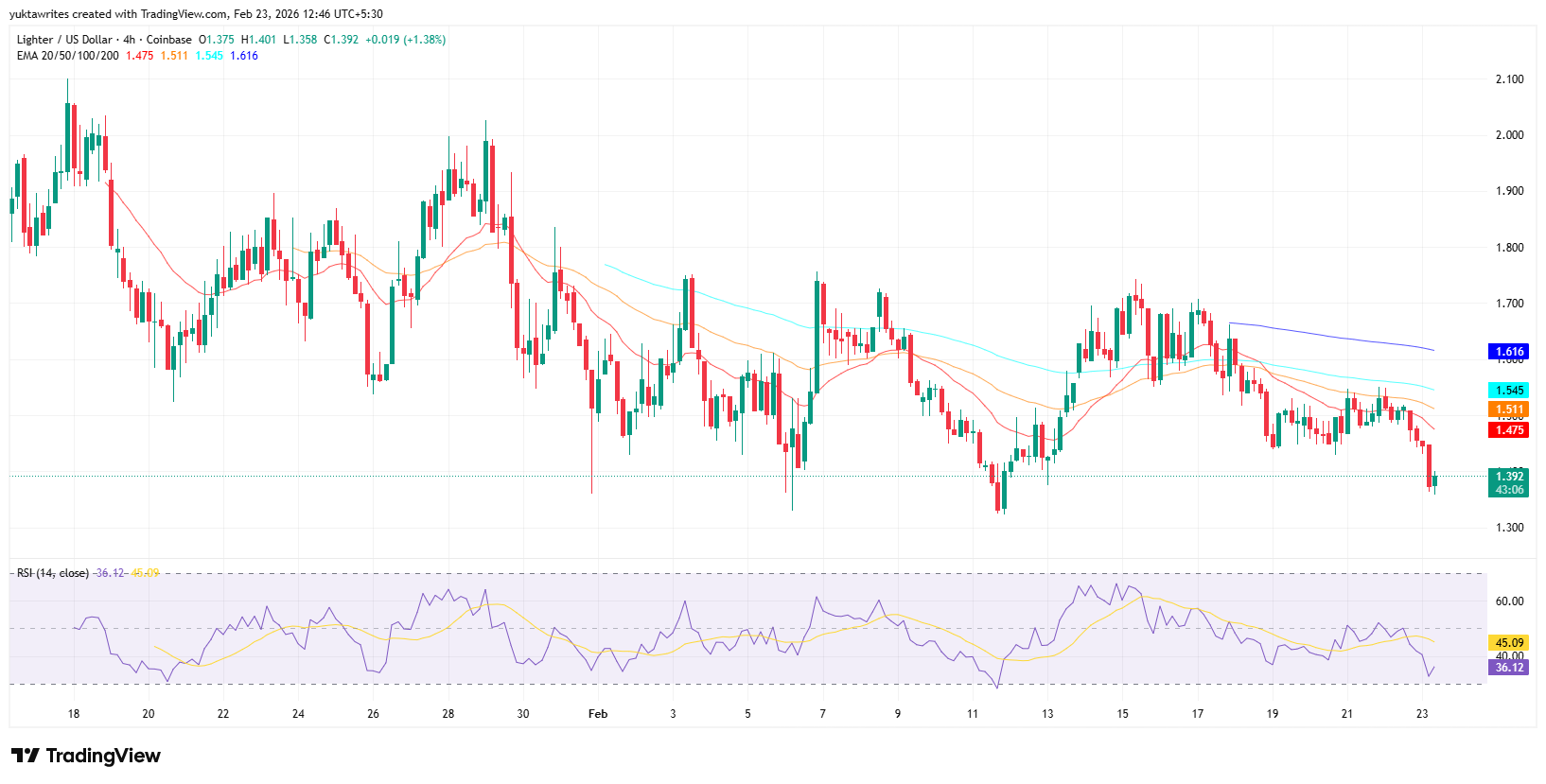
LIT price dynamics (Source: TradingView)
The price action has made relentless lower lows since late January, with the current level testing critical support around $1.35-$1.4. The $1.27 level is the key technical line—breaking below that invalidates the current range and likely accelerates the slide toward $0.91. Any recovery needs to reclaim the 20-period average at $1.47 as a first step, then push above $1.55-$1.6 to signal stabilization.
Lighter 2030 outlook depends on surviving the unlock
The 2030 case comes down to whether Lighter can turn Circle's revenue stream and product expansion into organic volume before 500 million tokens of insider supply starts unlocking in January 2027. If the Circle deal generates $30-40 million annually for buybacks and the platform builds real traction with RWA perpetuals, LIT could hit $8 to $15 by 2030. On January 31, Lighter launched an EVM-equivalent rollup with Axiom using OpenVM zkVM. The Lighter EVM connects the DEX directly with EVM apps like AAVE for lending and stablecoin issuers, transforming Lighter from a standalone perpetuals venue into general-purpose financial infrastructure.
But the competitive gap is real. As of mid-February, Lighter ranks fourth among perpetual DEXs with $782 million in open interest, way behind Hyperliquid's $5.1 billion and Aster's $1.86 billion. Market share collapsed from nearly 60% in mid-December to as low as 8.1% by mid-February—a direct result of the post-airdrop liquidity drain. LIT dropped 45% after the December 30 airdrop, triggering an exodus of yield farmers. Analysts have also questioned volume authenticity, noting high reported trading volumes don't match proportional open interest growth—a pattern often tied to incentive-driven rather than organic activity.
The staking mechanism helps on the supply side. Lighter requires 1 LIT staked for every 10 USDC deposited in the Liquidity Pool. When this launched January 15, 65 million LIT—25% of circulating supply—got staked within 24 hours. With only 250 million of 1 billion total LIT in circulation, the free float is compressed. But tokenomics are brutal: 50% of total supply goes to team (26%) and investors (24%), with a one-year cliff and three-year linear vesting starting January 2027. Backers include Founders Fund, Ribbit Capital, Haun Ventures, and Robinhood—a $68 million raise at $2.5 billion valuation. That's 500 million tokens hitting circulation in roughly ten months.
What investors should monitor
Circle revenue-sharing implementation and whether $30-40M actually flows to buybacks is the big one. Organic volume trends stripped of incentive noise show if the product has real traction. Watch for Korean stock perpetuals adoption metrics and whether RWA products differentiate Lighter from competitors. The January 2027 cliff unlock timeline matters a lot—if the platform hasn't built substantial organic demand by then, those 500 million tokens will crush price. Market share recovery from the 8.1% low signals competitive positioning.
Analyst Anton Kharitonov said it clearly:
"Lighter has a $920 million Circle deal that could generate $30-40M annually for buybacks, but volumes dropped 6x and 500 million tokens unlock in ten months. The Circle revenue stream is a lifeline, but execution has to happen fast."
By 2030, LIT's price will show whether the Circle revenue deal and RWA product expansion built enough organic gravity to survive the unlock wave, or if the post-airdrop volume collapse and insider dilution proved fatal.
Recently we discussed that Lighter confirmed a $920 million USDC revenue-sharing deal with Circle projected to generate $30-40 million annually, while weekly volumes dropped from $300 billion to under $50 billion in three months.






-
 Afghanistan
-
 Albania
-
 Algeria
-
 Angola
-
 Argentina
-
 Armenia
-
 Australia
-
 Austria
-
 Azerbaijan
-
 Bahamas
-
 Bahrain
-
 Bangladesh
-
 Belarus
-
 Belgium
-
 Bolivia
-
 Botswana
-
 Brazil
-
 Brunei
-
 Bulgaria
-
 Cambodia
-
 Cameroon
-
 Canada
-
 Chile
Chile
-
 China
China
-
 Colombia
-
 Congo
Congo
-
 Costa Rica
-
 Cote d'Ivoire
-
 Croatia
-
 Cuba
Cuba
-
 Cyprus
-
 Czechia
-
 DR Congo
-
 Denmark
-
 Dominican Republic
-
 Ecuador
-
 Egypt
Egypt
-
 El Salvador
-
 Estonia
-
 Eswatini
-
 Ethiopia
-
 Finland
-
 France
-
 Georgia
-
 Germany
-
 Ghana
Ghana
-
 Greece
-
 Haiti
Haiti
-
 Hong Kong
-
 Hungary
-
 India
India
-
 Indonesia
-
 Iran, Islamic republic
-
 Iraq
Iraq
-
 Ireland
-
 Israel
-
 Italy
Italy
-
 Jamaica
-
 Japan
Japan
-
 Jordan
-
 Kazakhstan
-
 Kenya
Kenya
-
 Korea
Korea
-
 Kuwait
-
 Kyrgyzstan
-
 Laos
Laos
-
 Latvia
-
 Lebanon
-
 Lesotho
-
 Libya
Libya
-
 Lithuania
-
 Luxembourg
-
 Madagascar
-
 Malaysia
-
 Malta
Malta
-
 Mauritius
-
 Mexico
-
 Moldova
-
 Mongolia
-
 Montenegro
-
 Morocco
-
 Mozambique
-
 Myanmar
-
 Namibia
-
 Nepal
Nepal
-
 Netherlands
-
 New Zealand
-
 Nigeria
-
 North Macedonia
-
 Norway
-
 Oman
Oman
-
 Pakistan
-
 Palestine
-
 Panama
-
 Papua New Guinea
-
 Paraguay
-
 Peru
Peru
-
 Philippines
-
 Poland
-
 Portugal
-
 Puerto Rico
-
 Qatar
Qatar
-
 Reunion
-
 Romania
-
 Rwanda
-
 Saudi Arabia
-
 Serbia
-
 Singapore
-
 Slovakia
-
 Slovenia
-
 Somalia
-
 South Africa
-
 Spain
Spain
-
 Sri Lanka
-
 Sweden
-
 Switzerland
-
 Syria
Syria
-
 Taiwan
-
 Tajikistan
-
 Tanzania
-
 Thailand
-
 Trinidad and Tobago
-
 Tunisia
-
 Turkey
-
 UAE
UAE
-
 Uganda
-
 Ukraine
-
 United Kingdom
-
United States
-
 Uruguay
-
 Uzbekistan
-
 Venezuela
-
 Vietnam
-
 Yemen
Yemen
-
 Zambia
-
 Zimbabwe
- Forex
- Crypto












