
Most Bitcoin hashrate insulated from rising global oil prices
The oil shock triggered by the war involving Iran is unlikely to significantly affect electricity costs for Bitcoin miners. Roughly 90% of the global hash rate operates in markets where electricity prices have minimal correlation with crude oil prices.
Highlights
- Oil price surge from Iran conflict unlikely to raise Bitcoin mining power costs.
- Around 90% of global Bitcoin hash rate has weak oil price correlation.
- Bitcoin price volatility poses greater risk to miners than energy costs.
Only 10% of hashrate depends on oil
The military operation by the United States and Israel against Iran has pushed global oil prices higher, but Bitcoin miners are unlikely to be directly affected. Instead, miners may feel the impact of oil supply disruptions mainly through Bitcoin price volatility rather than through rising electricity bills.
About 20% of global oil supplies typically pass through the Strait. Following the escalation, Brent crude jumped from around $60 per barrel to above $100 before retreating to roughly $90. At the same time, decentralized derivatives markets such as Hyperliquid are increasingly being used to trade the asset outside traditional market hours.
According to data from the Cambridge Centre for Alternative Finance and the Bitcoin Mining Council, more than half of the Bitcoin network operates on non-fossil energy sources, while the direct use of crude oil as fuel for mining is considered “essentially a rounding error.”
Data from Hashrate Index shows that roughly 90% of global hash rate operates in markets where electricity prices have little correlation with crude oil prices.
The largest shares of global hash rate are located in the United States, Russia, and China, followed by Paraguay, the United Arab Emirates, Oman, Canada, Ethiopia, and Kazakhstan. Many of these markets rely primarily on natural gas, coal, or hydropower rather than oil, which limits the direct impact of crude oil price fluctuations on mining costs.
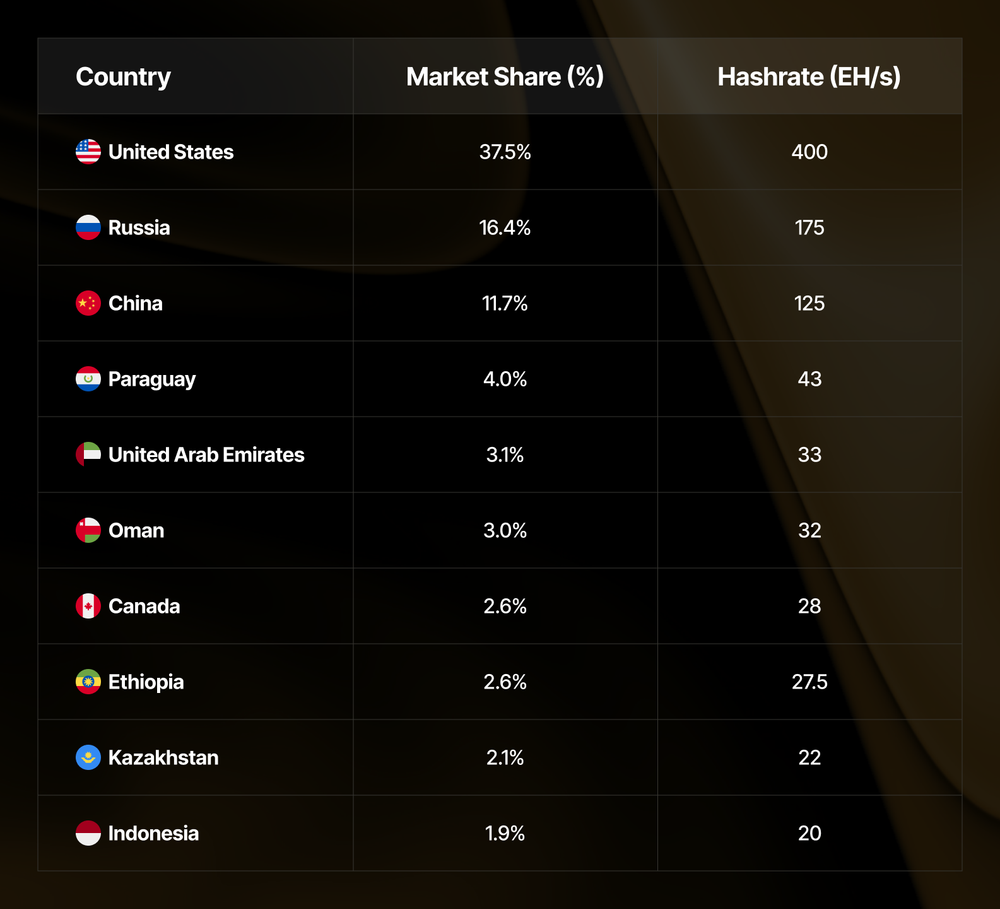
Global hashrate heatmap (Q1 2026). Source: Hashrate Index.
A more relevant question is whether oil price shocks influence electricity prices in countries where mining operations are concentrated. Persian Gulf countries, including the United Arab Emirates and Oman, account for about 6% of global hash rate. Adding Iran, Kuwait, Qatar, and Libya raises the share of the network sensitive to oil prices to roughly 8–10%.
Because most mining operations rely on power grids fueled by natural gas, coal, hydropower, or geothermal energy, the analysis suggests oil shocks would directly affect only a small portion of the network’s operating costs.
Even where some connection exists, the correlation between oil prices and electricity tariffs is relatively weak and tends to appear slowly due to regulated utility pricing cycles.
Bitcoin price matters more
However, the macroeconomic consequences of geopolitical turmoil pose a far greater risk to miners. Rising oil prices can strengthen inflation expectations and influence interest-rate outlooks, potentially pushing investors toward safer assets and away from volatile ones like Bitcoin. This dynamic could reduce mining profitability by compressing the hash price — the revenue earned per unit of computing power.
This effect was already visible earlier this year when hash price fell to a historic low of $27.89 per PH/s/day in February after Bitcoin dropped 23.8%, from about $78,000 to $65,000.
Therefore, while geopolitical events pushing oil prices above $100 may affect global markets, the main risk for Bitcoin miners lies in profitability rather than operational costs — specifically whether Bitcoin’s price can remain resilient amid broader macroeconomic uncertainty.
For the mining industry, the structure of regional energy markets remains a far more important factor. In recent years, many mining companies have deliberately relocated operations to jurisdictions with cheap and stable electricity, including hydropower in Latin America, gas-powered grids in the United States, and renewable energy in Africa and the Middle East. This diversification reduces the Bitcoin network’s sensitivity to individual commodity markets, including oil.
Moreover, rising oil prices may indirectly boost interest in mining as a way to monetize surplus energy resources. In several countries, projects already use stranded or flared natural gas from oil production to power mining equipment. In an environment of expensive oil and unstable energy supplies, such projects could become even more economically attractive, potentially supporting further decentralization and resilience of the global Bitcoin hash rate.
As we wrote, Big tech and Bitcoin mining fuel nuclear power renaissance








-
 Afghanistan
-
 Albania
-
 Algeria
-
 Angola
-
 Argentina
-
 Armenia
-
 Australia
-
 Austria
-
 Azerbaijan
-
 Bahamas
-
 Bahrain
-
 Bangladesh
-
 Belarus
-
 Belgium
-
 Bolivia
-
 Botswana
-
 Brazil
-
 Brunei
-
 Bulgaria
-
 Cambodia
-
 Cameroon
-
 Canada
-
 Chile
Chile
-
 China
China
-
 Colombia
-
 Congo
Congo
-
 Costa Rica
-
 Cote d'Ivoire
-
 Croatia
-
 Cuba
Cuba
-
 Cyprus
-
 Czechia
-
 DR Congo
-
 Denmark
-
 Dominican Republic
-
 Ecuador
-
 Egypt
Egypt
-
 El Salvador
-
 Estonia
-
 Eswatini
-
 Ethiopia
-
 Finland
-
 France
-
 Georgia
-
 Germany
-
 Ghana
Ghana
-
 Greece
-
 Haiti
Haiti
-
 Hong Kong
-
 Hungary
-
 India
India
-
 Indonesia
-
 Iran, Islamic republic
-
 Iraq
Iraq
-
 Ireland
-
 Israel
-
 Italy
Italy
-
 Jamaica
-
 Japan
Japan
-
 Jordan
-
 Kazakhstan
-
 Kenya
Kenya
-
 Korea
Korea
-
 Kuwait
-
 Kyrgyzstan
-
 Laos
Laos
-
 Latvia
-
 Lebanon
-
 Lesotho
-
 Libya
Libya
-
 Lithuania
-
 Luxembourg
-
 Madagascar
-
 Malaysia
-
 Malta
Malta
-
 Mauritius
-
 Mexico
-
 Moldova
-
 Mongolia
-
 Montenegro
-
 Morocco
-
 Mozambique
-
 Myanmar
-
 Namibia
-
 Nepal
Nepal
-
 Netherlands
-
 New Zealand
-
 Nigeria
-
 North Macedonia
-
 Norway
-
 Oman
Oman
-
 Pakistan
-
 Palestine
-
 Panama
-
 Papua New Guinea
-
 Paraguay
-
 Peru
Peru
-
 Philippines
-
 Poland
-
 Portugal
-
 Puerto Rico
-
 Qatar
Qatar
-
 Reunion
-
 Romania
-
 Rwanda
-
 Saudi Arabia
-
 Serbia
-
 Singapore
-
 Slovakia
-
 Slovenia
-
 Somalia
-
 South Africa
-
 Spain
Spain
-
 Sri Lanka
-
 Sweden
-
 Switzerland
-
 Syria
Syria
-
 Taiwan
-
 Tajikistan
-
 Tanzania
-
 Thailand
-
 Trinidad and Tobago
-
 Tunisia
-
 Turkey
-
 UAE
UAE
-
 Uganda
-
 Ukraine
-
 United Kingdom
-
United States
-
 Uruguay
-
 Uzbekistan
-
 Venezuela
-
 Vietnam
-
 Yemen
Yemen
-
 Zambia
-
 Zimbabwe
- Forex
- Crypto











