

Neutral session for Bitcoin as Iran threatens to exit ceasefire over Lebanon strikes

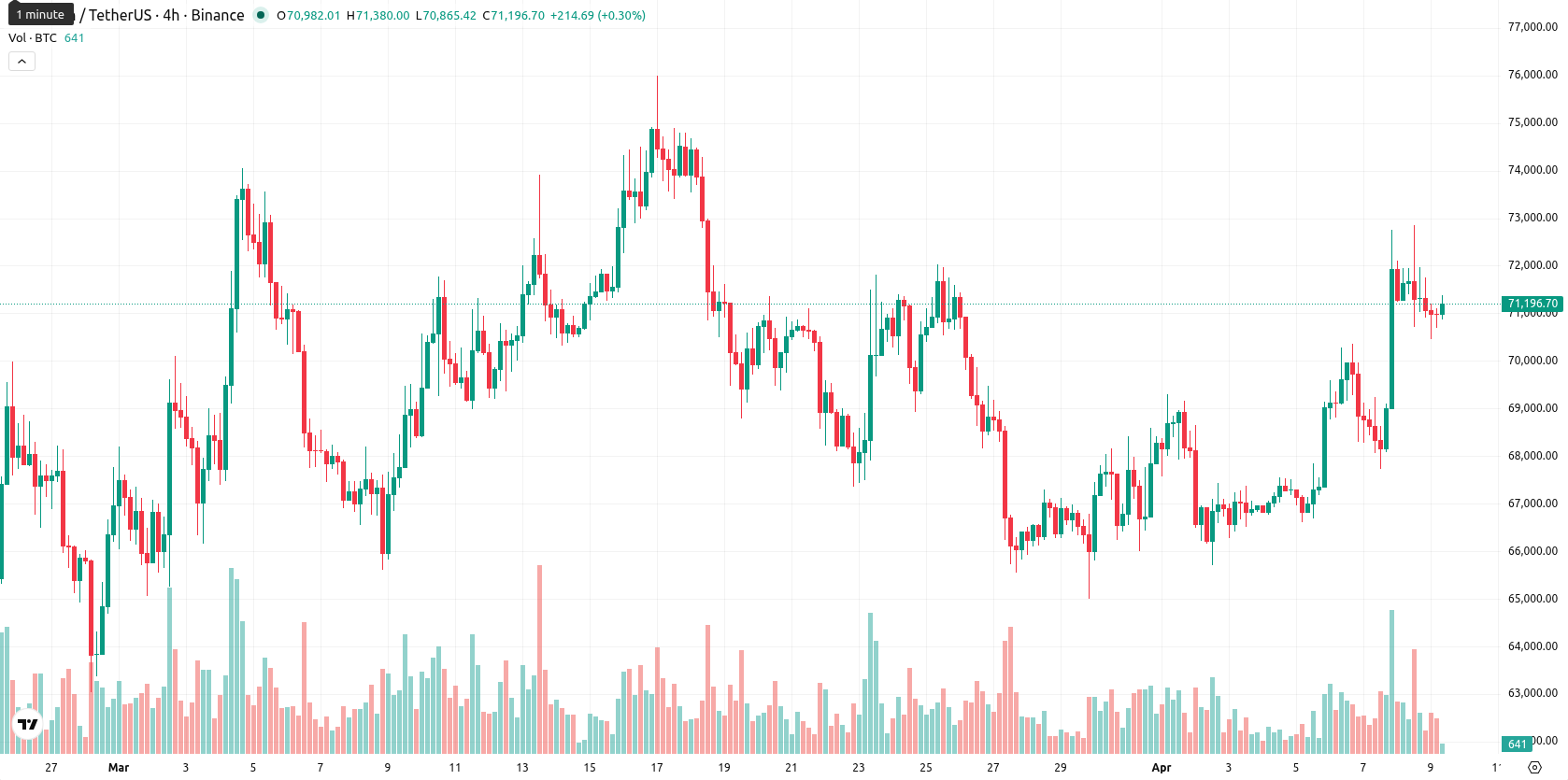
Bitcoin (BTC) is trading at $71,274.26 after declining 0.70% on the day. The price remains above its key short- and medium-term SMAs (SMA-20 at $68,644.88 and SMA-50 at $68,778.53), but below its SMA-200 at $88,713.25, indicating continued bullish momentum in the near term while longer-term sentiment stays cautious.
 78718
81971.00
Highlights
- A temporary US-Iran ceasefire boosted sentiment and stabilized Bitcoin above $71,000, but renewed threats from Iran raise geopolitical risk and endanger regional negotiations.
- US regulators announced stricter oversight on digital asset flows targeting stablecoin issuers, while Iran considers requiring tankers to pay Strait of Hormuz fees in Bitcoin or yuan to bypass sanctions.
- Bitcoin trades sideways between $70,900 and $71,700 with technicals signaling buyer dominance but overbought conditions and a higher risk of short-term downside.
Geopolitical relief lifts sentiment as Iran-U.S. truce faces renewed threat
A two-week ceasefire between the United States and Iran has temporarily eased geopolitical tensions, lifting market sentiment and prompting Bitcoin to reclaim and stabilize above the $71,000 level. However, the situation remains fragile as on Wednesday Iran threatened to withdraw from the agreement if Israeli strikes on Lebanon persist, injecting renewed uncertainty and putting further negotiations for reopening the Strait of Hormuz at risk. On April 8, U.S. Treasury Secretary Scott Bessent announced a new regulatory initiative to tighten oversight of digital asset flows, including stricter anti-money laundering and sanctions compliance requirements for stablecoin issuers and related firms, targeting illicit crypto activity and cross-border financial crime. In parallel, Iranian sources have signaled intentions to require oil tankers transiting the Strait of Hormuz to pay passage fees in Bitcoin or Chinese yuan, seeking to circumvent traditional financial channels and international sanctions, while U.S. authorities reaffirm that crypto transfers remain subject to OFAC restrictions and can be prosecuted as sanctions evasion.
Short-term buyer dominance counters overbought signals amid mixed momentum
BTC is holding above its key short- and medium-term SMAs, with the current price of $71,274.26 trading higher than both the SMA-20 ($68,644.88) and SMA-50 ($68,778.53). The price remains well below the longer-term SMA-200 ($88,713.25), indicating a bullish short- to mid-term bias, while longer-term momentum is still under pressure from sellers. The Ichimoku Kijun level at $70,500.00 sits below the current price and acts as immediate support. Momentum on D1 remains mostly neutral, as MACD provides a sideways cue and ADX hints at weak trend strength. Oscillators present mixed signals: RSI (56.05) suggests moderate buying, while the CCI (129.43) and Stoch RSI (83.28) indicate overbought conditions. BBP shows persistent buyer dominance intraday, confirming positive sentiment, although the AO remains neutral. BTC opened at $71,042.90, slightly below the previous close, showing no significant gap, and is now trading near the upper end of today’s range ($70,500 – $71,187.14). Volatility today has been moderate, with price action showing some buying pressure after the open but facing consolidation as upward momentum meets overbought readings. There is a clear divergence between oscillators and broader momentum signals.
Downside risk prevails as breakout probability stays limited
For the next week, BTC is expected to trade between $70,900 and $71,700, normalizing the weekly range to reflect typical volatility and the current price. There is a very low probability (less than 20%) of a significant upward breakout, making a further downside move the more likely short-term scenario. The baseline view is for price to continue in a sideways corridor near current levels. A bullish scenario would require a strong break above $71,700, while a bearish setup would see the price fall below immediate support at $70,500, opening the way to deeper pullbacks.
Earlier, analysts noted that Bitcoin’s price action remained highly sensitive to external geopolitical and commodity-related developments, with market sentiment shifting rapidly in response to regional news. The latest developments confirm that while near-term momentum is positive, persistent geopolitical uncertainty and evolving regulatory measures are keeping the risk of renewed volatility elevated—making $70,500 a critical support level to monitor in the coming sessions.










-
 Afghanistan
-
 Albania
-
 Algeria
-
 Angola
-
 Argentina
-
 Armenia
-
 Australia
-
 Austria
-
 Azerbaijan
-
 Bahamas
-
 Bahrain
-
 Bangladesh
-
 Belarus
-
 Belgium
-
 Bolivia
-
 Botswana
-
 Brazil
-
 Brunei
-
 Bulgaria
-
 Cambodia
-
 Cameroon
-
 Canada
-
 Chile
-
 China
-
 Colombia
-
 Congo
-
 Costa Rica
-
 Cote d'Ivoire
-
 Croatia
-
 Cuba
-
 Cyprus
-
 Czechia
-
 DR Congo
-
 Denmark
-
 Dominican Republic
-
 Ecuador
-
 Egypt
-
 El Salvador
-
 Estonia
-
 Eswatini
-
 Ethiopia
-
 Finland
-
 France
-
 Georgia
-
 Germany
-
 Ghana
-
 Greece
-
 Haiti
-
 Hong Kong
-
 Hungary
-
 India
-
 Indonesia
-
 Iran, Islamic republic
-
 Iraq
-
 Ireland
-
 Israel
-
 Italy
-
 Jamaica
-
 Japan
-
 Jordan
-
 Kazakhstan
-
 Kenya
-
 Korea
-
 Kuwait
-
 Kyrgyzstan
-
 Laos
-
 Latvia
-
 Lebanon
-
 Lesotho
-
 Libya
-
 Lithuania
-
 Luxembourg
-
 Madagascar
-
 Malaysia
-
 Malta
-
 Mauritius
-
 Mexico
-
 Moldova
-
 Mongolia
-
 Montenegro
-
 Morocco
-
 Mozambique
-
 Myanmar
-
 Namibia
-
 Nepal
-
 Netherlands
-
 New Zealand
-
 Nigeria
-
 North Macedonia
-
 Norway
-
 Oman
-
 Pakistan
-
 Palestine
-
 Panama
-
 Papua New Guinea
-
 Paraguay
-
 Peru
-
 Philippines
-
 Poland
-
 Portugal
-
 Puerto Rico
-
 Qatar
-
 Reunion
-
 Romania
-
 Rwanda
-
 Saudi Arabia
-
 Serbia
-
 Singapore
-
 Slovakia
-
 Slovenia
-
 Somalia
-
 South Africa
-
 Spain
-
 Sri Lanka
-
 Sweden
-
 Switzerland
-
 Syria
-
 Taiwan
-
 Tajikistan
-
 Tanzania
-
 Thailand
-
 Trinidad and Tobago
-
 Tunisia
-
 Turkey
-
 UAE
-
 Uganda
-
 Ukraine
-
 United Kingdom
-
United States
-
 Uruguay
-
 Uzbekistan
-
 Venezuela
-
 Vietnam
-
 Yemen
-
 Zambia
-
 Zimbabwe
- Forex
- Crypto












