

Will Internet Computer avoid deeper losses amid continued seller pressure?

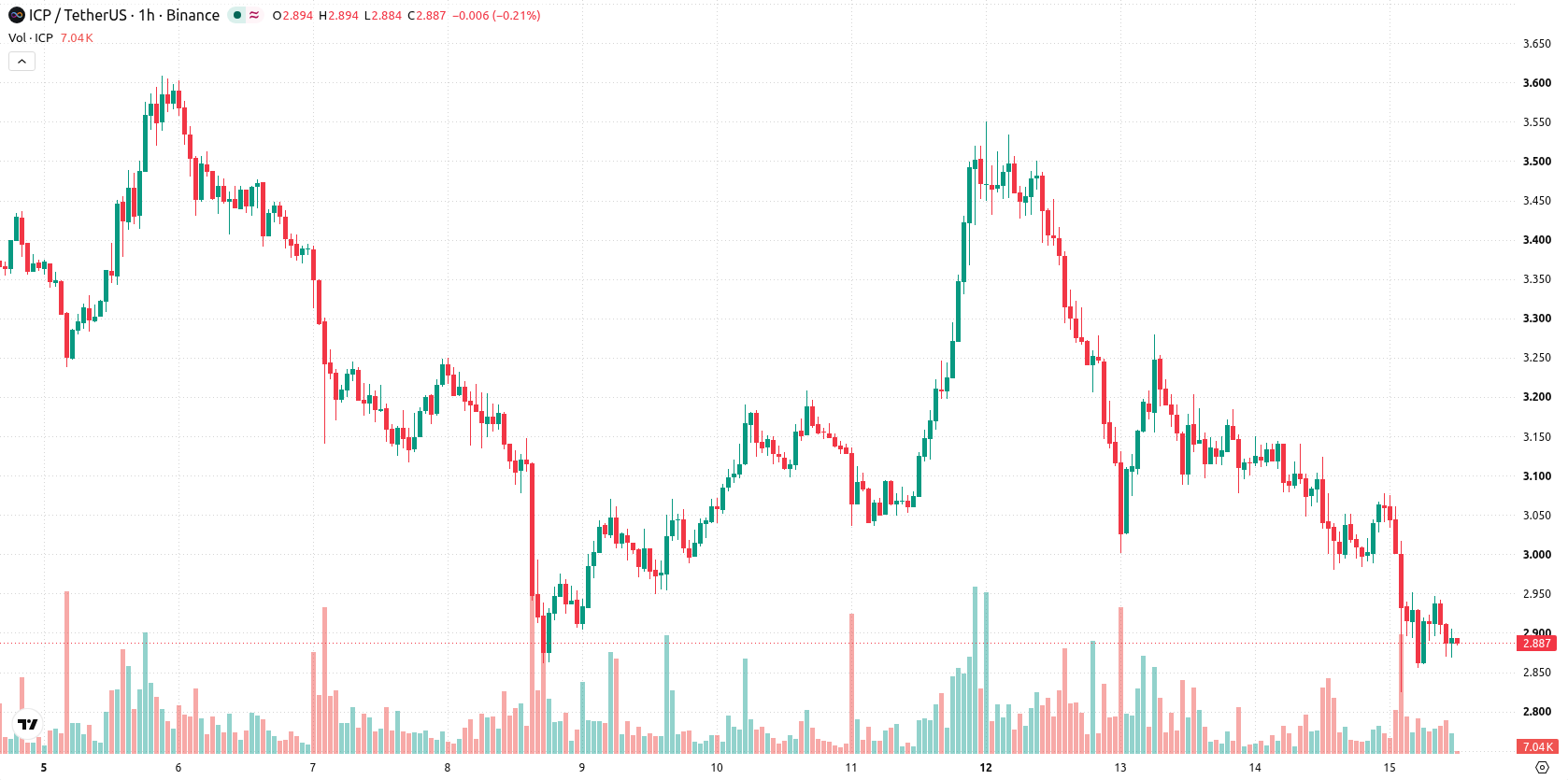
Internet Computer (ICP) is trading at $2.89 after a decline of 6.77% for the day. The price stands below its short- and medium-term moving averages but remains above the longer-term average.
 2.96
3.55
2.96
3.55
Highlights
- ICP/USD trades below short- and medium-term moving averages, indicating sustained bearish momentum in the near term.
- Momentum indicators such as MACD, ADX, and RSI show dominant selling pressure, with no sign of a technical rebound.
- ICP/USD closed at $2.89, with a projected range of $2.71 to $3.04 and a high likelihood of further decline.
Selling momentum dominates as price loses short-term support
On the technical side, ICP/USD is trading below the MA-20 and MA-50 on the H1 chart, with support continuing above the MA-200. The immediate resistance level is at the Ichimoku Kijun line of $2.97. Daily momentum indicators show strong selling conditions: both MACD and ADX are giving sell signals, while RSI is at 35.56, also indicating a bearish bias. CCI and Bull/Bear Power confirm a seller-dominated environment, whereas Stoch RSI and the Awesome Oscillator remain neutral, with no notable divergence between price and momentum.
Range-bound volatility persists as bearish risk outweighs rebound odds
In the short term, ICP/USD is expected to move within the $2.71–$3.04 range, reflecting typical volatility. The likelihood of a further decline remains high, while the prospect of a significant rebound appears very low. The baseline scenario is stabilization within this band; a move above immediate resistance at $2.97 would mark a bullish breakout, whereas a fall below $2.71 could trigger additional downside pressure.
Earlier, analysts noted that Internet Computer exhibited short-term bearish pressure despite longer-term technical support, with volatility fueled by new network initiatives and evolving adoption metrics. The latest market action reinforces this view, as persistent selling and bearish indicators keep ICP constrained within a $2.71–$3.04 range, making these levels essential for assessing breakout or breakdown risk.










-
 Afghanistan
-
 Albania
-
 Algeria
-
 Angola
-
 Argentina
-
 Armenia
-
 Australia
-
 Austria
-
 Azerbaijan
-
 Bahamas
-
 Bahrain
-
 Bangladesh
-
 Belarus
-
 Belgium
-
 Bolivia
-
 Botswana
-
 Brazil
-
 Brunei
-
 Bulgaria
-
 Cambodia
-
 Cameroon
-
 Canada
-
 Chile
Chile
-
 China
China
-
 Colombia
-
 Congo
Congo
-
 Costa Rica
-
 Cote d'Ivoire
-
 Croatia
-
 Cuba
Cuba
-
 Cyprus
-
 Czechia
-
 DR Congo
-
 Denmark
-
 Dominican Republic
-
 Ecuador
-
 Egypt
Egypt
-
 El Salvador
-
 Estonia
-
 Eswatini
-
 Ethiopia
-
 Finland
-
 France
-
 Georgia
-
 Germany
-
 Ghana
Ghana
-
 Greece
-
 Haiti
Haiti
-
 Hong Kong
-
 Hungary
-
 India
India
-
 Indonesia
-
 Iran, Islamic republic
-
 Iraq
Iraq
-
 Ireland
-
 Israel
-
 Italy
Italy
-
 Jamaica
-
 Japan
Japan
-
 Jordan
-
 Kazakhstan
-
 Kenya
Kenya
-
 Korea
Korea
-
 Kuwait
-
 Kyrgyzstan
-
 Laos
Laos
-
 Latvia
-
 Lebanon
-
 Lesotho
-
 Libya
Libya
-
 Lithuania
-
 Luxembourg
-
 Madagascar
-
 Malaysia
-
 Malta
Malta
-
 Mauritius
-
 Mexico
-
 Moldova
-
 Mongolia
-
 Montenegro
-
 Morocco
-
 Mozambique
-
 Myanmar
-
 Namibia
-
 Nepal
Nepal
-
 Netherlands
-
 New Zealand
-
 Nigeria
-
 North Macedonia
-
 Norway
-
 Oman
Oman
-
 Pakistan
-
 Palestine
-
 Panama
-
 Papua New Guinea
-
 Paraguay
-
 Peru
Peru
-
 Philippines
-
 Poland
-
 Portugal
-
 Puerto Rico
-
 Qatar
Qatar
-
 Reunion
-
 Romania
-
 Rwanda
-
 Saudi Arabia
-
 Serbia
-
 Singapore
-
 Slovakia
-
 Slovenia
-
 Somalia
-
 South Africa
-
 Spain
Spain
-
 Sri Lanka
-
 Sweden
-
 Switzerland
-
 Syria
Syria
-
 Taiwan
-
 Tajikistan
-
 Tanzania
-
 Thailand
-
 Trinidad and Tobago
-
 Tunisia
-
 Turkey
-
 UAE
UAE
-
 Uganda
-
 Ukraine
-
 United Kingdom
-
United States
-
 Uruguay
-
 Uzbekistan
-
 Venezuela
-
 Vietnam
-
 Yemen
Yemen
-
 Zambia
-
 Zimbabwe
- Forex
- Crypto












