

Can reduced trading activity pressure Raydium?

Raydium (RAY) is trading at $1.64, down 7.08% on the day. The asset currently sits below its key short- and medium-term moving averages, signaling continued near-term weakness relative to recent trading levels.
 1.4718
1.6306
Highlights
- Raydium trading volume has dropped to around half its 30-day average, reducing market participation and liquidity.
- Low turnover has coincided with significant intraday downside, raising the risk of volatile price swings in thin conditions.
- RAY/USD trades below key moving averages with bearish momentum, a high probability of moving to $1.6005 to $1.6881, and limited chance of an upward reversal.
Lower volume and thin liquidity amplify volatility risks
Raydium has experienced a marked reduction in trading volume, with recent flows measuring only about half of its 30-day average. This decline in activity reflects reduced market participation, which can limit liquidity and heighten the risk of volatile price swings in thin trading conditions. Such diminished turnover has accompanied today’s downside move.
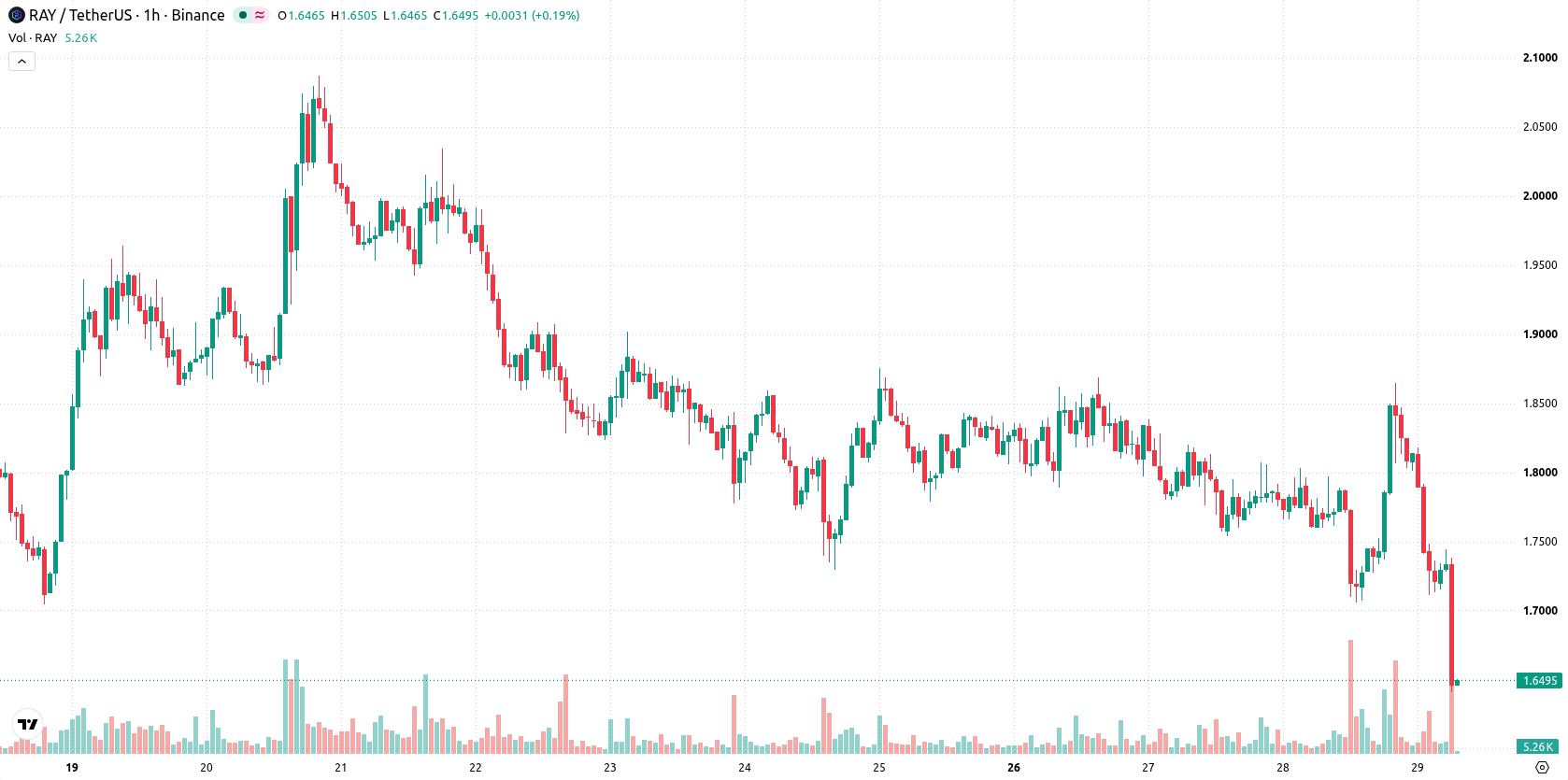
Bearish momentum persists as price tests resistance and signals sell
On the technical front, RAY is trading below the MA-20 at $1.76 and MA-50 at $1.77, while remaining above the longer-term MA-200 at $0.99. Immediate resistance stands at the Ichimoku Kijun level of $1.78. Momentum indicators reinforce the current selling pressure: MACD signals Sell, RSI reads 42.8 (Sell), CCI is in Sell territory, and Stoch RSI is oversold. The ADX is neutral, reflecting weak trend conviction, and both Bull/Bear Power and the Awesome Oscillator further support the dominance of sellers in the current session.
Downside risk dominates as consolidation limits bullish scenarios
Over the next 2–3 trading days, RAY is expected to consolidate within a range of $1.60 to $1.68. The probability of a move upward is regarded as very low, while the odds of a further decline are much higher in the current environment. A baseline scenario envisions range-bound action; a bullish breakout above the $1.78 resistance could spark additional buying, while a close below $1.60 would reinforce the short-term negative trend.
Earlier, analysts noted that Raydium's near-term outlook was pressured by persistent downside risk despite positive developments in its fundamentals. The current analysis adds that fading trading volumes and compressed liquidity heighten the risk of sharper price swings, making the $1.60 support level especially critical to monitor in the coming sessions.










-
 Afghanistan
-
 Albania
-
 Algeria
-
 Angola
-
 Argentina
-
 Armenia
-
 Australia
-
 Austria
-
 Azerbaijan
-
 Bahamas
-
 Bahrain
-
 Bangladesh
-
 Belarus
-
 Belgium
-
 Bolivia
-
 Botswana
-
 Brazil
-
 Brunei
-
 Bulgaria
-
 Cambodia
-
 Cameroon
-
 Canada
-
 Chile
-
 China
-
 Colombia
-
 Congo
-
 Costa Rica
-
 Cote d'Ivoire
-
 Croatia
-
 Cuba
-
 Cyprus
-
 Czechia
-
 DR Congo
-
 Denmark
-
 Dominican Republic
-
 Ecuador
-
 Egypt
-
 El Salvador
-
 Estonia
-
 Eswatini
-
 Ethiopia
-
 Finland
-
 France
-
 Georgia
-
 Germany
-
 Ghana
-
 Greece
-
 Haiti
-
 Hong Kong
-
 Hungary
-
 India
-
 Indonesia
-
 Iran, Islamic republic
-
 Iraq
-
 Ireland
-
 Israel
-
 Italy
-
 Jamaica
-
 Japan
-
 Jordan
-
 Kazakhstan
-
 Kenya
-
 Korea
-
 Kuwait
-
 Kyrgyzstan
-
 Laos
-
 Latvia
-
 Lebanon
-
 Lesotho
-
 Libya
-
 Lithuania
-
 Luxembourg
-
 Madagascar
-
 Malaysia
-
 Malta
-
 Mauritius
-
 Mexico
-
 Moldova
-
 Mongolia
-
 Montenegro
-
 Morocco
-
 Mozambique
-
 Myanmar
-
 Namibia
-
 Nepal
-
 Netherlands
-
 New Zealand
-
 Nigeria
-
 North Macedonia
-
 Norway
-
 Oman
-
 Pakistan
-
 Palestine
-
 Panama
-
 Papua New Guinea
-
 Paraguay
-
 Peru
-
 Philippines
-
 Poland
-
 Portugal
-
 Puerto Rico
-
 Qatar
-
 Reunion
-
 Romania
-
 Rwanda
-
 Saudi Arabia
-
 Serbia
-
 Singapore
-
 Slovakia
-
 Slovenia
-
 Somalia
-
 South Africa
-
 Spain
-
 Sri Lanka
-
 Sweden
-
 Switzerland
-
 Syria
-
 Taiwan
-
 Tajikistan
-
 Tanzania
-
 Thailand
-
 Trinidad and Tobago
-
 Tunisia
-
 Turkey
-
 UAE
-
 Uganda
-
 Ukraine
-
 United Kingdom
-
United States
-
 Uruguay
-
 Uzbekistan
-
 Venezuela
-
 Vietnam
-
 Yemen
-
 Zambia
-
 Zimbabwe
- Forex
- Crypto












