

Ongoing ETF outflows may deepen liquidity challenges for Bitcoin and restrict further advances

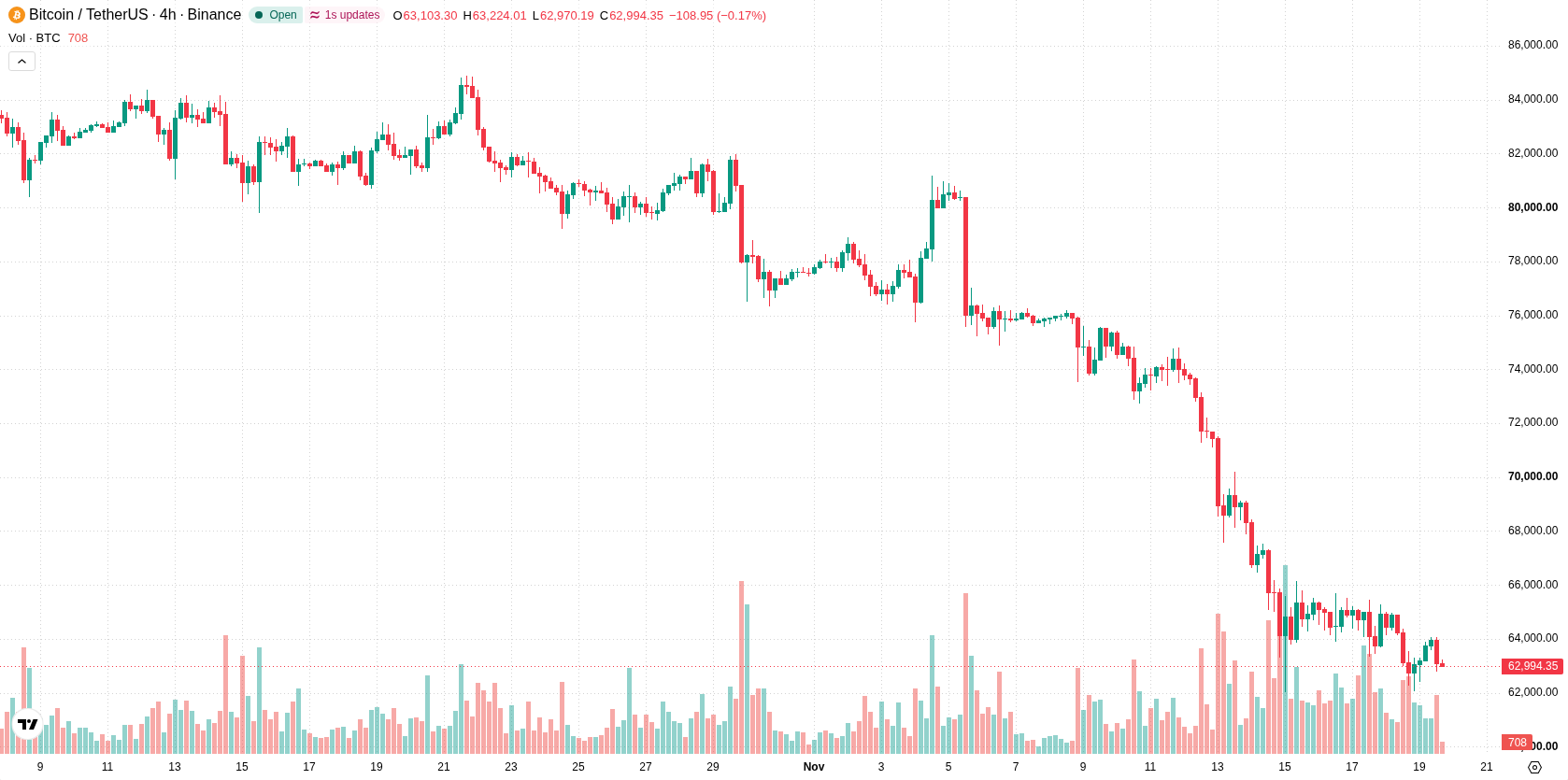
Bitcoin (BTC) is trading higher on November 19, 2026, quoted at $63,103 as of 16:30 UTC. Price action remains constrained as the market weighs signs of weaker institutional support for the asset. Traders are monitoring ETF flow data and shifts in institutional sentiment for potential signals of a reversal.
 64080.8
71514.01
Highlights
- Bitcoin held near $65,000 on November 18, 2026, as institutional outflows from spot Bitcoin ETFs persisted.
- Ongoing reduction in institutional buy support weakens major market liquidity and limits potential for significant price recovery.
- Technically, Bitcoin trades below key moving averages with selling indicators dominant and $64,097 acting as short-term resistance.
Weaker institutional demand pressures Bitcoin through ETF outflows
According to FXStreet, Bitcoin stalled near $65,000 as of November 18, 2026, with ongoing pressure from sustained institutional outflows from spot Bitcoin Exchange Traded Funds.
These persistent ETF outflows reduce major buy support in the market, which can drain liquidity and limit Bitcoin’s capacity for a stronger price recovery. This risk channel means institutional behavior is currently a headwind for upward momentum, even as retail interest may persist.
While no additional counterbalancing flows or policy catalysts are reported, the ongoing reduction in institutional buy support stands as the key risk limiting any upside from current levels.
Major moving averages and sell signals define 4H resistance zone
Technically, BTC remains below several key moving averages, highlighting hesitation and indecision linked to the external outflow dynamic. The 4H SMA-50 at $66,895 and SMA-200 at $76,031 are both positioned well above the market, showing that any recovery attempts are still capped by overhead supply.
Short-term momentum also lags, with the MACD signaling a strong sell and the ADX indicating a continued selling environment. The 4H Kijun at $64,097 now acts as immediate resistance, reflecting the technical hurdles facing bulls as long as outflows persist.
Institutional outflow risk versus confirmation above $64,097 resistance
Market stabilization depends on a reversal or at least a slowdown in institutional outflows, with sustained buy interest needed for a positive technical shift. Traders are watching reaction to the 4H Kijun around $64,097 as a near-term resistance zone; a clear break above this level on improving flows could signal renewed bullish momentum. Conversely, persistent weakness in institutional demand raises the risk of further pressure and range-bound trade.
Previously it was reported that Sui expanded its DeFi capabilities with the mainnet launch of Hashi, enabling Bitcoin to be used in onchain lending and yield products. The current market analysis, however, points to persistent institutional outflows as the dominant factor limiting Bitcoin’s upside, making a reversal in this trend the key condition for any renewed momentum or impact from such ecosystem developments.











-
 Afghanistan
-
 Albania
-
 Algeria
-
 Angola
-
 Argentina
-
 Armenia
-
 Australia
-
 Austria
-
 Azerbaijan
-
 Bahamas
-
 Bahrain
-
 Bangladesh
-
 Belarus
-
 Belgium
-
 Bolivia
-
 Botswana
-
 Brazil
-
 Brunei
-
 Bulgaria
-
 Cambodia
-
 Cameroon
-
 Canada
-
 Chile
-
 China
-
 Colombia
-
 Congo
-
 Costa Rica
-
 Cote d'Ivoire
-
 Croatia
-
 Cuba
-
 Cyprus
-
 Czechia
-
 DR Congo
-
 Denmark
-
 Dominican Republic
-
 Ecuador
-
 Egypt
-
 El Salvador
-
 Estonia
-
 Eswatini
-
 Ethiopia
-
 Finland
-
 France
-
 Georgia
-
 Germany
-
 Ghana
-
 Greece
-
 Haiti
-
 Hong Kong
-
 Hungary
-
 India
-
 Indonesia
-
 Iran, Islamic republic
-
 Iraq
-
 Ireland
-
 Israel
-
 Italy
-
 Jamaica
-
 Japan
-
 Jordan
-
 Kazakhstan
-
 Kenya
-
 Korea
-
 Kuwait
-
 Kyrgyzstan
-
 Laos
-
 Latvia
-
 Lebanon
-
 Lesotho
-
 Libya
-
 Lithuania
-
 Luxembourg
-
 Madagascar
-
 Malaysia
-
 Malta
-
 Mauritius
-
 Mexico
-
 Moldova
-
 Mongolia
-
 Montenegro
-
 Morocco
-
 Mozambique
-
 Myanmar
-
 Namibia
-
 Nepal
-
 Netherlands
-
 New Zealand
-
 Nigeria
-
 North Macedonia
-
 Norway
-
 Oman
-
 Pakistan
-
 Palestine
-
 Panama
-
 Papua New Guinea
-
 Paraguay
-
 Peru
-
 Philippines
-
 Poland
-
 Portugal
-
 Puerto Rico
-
 Qatar
-
 Reunion
-
 Romania
-
 Rwanda
-
 Saudi Arabia
-
 Serbia
-
 Singapore
-
 Slovakia
-
 Slovenia
-
 Somalia
-
 South Africa
-
 Spain
-
 Sri Lanka
-
 Sweden
-
 Switzerland
-
 Syria
-
 Taiwan
-
 Tajikistan
-
 Tanzania
-
 Thailand
-
 Trinidad and Tobago
-
 Tunisia
-
 Turkey
-
 UAE
-
 Uganda
-
 Ukraine
-
 United Kingdom
-
United States
-
 Uruguay
-
 Uzbekistan
-
 Venezuela
-
 Vietnam
-
 Yemen
-
 Zambia
-
 Zimbabwe
- Forex
- Crypto












