

EUR/USD rebounds toward 1.1000 as short covering challenges dollar strength

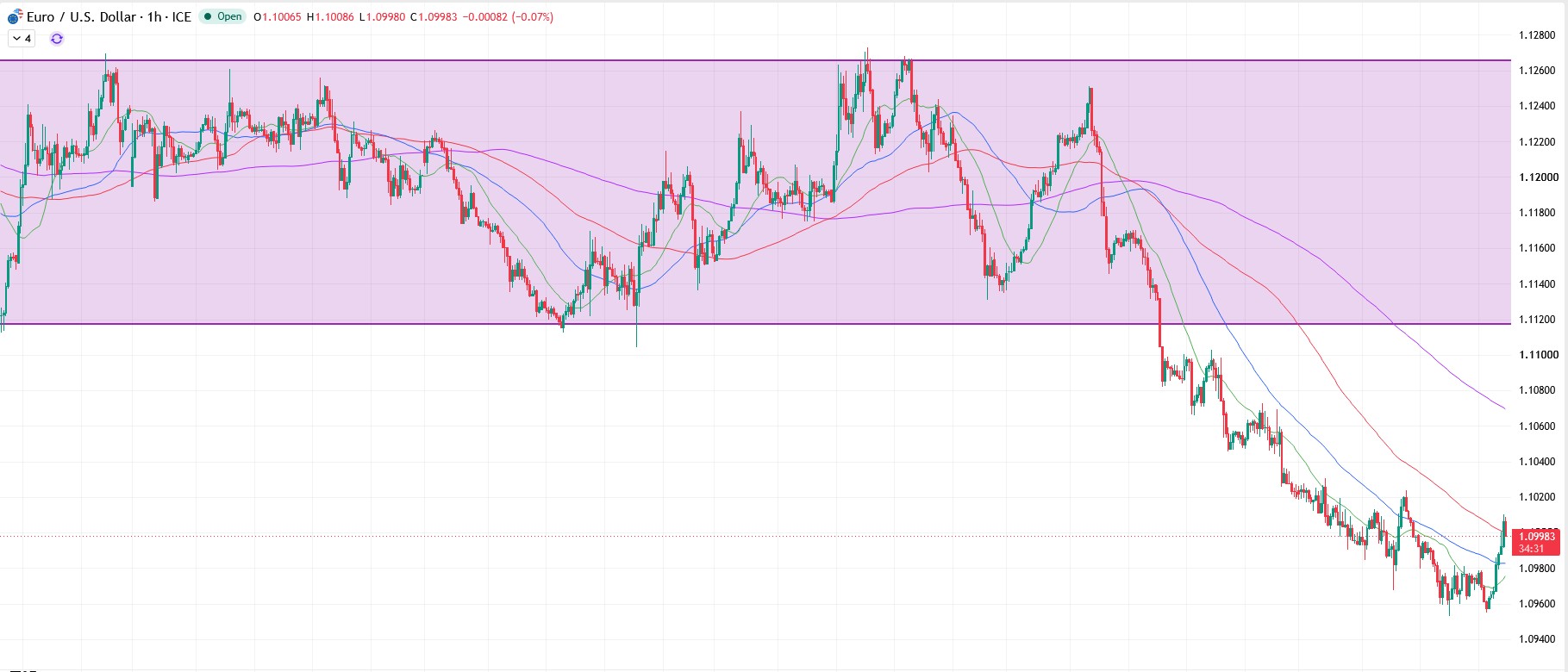
EUR/USD is trading around 1.0998 on November 19, attempting to establish itself above the psychological 1.1000 level after recovering from yesterday's low near 1.0953, its lowest level since April 2025. On the 1H chart, the pair remains in a pronounced downtrend that developed after the break below the 1.1110–1.1265 consolidation range, although buying activity has increased noticeably in recent hours.
 1.0990
1.1030
Fed minutes reveal growing divisions over interest rates
One of the main events over the past 24 hours was the release of the minutes from the Fed's October meeting on November 18, which confirmed growing disagreements within the Federal Reserve over the future course of monetary policy. At the October 27–28 meeting, the central bank kept its interest rate range unchanged at 3.75–4.00%, although the decision was approved by a vote of ten to two.
Lisa Cook and Beth Hammack favored an immediate 25-basis-point rate hike, arguing that current monetary conditions were not sufficiently restrictive to bring inflation back to the 2% target. However, most participants preferred to wait for additional economic data to assess the effects of September's rate increase and the impact of large-scale artificial intelligence investment on economic activity.
Of particular importance was the warning that the expansion of data center construction and increased spending by technology companies could sustain demand for labor, equipment, and electricity, creating additional inflationary risks. According to the minutes, some Fed officials believe another rate hike could be justified as early as December, while more aggressive tightening remains possible if price pressures persist.
Against this backdrop, the probability of a 25-basis-point rate hike in December remains around 90–95%, although expectations for the future path of interest rates are becoming increasingly divided. The Fed's stance continues to support the dollar, although the lack of consensus within the committee creates conditions for a correction following the U.S. currency's prolonged appreciation.
ABN AMRO highlights risks from crowded euro short positions
Another development attracting attention is an ABN AMRO research report published on November 18, in which analysts highlight changes in the nature of dollar demand and an excessive concentration of speculative positions against the euro. According to the bank's estimates, following the release of U.S. inflation data on November 10, the expected Fed interest rate for the end of September 2027 increased from 4.40% to 4.68%, representing an upward revision of approximately 28 basis points.
However, the dollar has continued to strengthen in recent days even without a comparable widening of the yield spread between U.S. and European bonds. This suggests that a significant part of the EUR/USD move is now driven by a reduction in risk exposure and demand for safe-haven assets rather than solely by changes in interest rate expectations.
Notably, the euro's weakness is not widespread: the European currency is losing ground against the dollar but remains more resilient against the Swiss franc and Swedish krona. At the same time, speculative positioning data indicate a substantial increase in net short positions in the euro.
Such concentration creates the risk of a sharp technical recovery, as even a moderate weakening of the dollar could trigger the simultaneous closing of a large number of positions betting on further EUR/USD declines. ABN AMRO analysts also expect currency market volatility to remain elevated through the end of the year, noting that the dollar's current behavior is becoming less predictable amid shifts in stock market sentiment.
Eurozone inflation and Lagarde's comments put ECB policy in focus
In the eurozone, the key factor remains the final October inflation data released by Eurostat yesterday, which confirmed that annual consumer price inflation accelerated to 4.0% from 3.8% in September. The final figures also revealed some differences from the preliminary estimates: energy inflation reached 21.0%, compared with the previously reported 20.8%, while core inflation, excluding energy, food, alcohol, and tobacco, accelerated to 2.6% against the preliminary estimate of 2.5%.
Price increases were particularly pronounced in Italy, where inflation reached 5.6%, while Germany recorded 2.9% and France 3.7%. These differences complicate the ECB's task of setting a single monetary policy, as tighter financial conditions can affect national economies differently. Additional attention today is focused on the eurozone's September balance of payments data: the seasonally adjusted current account surplus stood at approximately €12.5 billion, below expectations of €16.6 billion, although it exceeded the previous €8.7 billion.
This indicates an improvement in external balances compared with August, but also a weaker result than market expectations. ECB President Christine Lagarde is scheduled to speak later today, potentially providing greater clarity on the central bank's assessment of accelerating core inflation and the outlook for its December interest rate decision. A more hawkish stance from Lagarde could support the euro, particularly given the large number of open short positions, while an emphasis on weakness in the European economy could limit further EUR/USD recovery.
Although EUR bulls still have little reason for optimism, a base may form around 1.0960, from which the pair could attempt to extend its recovery. In that case, the bulls' nearest target could be resistance around 1.1040–1.1060. Nevertheless, as noted in EUR/USD remains below 1.1000 as Fed expectations raise the risk of a decline toward 1.0900, below 1.1020, the risks of another test of the aforementioned support and a break below it will remain high.











-
 Afghanistan
-
 Albania
-
 Algeria
-
 Angola
-
 Argentina
-
 Armenia
-
 Australia
-
 Austria
-
 Azerbaijan
-
 Bahamas
-
 Bahrain
-
 Bangladesh
-
 Belarus
-
 Belgium
-
 Bolivia
-
 Botswana
-
 Brazil
-
 Brunei
-
 Bulgaria
-
 Cambodia
-
 Cameroon
-
 Canada
-
 Chile
-
 China
-
 Colombia
-
 Congo
-
 Costa Rica
-
 Cote d'Ivoire
-
 Croatia
-
 Cuba
-
 Cyprus
-
 Czechia
-
 DR Congo
-
 Denmark
-
 Dominican Republic
-
 Ecuador
-
 Egypt
-
 El Salvador
-
 Estonia
-
 Eswatini
-
 Ethiopia
-
 Finland
-
 France
-
 Georgia
-
 Germany
-
 Ghana
-
 Greece
-
 Haiti
-
 Hong Kong
-
 Hungary
-
 India
-
 Indonesia
-
 Iran, Islamic republic
-
 Iraq
-
 Ireland
-
 Israel
-
 Italy
-
 Jamaica
-
 Japan
-
 Jordan
-
 Kazakhstan
-
 Kenya
-
 Korea
-
 Kuwait
-
 Kyrgyzstan
-
 Laos
-
 Latvia
-
 Lebanon
-
 Lesotho
-
 Libya
-
 Lithuania
-
 Luxembourg
-
 Madagascar
-
 Malaysia
-
 Malta
-
 Mauritius
-
 Mexico
-
 Moldova
-
 Mongolia
-
 Montenegro
-
 Morocco
-
 Mozambique
-
 Myanmar
-
 Namibia
-
 Nepal
-
 Netherlands
-
 New Zealand
-
 Nigeria
-
 North Macedonia
-
 Norway
-
 Oman
-
 Pakistan
-
 Palestine
-
 Panama
-
 Papua New Guinea
-
 Paraguay
-
 Peru
-
 Philippines
-
 Poland
-
 Portugal
-
 Puerto Rico
-
 Qatar
-
 Reunion
-
 Romania
-
 Rwanda
-
 Saudi Arabia
-
 Serbia
-
 Singapore
-
 Slovakia
-
 Slovenia
-
 Somalia
-
 South Africa
-
 Spain
-
 Sri Lanka
-
 Sweden
-
 Switzerland
-
 Syria
-
 Taiwan
-
 Tajikistan
-
 Tanzania
-
 Thailand
-
 Trinidad and Tobago
-
 Tunisia
-
 Turkey
-
 UAE
-
 Uganda
-
 Ukraine
-
 United Kingdom
-
United States
-
 Uruguay
-
 Uzbekistan
-
 Venezuela
-
 Vietnam
-
 Yemen
-
 Zambia
-
 Zimbabwe
- Forex
- Crypto












