

Avalanche stalls below Ichimoku Kijun resistance as traders eye potential for further downside: weekly outlook

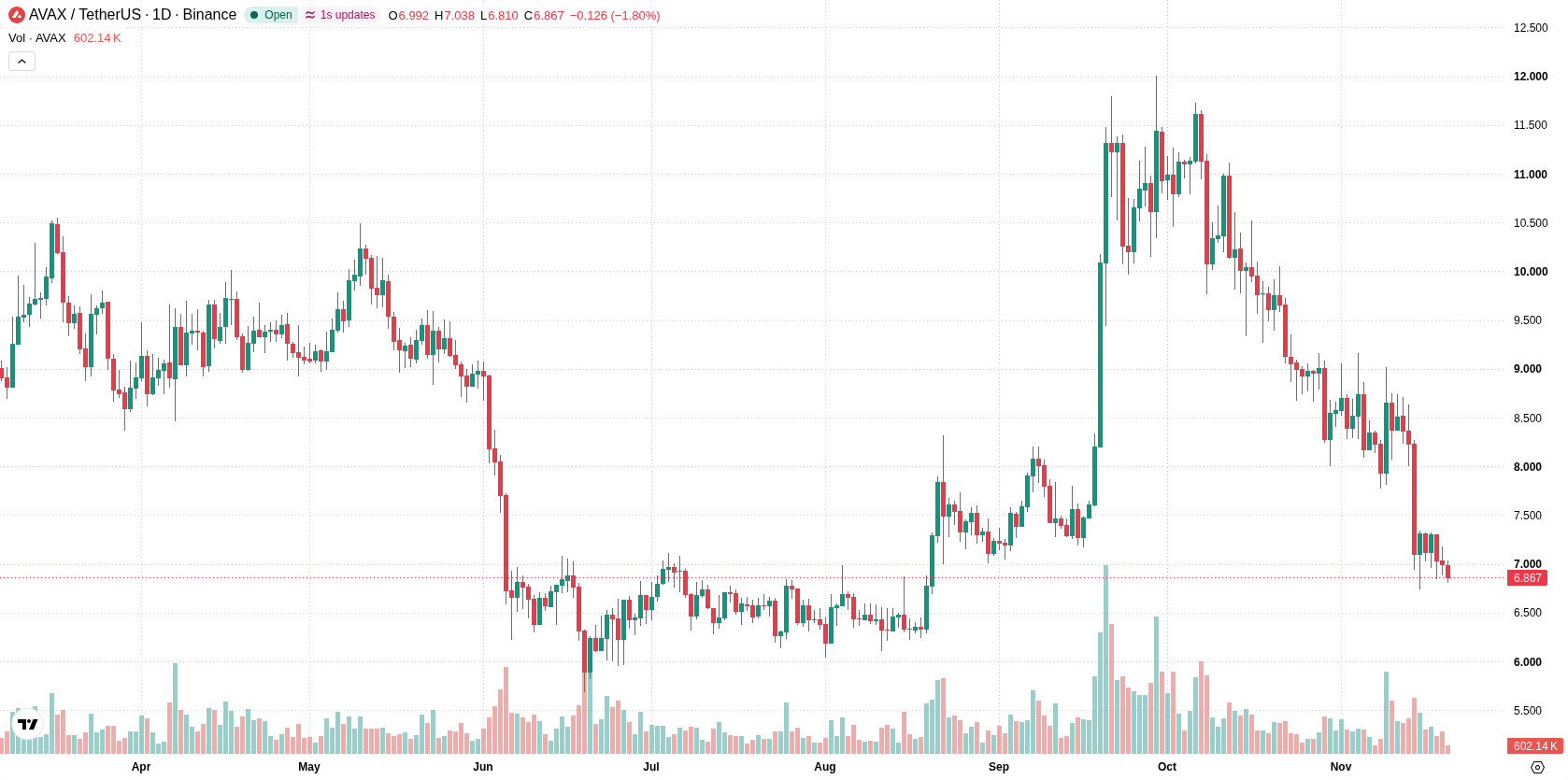
Institutional momentum is in focus for Avalanche (AVAX) this week as the digital asset holds near $6.87 after a sharp decline of around 18% over the past seven days. Despite major adoption headlines supporting the technology, mounting sell pressure and lingering uncertainty over broader risk appetite keep traders cautious heading into the new week.
 7.04
8.27
Highlights
- Avalanche fell 18.22% this week to $6.87, trading near the bottom of its latest range.
- The price remains under key moving averages with continued sell momentum and volatility at 22.7%.
- If support at $6.74 fails, downside risk extends to $5.89; upside requires reclaiming $7.95 for rebound potential.
Institutional adoption headlines boost long-term sentiment despite pending approvals
On November 9, 2026, Avalanche's blockchain was selected to power a new tokenized stock exchange backed by the New York Stock Exchange and Intercontinental Exchange, according to The Motley Fool and AOL. Regulatory approvals and operational details remain pending, but the move highlights deepening institutional adoption. Additionally, Investing.com reported that Avalanche Treasury Company turned profitable in Q3 2026 and the United Arab Emirates announced plans to use AVAX technology for its national digital ID platform.
Momentum stays bearish over the week as price tests support and CCI oversold
On the daily chart, Avalanche shows a sustained move lower with a firm trend, reinforced by volatility at 22.7%. The MACD continues to signal sell momentum, and CCI is in the oversold zone at -125.76. Pressure remains with sellers as price holds just above nearest support at $6.74, while the Ichimoku Kijun at $7.95 serves as immediate resistance. This technical setup points to selling exhaustion risk, but buyers have yet to show meaningful strength.
Downside risk prevails for next week with low rebound probability
Next week, the expected range spans $5.89 to $7.67, with a very high probability of further decline and less than a 20% chance of a bounce. The base case expects Avalanche to remain under pressure between $6.74 and $7.67. A recovery above $7.95 would open the way for a short-term rebound. Should price lose support at $6.74, downside continuation toward the $5.89 area becomes the primary risk.
Earlier, analysts noted that Avalanche was under intensifying pressure as investors broadly retreated from risk assets, overshadowing individual project fundamentals. The current focus on institutional adoption—highlighted by new enterprise deals and profitability milestones—adds to the narrative, but persistent technical weakness suggests downside risk remains the prevailing scenario in the near term.






Latest Avalanche News





-
 Afghanistan
-
 Albania
-
 Algeria
-
 Angola
-
 Argentina
-
 Armenia
-
 Australia
-
 Austria
-
 Azerbaijan
-
 Bahamas
-
 Bahrain
-
 Bangladesh
-
 Belarus
-
 Belgium
-
 Bolivia
-
 Botswana
-
 Brazil
-
 Brunei
-
 Bulgaria
-
 Cambodia
-
 Cameroon
-
 Canada
-
 Chile
-
 China
-
 Colombia
-
 Congo
-
 Costa Rica
-
 Cote d'Ivoire
-
 Croatia
-
 Cuba
-
 Cyprus
-
 Czechia
-
 DR Congo
-
 Denmark
-
 Dominican Republic
-
 Ecuador
-
 Egypt
-
 El Salvador
-
 Estonia
-
 Eswatini
-
 Ethiopia
-
 Finland
-
 France
-
 Georgia
-
 Germany
-
 Ghana
-
 Greece
-
 Haiti
-
 Hong Kong
-
 Hungary
-
 India
-
 Indonesia
-
 Iran, Islamic republic
-
 Iraq
-
 Ireland
-
 Israel
-
 Italy
-
 Jamaica
-
 Japan
-
 Jordan
-
 Kazakhstan
-
 Kenya
-
 Korea
-
 Kuwait
-
 Kyrgyzstan
-
 Laos
-
 Latvia
-
 Lebanon
-
 Lesotho
-
 Libya
-
 Lithuania
-
 Luxembourg
-
 Madagascar
-
 Malaysia
-
 Malta
-
 Mauritius
-
 Mexico
-
 Moldova
-
 Mongolia
-
 Montenegro
-
 Morocco
-
 Mozambique
-
 Myanmar
-
 Namibia
-
 Nepal
-
 Netherlands
-
 New Zealand
-
 Nigeria
-
 North Macedonia
-
 Norway
-
 Oman
-
 Pakistan
-
 Palestine
-
 Panama
-
 Papua New Guinea
-
 Paraguay
-
 Peru
-
 Philippines
-
 Poland
-
 Portugal
-
 Puerto Rico
-
 Qatar
-
 Reunion
-
 Romania
-
 Rwanda
-
 Saudi Arabia
-
 Serbia
-
 Singapore
-
 Slovakia
-
 Slovenia
-
 Somalia
-
 South Africa
-
 Spain
-
 Sri Lanka
-
 Sweden
-
 Switzerland
-
 Syria
-
 Taiwan
-
 Tajikistan
-
 Tanzania
-
 Thailand
-
 Trinidad and Tobago
-
 Tunisia
-
 Turkey
-
 UAE
-
 Uganda
-
 Ukraine
-
 United Kingdom
-
United States
-
 Uruguay
-
 Uzbekistan
-
 Venezuela
-
 Vietnam
-
 Yemen
-
 Zambia
-
 Zimbabwe
- Forex
- Crypto












