

ETF withdrawals and macro uncertainty deepen risk-off mood for ZCash

ZCash (ZEC) is trading at $763.55 and moved lower by 15.68% as of the last quote on November 20, 2026. Renewed concerns about U.S. Federal Reserve monetary tightening and widespread ETF outflows resulted in sustained selling pressure across the cryptocurrency market. Investors are watching upcoming U.S. Fed statements and ETF fund flows for further clues on risk appetite and liquidity conditions.
 899
973.87
Highlights
- Cryptocurrency markets, including ZEC, fell as institutional investors pulled funds from exchange-traded funds, reducing market liquidity.
- Rising uncertainty about upcoming U.S. Federal Reserve monetary policy increased pressure on digital assets and prompted broad risk-off sentiment.
- ZEC trades in a sustained downtrend below key resistance at $891, with technical signals indicating oversold conditions and continued selling momentum dependent on external macro factors.
ETF outflows and Fed policy fears hit crypto demand
According to Crypto, on November 20, 2026, the broader cryptocurrency market, including ZEC, faced notable declines as institutional outflows from exchange-traded funds coincided with renewed uncertainty about forthcoming U.S. Federal Reserve monetary policy.
The pullback in ETF investors withdrew significant liquidity from digital asset markets, reducing demand for ZEC. Heightened anticipation of tighter monetary policy further weighed on overall market sentiment and deepened the selling pressure.
These developments led to a broad risk-off shift across cryptocurrencies, with ZEC experiencing similar drawbacks due to macroeconomic uncertainty and the direct impact of dampened liquidity conditions.
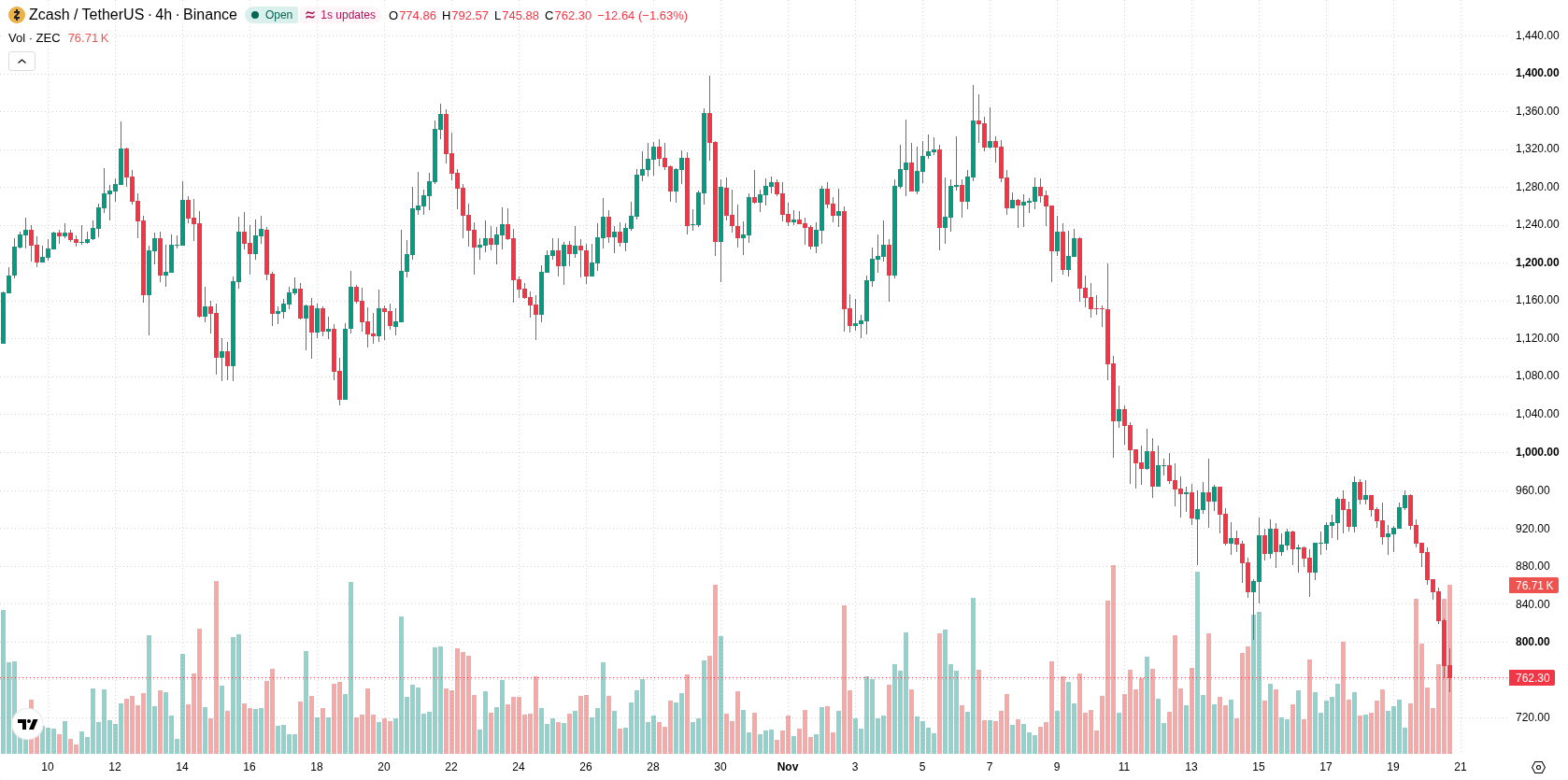
Bearish momentum persists below key moving averages
Technical signals on the 4H chart reflect persistent bearish momentum, with ZEC trading below the 4H SMA-50 at $915.19 and the 4H SMA-200 at $1,143. Both moving averages confirm the prevailing downtrend after the recent macro-driven sell-off.
RSI is now in an oversold zone, reinforcing the weakness, while both MACD and ADX continue to signal selling conditions. The H4 Kijun at $891 currently acts as the nearest resistance, with no indication of reversal at this stage.
Macro risk and resistance around $891 shape next moves
Further movement in ZEC is likely to hinge on shifts in external macro factors such as U.S. monetary policy direction and renewed ETF inflows. Stabilization would require ZEC to reclaim levels around the $891 resistance or see improved sentiment on market liquidity. A close above this area could act as an early signal for reduced downside risk, while further ETF outflows may sustain selling momentum.
Earlier, analysts noted that persistent institutional outflows and technical weakness were driving sustained downside pressure in ZCash. The current article reinforces this bearish narrative, emphasizing that future moves will depend on developments in U.S. Federal Reserve policy and ETF fund flows.









-
 Afghanistan
-
 Albania
-
 Algeria
-
 Angola
-
 Argentina
-
 Armenia
-
 Australia
-
 Austria
-
 Azerbaijan
-
 Bahamas
-
 Bahrain
-
 Bangladesh
-
 Belarus
-
 Belgium
-
 Bolivia
-
 Botswana
-
 Brazil
-
 Brunei
-
 Bulgaria
-
 Cambodia
-
 Cameroon
-
 Canada
-
 Chile
-
 China
-
 Colombia
-
 Congo
-
 Costa Rica
-
 Cote d'Ivoire
-
 Croatia
-
 Cuba
-
 Cyprus
-
 Czechia
-
 DR Congo
-
 Denmark
-
 Dominican Republic
-
 Ecuador
-
 Egypt
-
 El Salvador
-
 Estonia
-
 Eswatini
-
 Ethiopia
-
 Finland
-
 France
-
 Georgia
-
 Germany
-
 Ghana
-
 Greece
-
 Haiti
-
 Hong Kong
-
 Hungary
-
 India
-
 Indonesia
-
 Iran, Islamic republic
-
 Iraq
-
 Ireland
-
 Israel
-
 Italy
-
 Jamaica
-
 Japan
-
 Jordan
-
 Kazakhstan
-
 Kenya
-
 Korea
-
 Kuwait
-
 Kyrgyzstan
-
 Laos
-
 Latvia
-
 Lebanon
-
 Lesotho
-
 Libya
-
 Lithuania
-
 Luxembourg
-
 Madagascar
-
 Malaysia
-
 Malta
-
 Mauritius
-
 Mexico
-
 Moldova
-
 Mongolia
-
 Montenegro
-
 Morocco
-
 Mozambique
-
 Myanmar
-
 Namibia
-
 Nepal
-
 Netherlands
-
 New Zealand
-
 Nigeria
-
 North Macedonia
-
 Norway
-
 Oman
-
 Pakistan
-
 Palestine
-
 Panama
-
 Papua New Guinea
-
 Paraguay
-
 Peru
-
 Philippines
-
 Poland
-
 Portugal
-
 Puerto Rico
-
 Qatar
-
 Reunion
-
 Romania
-
 Rwanda
-
 Saudi Arabia
-
 Serbia
-
 Singapore
-
 Slovakia
-
 Slovenia
-
 Somalia
-
 South Africa
-
 Spain
-
 Sri Lanka
-
 Sweden
-
 Switzerland
-
 Syria
-
 Taiwan
-
 Tajikistan
-
 Tanzania
-
 Thailand
-
 Trinidad and Tobago
-
 Tunisia
-
 Turkey
-
 UAE
-
 Uganda
-
 Ukraine
-
 United Kingdom
-
United States
-
 Uruguay
-
 Uzbekistan
-
 Venezuela
-
 Vietnam
-
 Yemen
-
 Zambia
-
 Zimbabwe
- Forex
- Crypto












