

Can SOL recover if institutional interest for income-linked funds returns?

Solana (SOL) is trading lower at $67.98 as of November 20, 2026, down 6.66% on the day. The immediate move is tied to broader concerns about the lack of institutional investor demand for new income-oriented crypto funds. Traders are monitoring any signs of renewed fund launches or institutional inflows into Solana investment products.
 73.56
78.50
Highlights
- Roundhill Investments withdrew its planned Solana covered-call ETF due to limited demand for income-focused crypto products.
- Spot Solana ETFs attracted $969 million in inflows since May, whereas covered-call strategies gathered only $12 million.
- SOL trades below key moving averages with persistent selling pressure and bearish indicators; $71.79 is a critical resistance level for recovery.
ETF withdrawal limits institutional inflow potential for Solana
According to CoinShares, Roundhill Investments withdrew its proposed Solana covered-call ETF on November 20, 2026, citing limited investor demand for income-oriented cryptocurrency products. Since May, spot Solana ETFs accumulated $969 million in inflows, while covered-call products saw just $12 million over the same period, also reported by CoinShares.
This withdrawal highlights restricted appetite among institutional investors for newer Solana-linked offerings, particularly those promising regular income distribution. The lack of demand for such ETFs constrains potential sources of sizeable investment, reducing capital inflows that could have otherwise offered price support to SOL.
While spot Solana ETF inflows have been robust, the minimal reception for income-oriented strategies reflects a selective institutional preference and narrows the base of supportive flows for SOL. Any reversal in demand for these products could alter fund flows, but the current environment limits broader institutional participation.
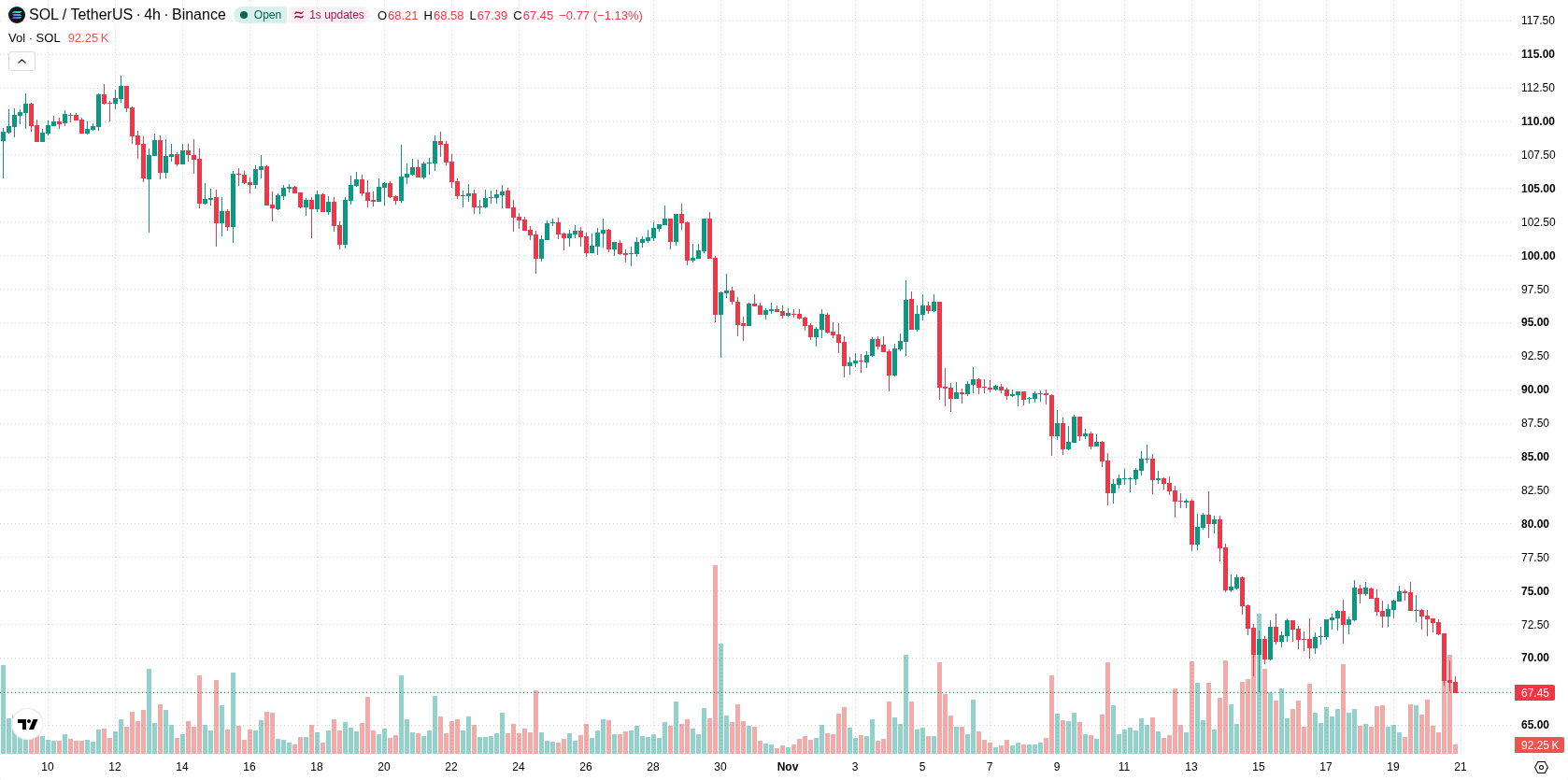
SOL technical picture under pressure from macro investor caution
In the current 4H timeframe, SOL is positioned well under the SMA-50 at $74.13 and the SMA-200 at $90.83, emphasizing persistent selling pressure linked to negative macro sentiment. Technical signals remain bearish, with the 4H Kijun at $71.79 acting as resistance.
RSI is in oversold territory, indicating stretched conditions to the downside, while both MACD and ADX support the continuation of a sell bias. No mixed signals are present, confirming that institutional caution continues to drive near-term market direction.
Institutional demand return or key resistance at $71.79 to shift trend
SOL's outlook will depend on whether any renewed institutional demand emerges, particularly through new fund products or a shift in investor flows. The $71.79 level acts as resistance to the upside; failure to reclaim this area signals continued vulnerability. Close monitoring of ETF launches or a change in capital allocation will be key in assessing prospects for stabilization or potential recovery.
Previously it was reported that sustained bearish momentum and diminished institutional involvement were pressuring Solana despite network developments. The current article reinforces this outlook, citing ongoing institutional caution and limited demand for Solana-linked income products, with renewed fund launches or shifts in investor flows remaining the key factors to monitor for potential trend reversal.









-
 Afghanistan
-
 Albania
-
 Algeria
-
 Angola
-
 Argentina
-
 Armenia
-
 Australia
-
 Austria
-
 Azerbaijan
-
 Bahamas
-
 Bahrain
-
 Bangladesh
-
 Belarus
-
 Belgium
-
 Bolivia
-
 Botswana
-
 Brazil
-
 Brunei
-
 Bulgaria
-
 Cambodia
-
 Cameroon
-
 Canada
-
 Chile
-
 China
-
 Colombia
-
 Congo
-
 Costa Rica
-
 Cote d'Ivoire
-
 Croatia
-
 Cuba
-
 Cyprus
-
 Czechia
-
 DR Congo
-
 Denmark
-
 Dominican Republic
-
 Ecuador
-
 Egypt
-
 El Salvador
-
 Estonia
-
 Eswatini
-
 Ethiopia
-
 Finland
-
 France
-
 Georgia
-
 Germany
-
 Ghana
-
 Greece
-
 Haiti
-
 Hong Kong
-
 Hungary
-
 India
-
 Indonesia
-
 Iran, Islamic republic
-
 Iraq
-
 Ireland
-
 Israel
-
 Italy
-
 Jamaica
-
 Japan
-
 Jordan
-
 Kazakhstan
-
 Kenya
-
 Korea
-
 Kuwait
-
 Kyrgyzstan
-
 Laos
-
 Latvia
-
 Lebanon
-
 Lesotho
-
 Libya
-
 Lithuania
-
 Luxembourg
-
 Madagascar
-
 Malaysia
-
 Malta
-
 Mauritius
-
 Mexico
-
 Moldova
-
 Mongolia
-
 Montenegro
-
 Morocco
-
 Mozambique
-
 Myanmar
-
 Namibia
-
 Nepal
-
 Netherlands
-
 New Zealand
-
 Nigeria
-
 North Macedonia
-
 Norway
-
 Oman
-
 Pakistan
-
 Palestine
-
 Panama
-
 Papua New Guinea
-
 Paraguay
-
 Peru
-
 Philippines
-
 Poland
-
 Portugal
-
 Puerto Rico
-
 Qatar
-
 Reunion
-
 Romania
-
 Rwanda
-
 Saudi Arabia
-
 Serbia
-
 Singapore
-
 Slovakia
-
 Slovenia
-
 Somalia
-
 South Africa
-
 Spain
-
 Sri Lanka
-
 Sweden
-
 Switzerland
-
 Syria
-
 Taiwan
-
 Tajikistan
-
 Tanzania
-
 Thailand
-
 Trinidad and Tobago
-
 Tunisia
-
 Turkey
-
 UAE
-
 Uganda
-
 Ukraine
-
 United Kingdom
-
United States
-
 Uruguay
-
 Uzbekistan
-
 Venezuela
-
 Vietnam
-
 Yemen
-
 Zambia
-
 Zimbabwe
- Forex
- Crypto












