

Polygon technical analysis: Bearish setup dominates as sellers control the trend

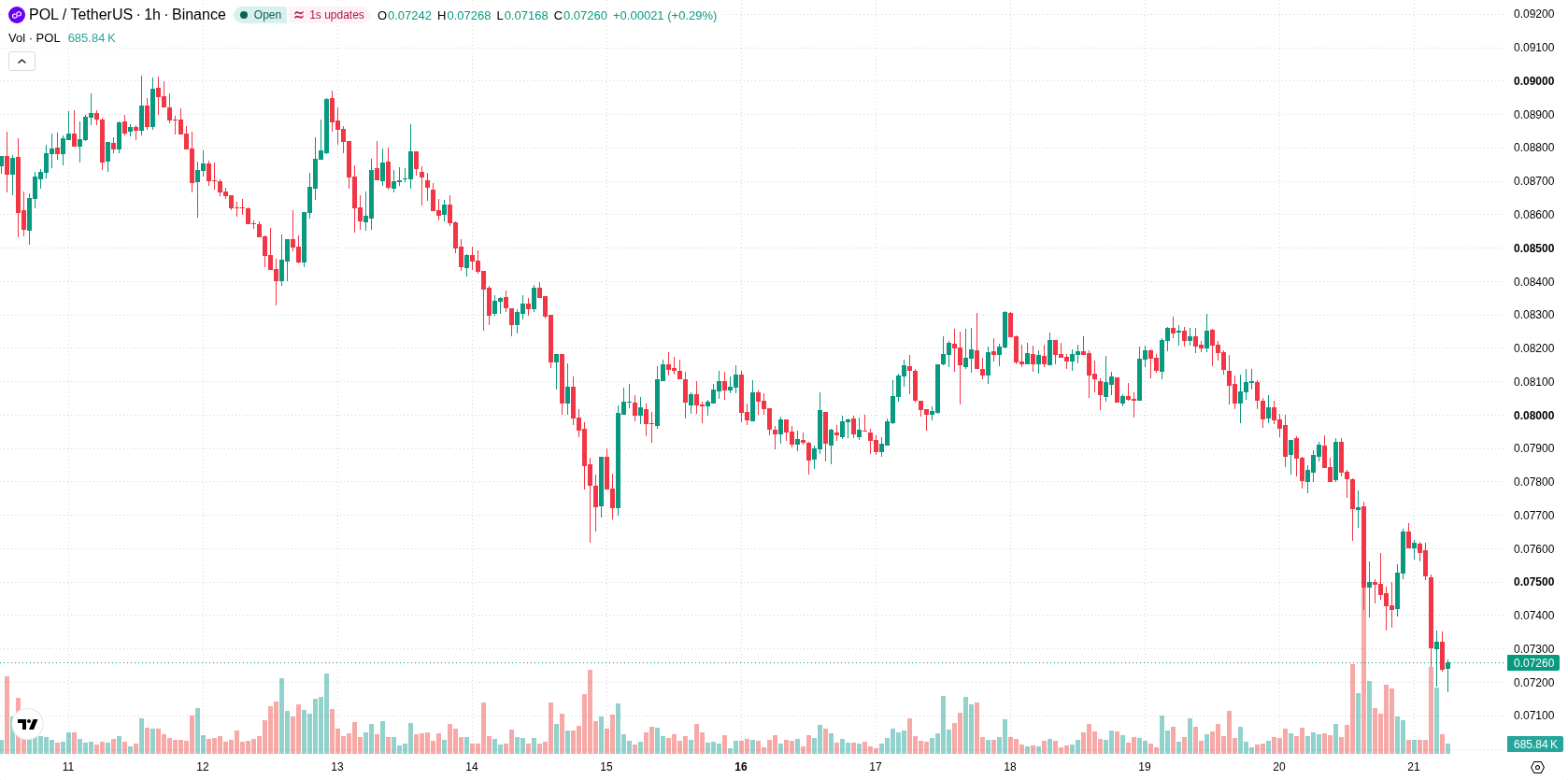
Polygon (POL) is trading at $0.0723, down 7.81% for the day. The asset remains below its key short-, medium-, and long-term moving averages, reflecting ongoing pressure from sellers.
 0.0763
0.0831
Highlights
- Polygon deployed the Heimdall v0.14.0 upgrade and Purley hard-fork, adding new validator voting and fee management features.
- The upgrade aims to boost security and operational efficiency but may cause temporary adjustment issues for node operators.
- POL/USD trades below key moving averages with strong downside momentum; next session range projected at $0.0694 to $0.0744.
Protocol upgrade introduces security gains but heightens operator caution
Polygon implemented the Heimdall v0.14.0 upgrade to its mainnet and Amoy testnet, introducing the Purley hard-fork with new functionalities for validator voting, improved bridge event confirmation, and updates to staking and governance fee management, according to Tokenpost. These changes are designed to enhance the network's security and operational efficiency but may also introduce transitional adjustments and short-term uncertainty among node operators. The timing of the deployment coincides with heightened caution across the market, as participants assess the broader impact of new protocol features on network stability.
Sustained downside momentum as oversold signals meet firm resistance
On the technical front, POL/USD is trading below the H1 SMA-20 at $0.0756, H1 SMA-50 at $0.0786, and D1 SMA-200 at $0.089. The Ichimoku Kijun is set at $0.0756, now acting as immediate resistance. Momentum indicators are negative, with MACD and ADX both showing a sell signal. RSI and CCI are both oversold, while Stoch RSI is neutral. Bull/Bear Power remains negative at -0.0013, and the Awesome Oscillator aligns with the ongoing downside move.
Bearish bias persists as breakout unlikely within volatility band
For the next session, POL/USD is expected to trade between $0.0694 and $0.0744 as part of a typical volatility band relative to current levels. The baseline scenario calls for sideways consolidation within this range. A move above resistance at $0.0756 would be necessary to trigger a bullish reversal, while a break below the lower support may result in an extension of the downtrend toward the range floor. Overall, further downside appears much more probable than a rebound in the immediate term.
Earlier, analysts noted that Polygon was experiencing persistent technical weakness and a prevailing bearish trend despite ongoing network developments. The latest analysis reinforces this outlook, with dominant downside signals and operational adjustments following the Heimdall v0.14.0 upgrade keeping attention on immediate support levels as the key area for potential downside risk.










-
 Afghanistan
-
 Albania
-
 Algeria
-
 Angola
-
 Argentina
-
 Armenia
-
 Australia
-
 Austria
-
 Azerbaijan
-
 Bahamas
-
 Bahrain
-
 Bangladesh
-
 Belarus
-
 Belgium
-
 Bolivia
-
 Botswana
-
 Brazil
-
 Brunei
-
 Bulgaria
-
 Cambodia
-
 Cameroon
-
 Canada
-
 Chile
-
 China
-
 Colombia
-
 Congo
-
 Costa Rica
-
 Cote d'Ivoire
-
 Croatia
-
 Cuba
-
 Cyprus
-
 Czechia
-
 DR Congo
-
 Denmark
-
 Dominican Republic
-
 Ecuador
-
 Egypt
-
 El Salvador
-
 Estonia
-
 Eswatini
-
 Ethiopia
-
 Finland
-
 France
-
 Georgia
-
 Germany
-
 Ghana
-
 Greece
-
 Haiti
-
 Hong Kong
-
 Hungary
-
 India
-
 Indonesia
-
 Iran, Islamic republic
-
 Iraq
-
 Ireland
-
 Israel
-
 Italy
-
 Jamaica
-
 Japan
-
 Jordan
-
 Kazakhstan
-
 Kenya
-
 Korea
-
 Kuwait
-
 Kyrgyzstan
-
 Laos
-
 Latvia
-
 Lebanon
-
 Lesotho
-
 Libya
-
 Lithuania
-
 Luxembourg
-
 Madagascar
-
 Malaysia
-
 Malta
-
 Mauritius
-
 Mexico
-
 Moldova
-
 Mongolia
-
 Montenegro
-
 Morocco
-
 Mozambique
-
 Myanmar
-
 Namibia
-
 Nepal
-
 Netherlands
-
 New Zealand
-
 Nigeria
-
 North Macedonia
-
 Norway
-
 Oman
-
 Pakistan
-
 Palestine
-
 Panama
-
 Papua New Guinea
-
 Paraguay
-
 Peru
-
 Philippines
-
 Poland
-
 Portugal
-
 Puerto Rico
-
 Qatar
-
 Reunion
-
 Romania
-
 Rwanda
-
 Saudi Arabia
-
 Serbia
-
 Singapore
-
 Slovakia
-
 Slovenia
-
 Somalia
-
 South Africa
-
 Spain
-
 Sri Lanka
-
 Sweden
-
 Switzerland
-
 Syria
-
 Taiwan
-
 Tajikistan
-
 Tanzania
-
 Thailand
-
 Trinidad and Tobago
-
 Tunisia
-
 Turkey
-
 UAE
-
 Uganda
-
 Ukraine
-
 United Kingdom
-
United States
-
 Uruguay
-
 Uzbekistan
-
 Venezuela
-
 Vietnam
-
 Yemen
-
 Zambia
-
 Zimbabwe
- Forex
- Crypto












