

Pepe declines as sellers maintain control of the short-term trend

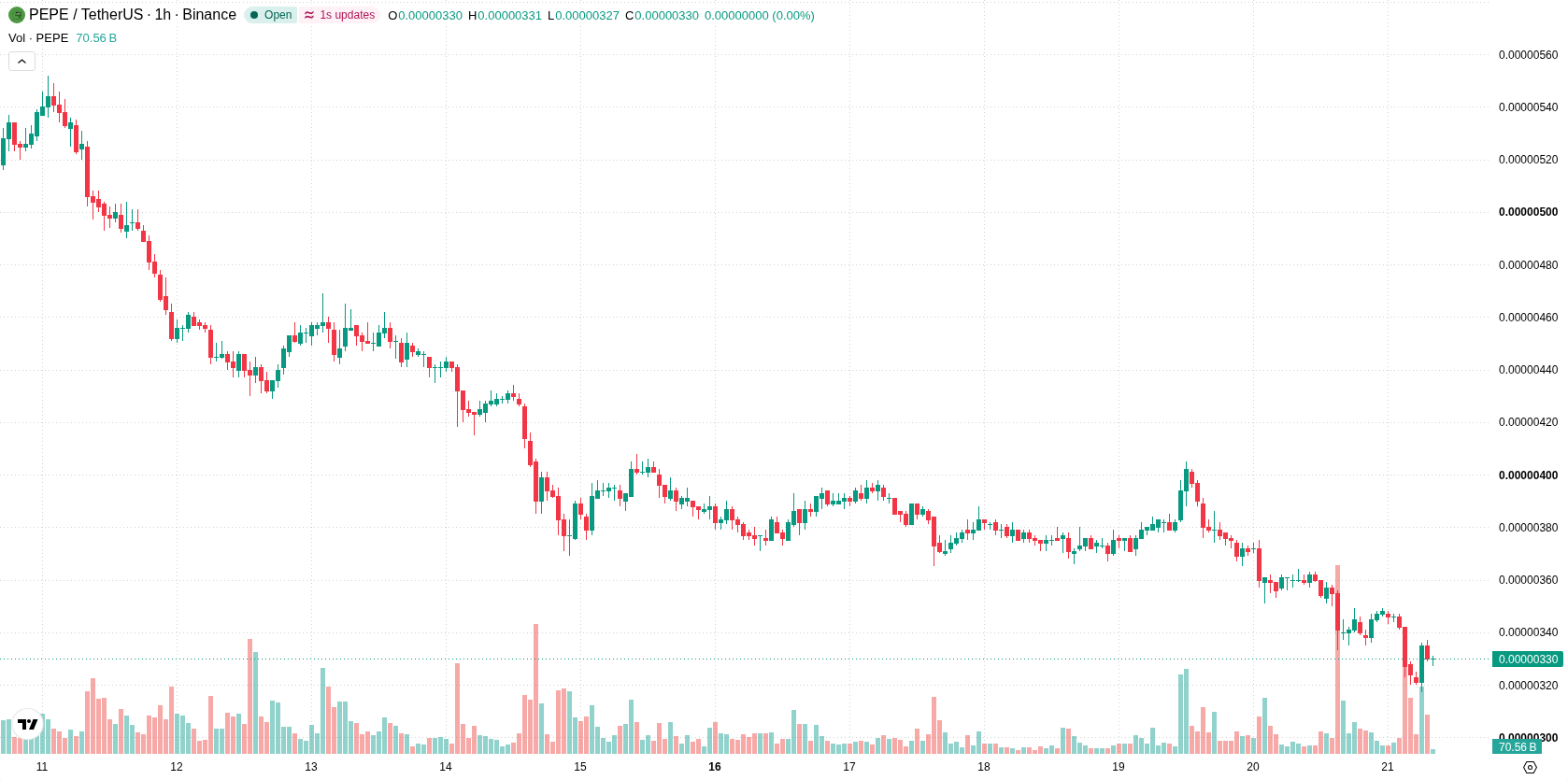
Pepe (PEPE) is trading at $0.000003, down 8.33% on the day. The asset sits below its key moving averages, marking continued downside pressure.
 0.0535
0.054080
Highlights
- PEPE/USD trades below key moving averages across all timeframes, confirming persistent seller pressure and a bearish structure.
- Bearish momentum dominates with MACD, ADX, and negative intraday power, despite some oscillators remaining neutral or overbought.
- Price fell 8.33% with projected consolidation between $0.000002832 and $0.0000034, and a very high probability of further downside.
Bearish momentum persists as technical clusters reinforce downside
On the H1 timeframe, PEPE/USD is trading below the H1 SMA-20 at $0.000003414 and H1 SMA-50 at $0.000003605. On the daily chart, the price remains under the D1 SMA-200 at $0.000003543, with the Ichimoku Kijun currently at $0.000003405, serving as immediate resistance. Momentum indicators, including MACD and ADX, reflect ongoing bearish pressure, while RSI and CCI remain in neutral zones. Stoch RSI is in the overbought territory, highlighting the risk of a downside correction. Negative Bull/Bear Power readings and alignment of the Awesome Oscillator further point to strong seller dominance intraday, although oscillators provide some mixed signals.
Downward scenario favored as rebound conditions remain unlikely
Over the next two to three trading days, PEPE/USD is expected to consolidate within a volatility band from $0.000002832 to $0.0000034. The probability of an upward move is very low, while a downward scenario remains highly probable, making a sustained rebound unlikely. The baseline scenario is for price action to remain within this range, with a bullish case requiring a decisive move above immediate resistance and a bearish case seeing a breakdown below projected support to reinforce recent downside momentum.
Earlier, analysts noted that Pepe was grappling with persistent selling pressure and a dominant bearish trend. The current market action reinforces this outlook, with near-term risks still skewed to the downside and traders advised to monitor for a decisive break below the established volatility band, which could trigger further selling.










-
 Afghanistan
-
 Albania
-
 Algeria
-
 Angola
-
 Argentina
-
 Armenia
-
 Australia
-
 Austria
-
 Azerbaijan
-
 Bahamas
-
 Bahrain
-
 Bangladesh
-
 Belarus
-
 Belgium
-
 Bolivia
-
 Botswana
-
 Brazil
-
 Brunei
-
 Bulgaria
-
 Cambodia
-
 Cameroon
-
 Canada
-
 Chile
-
 China
-
 Colombia
-
 Congo
-
 Costa Rica
-
 Cote d'Ivoire
-
 Croatia
-
 Cuba
-
 Cyprus
-
 Czechia
-
 DR Congo
-
 Denmark
-
 Dominican Republic
-
 Ecuador
-
 Egypt
-
 El Salvador
-
 Estonia
-
 Eswatini
-
 Ethiopia
-
 Finland
-
 France
-
 Georgia
-
 Germany
-
 Ghana
-
 Greece
-
 Haiti
-
 Hong Kong
-
 Hungary
-
 India
-
 Indonesia
-
 Iran, Islamic republic
-
 Iraq
-
 Ireland
-
 Israel
-
 Italy
-
 Jamaica
-
 Japan
-
 Jordan
-
 Kazakhstan
-
 Kenya
-
 Korea
-
 Kuwait
-
 Kyrgyzstan
-
 Laos
-
 Latvia
-
 Lebanon
-
 Lesotho
-
 Libya
-
 Lithuania
-
 Luxembourg
-
 Madagascar
-
 Malaysia
-
 Malta
-
 Mauritius
-
 Mexico
-
 Moldova
-
 Mongolia
-
 Montenegro
-
 Morocco
-
 Mozambique
-
 Myanmar
-
 Namibia
-
 Nepal
-
 Netherlands
-
 New Zealand
-
 Nigeria
-
 North Macedonia
-
 Norway
-
 Oman
-
 Pakistan
-
 Palestine
-
 Panama
-
 Papua New Guinea
-
 Paraguay
-
 Peru
-
 Philippines
-
 Poland
-
 Portugal
-
 Puerto Rico
-
 Qatar
-
 Reunion
-
 Romania
-
 Rwanda
-
 Saudi Arabia
-
 Serbia
-
 Singapore
-
 Slovakia
-
 Slovenia
-
 Somalia
-
 South Africa
-
 Spain
-
 Sri Lanka
-
 Sweden
-
 Switzerland
-
 Syria
-
 Taiwan
-
 Tajikistan
-
 Tanzania
-
 Thailand
-
 Trinidad and Tobago
-
 Tunisia
-
 Turkey
-
 UAE
-
 Uganda
-
 Ukraine
-
 United Kingdom
-
United States
-
 Uruguay
-
 Uzbekistan
-
 Venezuela
-
 Vietnam
-
 Yemen
-
 Zambia
-
 Zimbabwe
- Forex
- Crypto












