

Roundhill ETF withdrawal may deepen capital access concerns for Solana as institutional product diversity narrows

Solana (SOL) is trading below recent moving averages as of November 22, 2026, moving modestly lower in today's session. Attention is focused on ETF demand trends amid mixed signals for new institutional capital. Traders are watching for shifts between spot and income-oriented ETF interest and potential changes in institutional allocations.
 71.43
75.78
Highlights
- Roundhill withdrew its Solana Covered Call ETF proposal after a year in review, citing limited demand for income-oriented crypto products.
- Spot Solana ETFs recorded $969 million in inflows since May 2026, showing traditional investor interest in direct SOL exposure.
- Solana price remains below key moving averages with bearish technical signals and downside risk if support at $70.26 fails to hold.
ETF withdrawals highlight institutional demand risk for SOL
According to CoinShares, on November 20, 2026, Roundhill withdrew its proposed Solana Covered Call ETF after more than a year in the approval process, citing limited demand for income-oriented crypto investment products. Spot Solana ETFs, however, have attracted $969 million in inflows since May 2026.
The withdrawal of the income-focused Solana ETF points to weak institutional appetite for income-oriented crypto products, potentially reducing diversity among Solana-related offerings and limiting avenues for fresh capital inflows. This could challenge the expansion of broader ETF-based access for SOL, especially from yield-seeking investors.
At the same time, spot ETF inflows demonstrate that traditional investor demand for straightforward Solana exposure remains active. This ongoing interest may partially offset institutional hesitation around niche or structured products.
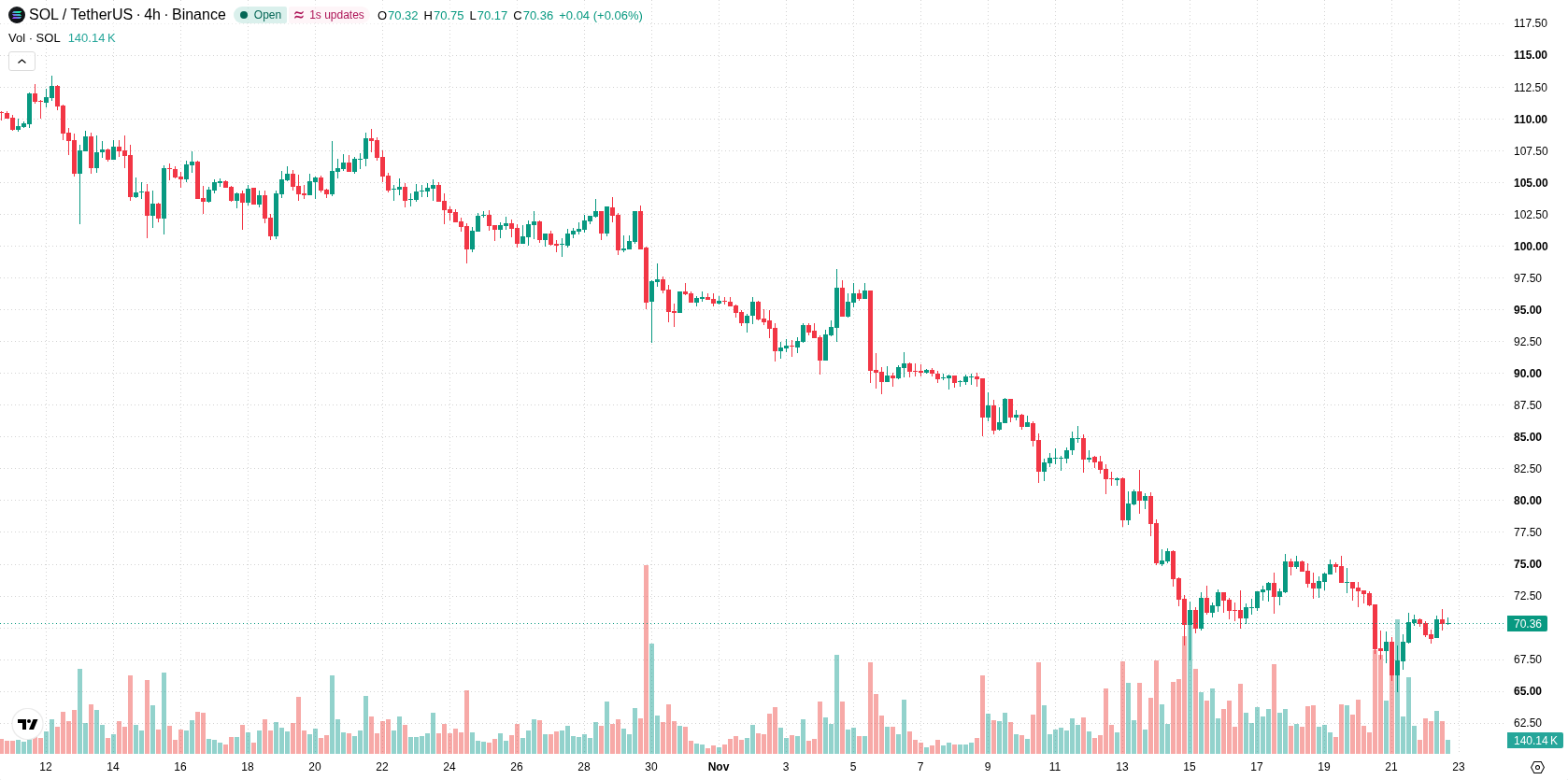
SOL momentum weak with price below H4 SMAs
On the 4H chart, SOL continues to trade below the H4 SMA-50 at $71.91 and well below the H4 SMA-200 at $88.91, indicating weaker momentum in the current setup. The H4 Ichimoku Kijun at $70.26 offers an identifiable support zone for the short term.
Technical signals are mostly bearish, with MACD in strong sell territory and ADX also favoring the sell side. Mixed signals arise as price approaches the Kijun support, warranting caution for directional conviction without confirmation from spot flows or return of institutional interest.
Institutional interest and $70.26 support level define next move
Further downside risk may develop if SOL falls below the $70.26 H4 Kijun support. Stabilization above this zone could provide a short-term floor, while any move toward resistance near the H4 SMA-50 at $71.91 would depend on improved demand for Solana investment products. Monitoring for renewed institutional or ETF activity remains key for directional clarity.
Earlier, analysts noted that Solana's long-term growth prospects hinge on sustained demand for its financial services and the network's ability to turn increasing transaction volumes into tangible revenue. The current focus on ETF demand and ongoing monitoring of institutional flows adds a new dimension, with the potential for renewed institutional or ETF activity now serving as the key macroeconomic driver to watch for Solana's next move.






Latest Solana News




-
 Afghanistan
-
 Albania
-
 Algeria
-
 Angola
-
 Argentina
-
 Armenia
-
 Australia
-
 Austria
-
 Azerbaijan
-
 Bahamas
-
 Bahrain
-
 Bangladesh
-
 Belarus
-
 Belgium
-
 Bolivia
-
 Botswana
-
 Brazil
-
 Brunei
-
 Bulgaria
-
 Cambodia
-
 Cameroon
-
 Canada
-
 Chile
-
 China
-
 Colombia
-
 Congo
-
 Costa Rica
-
 Cote d'Ivoire
-
 Croatia
-
 Cuba
-
 Cyprus
-
 Czechia
-
 DR Congo
-
 Denmark
-
 Dominican Republic
-
 Ecuador
-
 Egypt
-
 El Salvador
-
 Estonia
-
 Eswatini
-
 Ethiopia
-
 Finland
-
 France
-
 Georgia
-
 Germany
-
 Ghana
-
 Greece
-
 Haiti
-
 Hong Kong
-
 Hungary
-
 India
-
 Indonesia
-
 Iran, Islamic republic
-
 Iraq
-
 Ireland
-
 Israel
-
 Italy
-
 Jamaica
-
 Japan
-
 Jordan
-
 Kazakhstan
-
 Kenya
-
 Korea
-
 Kuwait
-
 Kyrgyzstan
-
 Laos
-
 Latvia
-
 Lebanon
-
 Lesotho
-
 Libya
-
 Lithuania
-
 Luxembourg
-
 Madagascar
-
 Malaysia
-
 Malta
-
 Mauritius
-
 Mexico
-
 Moldova
-
 Mongolia
-
 Montenegro
-
 Morocco
-
 Mozambique
-
 Myanmar
-
 Namibia
-
 Nepal
-
 Netherlands
-
 New Zealand
-
 Nigeria
-
 North Macedonia
-
 Norway
-
 Oman
-
 Pakistan
-
 Palestine
-
 Panama
-
 Papua New Guinea
-
 Paraguay
-
 Peru
-
 Philippines
-
 Poland
-
 Portugal
-
 Puerto Rico
-
 Qatar
-
 Reunion
-
 Romania
-
 Rwanda
-
 Saudi Arabia
-
 Serbia
-
 Singapore
-
 Slovakia
-
 Slovenia
-
 Somalia
-
 South Africa
-
 Spain
-
 Sri Lanka
-
 Sweden
-
 Switzerland
-
 Syria
-
 Taiwan
-
 Tajikistan
-
 Tanzania
-
 Thailand
-
 Trinidad and Tobago
-
 Tunisia
-
 Turkey
-
 UAE
-
 Uganda
-
 Ukraine
-
 United Kingdom
-
United States
-
 Uruguay
-
 Uzbekistan
-
 Venezuela
-
 Vietnam
-
 Yemen
-
 Zambia
-
 Zimbabwe
- Forex
- Crypto












