

Zcash slides after policy uncertainty and fund withdrawals reduce liquidity in digital assets

Zcash (ZEC) is trading lower in the latest session, with the move reflecting renewed concerns about US Federal Reserve policy and the impact of large institutional fund outflows. Ongoing macroeconomic caution is leading to a more defensive setup for ZEC, with traders watching for further developments from the Fed and institutional flows.
 799.1
973.87
Highlights
- Zcash fell alongside other cryptocurrencies as markets reacted to renewed US Federal Reserve policy uncertainty and large institutional outflows.
- Higher interest rate expectations and significant fund withdrawals continue to pressure ZEC, reducing liquidity and suppressing risk appetite.
- ZEC trades below key technical levels with strong bearish trend signals, remaining vulnerable to additional declines if outflows and hawkish signals persist.
US Federal Reserve policy and institutional outflows weigh on crypto
According to Crypto, on November 20, 2026, Zcash experienced a marked decline together with other cryptocurrencies as markets reacted to renewed uncertainty over US Federal Reserve monetary policy, institutional fund withdrawals, and persistent selling pressure.
This backdrop has negatively affected liquidity across the crypto sector, as higher interest rate expectations and the exit of major funds have led to weakened risk appetite and put pressure on assets such as ZEC.
While the immediate catalyst has been macro policy signals and institutional flows, no new positive counterweights have emerged to offset this environment, leaving price action vulnerable to further downside if outflows persist.
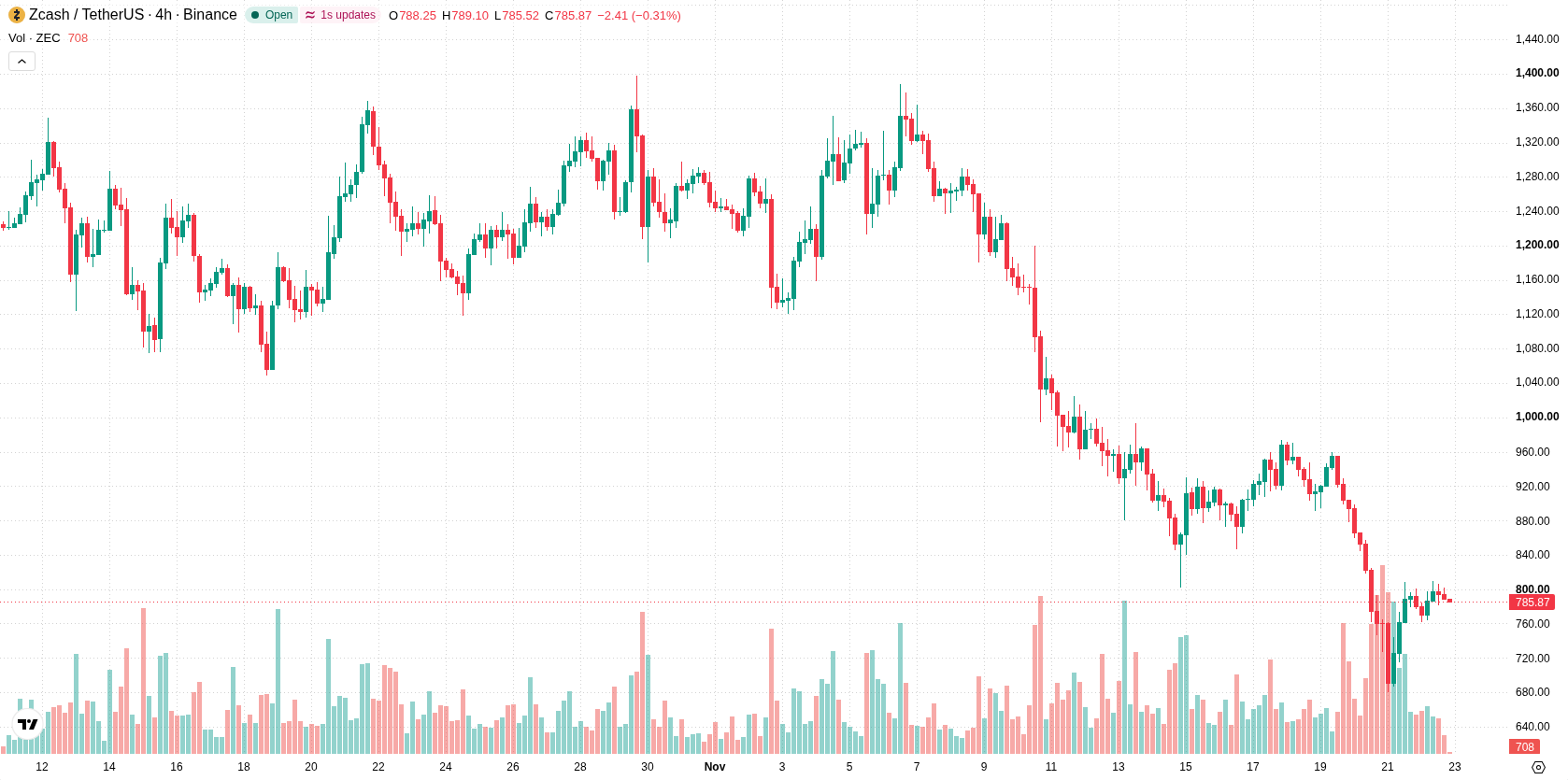
Downward trend momentum with ZEC below key 4H averages
ZEC remains below the 4H SMA-50 at $869.72 and the 4H SMA-200 at $1,120, reinforcing the impact of recent risk-off signals from policy and fund flow channels. Short-term momentum stays muted as price also trades below the 4H SMA-20 at $801.75, with the 4H Kijun at $819.74 now acting as an immediate area of resistance.
Bearish momentum remains in focus, as selling pressure is supported by a strong sell reading from the MACD and a sell signal from the ADX. Mixed signals are limited with the major trend and supporting indicators aligning to the downside scenario.
Further downside risk unless ZEC reclaims resistance around $820
ZEC remains sensitive to further signals from the Federal Reserve and signs of renewed institutional engagement. Any move above resistance around $820 would be the first indication of potential stabilization, but ongoing outflows or hawkish policy surprises could trigger additional declines. Market participants should monitor policy updates and fund flow data closely for signs of a change in trend.
Earlier, analysts noted that Zcash's outlook was heavily influenced by both internal governance developments and sensitivity to shifts in U.S. monetary policy. The current article reinforces this view as continued macroeconomic uncertainty and institutional fund outflows have placed added emphasis on monitoring Federal Reserve policy updates and fund flow data for the next decisive move.








-
 Afghanistan
-
 Albania
-
 Algeria
-
 Angola
-
 Argentina
-
 Armenia
-
 Australia
-
 Austria
-
 Azerbaijan
-
 Bahamas
-
 Bahrain
-
 Bangladesh
-
 Belarus
-
 Belgium
-
 Bolivia
-
 Botswana
-
 Brazil
-
 Brunei
-
 Bulgaria
-
 Cambodia
-
 Cameroon
-
 Canada
-
 Chile
-
 China
-
 Colombia
-
 Congo
-
 Costa Rica
-
 Cote d'Ivoire
-
 Croatia
-
 Cuba
-
 Cyprus
-
 Czechia
-
 DR Congo
-
 Denmark
-
 Dominican Republic
-
 Ecuador
-
 Egypt
-
 El Salvador
-
 Estonia
-
 Eswatini
-
 Ethiopia
-
 Finland
-
 France
-
 Georgia
-
 Germany
-
 Ghana
-
 Greece
-
 Haiti
-
 Hong Kong
-
 Hungary
-
 India
-
 Indonesia
-
 Iran, Islamic republic
-
 Iraq
-
 Ireland
-
 Israel
-
 Italy
-
 Jamaica
-
 Japan
-
 Jordan
-
 Kazakhstan
-
 Kenya
-
 Korea
-
 Kuwait
-
 Kyrgyzstan
-
 Laos
-
 Latvia
-
 Lebanon
-
 Lesotho
-
 Libya
-
 Lithuania
-
 Luxembourg
-
 Madagascar
-
 Malaysia
-
 Malta
-
 Mauritius
-
 Mexico
-
 Moldova
-
 Mongolia
-
 Montenegro
-
 Morocco
-
 Mozambique
-
 Myanmar
-
 Namibia
-
 Nepal
-
 Netherlands
-
 New Zealand
-
 Nigeria
-
 North Macedonia
-
 Norway
-
 Oman
-
 Pakistan
-
 Palestine
-
 Panama
-
 Papua New Guinea
-
 Paraguay
-
 Peru
-
 Philippines
-
 Poland
-
 Portugal
-
 Puerto Rico
-
 Qatar
-
 Reunion
-
 Romania
-
 Rwanda
-
 Saudi Arabia
-
 Serbia
-
 Singapore
-
 Slovakia
-
 Slovenia
-
 Somalia
-
 South Africa
-
 Spain
-
 Sri Lanka
-
 Sweden
-
 Switzerland
-
 Syria
-
 Taiwan
-
 Tajikistan
-
 Tanzania
-
 Thailand
-
 Trinidad and Tobago
-
 Tunisia
-
 Turkey
-
 UAE
-
 Uganda
-
 Ukraine
-
 United Kingdom
-
United States
-
 Uruguay
-
 Uzbekistan
-
 Venezuela
-
 Vietnam
-
 Yemen
-
 Zambia
-
 Zimbabwe
- Forex
- Crypto












