

Can XRP find support with US policy and institutional flows in flux?

XRP (XRP) is trading below major medium-term averages following a modest downward move. Institutional outflows and macro policy uncertainty are acting as headwinds for the token, while traders are focused on incoming US rate decisions and ETF fund flows for potential shifts in sentiment.
 0.9294
1.0078
Highlights
- US spot XRP ETFs recorded $19.13 million in net outflows for the week ending November 13, 2026, the largest since March.
- Investor capital withdrawals come as Federal Reserve meeting minutes indicate potential rate hikes and sustain pressure on risk assets.
- XRP trades below key moving averages with strong bearish momentum, and further downside risk remains unless institutional flows or US policy direction reverse.
Largest XRP ETF outflows since March on weak demand
According to Coincentral, spot XRP exchange-traded funds in the US posted $19.13 million in net outflows for the week ending November 13, 2026, representing the largest weekly withdrawal since March and indicating reduced institutional demand.
These outflows suggest investors are pulling capital from XRP-related products amid falling appetite for speculative exposure. The reduced inflow also reflects caution as macroeconomic conditions make it harder for risk assets to attract new funding.
Additional macro headwinds came from the October 2026 Federal Reserve meeting minutes, which showed policymakers leaning toward further rate hikes—an environment typically unfavorable for crypto assets like XRP due to higher opportunity costs and weaker demand for non-yielding alternatives, as reported by Coincentral Coincentral.
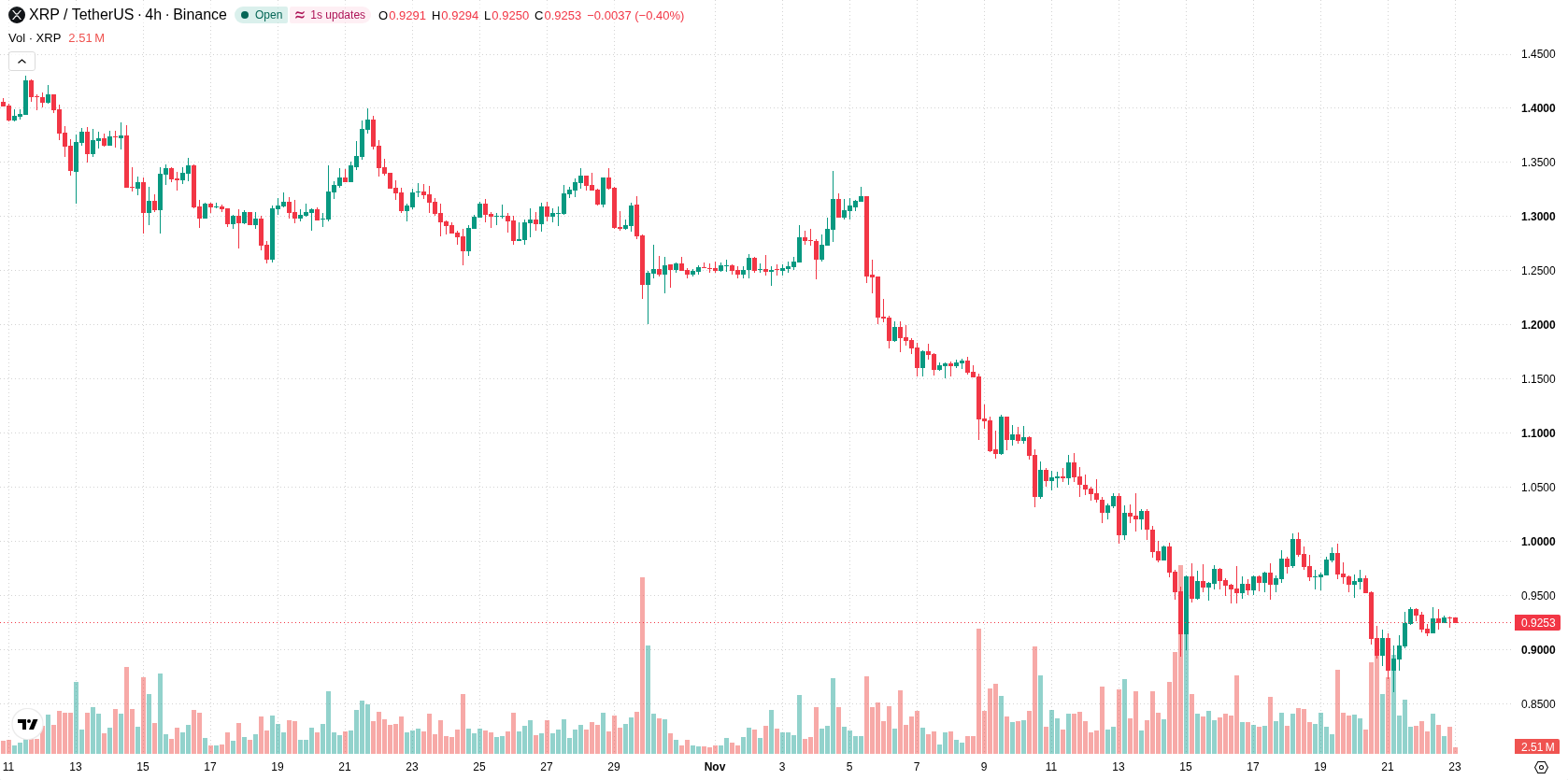
Price holds below 4H moving averages with bearish momentum
The 4H technical chart for XRP shows persistent bearish momentum, with the price holding below the 4H SMA-50 at $0.9505 and the 4H SMA-200 at $1.1537. Other key signals, such as the 4H Kijun resistance level at $0.9289, highlight continued pressure in the short and medium term.
Momentum indicators remain negative, with the MACD in strong sell territory and ADX readings confirming bearish strength rather than mixed signals. Downside risk dominates unless a marked change in fund flows or macro policy direction emerges.
US rate signals and institutional flows drive next move
XRP's ability to stabilize will depend on signs of renewed institutional allocations or a shift in US monetary policy. Traders should watch for any reclaim of resistance around $0.93 to signal a potential easing in current headwinds. Until then, risks remain tilted to the downside, particularly if macro liquidity contracts further.
Earlier, analysts noted that XRP was contending with sustained downward pressure amid macroeconomic risks and diminished speculative activity, favoring a cautious near-term stance. The current outlook reinforces this view, as recent institutional outflows and tightening US monetary policy remain pivotal factors for traders assessing the potential for stabilization or further downside.











-
 Afghanistan
-
 Albania
-
 Algeria
-
 Angola
-
 Argentina
-
 Armenia
-
 Australia
-
 Austria
-
 Azerbaijan
-
 Bahamas
-
 Bahrain
-
 Bangladesh
-
 Belarus
-
 Belgium
-
 Bolivia
-
 Botswana
-
 Brazil
-
 Brunei
-
 Bulgaria
-
 Cambodia
-
 Cameroon
-
 Canada
-
 Chile
-
 China
-
 Colombia
-
 Congo
-
 Costa Rica
-
 Cote d'Ivoire
-
 Croatia
-
 Cuba
-
 Cyprus
-
 Czechia
-
 DR Congo
-
 Denmark
-
 Dominican Republic
-
 Ecuador
-
 Egypt
-
 El Salvador
-
 Estonia
-
 Eswatini
-
 Ethiopia
-
 Finland
-
 France
-
 Georgia
-
 Germany
-
 Ghana
-
 Greece
-
 Haiti
-
 Hong Kong
-
 Hungary
-
 India
-
 Indonesia
-
 Iran, Islamic republic
-
 Iraq
-
 Ireland
-
 Israel
-
 Italy
-
 Jamaica
-
 Japan
-
 Jordan
-
 Kazakhstan
-
 Kenya
-
 Korea
-
 Kuwait
-
 Kyrgyzstan
-
 Laos
-
 Latvia
-
 Lebanon
-
 Lesotho
-
 Libya
-
 Lithuania
-
 Luxembourg
-
 Madagascar
-
 Malaysia
-
 Malta
-
 Mauritius
-
 Mexico
-
 Moldova
-
 Mongolia
-
 Montenegro
-
 Morocco
-
 Mozambique
-
 Myanmar
-
 Namibia
-
 Nepal
-
 Netherlands
-
 New Zealand
-
 Nigeria
-
 North Macedonia
-
 Norway
-
 Oman
-
 Pakistan
-
 Palestine
-
 Panama
-
 Papua New Guinea
-
 Paraguay
-
 Peru
-
 Philippines
-
 Poland
-
 Portugal
-
 Puerto Rico
-
 Qatar
-
 Reunion
-
 Romania
-
 Rwanda
-
 Saudi Arabia
-
 Serbia
-
 Singapore
-
 Slovakia
-
 Slovenia
-
 Somalia
-
 South Africa
-
 Spain
-
 Sri Lanka
-
 Sweden
-
 Switzerland
-
 Syria
-
 Taiwan
-
 Tajikistan
-
 Tanzania
-
 Thailand
-
 Trinidad and Tobago
-
 Tunisia
-
 Turkey
-
 UAE
-
 Uganda
-
 Ukraine
-
 United Kingdom
-
United States
-
 Uruguay
-
 Uzbekistan
-
 Venezuela
-
 Vietnam
-
 Yemen
-
 Zambia
-
 Zimbabwe
- Forex
- Crypto












