

DeXe slides lower as sellers maintain pressure in a clear downward price move

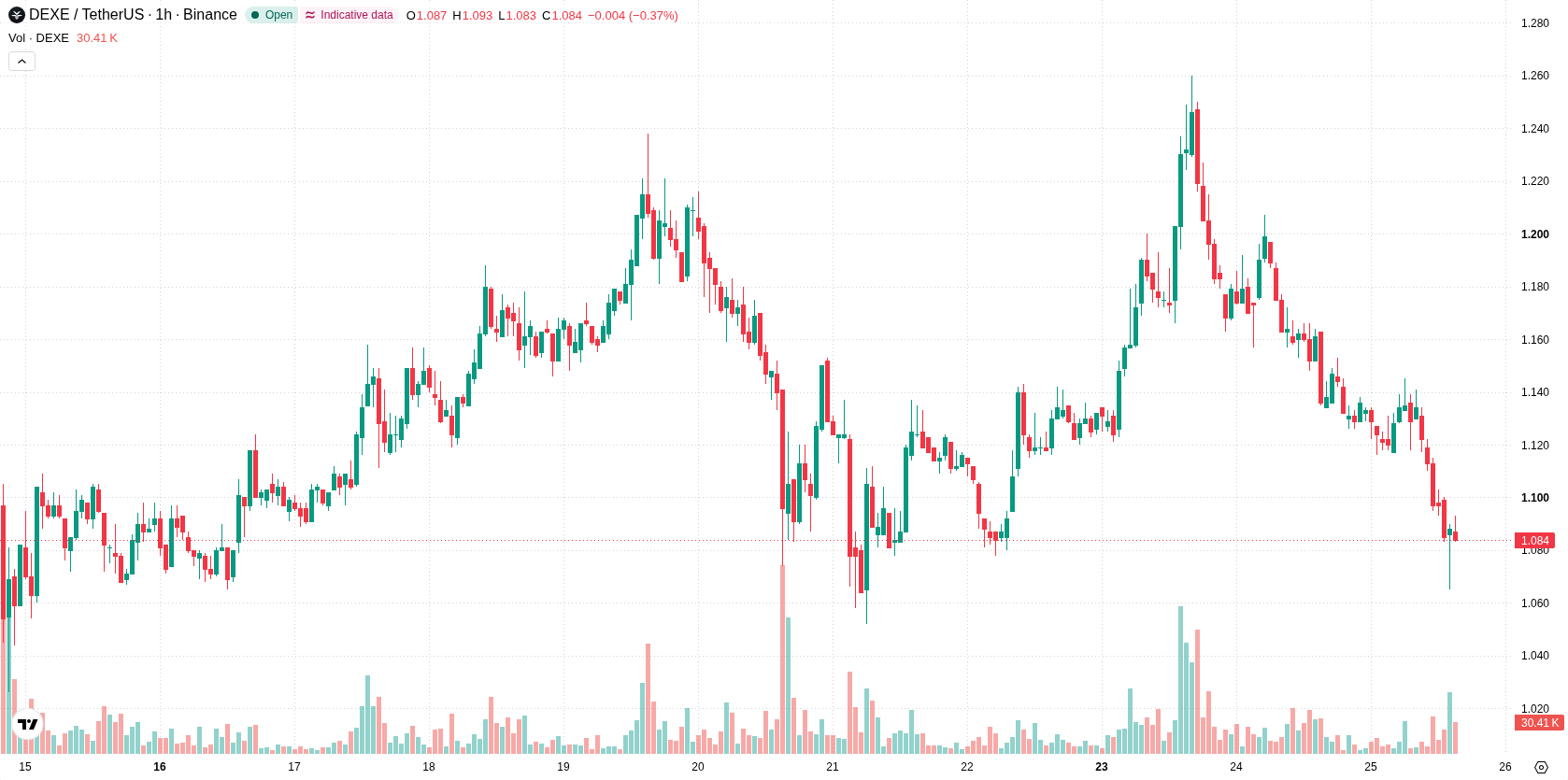
DeXe (DEXE) is trading at $1.09, down 5.72% on the day. The price currently sits below its key short- and medium-term moving averages, with heavy downside movement dominating today's session.
 1.15
1.26
Highlights
- DEXE/USD remains in a strong downtrend, trading below key moving averages and immediate resistance at $1.12.
- Momentum indicators confirm persistent bearish pressure, with oversold conditions and sellers dominating intraday action.
- Expected price range over the next 2 to 3 days is $1.04 to $1.14, with further downside more likely than a reversal.
Selling momentum persists as support breaks and oscillators turn oversold
On the technical front, DEXE/USD remains below the H1 SMA-20 at $1.12, H1 SMA-50 at $1.16, and well under the D1 SMA-200 at $9.04. The Ichimoku Kijun level at $1.12 is the immediate resistance. Momentum indicators are negative: MACD and ADX show ongoing selling pressure, while RSI, Stoch RSI, and CCI have all moved into oversold territory, indicating conditions for a potential short-term rebound, though no reversal signals are confirmed. Bull/Bear Power is slightly negative at -0.02, and the Awesome Oscillator continues to reflect a clear downtrend.
Limited rebound potential as volatility bands constrain outlook
Over the next two to three days, DEXE is expected to fluctuate between $1.04 and $1.14, reflecting the typical volatility band relative to current levels. The likelihood of a sustained upward move is very low, with a strong probability of further downside or range trading. Any bullish breakout would require a clear regain and hold above immediate resistance at $1.12, while a drop below $1.04 may trigger additional selling as the downtrend persists.
Earlier, analysts noted that DeXe was experiencing persistent bearish momentum, with key technical indicators highlighting sustained downside risk. The latest data reinforces this outlook, and traders should closely monitor DeXe's ability to hold above $1.04 as any breakdown below this level could accelerate further losses.










-
 Afghanistan
-
 Albania
-
 Algeria
-
 Angola
-
 Argentina
-
 Armenia
-
 Australia
-
 Austria
-
 Azerbaijan
-
 Bahamas
-
 Bahrain
-
 Bangladesh
-
 Belarus
-
 Belgium
-
 Bolivia
-
 Botswana
-
 Brazil
-
 Brunei
-
 Bulgaria
-
 Cambodia
-
 Cameroon
-
 Canada
-
 Chile
-
 China
-
 Colombia
-
 Congo
-
 Costa Rica
-
 Cote d'Ivoire
-
 Croatia
-
 Cuba
-
 Cyprus
-
 Czechia
-
 DR Congo
-
 Denmark
-
 Dominican Republic
-
 Ecuador
-
 Egypt
-
 El Salvador
-
 Estonia
-
 Eswatini
-
 Ethiopia
-
 Finland
-
 France
-
 Georgia
-
 Germany
-
 Ghana
-
 Greece
-
 Haiti
-
 Hong Kong
-
 Hungary
-
 India
-
 Indonesia
-
 Iran, Islamic republic
-
 Iraq
-
 Ireland
-
 Israel
-
 Italy
-
 Jamaica
-
 Japan
-
 Jordan
-
 Kazakhstan
-
 Kenya
-
 Korea
-
 Kuwait
-
 Kyrgyzstan
-
 Laos
-
 Latvia
-
 Lebanon
-
 Lesotho
-
 Libya
-
 Lithuania
-
 Luxembourg
-
 Madagascar
-
 Malaysia
-
 Malta
-
 Mauritius
-
 Mexico
-
 Moldova
-
 Mongolia
-
 Montenegro
-
 Morocco
-
 Mozambique
-
 Myanmar
-
 Namibia
-
 Nepal
-
 Netherlands
-
 New Zealand
-
 Nigeria
-
 North Macedonia
-
 Norway
-
 Oman
-
 Pakistan
-
 Palestine
-
 Panama
-
 Papua New Guinea
-
 Paraguay
-
 Peru
-
 Philippines
-
 Poland
-
 Portugal
-
 Puerto Rico
-
 Qatar
-
 Reunion
-
 Romania
-
 Rwanda
-
 Saudi Arabia
-
 Serbia
-
 Singapore
-
 Slovakia
-
 Slovenia
-
 Somalia
-
 South Africa
-
 Spain
-
 Sri Lanka
-
 Sweden
-
 Switzerland
-
 Syria
-
 Taiwan
-
 Tajikistan
-
 Tanzania
-
 Thailand
-
 Trinidad and Tobago
-
 Tunisia
-
 Turkey
-
 UAE
-
 Uganda
-
 Ukraine
-
 United Kingdom
-
United States
-
 Uruguay
-
 Uzbekistan
-
 Venezuela
-
 Vietnam
-
 Yemen
-
 Zambia
-
 Zimbabwe
- Forex
- Crypto












