

NEAR extends decline as stronger US dollar and Fed rate hike signals draw capital away from risk assets

NEAR (NEAR) is trading below its recent averages amid ongoing bearish momentum. The asset remains pressured as November's macro environment has favored the US dollar over risk assets such as NEAR. Traders are watching US monetary policy signals for a potential shift in demand dynamics.
 2.903
3.4770
Highlights
- The US dollar strengthened 2.5% up to November 18, 2026, as expectations for Federal Reserve rate hikes advanced.
- Capital rotated into dollar-denominated assets and away from risk investments such as cryptocurrencies, reducing demand for NEAR.
- NEAR/USD trades below major moving averages with mixed momentum, needing a move above $2.96 for signs of technical stabilization.
US dollar rally and Fed hike expectations pressure crypto demand
According to FXStreet, the US dollar strengthened by 2.5% during the month up to November 18, 2026, as expectations for Federal Reserve rate hikes increased.
This shift attracted capital into dollar-denominated assets and decreased demand for risk-based investments, including cryptocurrencies like NEAR. Higher US yields served as the main channel restricting appetite for NEAR/USD.
Earlier declines in major crypto assets and gold further contextualized the risk-off sentiment tied to the stronger US currency, while no directly offsetting developments were reported.
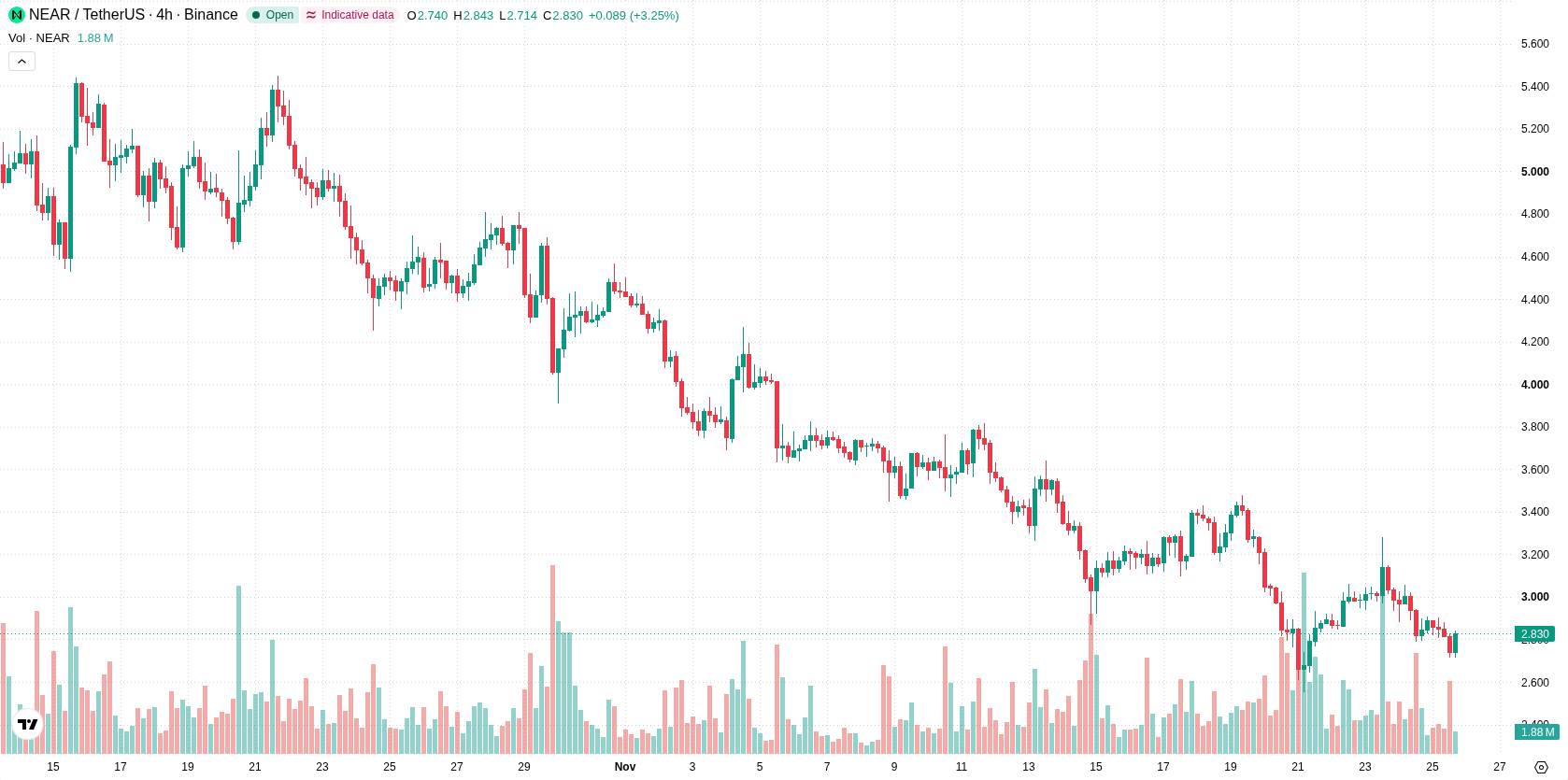
Downtrend persists below H4 moving averages and $2.961 Kijun
On the 4H chart, NEAR remains under its key moving averages, with the SMA-50 at $3.0387 and the SMA-200 at $3.7211 both positioned above the current price. The asset also sits below the shorter-term SMA-20 on 4H at $2.9473, emphasizing persistent downside conditions.
The 4H MACD issues a sell signal, while ADX indicates a neutral trend, pointing to cautious and mixed momentum. The immediate resistance is marked by the Kijun level at $2.961, which would need to be cleared for any technical improvement.
Fed policy decisions as the next catalyst for NEAR direction
Further signals from the Federal Reserve on the pace or scale of rate hikes could quickly change appetite for risk assets, including NEAR. A move above the area around the $2.96 Kijun resistance would be needed to signal stabilization. Until then, the asset remains sensitive to US macro policy shifts and broader risk sentiment.
Earlier, analysts noted that NEAR faced heightened downside risks due to persistent restrictive monetary policy and ongoing geopolitical uncertainty. The current analysis reaffirms this cautious outlook, with NEAR remaining under pressure as US Federal Reserve rate expectations and dollar strength continue to serve as the primary macroeconomic factors to watch for the asset's next move.










-
 Afghanistan
-
 Albania
-
 Algeria
-
 Angola
-
 Argentina
-
 Armenia
-
 Australia
-
 Austria
-
 Azerbaijan
-
 Bahamas
-
 Bahrain
-
 Bangladesh
-
 Belarus
-
 Belgium
-
 Bolivia
-
 Botswana
-
 Brazil
-
 Brunei
-
 Bulgaria
-
 Cambodia
-
 Cameroon
-
 Canada
-
 Chile
-
 China
-
 Colombia
-
 Congo
-
 Costa Rica
-
 Cote d'Ivoire
-
 Croatia
-
 Cuba
-
 Cyprus
-
 Czechia
-
 DR Congo
-
 Denmark
-
 Dominican Republic
-
 Ecuador
-
 Egypt
-
 El Salvador
-
 Estonia
-
 Eswatini
-
 Ethiopia
-
 Finland
-
 France
-
 Georgia
-
 Germany
-
 Ghana
-
 Greece
-
 Haiti
-
 Hong Kong
-
 Hungary
-
 India
-
 Indonesia
-
 Iran, Islamic republic
-
 Iraq
-
 Ireland
-
 Israel
-
 Italy
-
 Jamaica
-
 Japan
-
 Jordan
-
 Kazakhstan
-
 Kenya
-
 Korea
-
 Kuwait
-
 Kyrgyzstan
-
 Laos
-
 Latvia
-
 Lebanon
-
 Lesotho
-
 Libya
-
 Lithuania
-
 Luxembourg
-
 Madagascar
-
 Malaysia
-
 Malta
-
 Mauritius
-
 Mexico
-
 Moldova
-
 Mongolia
-
 Montenegro
-
 Morocco
-
 Mozambique
-
 Myanmar
-
 Namibia
-
 Nepal
-
 Netherlands
-
 New Zealand
-
 Nigeria
-
 North Macedonia
-
 Norway
-
 Oman
-
 Pakistan
-
 Palestine
-
 Panama
-
 Papua New Guinea
-
 Paraguay
-
 Peru
-
 Philippines
-
 Poland
-
 Portugal
-
 Puerto Rico
-
 Qatar
-
 Reunion
-
 Romania
-
 Rwanda
-
 Saudi Arabia
-
 Serbia
-
 Singapore
-
 Slovakia
-
 Slovenia
-
 Somalia
-
 South Africa
-
 Spain
-
 Sri Lanka
-
 Sweden
-
 Switzerland
-
 Syria
-
 Taiwan
-
 Tajikistan
-
 Tanzania
-
 Thailand
-
 Trinidad and Tobago
-
 Tunisia
-
 Turkey
-
 UAE
-
 Uganda
-
 Ukraine
-
 United Kingdom
-
United States
-
 Uruguay
-
 Uzbekistan
-
 Venezuela
-
 Vietnam
-
 Yemen
-
 Zambia
-
 Zimbabwe
- Forex
- Crypto












