

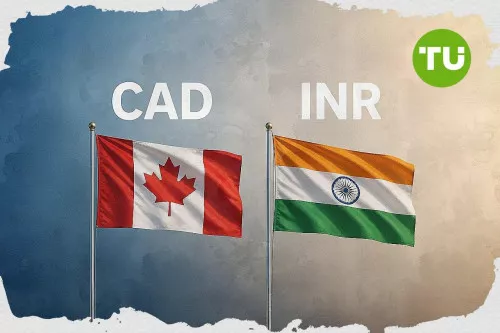
CAD/INR holds near ₹68.6077 resistance as foreign bank USD inflows limit upside

Canadian Dollar vs Indian Rupee (CAD/INR) is trading at ₹68.31, closing lower for the session after a down move. The pair currently sits below its key short- and medium-term moving averages but remains above major long-term averages.
 66.0603
66.2354
Highlights
- The Reserve Bank of India intervened in both spot and swap forex markets to support the Indian rupee against the U.S. dollar during elevated oil prices.
- Dollar inflows from foreign banks increased, resulting in a firmer rupee and a decline in CAD/INR, with overall market impact observed from ongoing central bank operations.
- CAD/INR trades below short- and medium-term moving averages with technical indicators signaling strong downside momentum and a projected 2 to 3 day range of ₹67.9685 to ₹68.6516.
Rupee gains as RBI intervention and dollar inflows weigh on CAD/INR
The Reserve Bank of India intervened in the forex market to support the Indian rupee against the U.S. dollar amid elevated oil prices, according to Economictimes Indiatimes. This direct action involved participation in both spot and swap markets, resulting in a firmer rupee as dollar inflows from foreign banks increased. The strengthening rupee contributed to Canadian Dollar vs Indian Rupee losses, as reported by Economictimes Indiatimes, with overall market sentiment reflecting the impact of ongoing central bank operations.
Downside momentum prevails as sellers dominate below resistance
Intraday price action shows CAD/INR trading below the MA-20 and MA-50 on the hourly chart, while the pair remains above the MA-200 on the daily timeframe. The Ichimoku Kijun level at ₹68.6077 acts as immediate resistance, confining upside attempts. Momentum signals are weak: both RSI and CCI are in sell territory, with Stochastic RSI registering as oversold, pointing to downside fatigue. MACD confirms a bearish setup, whereas ADX stays neutral, indicating the underlying trend lacks conviction. Intraday Bull/Bear Power leans in favor of sellers, and price movement near the daily low aligns with this technical picture.
Weak rebound odds as downside risk dominates short-term forecast
Looking out over the next 2–3 trading days, price is forecast to consolidate within a typical volatility band between ₹67.9685 and ₹68.6516. The probability of an upside move is considered very low, while the likelihood of renewed downside remains high and a reversal is not anticipated in the immediate term. The baseline scenario calls for range-bound action just below immediate resistance, with a bullish scenario only becoming viable if a decisive breakout above resistance is achieved. If the lower bound of the anticipated range fails, further declines may unfold.
Earlier, analysts noted that Canadian Dollar vs Indian Rupee maintained a bullish technical outlook, trading above its key moving averages and approaching near-term resistance. The current decline below short- and medium-term averages, alongside bearish momentum signals, marks a shift in trend, with traders now advised to monitor the lower end of the expected volatility band as a potential trigger for further downside.










-
 Afghanistan
-
 Albania
-
 Algeria
-
 Angola
-
 Argentina
-
 Armenia
-
 Australia
-
 Austria
-
 Azerbaijan
-
 Bahamas
-
 Bahrain
-
 Bangladesh
-
 Belarus
-
 Belgium
-
 Bolivia
-
 Botswana
-
 Brazil
-
 Brunei
-
 Bulgaria
-
 Cambodia
-
 Cameroon
-
 Canada
-
 Chile
-
 China
-
 Colombia
-
 Congo
-
 Costa Rica
-
 Cote d'Ivoire
-
 Croatia
-
 Cuba
-
 Cyprus
-
 Czechia
-
 DR Congo
-
 Denmark
-
 Dominican Republic
-
 Ecuador
-
 Egypt
-
 El Salvador
-
 Estonia
-
 Eswatini
-
 Ethiopia
-
 Finland
-
 France
-
 Georgia
-
 Germany
-
 Ghana
-
 Greece
-
 Haiti
-
 Hong Kong
-
 Hungary
-
 India
-
 Indonesia
-
 Iran, Islamic republic
-
 Iraq
-
 Ireland
-
 Israel
-
 Italy
-
 Jamaica
-
 Japan
-
 Jordan
-
 Kazakhstan
-
 Kenya
-
 Korea
-
 Kuwait
-
 Kyrgyzstan
-
 Laos
-
 Latvia
-
 Lebanon
-
 Lesotho
-
 Libya
-
 Lithuania
-
 Luxembourg
-
 Madagascar
-
 Malaysia
-
 Malta
-
 Mauritius
-
 Mexico
-
 Moldova
-
 Mongolia
-
 Montenegro
-
 Morocco
-
 Mozambique
-
 Myanmar
-
 Namibia
-
 Nepal
-
 Netherlands
-
 New Zealand
-
 Nigeria
-
 North Macedonia
-
 Norway
-
 Oman
-
 Pakistan
-
 Palestine
-
 Panama
-
 Papua New Guinea
-
 Paraguay
-
 Peru
-
 Philippines
-
 Poland
-
 Portugal
-
 Puerto Rico
-
 Qatar
-
 Reunion
-
 Romania
-
 Rwanda
-
 Saudi Arabia
-
 Serbia
-
 Singapore
-
 Slovakia
-
 Slovenia
-
 Somalia
-
 South Africa
-
 Spain
-
 Sri Lanka
-
 Sweden
-
 Switzerland
-
 Syria
-
 Taiwan
-
 Tajikistan
-
 Tanzania
-
 Thailand
-
 Trinidad and Tobago
-
 Tunisia
-
 Turkey
-
 UAE
-
 Uganda
-
 Ukraine
-
 United Kingdom
-
United States
-
 Uruguay
-
 Uzbekistan
-
 Venezuela
-
 Vietnam
-
 Yemen
-
 Zambia
-
 Zimbabwe
- Forex
- Crypto












