
Microsoft steadies above $490 as investors weigh AI optimism against valuation risks
Microsoft shares are rebuilding after a sharp November selloff that broke trend, flushed momentum traders, and briefly pushed price below the 200-day EMA for the first time since early 2023. The decline forced MSFT into oversold territory near $478, where dip-buyers re-emerged and prevented a deeper breakdown.
Highlights
- Microsoft rebounds near $490 after defending the 200-day EMA at $479.
- Analysts highlight MSFT as a top AI hyperscaler pick for 2026.
- The stock faces key resistance between $498 and $505 before momentum can build.
By Tuesday, the stock had climbed back toward $490, moving inside a fragile but improving recovery structure as investors weigh renewed AI optimism against a still-uncertain macro backdrop.
Technical recovery builds after November’s breakdown
Microsoft’s rebound began with a clean rejection of the $478 zone, where the long-term trend met heavily oversold technical conditions. Price is now testing early resistance aligned with the 23.6% and 38.2% Fibonacci retracements at $486 and $499. This pocket represents the first decision point: either the recovery gains traction, or price slips back into a wider consolidation.
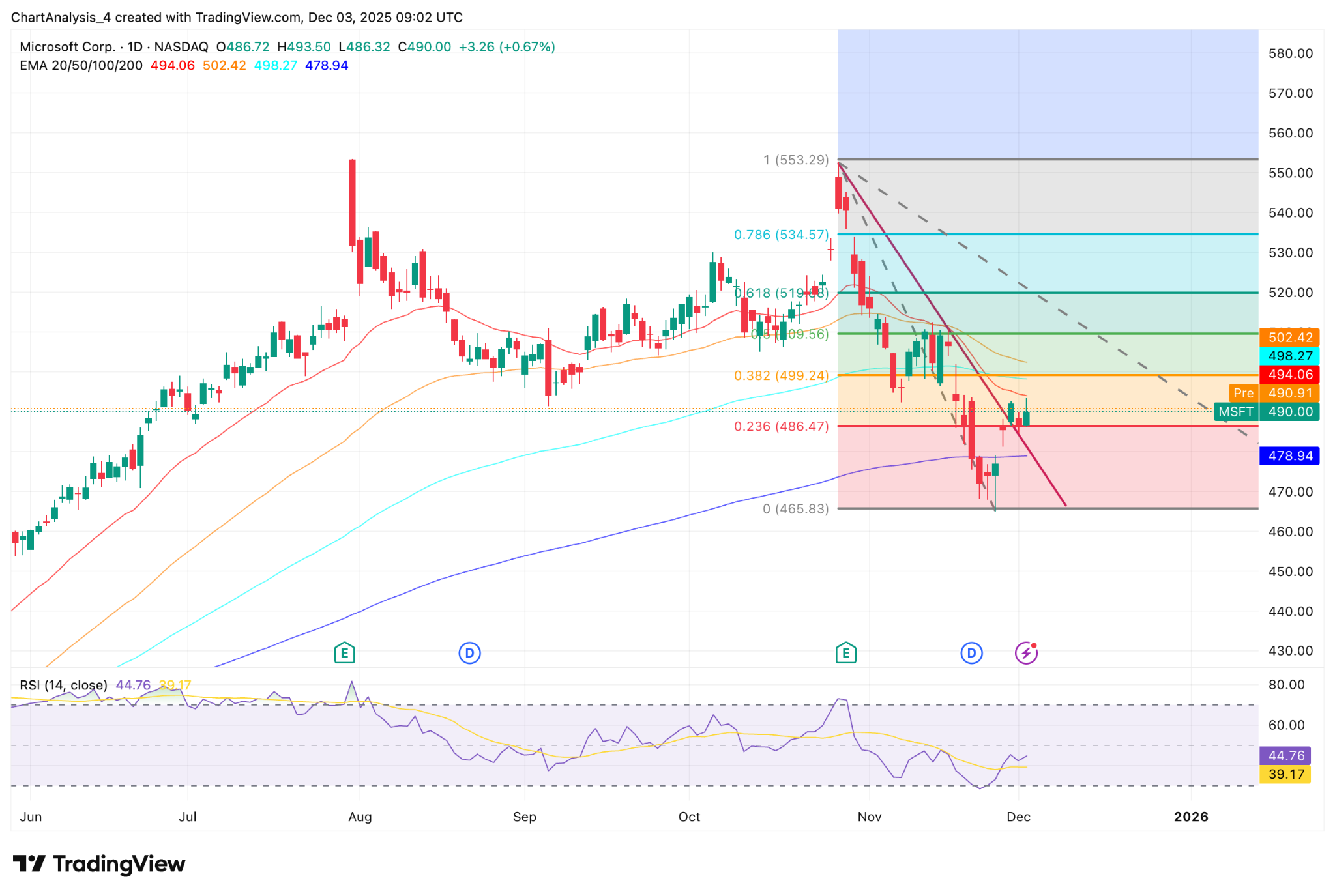
MSFT price dynamics (Source: TradingView)
The 50-day EMA, positioned near $502, forms a stacked resistance cluster between $498 and $505. A decisive break above this area would shift momentum in favor of bulls and open a run toward the 61.8% retracement at $519. Clearing $519–$535 would complete the technical repair cycle and allow MSFT to retest the October peak near $553.
For now, momentum indicators remain mixed. The RSI has lifted to 45 from oversold levels but has not entered bullish expansion territory. The 200-day EMA near $479 is now the most important structural support. A close beneath it would undermine the recovery and expose the broader demand pocket at $458–$465, a region that supported the summer rally.
AI positioning strengthens even as valuation questions persist
Microsoft’s fundamental backdrop remains strong. Wedbush analyst Dan Ives named MSFT his top AI hyperscaler pick for 2026, arguing that the company sits at the center of an enterprise AI cycle that will drive multi-year data-center expansion and cloud demand. The thesis hinges on Microsoft’s unique mix of infrastructure scale, cloud dominance, and high-margin AI services, placing it at the top of the sector’s value chain.
But valuation remains an active debate. MSFT trades near 30x forward earnings, a premium multiple that leaves the stock sensitive to shifts in sentiment. Bulls argue that structural AI and cloud demand justify the valuation, while skeptics point to cost pressure, hardware constraints, and uncertainty around how quickly generative AI revenue converts into meaningful earnings. The market’s tone suggests investors see the premium as acceptable, provided earnings visibility stays intact.
Macro conditions also shape this recovery. U.S. equities have rallied into expectations that the Federal Reserve will cut rates next week, a shift that supports long-duration assets like Microsoft. Lower yields, resilient consumption, and stabilizing tech sector flows have helped MSFT regain footing, but the absence of immediate catalysts has kept the rebound orderly rather than explosive.
Investors are now waiting for the Fed meeting to reprice risk with conviction. Until then, Microsoft trades in a zone defined by technical thresholds and sentiment stabilization rather than broad-based risk appetite.
Near-term levels define the next move
The path ahead is dominated by clear technical markers. A close above $505 would likely trigger momentum buying and set up a run toward $519–$535. A failure to break resistance would keep the stock inside a sideways regime, with the $479–$480 region acting as the critical pivot. Traders will be closely watching whether Microsoft can align its early recovery with the broader tech rotation that has accompanied expectations of rate cuts.
For now, MSFT is rebuilding trust after a deep correction. The stock remains one of the most structurally advantaged names in the AI transition, supported by strong balance-sheet capacity, sector leadership, and high-quality revenue expansion. But the climb back toward prior highs will depend on a combination of technical confirmation, macro stabilization, and renewed confidence from institutional buyers.
Earlier analysis emphasized that Microsoft’s correction was a reset rather than a structural breakdown, with selling driven by momentum unwinds instead of fundamental deterioration. The latest rebound reinforces that view. Technical stabilization, improving momentum, and strong AI-driven positioning suggest the stock is entering a repair phase—not a reversal of its long-term narrative.





Latest Microsoft News





-
 Afghanistan
-
 Albania
-
 Algeria
-
 Angola
-
 Argentina
-
 Armenia
-
 Australia
-
 Austria
-
 Azerbaijan
-
 Bahamas
-
 Bahrain
-
 Bangladesh
-
 Belarus
-
 Belgium
-
 Bolivia
-
 Botswana
-
 Brazil
-
 Brunei
-
 Bulgaria
-
 Cambodia
-
 Cameroon
-
 Canada
-
 Chile
Chile
-
 China
China
-
 Colombia
-
 Congo
Congo
-
 Costa Rica
-
 Cote d'Ivoire
-
 Croatia
-
 Cuba
Cuba
-
 Cyprus
-
 Czechia
-
 DR Congo
-
 Denmark
-
 Dominican Republic
-
 Ecuador
-
 Egypt
Egypt
-
 El Salvador
-
 Estonia
-
 Eswatini
-
 Ethiopia
-
 Finland
-
 France
-
 Georgia
-
 Germany
-
 Ghana
Ghana
-
 Greece
-
 Haiti
Haiti
-
 Hong Kong
-
 Hungary
-
 India
India
-
 Indonesia
-
 Iran, Islamic republic
-
 Iraq
Iraq
-
 Ireland
-
 Israel
-
 Italy
Italy
-
 Jamaica
-
 Japan
Japan
-
 Jordan
-
 Kazakhstan
-
 Kenya
Kenya
-
 Korea
Korea
-
 Kuwait
-
 Kyrgyzstan
-
 Laos
Laos
-
 Latvia
-
 Lebanon
-
 Lesotho
-
 Libya
Libya
-
 Lithuania
-
 Luxembourg
-
 Madagascar
-
 Malaysia
-
 Malta
Malta
-
 Mauritius
-
 Mexico
-
 Moldova
-
 Mongolia
-
 Montenegro
-
 Morocco
-
 Mozambique
-
 Myanmar
-
 Namibia
-
 Nepal
Nepal
-
 Netherlands
-
 New Zealand
-
 Nigeria
-
 North Macedonia
-
 Norway
-
 Oman
Oman
-
 Pakistan
-
 Palestine
-
 Panama
-
 Papua New Guinea
-
 Paraguay
-
 Peru
Peru
-
 Philippines
-
 Poland
-
 Portugal
-
 Puerto Rico
-
 Qatar
Qatar
-
 Reunion
-
 Romania
-
 Rwanda
-
 Saudi Arabia
-
 Serbia
-
 Singapore
-
 Slovakia
-
 Slovenia
-
 Somalia
-
 South Africa
-
 Spain
Spain
-
 Sri Lanka
-
 Sweden
-
 Switzerland
-
 Syria
Syria
-
 Taiwan
-
 Tajikistan
-
 Tanzania
-
 Thailand
-
 Trinidad and Tobago
-
 Tunisia
-
 Turkey
-
 UAE
UAE
-
 Uganda
-
 Ukraine
-
 United Kingdom
-
United States
-
 Uruguay
-
 Uzbekistan
-
 Venezuela
-
 Vietnam
-
 Yemen
Yemen
-
 Zambia
-
 Zimbabwe
- Forex
- Crypto












