
Microsoft steadies above $480 as AI-linked price hikes reshape long-term view

Microsoft shares are attempting to stabilize near $480 after a steep selloff erased nearly half of the stock’s multi-month advance. The decline drove the stock deep into oversold territory before buyers stepped in, though the rebound has yet to prove durable.
Highlights
- MSFT holds above the $478 200-day EMA after a sharp correction.
- Rebound stalls at $486, the first key Fibonacci test.
- New Microsoft 365 price hikes add long-term strategic catalyst.
The market is trying to form a bottom, but downside pressure has not fully cleared.
Correction stabilizes but resistance remains dense above $486
The stock’s recovery effort stalled beneath the 0.236 Fibonacci retracement at $486, turning the area into the first line of resistance. Price trades near $480, with the 200-day EMA at $478 acting as a pivotal long-term support level. Historically, Microsoft has defended this average during periods of trend fatigue. Losing it would alter the character of the pullback and expose $460–$455, a structural support band just above the recent low.
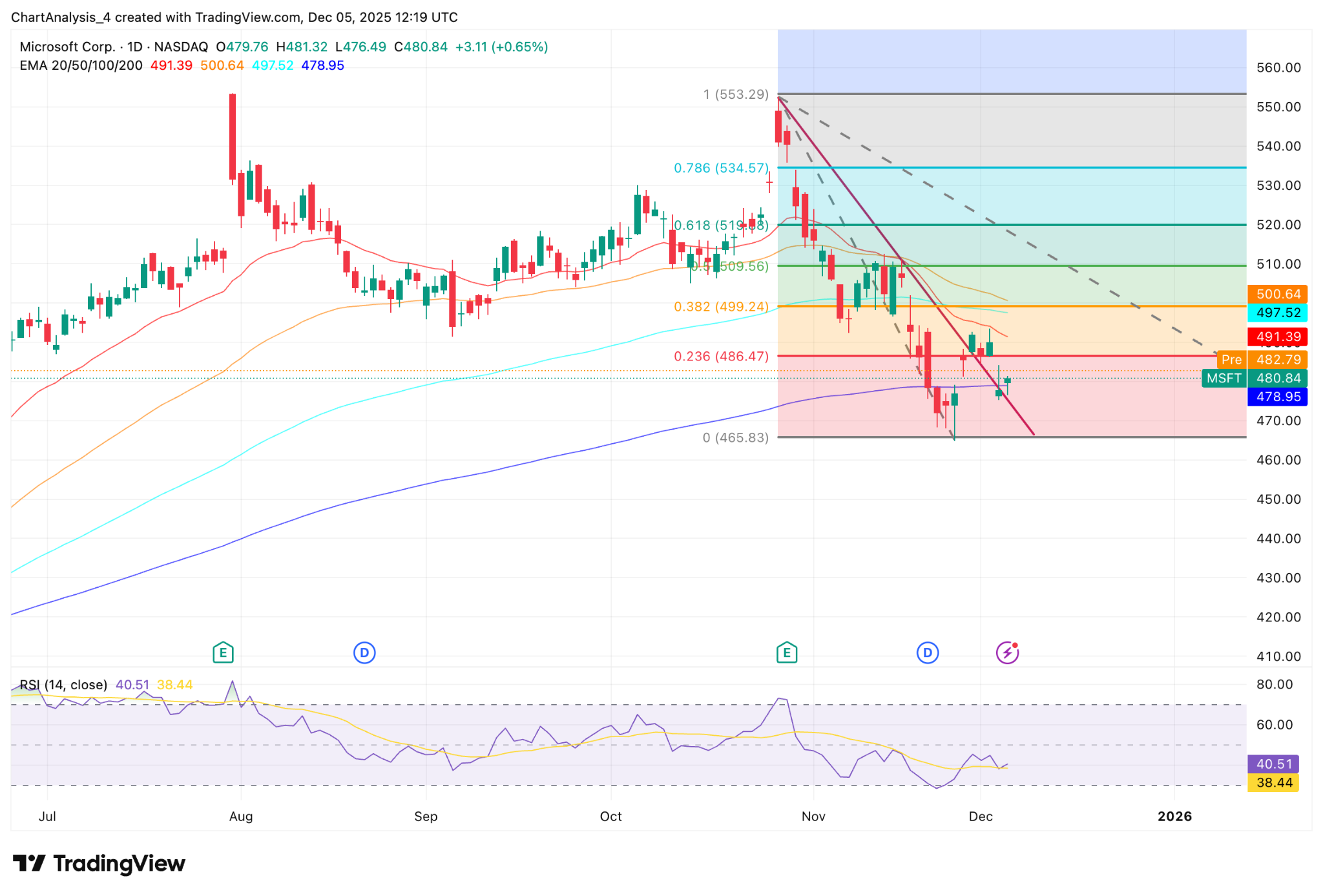
MSFT price dynamics (Source: TradingView)
Above current levels, the path higher remains crowded with obstacles. The 0.382 retracement at $499 sits directly under the 50-day EMA at $500, creating a resistance pocket where sellers are likely to re-enter. A decisive break through this zone would mark the first meaningful shift in directional momentum. Until then, upside remains constrained by the descending trendline from the November peak, which continues to cap rebound attempts.
Momentum reflects the aftermath of forced selling rather than the start of a trend reversal. The RSI has lifted from extreme lows to around 40, signaling that pressure has eased but accumulation has not begun. The indicator remains in bearish territory, reinforcing that stabilization alone is not sufficient to confirm a shift in bias.
Price hikes reshape long-term narrative as AI investments scale
Microsoft introduced sweeping price increases for its Microsoft 365 suite, scheduled for July 2026. The hikes span commercial, small business, and government plans, with select tiers rising by as much as 33 percent. The change highlights the company’s push to monetize AI-driven enhancements, including Copilot, and signals a willingness to expand margins through value-based pricing.
The move reinforces Microsoft’s strategic position as AI spending accelerates. But it also underscores a delicate balancing act. Competition from Google’s cloud and productivity products has intensified, and Microsoft is effectively testing price elasticity across a deeply embedded customer base. While enterprises rarely abandon high-friction software suites, aggressive increases carry reputational and churn risk if economic conditions deteriorate.
The rollout comes during a period of heightened sensitivity for mega-cap tech. Investors spent most of the year positioned heavily long in AI beneficiaries, leaving the group vulnerable to sharp unwinds once momentum slowed. Microsoft’s correction reflects this broader rotation as much as anything company-specific. The pricing announcement adds a constructive long-term storyline, but it does not meaningfully alter the near-term technical picture.
Pivotal test ahead as Microsoft balances technical pressure and strategic tailwinds
Microsoft now sits in a transitional phase. The steep correction has cooled, but the stock remains pinned beneath multiple resistance layers and continues to lack follow-through buying. The 200-day EMA is holding, yet only narrowly. A push through $499–$500 would be the clearest sign that buyers are regaining control, opening the door to recovery targets at $518 and $534. If price slips below $478, however, the risk shifts toward a retest of the lows and a deeper unwinding into the low $450s.
Previously, we discussed that Microsoft’s ability to reclaim the mid-$500 range hinged on sustained momentum and fresh inflows driven by its AI monetization strategy. The recent technical deterioration and the struggle to clear early Fibonacci levels underscore that the stock remains in repair mode rather than recovery. The long-term outlook is intact, but the chart still signals caution.





Latest Microsoft News








-
 Afghanistan
-
 Albania
-
 Algeria
-
 Angola
-
 Argentina
-
 Armenia
-
 Australia
-
 Austria
-
 Azerbaijan
-
 Bahamas
-
 Bahrain
-
 Bangladesh
-
 Belarus
-
 Belgium
-
 Bolivia
-
 Botswana
-
 Brazil
-
 Brunei
-
 Bulgaria
-
 Cambodia
-
 Cameroon
-
 Canada
-
 Chile
Chile
-
 China
China
-
 Colombia
-
 Congo
Congo
-
 Costa Rica
-
 Cote d'Ivoire
-
 Croatia
-
 Cuba
Cuba
-
 Cyprus
-
 Czechia
-
 DR Congo
-
 Denmark
-
 Dominican Republic
-
 Ecuador
-
 Egypt
Egypt
-
 El Salvador
-
 Estonia
-
 Eswatini
-
 Ethiopia
-
 Finland
-
 France
-
 Georgia
-
 Germany
-
 Ghana
Ghana
-
 Greece
-
 Haiti
Haiti
-
 Hong Kong
-
 Hungary
-
 India
India
-
 Indonesia
-
 Iran, Islamic republic
-
 Iraq
Iraq
-
 Ireland
-
 Israel
-
 Italy
Italy
-
 Jamaica
-
 Japan
Japan
-
 Jordan
-
 Kazakhstan
-
 Kenya
Kenya
-
 Korea
Korea
-
 Kuwait
-
 Kyrgyzstan
-
 Laos
Laos
-
 Latvia
-
 Lebanon
-
 Lesotho
-
 Libya
Libya
-
 Lithuania
-
 Luxembourg
-
 Madagascar
-
 Malaysia
-
 Malta
Malta
-
 Mauritius
-
 Mexico
-
 Moldova
-
 Mongolia
-
 Montenegro
-
 Morocco
-
 Mozambique
-
 Myanmar
-
 Namibia
-
 Nepal
Nepal
-
 Netherlands
-
 New Zealand
-
 Nigeria
-
 North Macedonia
-
 Norway
-
 Oman
Oman
-
 Pakistan
-
 Palestine
-
 Panama
-
 Papua New Guinea
-
 Paraguay
-
 Peru
Peru
-
 Philippines
-
 Poland
-
 Portugal
-
 Puerto Rico
-
 Qatar
Qatar
-
 Reunion
-
 Romania
-
 Rwanda
-
 Saudi Arabia
-
 Serbia
-
 Singapore
-
 Slovakia
-
 Slovenia
-
 Somalia
-
 South Africa
-
 Spain
Spain
-
 Sri Lanka
-
 Sweden
-
 Switzerland
-
 Syria
Syria
-
 Taiwan
-
 Tajikistan
-
 Tanzania
-
 Thailand
-
 Trinidad and Tobago
-
 Tunisia
-
 Turkey
-
 UAE
UAE
-
 Uganda
-
 Ukraine
-
 United Kingdom
-
United States
-
 Uruguay
-
 Uzbekistan
-
 Venezuela
-
 Vietnam
-
 Yemen
Yemen
-
 Zambia
-
 Zimbabwe
- Forex
- Crypto












