
Nikkei 225 slips 0.9% as SoftBank slump and BOJ hike fear pressure tech stocks
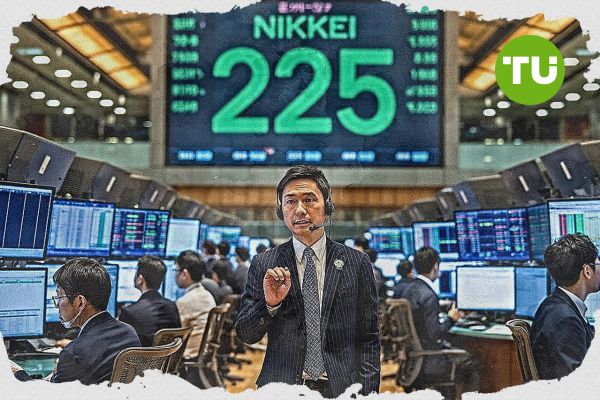
The Nikkei 225 fell 0.9% to close near 50,149 on Thursday as a sharp slide in SoftBank erased early-session gains and dragged Japan’s heavyweight tech names lower. Oracle’s steep post-earnings decline spilled into Asian markets, triggering a 7% drop in SoftBank and weakening sentiment across semiconductor equipment makers, industrials and major consumer-electronics stocks.
Highlights
- SoftBank drops 7% after Oracle fallout.
- Nikkei closes 0.9% lower at 50,149.
- BOJ hike concerns add pressure to tech and export names.
The session began on steady footing, but momentum cracked mid-day as SoftBank’s slide cascaded across the index. Lasertec, Fujikura, Mitsubishi Heavy, Sanrio and Nintendo all turned lower, reflecting a broad shift to risk-off positioning. Investors grew cautious not only because of the global tech earnings reset but also due to the possibility that the BOJ could introduce its first rate hike of the cycle. That combination left buyers reluctant to defend early advances.
Technical picture shows fatigue but broader uptrend intact
From a structural standpoint, the Nikkei remains in an established uptrend, though recent price action shows signs of cooling. The index sits directly above the 20-day EMA at 50,061, a level that has served as a stabilizing pivot throughout the past month. The 50-day EMA at 48,871 holds further below, anchoring the medium-term trend.
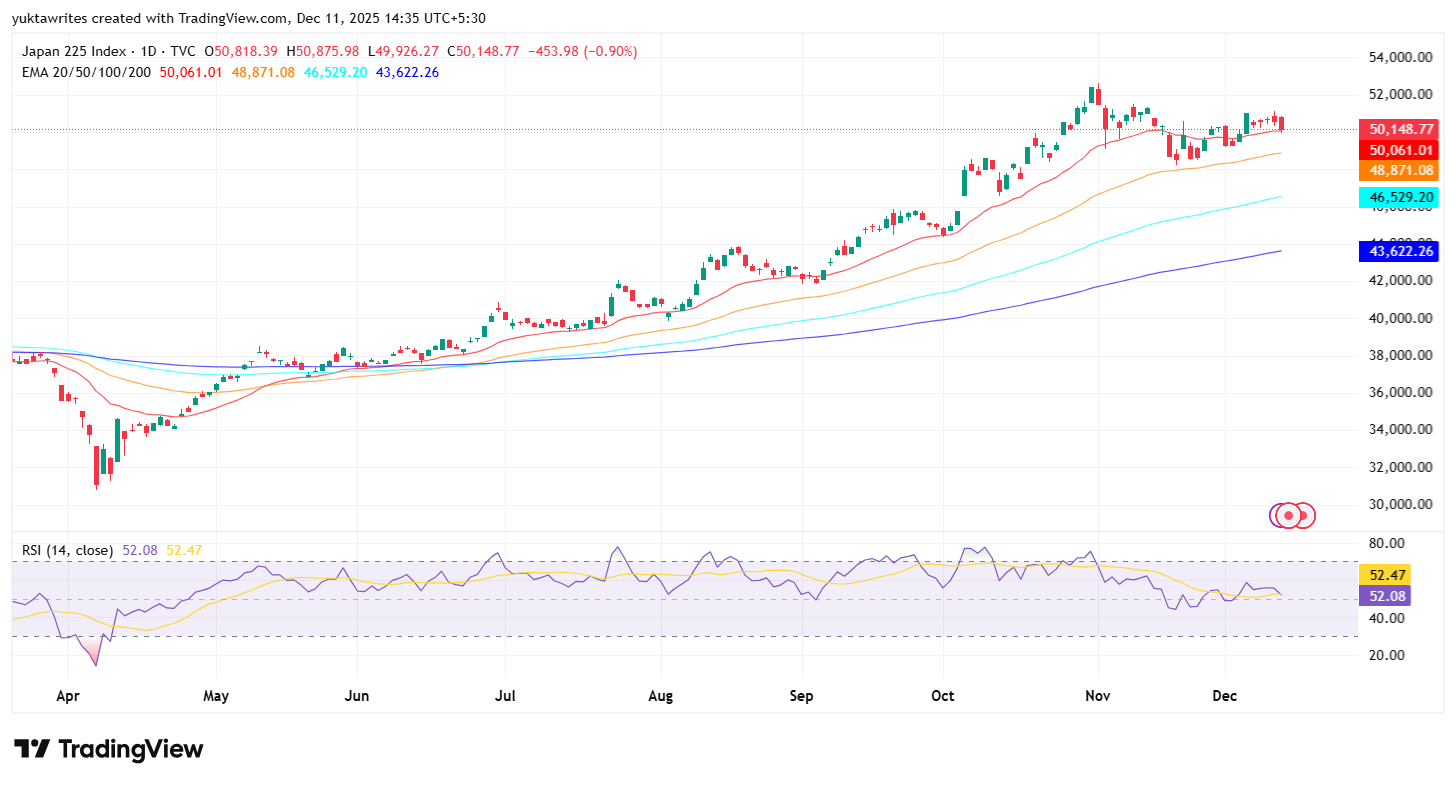
Nikkei 225 index price dynamics (Source: TradingView)
However, repeated failures to push beyond the 51,500 region highlight fading momentum. RSI at 52 reflects neutrality rather than the high-energy thrust seen during the October breakout. Price ranges have tightened over the past two weeks, a classic sign that market participants are waiting for a clearer macro signal before committing to fresh positions.
Short-term structure is more fragile. On the 30-minute chart, the Supertrend flipped bearish after SoftBank’s slide triggered a sharp intraday decline. SAR dots remain above price, reinforcing downward pressure. An initial attempt to rebound from the 50,000 level stalled at resistance near the Supertrend line at 50,544. Until the index can reclaim that intraday pivot, short-term risks point toward retests of 49,900 and 49,700. These levels acted as key accumulation zones last week and will determine whether dip-buyers remain engaged.
Policy risks and global tech sentiment shape near-term direction
Despite the pullback, the broader backdrop for Japanese equities remains constructive. Corporate governance reforms, strong capital spending and steady foreign inflows have been reliable supports throughout the year. The long-term trend remains intact as long as the Nikkei holds above the 50-day EMA.
The immediate risk lies in policy divergence. A BOJ rate hike next week would widen the gap between Japanese tightening and global easing expectations. A firmer yen would pressure export-heavy and yen-sensitive sectors, which have powered the index’s run to historic highs. If the currency strengthens sharply, the Nikkei could find it harder to maintain its upper range.
Global tech sentiment also remains a swing factor. Oracle’s earnings-driven drop has shaken confidence in a sector that heavily influences the index. If U.S. megacaps remain volatile into next week’s data releases, Japanese tech could remain under pressure.
For now, the Nikkei stands at an inflection point. Holding above 50,000 would allow consolidation and another attempt at 51,500. Losing that shelf could unwind momentum toward the 48,800–49,000 region where the 50-day EMA and earlier breakout structure converge.
Outlook as traders watch BOJ decision
Market attention now shifts to whether today’s weakness was a SoftBank-specific shock or an early signal of broader hesitation ahead of next week’s BOJ meeting. The policy outcome, combined with global earnings sentiment and yen behavior, will determine whether the index resumes its upward trajectory or slips into a deeper consolidation phase.
Previously, we discussed how export strength, foreign inflows and improved governance kept Japan’s market resilient even during global tech volatility. The current pullback echoes that theme: the uptrend remains intact, but short-term direction hinges on whether tightening risks materialize.


Latest Nikkei 225 News







-
 Afghanistan
-
 Albania
-
 Algeria
-
 Angola
-
 Argentina
-
 Armenia
-
 Australia
-
 Austria
-
 Azerbaijan
-
 Bahamas
-
 Bahrain
-
 Bangladesh
-
 Belarus
-
 Belgium
-
 Bolivia
-
 Botswana
-
 Brazil
-
 Brunei
-
 Bulgaria
-
 Cambodia
-
 Cameroon
-
 Canada
-
 Chile
Chile
-
 China
China
-
 Colombia
-
 Congo
Congo
-
 Costa Rica
-
 Cote d'Ivoire
-
 Croatia
-
 Cuba
Cuba
-
 Cyprus
-
 Czechia
-
 DR Congo
-
 Denmark
-
 Dominican Republic
-
 Ecuador
-
 Egypt
Egypt
-
 El Salvador
-
 Estonia
-
 Eswatini
-
 Ethiopia
-
 Finland
-
 France
-
 Georgia
-
 Germany
-
 Ghana
Ghana
-
 Greece
-
 Haiti
Haiti
-
 Hong Kong
-
 Hungary
-
 India
India
-
 Indonesia
-
 Iran, Islamic republic
-
 Iraq
Iraq
-
 Ireland
-
 Israel
-
 Italy
Italy
-
 Jamaica
-
 Japan
Japan
-
 Jordan
-
 Kazakhstan
-
 Kenya
Kenya
-
 Korea
Korea
-
 Kuwait
-
 Kyrgyzstan
-
 Laos
Laos
-
 Latvia
-
 Lebanon
-
 Lesotho
-
 Libya
Libya
-
 Lithuania
-
 Luxembourg
-
 Madagascar
-
 Malaysia
-
 Malta
Malta
-
 Mauritius
-
 Mexico
-
 Moldova
-
 Mongolia
-
 Montenegro
-
 Morocco
-
 Mozambique
-
 Myanmar
-
 Namibia
-
 Nepal
Nepal
-
 Netherlands
-
 New Zealand
-
 Nigeria
-
 North Macedonia
-
 Norway
-
 Oman
Oman
-
 Pakistan
-
 Palestine
-
 Panama
-
 Papua New Guinea
-
 Paraguay
-
 Peru
Peru
-
 Philippines
-
 Poland
-
 Portugal
-
 Puerto Rico
-
 Qatar
Qatar
-
 Reunion
-
 Romania
-
 Rwanda
-
 Saudi Arabia
-
 Serbia
-
 Singapore
-
 Slovakia
-
 Slovenia
-
 Somalia
-
 South Africa
-
 Spain
Spain
-
 Sri Lanka
-
 Sweden
-
 Switzerland
-
 Syria
Syria
-
 Taiwan
-
 Tajikistan
-
 Tanzania
-
 Thailand
-
 Trinidad and Tobago
-
 Tunisia
-
 Turkey
-
 UAE
UAE
-
 Uganda
-
 Ukraine
-
 United Kingdom
-
United States
-
 Uruguay
-
 Uzbekistan
-
 Venezuela
-
 Vietnam
-
 Yemen
Yemen
-
 Zambia
-
 Zimbabwe
- Forex
- Crypto











