
Tesla stock dips 1.2% as U.S. November sales fall to four‑year low
As of December 12, Tesla stock is trading at $446.00, down 1.2% in the past 24 hours, pressured by weak U.S. sales data and continued uncertainty surrounding EV demand across major markets.
Highlights
- Tesla's U.S. sales fell 23% in November to 39,800 units, the lowest monthly figure since early 2022.
- The decline came despite price cuts and new entry-level models, signaling weakening domestic demand.
- Tesla stock dropped 1.2% to $446 amid growing concerns over slowing EV momentum.
Tesla’s share price is currently pinned between key support and resistance levels. Short-term price action shows the stock consolidating just below the psychological $450 mark, with near-term resistance visible at the $480–$500 range. That zone capped the stock’s advance earlier this year and aligns with several failed breakout attempts in 2024, making it a critical inflection point.
On the downside, support is found in the $420–$430 area, which previously acted as a reversal point in October and November. A break below that could open a path toward more significant retracement, potentially testing levels closer to $400. Tesla’s current price is sitting almost exactly on the 50-day moving average, while remaining below the 200-day moving average—a configuration typically interpreted as neutral to bearish. This alignment reflects a pause in momentum following a sharp rally that peaked earlier in Q4.
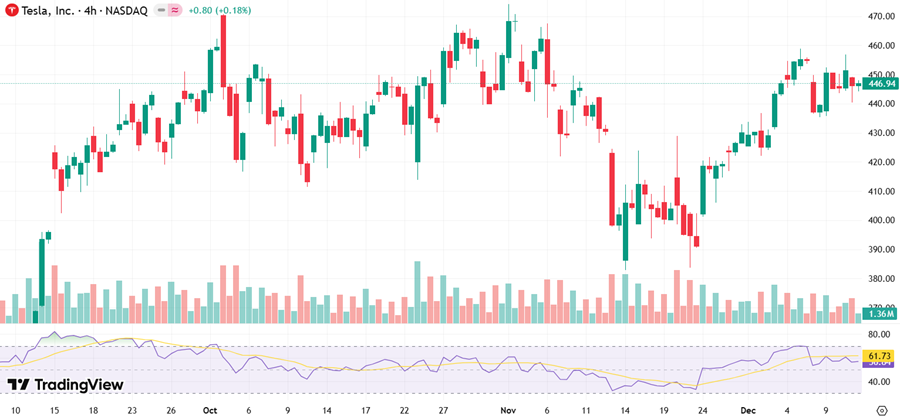
Tesla stock price dynamics (October 2025 - December 2025). Source: TradingView
Volume levels have declined modestly over the past two weeks, suggesting a lack of conviction among buyers as Tesla trades within this defined channel. Relative Strength Index (RSI) hovers around 52, offering no clear overbought or oversold signals. In essence, the technical outlook points to consolidation, with a directional breakout likely dictated by upcoming news on deliveries or forward guidance.
U.S. demand collapses despite pricing cuts and tax credits
Tesla’s November sales data paints a challenging picture. U.S. sales dropped to 39,800 units, marking a nearly 23% year-on-year decline and the lowest monthly result since Q1 2022. The drop occurred despite Tesla rolling out cheaper “Standard” versions of its Model Y and Model 3, clearly indicating that pricing cuts alone are no longer sufficient to stimulate demand.
This development is especially concerning as it comes at a time when competitors like Ford, Hyundai, and Chinese brands are aggressively expanding their EV offerings, often with fresher designs and broader consumer incentives. Moreover, Tesla has not refreshed its core vehicle lineup in years, and although the Cybertruck has officially launched, production is limited and unlikely to affect volumes in the near term.
Beyond product-related concerns, Tesla’s brand perception in the U.S. has come under pressure. Analysts suggest that CEO Elon Musk’s political commentary and controversial public behavior may have alienated segments of the traditional buyer base. Tesla’s global sales in Europe and China have also shown signs of stagnation or decline, adding to concerns that the company's growth engine is slowing across multiple geographies.
Range-bound with downside risks into year-end
The bullish case would require a meaningful positive catalyst—such as improved delivery numbers in December, a strong Cybertruck ramp-up, or major progress on its autonomous platform. In that scenario, a clean breakout above $500 could trigger momentum buying toward the $520–$540 range. A renewed push by institutional investors, especially tech-focused funds, could further amplify gains if macro sentiment turns risk-on.
The base case assumes neutral sales and no significant news from Tesla, keeping the stock stuck in consolidation, potentially closing the year near $440–$450. In this scenario, volatility may remain low as investors await Q4 earnings for updated guidance on margins and delivery targets.
Investor focus has intensified after Elon Musk pledged to launch fully autonomous robotaxis, starting with the removal of safety drivers in Austin within three weeks. The move marks a key milestone in Tesla’s autonomy strategy and has fueled recent bullish sentiment around the stock.





Latest Tesla News







-
 Afghanistan
-
 Albania
-
 Algeria
-
 Angola
-
 Argentina
-
 Armenia
-
 Australia
-
 Austria
-
 Azerbaijan
-
 Bahamas
-
 Bahrain
-
 Bangladesh
-
 Belarus
-
 Belgium
-
 Bolivia
-
 Botswana
-
 Brazil
-
 Brunei
-
 Bulgaria
-
 Cambodia
-
 Cameroon
-
 Canada
-
 Chile
Chile
-
 China
China
-
 Colombia
-
 Congo
Congo
-
 Costa Rica
-
 Cote d'Ivoire
-
 Croatia
-
 Cuba
Cuba
-
 Cyprus
-
 Czechia
-
 DR Congo
-
 Denmark
-
 Dominican Republic
-
 Ecuador
-
 Egypt
Egypt
-
 El Salvador
-
 Estonia
-
 Eswatini
-
 Ethiopia
-
 Finland
-
 France
-
 Georgia
-
 Germany
-
 Ghana
Ghana
-
 Greece
-
 Haiti
Haiti
-
 Hong Kong
-
 Hungary
-
 India
India
-
 Indonesia
-
 Iran, Islamic republic
-
 Iraq
Iraq
-
 Ireland
-
 Israel
-
 Italy
Italy
-
 Jamaica
-
 Japan
Japan
-
 Jordan
-
 Kazakhstan
-
 Kenya
Kenya
-
 Korea
Korea
-
 Kuwait
-
 Kyrgyzstan
-
 Laos
Laos
-
 Latvia
-
 Lebanon
-
 Lesotho
-
 Libya
Libya
-
 Lithuania
-
 Luxembourg
-
 Madagascar
-
 Malaysia
-
 Malta
Malta
-
 Mauritius
-
 Mexico
-
 Moldova
-
 Mongolia
-
 Montenegro
-
 Morocco
-
 Mozambique
-
 Myanmar
-
 Namibia
-
 Nepal
Nepal
-
 Netherlands
-
 New Zealand
-
 Nigeria
-
 North Macedonia
-
 Norway
-
 Oman
Oman
-
 Pakistan
-
 Palestine
-
 Panama
-
 Papua New Guinea
-
 Paraguay
-
 Peru
Peru
-
 Philippines
-
 Poland
-
 Portugal
-
 Puerto Rico
-
 Qatar
Qatar
-
 Reunion
-
 Romania
-
 Rwanda
-
 Saudi Arabia
-
 Serbia
-
 Singapore
-
 Slovakia
-
 Slovenia
-
 Somalia
-
 South Africa
-
 Spain
Spain
-
 Sri Lanka
-
 Sweden
-
 Switzerland
-
 Syria
Syria
-
 Taiwan
-
 Tajikistan
-
 Tanzania
-
 Thailand
-
 Trinidad and Tobago
-
 Tunisia
-
 Turkey
-
 UAE
UAE
-
 Uganda
-
 Ukraine
-
 United Kingdom
-
United States
-
 Uruguay
-
 Uzbekistan
-
 Venezuela
-
 Vietnam
-
 Yemen
Yemen
-
 Zambia
-
 Zimbabwe
- Forex
- Crypto











