

Nvidia stock stabilizes at $189 as Vera Rubin Superchip debuts at CES 2026
As of January 6, Nvidia stock is trading at $188.98, up 0.1% over the past 24 hours. The stock is consolidating near recent highs after rebounding from October 2025 lows, reflecting investor confidence in AI.
Highlights
- Nvidia introduced the Vera Rubin AI Superchip at CES 2026, positioning it as the successor to the Blackwell GPU architecture.
- The platform promises major performance gains and is already in production, with shipments expected in the second half of 2026.
- Nvidia stock remained stable at $189 as the market awaited further details on adoption and revenue impact.
The near-term support level is located between $175 and $180, a zone tested multiple times since September and defended successfully after the post-SoftBank sell-off. A breakdown below $175 would indicate a shift in short-term sentiment, with the next floor near $165. On the upside, immediate resistance stands at the recent high of $212, set in November, with a breakout potentially targeting the $225–$230 range over the next quarter if bullish catalysts materialize.
NVDA is trading above its 50-day and 200-day moving averages, a classically bullish alignment that suggests the longer-term trend remains intact. The stock’s 200-day MA, currently around $168, offers a deeper layer of trend support. Momentum indicators such as the RSI remain neutral, suggesting the current rangebound action may precede a directional breakout tied to upcoming product and earnings developments.
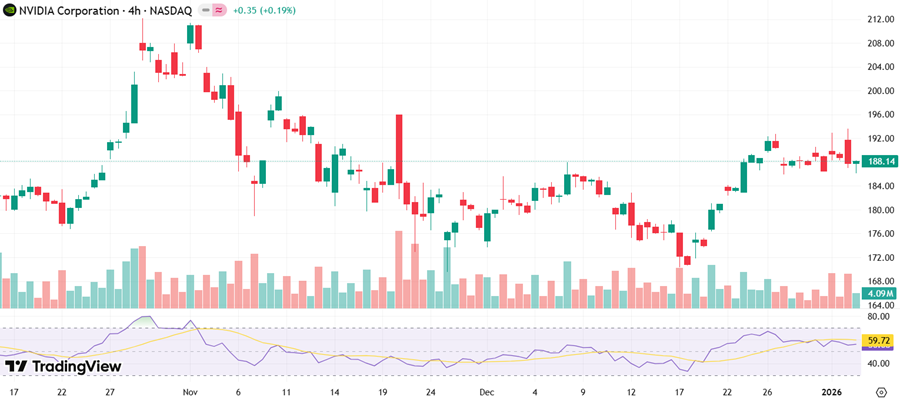
Nvidia stock price dynamics (November 2025 - January 2025). Source: TradingView
Valuation remains elevated but increasingly justified, with Nvidia’s trailing P/E ratio sitting at approximately 46.7. Forward earnings expectations are climbing in line with AI hardware demand, which may support further price expansion provided margin stability continues.
Vera Rubin AI platform shifts focus to second-half 2026 deployments
Nvidia's most significant development in early 2026 came with the CES launch of the Vera Rubin AI platform—its next-generation architecture designed to succeed the Blackwell GPU line. Announced by CEO Jensen Huang, Rubin is a full-stack AI compute solution incorporating a new Rubin GPU, a Vera CPU, high-speed networking (NVLink 6), and tightly integrated DPU and NIC technologies. The platform promises transformative efficiency gains, including the ability to train foundation models using 75% fewer chips compared to existing architectures.
According to industry coverage, the Rubin platform is already in production and expected to ship in volume by mid to late 2026. Early partners reportedly include hyperscalers such as Microsoft Azure and AI startups like CoreWeave, which are building large-scale AI clusters around Nvidia’s stack. This reinforces Nvidia’s dominant position in AI compute, where it already holds an estimated 85–90% market share in the data center accelerator segment.
Beyond hardware, Nvidia continues to push forward with its AI model initiatives, including the Alpamayo (autonomous driving) and Clara (medical imaging and diagnostics) open model programs. These are intended to expand its platform ecosystem and deepen customer lock-in, potentially raising long-term margins as software and services revenue scales.
Base case consolidation, bullish breakout depends on execution
In the base case scenario, Nvidia shares remain rangebound between $180 and $210 in the first half of 2026. This would reflect a balanced market stance as investors wait for confirmation that Rubin’s production ramp and customer adoption remain on schedule. With strong AI tailwinds and a high backlog (~$500 billion across data center customers), Nvidia’s fundamentals remain sound even amid valuation sensitivity.
A bullish breakout scenario could unfold if early Rubin shipments validate performance claims and drive upside revisions in earnings guidance. In that case, NVDA could test the $225–$250 zone by mid-2026. This outcome would likely require strong adoption metrics from major hyperscalers and a stable macroeconomic backdrop, especially regarding semiconductor supply chains and China export controls.
Nvidia disclosed a $5 billion investment in Intel, acquiring a 4% stake at $23.28 per share under a previously arranged agreement. The move positions Nvidia as a major institutional shareholder and signals deeper strategic intent beyond a financial holding.





Latest NVIDIA News




-
 Afghanistan
-
 Albania
-
 Algeria
-
 Angola
-
 Argentina
-
 Armenia
-
 Australia
-
 Austria
-
 Azerbaijan
-
 Bahamas
-
 Bahrain
-
 Bangladesh
-
 Belarus
-
 Belgium
-
 Bolivia
-
 Botswana
-
 Brazil
-
 Brunei
-
 Bulgaria
-
 Cambodia
-
 Cameroon
-
 Canada
-
 Chile
Chile
-
 China
China
-
 Colombia
-
 Congo
Congo
-
 Costa Rica
-
 Cote d'Ivoire
-
 Croatia
-
 Cuba
Cuba
-
 Cyprus
-
 Czechia
-
 DR Congo
-
 Denmark
-
 Dominican Republic
-
 Ecuador
-
 Egypt
Egypt
-
 El Salvador
-
 Estonia
-
 Eswatini
-
 Ethiopia
-
 Finland
-
 France
-
 Georgia
-
 Germany
-
 Ghana
Ghana
-
 Greece
-
 Haiti
Haiti
-
 Hong Kong
-
 Hungary
-
 India
India
-
 Indonesia
-
 Iran, Islamic republic
-
 Iraq
Iraq
-
 Ireland
-
 Israel
-
 Italy
Italy
-
 Jamaica
-
 Japan
Japan
-
 Jordan
-
 Kazakhstan
-
 Kenya
Kenya
-
 Korea
Korea
-
 Kuwait
-
 Kyrgyzstan
-
 Laos
Laos
-
 Latvia
-
 Lebanon
-
 Lesotho
-
 Libya
Libya
-
 Lithuania
-
 Luxembourg
-
 Madagascar
-
 Malaysia
-
 Malta
Malta
-
 Mauritius
-
 Mexico
-
 Moldova
-
 Mongolia
-
 Montenegro
-
 Morocco
-
 Mozambique
-
 Myanmar
-
 Namibia
-
 Nepal
Nepal
-
 Netherlands
-
 New Zealand
-
 Nigeria
-
 North Macedonia
-
 Norway
-
 Oman
Oman
-
 Pakistan
-
 Palestine
-
 Panama
-
 Papua New Guinea
-
 Paraguay
-
 Peru
Peru
-
 Philippines
-
 Poland
-
 Portugal
-
 Puerto Rico
-
 Qatar
Qatar
-
 Reunion
-
 Romania
-
 Rwanda
-
 Saudi Arabia
-
 Serbia
-
 Singapore
-
 Slovakia
-
 Slovenia
-
 Somalia
-
 South Africa
-
 Spain
Spain
-
 Sri Lanka
-
 Sweden
-
 Switzerland
-
 Syria
Syria
-
 Taiwan
-
 Tajikistan
-
 Tanzania
-
 Thailand
-
 Trinidad and Tobago
-
 Tunisia
-
 Turkey
-
 UAE
UAE
-
 Uganda
-
 Ukraine
-
 United Kingdom
-
United States
-
 Uruguay
-
 Uzbekistan
-
 Venezuela
-
 Vietnam
-
 Yemen
Yemen
-
 Zambia
-
 Zimbabwe
- Forex
- Crypto












