
S&P 500 price holds below 7,000 as earnings and inflation test momentum

The S&P 500 is trading just under the 7,000 mark as January 12 begins, holding near record highs but showing early signs of fatigue. Futures edged lower ahead of the cash open, reflecting rising caution as markets head into a dense earnings week and a critical U.S. inflation report that could reshape Federal Reserve expectations.
Highlights
- S&P 500 consolidates below 7,000 as earnings and inflation loom.
- Momentum remains positive, but RSI shows signs of flattening.
- A break above 7,000 or below 6,880 likely defines the next move.
The pause near record levels is less about outright weakness and more about timing. After a powerful advance from the April lows, the index is entering a phase where catalysts matter more than momentum alone. With bank earnings, broader corporate results, and inflation data converging, investors are reassessing risk near highs rather than pressing exposure aggressively.
Trend intact, but extension risk is rising
From a higher-timeframe perspective, the S&P 500 remains firmly in a primary uptrend. On the daily chart, price continues to trade above its rising 20, 50, 100, and 200-day EMAs, confirming that the broader structure is still bullish. The 20-day EMA near 6,880 has acted as consistent dynamic support since November, absorbing every pullback attempt.
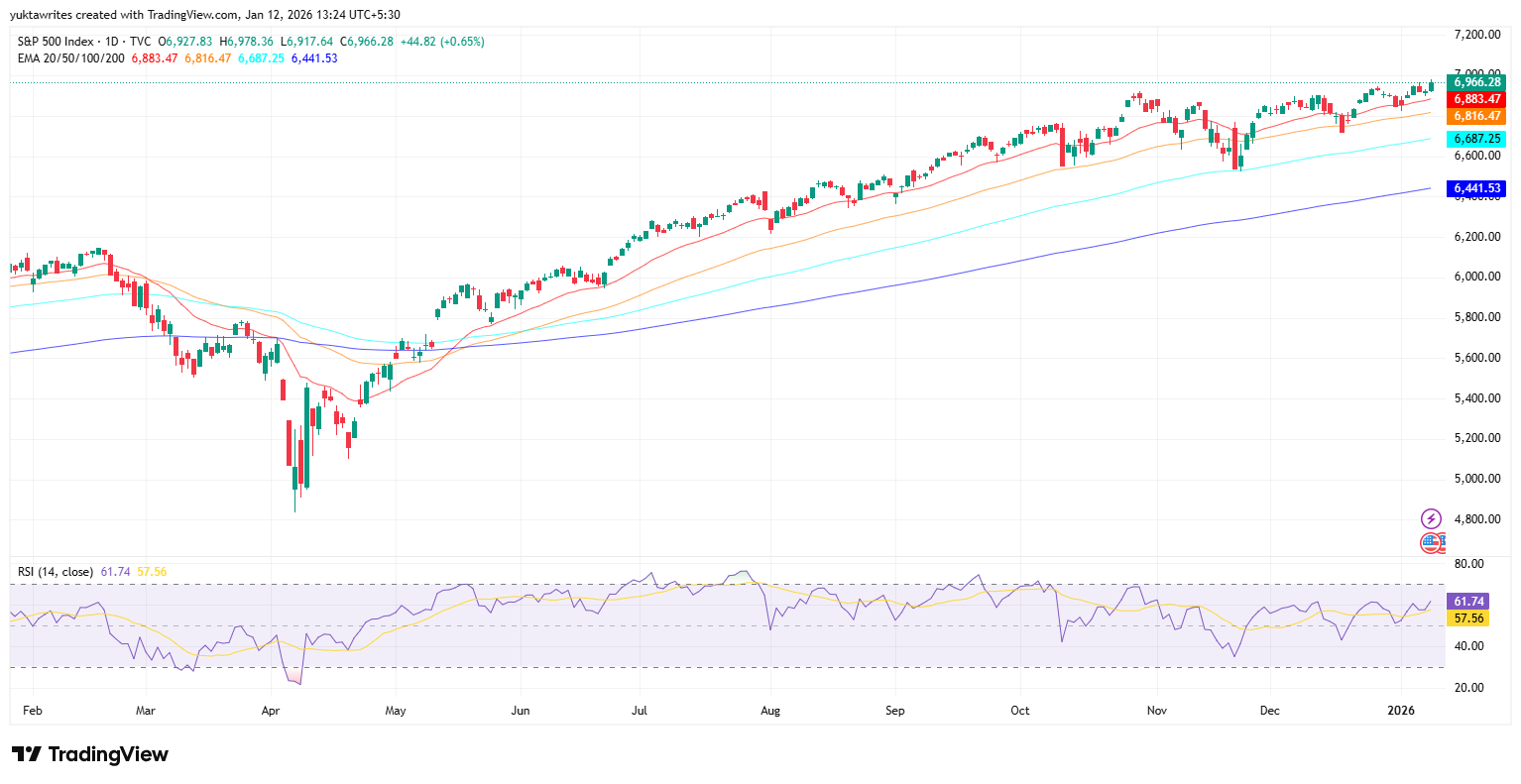
S&P 500 index dynamics (Source: TradingView)
At the same time, the index’s distance from the 200-day EMA near 6,440 highlights how extended the rally has become. That gap does not signal an imminent reversal, but it does increase sensitivity to macro surprises or earnings disappointments. Markets that are this extended tend to react more sharply to negative news, even when the longer-term trend remains intact.
Price action over the past several weeks reflects that balance. The index continues to print higher highs and higher lows, but progress has slowed as it approaches the psychologically important 7,000 level. This behavior is consistent with consolidation at elevated levels rather than distribution, yet it also suggests upside is no longer effortless.
Momentum indicators echo that message. Daily RSI is holding in the low-60s, a zone associated with healthy trends, but it has struggled to push decisively above 65 since mid-December. This flattening in RSI often precedes sideways trade or shallow pullbacks, especially when markets are waiting on macro confirmation.
Short-term hesitation meets macro catalysts
Shorter-term charts show a market growing more selective. On the 30-minute timeframe, the S&P 500 is still respecting Supertrend support, but the slope has flattened noticeably. Parabolic SAR has tightened closer to price, signaling reduced intraday follow-through. The index has repeatedly stalled just below 7,000, indicating that sellers are active near that round-number resistance even as dips remain shallow.
The macro calendar explains the hesitation. This week marks the start of earnings season for major U.S. banks, including JPMorgan Chase, Bank of America, Wells Fargo, Citigroup, Morgan Stanley, and Goldman Sachs. Their results will offer insight into credit conditions, trading activity, and deal flow, all of which matter for broader risk appetite. Reports from BlackRock, Delta Air Lines, Bank of New York Mellon, and PNC Financial will add further color across asset management, travel, and regional banking.
Overlaying earnings is Tuesday’s U.S. inflation report, a clear binary risk. Any upside surprise would complicate the narrative of timely Federal Reserve rate cuts and could force markets to reprice both the timing and depth of easing. Conversely, a benign print would likely reinforce the soft-landing thesis and support equity multiples near highs.
Geopolitical considerations add another layer. Renewed focus on potential U.S. action toward Iran, alongside ongoing U.S. involvement in South America, has not derailed the rally but does raise headline risk. In extended markets, such risks often encourage profit-taking near resistance rather than aggressive breakout buying.
Levels that define the next phase
Technically, the roadmap is clear. On the downside, the 6,880 to 6,900 zone is the first support area to monitor. A sustained break below that range would likely trigger a deeper pullback toward 6,820 and potentially the 50-day EMA near 6,815. Such a move would still be consistent with a healthy correction unless selling accelerates beyond those levels.
On the upside, a clean daily close above 7,000 is required to reassert momentum and open the path toward 7,100. However, follow-through would likely depend on supportive earnings results and inflation data that does not challenge the Fed’s easing outlook. Without that confirmation, upside attempts risk being faded.
Overall, the S&P 500 remains in a strong uptrend, but the character of the market is changing. Conditions are shifting from momentum-driven to event-driven, where data and earnings carry more weight than trend inertia. Traders should respect the broader bullish structure while remaining alert to volatility around key releases. Strength above 7,000 favors continuation, while a loss of 6,880 would suggest consolidation is evolving into a more corrective phase.
In earlier analysis highlighted that the S&P 500’s advance from the April lows was becoming increasingly sensitive to macro catalysts as valuations stretched. The current pause below 7,000 aligns with that framework, as the index digests gains and awaits confirmation from earnings and inflation before committing to the next directional leg.



Latest S&P 500 News










-
 Afghanistan
-
 Albania
-
 Algeria
-
 Angola
-
 Argentina
-
 Armenia
-
 Australia
-
 Austria
-
 Azerbaijan
-
 Bahamas
-
 Bahrain
-
 Bangladesh
-
 Belarus
-
 Belgium
-
 Bolivia
-
 Botswana
-
 Brazil
-
 Brunei
-
 Bulgaria
-
 Cambodia
-
 Cameroon
-
 Canada
-
 Chile
Chile
-
 China
China
-
 Colombia
-
 Congo
Congo
-
 Costa Rica
-
 Cote d'Ivoire
-
 Croatia
-
 Cuba
Cuba
-
 Cyprus
-
 Czechia
-
 DR Congo
-
 Denmark
-
 Dominican Republic
-
 Ecuador
-
 Egypt
Egypt
-
 El Salvador
-
 Estonia
-
 Eswatini
-
 Ethiopia
-
 Finland
-
 France
-
 Georgia
-
 Germany
-
 Ghana
Ghana
-
 Greece
-
 Haiti
Haiti
-
 Hong Kong
-
 Hungary
-
 India
India
-
 Indonesia
-
 Iran, Islamic republic
-
 Iraq
Iraq
-
 Ireland
-
 Israel
-
 Italy
Italy
-
 Jamaica
-
 Japan
Japan
-
 Jordan
-
 Kazakhstan
-
 Kenya
Kenya
-
 Korea
Korea
-
 Kuwait
-
 Kyrgyzstan
-
 Laos
Laos
-
 Latvia
-
 Lebanon
-
 Lesotho
-
 Libya
Libya
-
 Lithuania
-
 Luxembourg
-
 Madagascar
-
 Malaysia
-
 Malta
Malta
-
 Mauritius
-
 Mexico
-
 Moldova
-
 Mongolia
-
 Montenegro
-
 Morocco
-
 Mozambique
-
 Myanmar
-
 Namibia
-
 Nepal
Nepal
-
 Netherlands
-
 New Zealand
-
 Nigeria
-
 North Macedonia
-
 Norway
-
 Oman
Oman
-
 Pakistan
-
 Palestine
-
 Panama
-
 Papua New Guinea
-
 Paraguay
-
 Peru
Peru
-
 Philippines
-
 Poland
-
 Portugal
-
 Puerto Rico
-
 Qatar
Qatar
-
 Reunion
-
 Romania
-
 Rwanda
-
 Saudi Arabia
-
 Serbia
-
 Singapore
-
 Slovakia
-
 Slovenia
-
 Somalia
-
 South Africa
-
 Spain
Spain
-
 Sri Lanka
-
 Sweden
-
 Switzerland
-
 Syria
Syria
-
 Taiwan
-
 Tajikistan
-
 Tanzania
-
 Thailand
-
 Trinidad and Tobago
-
 Tunisia
-
 Turkey
-
 UAE
UAE
-
 Uganda
-
 Ukraine
-
 United Kingdom
-
United States
-
 Uruguay
-
 Uzbekistan
-
 Venezuela
-
 Vietnam
-
 Yemen
Yemen
-
 Zambia
-
 Zimbabwe
- Forex
- Crypto











